Drama Structure Slides MONDAY • 40-MINUTE LESSON • AZ 3.RL.5
Drama Structure Blueprint
The Saga of Pecos Bill — How Plays Are Built
Learning Goal: I can identify parts of a drama and explain how each new scene builds on earlier events.
Today's 40-Minute Trail Map
1. Mini-Lesson (10 min)
Parts of a Drama
Explore how a play script looks different from a regular story.
2. I Do (5 min)
Teacher Model
Watch how to trace how Scene 1 sets up Scene 2.
3. We Do (10 min)
Partner & Class Practice
Connect Bill's coyote life to meeting the cowboy.
4. You Do (15 min)
Independent Thinking
Analyze how later scenes depend on earlier ones.
What Makes a Drama Special?
The Saga of Pecos Bill is written as a play (drama) . Look at the parts on page 298:
1. Cast of Characters
Lists who is in the play (4 Narrators, Pa, Ma, Pecos Bill, Cowboy 1 & 2, Mountain Lion).
2. Staging / Stage Directions
Tells actors where to sit, stand, or move (e.g., narrators on stools with music stands).
3. Dialogue
The exact words characters speak aloud after their bolded name.
4. Building Scenes
Each new event builds on what happened before, like stacking blocks!
I DO — WATCH ME THINK
How Does the Beginning Build the Story?
Text Evidence (Lines 2–13): Bill's family has 15 or 20 kids, so his parents forget their names. When the wagon bounces over the state line, Bill falls out—and nobody notices for a week!
Teacher Think-Aloud: "Why did the playwright start with a giant, forgetful family? Because if Bill had only 1 sibling, his parents would notice he fell out! That early detail makes it possible for Bill to be raised by coyotes next."
WE DO — TURN & TALK
Connecting Coyote Life to Cowboy Life
Look at Lines 14–31 (Pages 300–301):
Bill learns to bay at the moon, hunt rabbits, and wrestle coyotes.
Then, a mountain lion jumps onto Bill's back, and Bill wrestles it to the ground!
Higher-Order Question:
How did Bill's earlier time living with coyotes prepare him to tame the mountain lion?
Stem: "Because Bill learned to ________ with the coyotes, he was able to ________."
YOU DO — INDEPENDENT WORK (15 MIN)
Your Turn on the Worksheet
Step 1: Complete the We Do check-in if needed, then move to You Do .
Step 2: Explain how Bill's rattlesnake lasso (p. 302) builds up to ending the Texas drought (p. 304).
Step 3: Write neatly on the defined lines using the sentence stems for support.
Drama Structure Worksheet Monday • AZ 3.RL.5 • Drama Structure
Drama Structure Blueprint
Name: ______________________ Date: ___________
Target: Refer to parts of a drama (staging, characters, dialogue) and explain how each new scene builds on earlier events in The Saga of Pecos Bill .
I Do • Teacher Model How Early Details Set Up Later Scenes
Question: Look at the Staging box and Lines 2–13 (pp. 298–299). Why did the playwright tell us Bill's family had 15 or 20 kids and forgot their names?
Model Answer: The playwright included this detail so the reader understands why nobody noticed Bill fell out of the wagon. That early event builds directly to the next scene, where Bill is left alone and raised by coyotes.
We Do • Guided Practice Connecting the Script Together
1. Look at the Characters list and Staging notes on page 298. Why are there 4 Narrators seated on stools while other characters walk around?
A. The narrators are tired and do not have any lines to speak.
B. The narrators tell the big story events while the other characters act out the dialogue.
C. The narrators are watching the play from the audience.
D. The other characters forgot to bring their scripts to the stage.
2. Look at Lines 15–31 (pp. 300–301). How did Bill's time living with the coyotes prepare him to wrestle the mountain lion?
Sentence Stem: Because Bill learned to ____________________ with the coyotes, he was able to ____________________ when the mountain lion jumped on him.
Drama Structure Blueprint — Page 2
AZ 3.RL.5 • Independent Practice
You Do • Independent Thinking Analyze How Scenes Build
3. On page 302 (Lines 32–34), Bill grabs a 10-foot rattlesnake and turns it into a 30-foot coiled rope. How does this scene build toward what happens on page 304 (Lines 40–41)?
Sentence Stem: In the earlier scene, Bill ____________________. This builds to the next scene because later he uses ____________________ to ____________________.
4. Imagine the playwright deleted the scene where Cowboy 1 tells Bill, "The thing that all coyotes got is a tail" (Lines 20–23). How would the rest of the play change? Explain your thinking.
Sentence Stem: If that scene were deleted, Bill might never realize ____________________, so he would not ____________________.
5. Look at page 306 (Lines 49–53). Who speaks the most lines at the end of the play—the characters or the narrators? Why do you think the playwright structured the ending this way?
Sentence Stem: At the end of the play, the ____________________ speak the most lines because ____________________.
Drama Structure Teacher Guide Monday Teacher Guide • AZ 3.RL.5
Drama Structure Blueprint Key
40 Minutes Total
40-Minute Pacing & Facilitation
0–10 min | Slides 1–3: Preview drama terms (Cast of Characters, Staging, Dialogue) using p. 298 of The Saga of Pecos Bill .
10–15 min | Slide 4 (I Do): Think aloud about how Bill's large, forgetful family makes the coyote scene possible.
15–25 min | Slide 5 (We Do): Complete Worksheet Q1–Q2 together via Turn & Talk before students write.
25–40 min | Slide 6 (You Do): Students complete Q3–Q5 independently. Circulate to prompt text evidence.
Worksheet Answer Key & Sample Responses
We Do Q1: B — The narrators tell the big story events while the other characters act out the dialogue.
We Do Q2 (Sample): Because Bill learned to wrestle with the other coyotes , he was able to fight and tame the mountain lion when it jumped on him.
You Do Q3 (Sample): In the earlier scene, Bill turns a 10-foot rattlesnake into a 30-foot coiled lasso . This builds to the next scene because later he uses that rattlesnake lasso to rope up water from the Rio Grande River and end the Texas drought .
You Do Q4 (Sample): If that scene were deleted, Bill might never realize he does not have a tail and is actually human , so he would not decide to leave the coyotes and become a cowboy .
You Do Q5 (Sample): At the end of the play, the narrators speak the most lines because they need to summarize big events across California and Texas (Death Valley and wide-open spaces) quickly to wrap up the saga .
Word Wranglers Slides TUESDAY • 40-MINUTE LESSON • AZ 3.RL.4
Word Wranglers Lab
Literal vs. Nonliteral Language in The Saga of Pecos Bill
Learning Goal: I can figure out word meanings from context and tell the difference between literal and nonliteral (exaggerated) tall-tale language.
Story Vocabulary (10 Min Mini-Lesson)
genuine (p. 298)
Real and exactly what it seems to be (a genuine grizzly bear).
saga (p. 299)
A long, detailed story about heroic events.
coiled (p. 302)
Shaped into loops or rings, like a lasso.
whirled & tame (p. 304)
Whirled: spun quickly. Tame: teach a wild thing to obey.
Literal vs. Nonliteral Tall-Tale Language
Literal Language
Means exactly what the words say.
Example: "Bill sat on a wooden wagon." (Can actually happen!)
Nonliteral / Tall-Tale Exaggeration
Stretches the truth for humor or drama!
Example: "The tornado tied rivers into knots." (Shows how wild it was!)
I DO — WATCH ME ANALYZE (5 MIN)
Decoding Tall-Tale Phrases
Text Quote (p. 304, Line 44):
"That tornado... began to leaping around like it was full of about a hundred wildcats."
Teacher Think-Aloud: "Are there literally 100 wildcats inside the tornado? No! That is nonliteral language (a simile/exaggeration). The author uses it to help us picture how fierce, noisy, and impossible to control the storm was."
WE DO — TURN & TALK (10 MIN)
Test This Phrase Together
"That 10-foot rattlesnake was 30 feet long... Bill coiled up that 30-foot snake just like it was a rope." (p. 302, Lines 33–34)
1. What does the word coiled mean here?
2. Why is spinning a snake until it stretches to 30 feet nonliteral ? What does it show about Bill?
Stem: "This phrase is nonliteral because ________. It shows that Pecos Bill is ________."
YOU DO — INDEPENDENT WORK (15 MIN)
Your Turn on the Worksheet
Part 1: Use context clues to explain whirled and tame in your own words.
Part 2: Analyze nonliteral phrases like "roped up all the water from the Rio Grande" and "washed out the Grand Canyon."
Part 3: Write neatly on the defined lines using the sentence stems!
Word Wranglers Worksheet Tuesday • AZ 3.RL.4 • Vocabulary & Nonliteral Language
Word Wranglers Lab
Name: ______________________ Date: ___________
Target: Determine the meaning of words in context and distinguish literal from nonliteral tall-tale language in The Saga of Pecos Bill .
I Do • Teacher Model Decoding Nonliteral Language
Quote (p. 304, Line 44): "That tornado... began to leaping around like it was full of about a hundred wildcats."
Model Answer: This is nonliteral because a tornado cannot actually hold 100 wildcats inside it. The author uses this exaggeration to help the reader imagine how wild, loud, and dangerous the tornado was.
We Do • Guided Practice Context Clues & Exaggeration
1. On page 298 (Line 3), Bill finds a "genuine grizzly bear" instead of a toy teddy bear. What does genuine mean?
A. Soft and stuffed with cotton
B. Real and exactly what it seems to be
C. Pretend and made of plastic
D. Tiny enough to fit in a crib
2. Read Lines 33–34 (p. 302): "Bill coiled up that 30-foot snake just like it was a rope." Why is stretching a snake to 30 feet nonliteral , and what does it show about Bill?
Sentence Stem: Stretching a snake to 30 feet is nonliteral because ____________________. The author uses this exaggeration to show that Bill is ____________________.
Word Wranglers Lab — Page 2
AZ 3.RL.4 • Independent Practice
You Do • Independent Thinking Wrangle the Words & Meanings
3. Read Line 44–45 (p. 304): "That tornado whipped and whirled... Hold on tight! I aim to tame you." Use context clues to explain what whirled and tame mean.
Sentence Stem: Based on the text, whirled means ____________________, and tame means ____________________.
4. Read Line 41 (p. 304): "he roped up all the water from the Rio Grande River." Explain what this nonliteral phrase really means in the story and why the author didn't just write "Bill brought water."
Sentence Stem: This nonliteral phrase means ____________________. The author wrote it this way instead of "Bill brought water" because ____________________.
5. On page 305 (Line 47), Narrator 3 says the tornado "tied up rivers into knots." Write a literal sentence that describes the same storm without using exaggeration.
Sentence Stem: Literally, the storm ____________________.
Word Wranglers Teacher Guide Tuesday Teacher Guide • AZ 3.RL.4
Word Wranglers Lab Key
40 Minutes Total
40-Minute Pacing & Facilitation
0–10 min | Slides 1–3: Introduce the 5 HMH glossary words and contrast literal vs. nonliteral tall-tale language.
10–15 min | Slide 4 (I Do): Model how "full of about a hundred wildcats" paints a vivid picture rather than a literal fact.
15–25 min | Slide 5 (We Do): Guide students through Q1 and Q2 on the worksheet using Turn & Talk.
25–40 min | Slide 6 (You Do): Students complete Q3–Q5 independently. Support struggling writers with the sentence stems.
Worksheet Answer Key & Sample Responses
We Do Q1: B — Real and exactly what it seems to be.
We Do Q2 (Sample): Stretching a snake to 30 feet is nonliteral because a real snake cannot be spun longer like stretchy dough or a rope . The author uses this exaggeration to show that Bill is unbelievably strong and fearless .
You Do Q3 (Sample): Based on the text, whirled means spun and turned very quickly , and tame means to teach a wild thing to do what you want .
You Do Q4 (Sample): This nonliteral phrase means Bill found a way to bring water back to the dry ranch . The author wrote it this way instead of "Bill brought water" because it makes Bill sound like a larger-than-life hero and fits the funny tall tale style .
You Do Q5 (Sample): Literally, the storm flooded the rivers and blew strong winds across Texas .
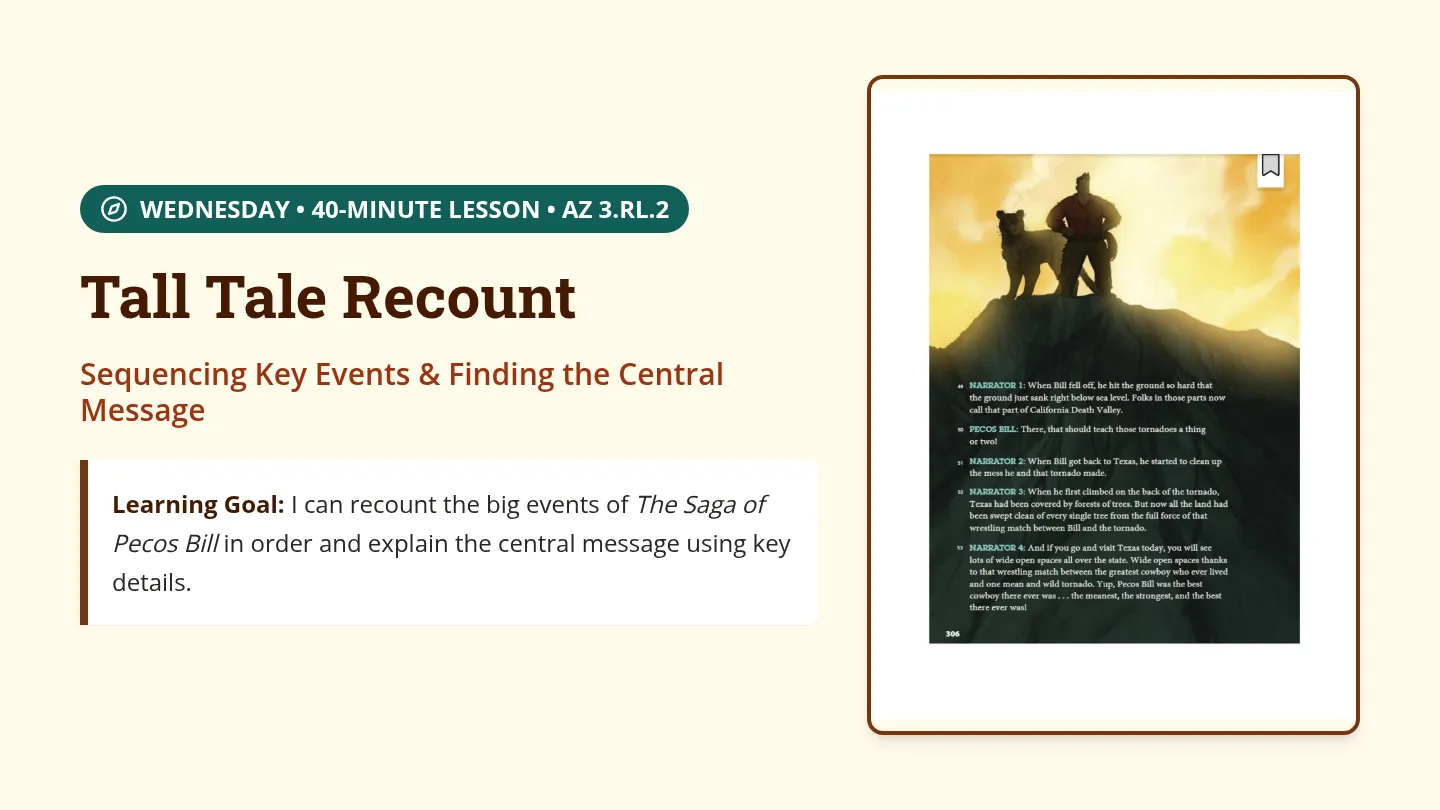
Tall Tale Recount Slides WEDNESDAY • 40-MINUTE LESSON • AZ 3.RL.2
Tall Tale Recount
Sequencing Key Events & Finding the Central Message
Learning Goal: I can recount the big events of The Saga of Pecos Bill in order and explain the central message using key details.
Recount vs. Central Message (10 Min)
Recounting (What Happened)
Only the MOST important events in order.
Beginning → Middle → Climax → Ending. Leave out tiny details!
Central Message (The Big Lesson)
What the story teaches us about life.
Ask: How did the hero solve problems? What attitude helped them succeed?
I DO — WATCH ME RECOUNT (5 MIN)
Picking Key Events, Skipping Tiny Details
Beginning of the Play (pp. 298–301): Which detail belongs in a recount?
KEY EVENT:
Bill falls out of his family's wagon and is raised by coyotes until a cowboy helps him realize he is human.
SMALL DETAIL (Skip):
The narrators sit on stools or high chairs with scripts on music stands.
WE DO — TURN & TALK (10 MIN)
Discovering the Central Message
Look at all the problems Pecos Bill faces: he is lost in the wild, faces a mountain lion and rattlesnake, arrives during a terrible drought, and meets the meanest tornado ever!
Higher-Order Question:
Instead of giving up or running away, what does Bill do every time? What central message does that teach us?
Stem: "A central message of the play is ________ because Bill always ________."
YOU DO — INDEPENDENT WORK (15 MIN)
Your Turn on the Worksheet
Part 1: Recount the Middle, Climax, and Ending of The Saga of Pecos Bill on the defined lines.
Part 2: Explain how TWO key details from the play prove the central message.
Part 3: Use the sentence stems if you need help starting your sentences!
Tall Tale Recount Worksheet Wednesday • AZ 3.RL.2 • Recount & Central Message
Tall Tale Recount
Name: ______________________ Date: ___________
Target: Recount key events from The Saga of Pecos Bill in order and explain how key details convey the central message.
I Do • Teacher Model Recounting the Beginning
Model Recount (Beginning, pp. 298–301): Pecos Bill falls out of his family's wagon on the way West and is raised by coyotes. When a cowboy points out that Bill has no tail, Bill realizes he is human and decides to become a cowboy.
We Do • Guided Practice Identifying the Central Message
1. Which statement best describes the central message of The Saga of Pecos Bill ?
A. Never travel in a covered wagon with a large family.
B. With courage and creative problem-solving, you can overcome even the biggest challenges.
C. Coyotes make better pets than grizzly bears or mountain lions.
D. Texas is the only state that has wide-open spaces and ranches.
2. Recount the Middle of the play (pp. 301–304): What animals does Bill tame on his way to the ranch, and how does he help the cowboys when he arrives?
Sentence Stem: On his way to the ranch, Bill tames ____________________. When he arrives during a drought, he helps the cowboys by ____________________.
Tall Tale Recount — Page 2
AZ 3.RL.2 • Independent Practice
You Do • Independent Thinking Finish the Recount & Prove the Message
3. Recount the Climax and Ending (pp. 304–306): What happens when the meanest tornado hits Texas, and how does the play end?
Sentence Stem: Next, Bill jumps on ____________________ and rides it until ____________________. At the end, Bill ____________________.
4. Explain how two key details from the play show the central message (that courage and creative problem-solving help you overcome huge challenges).
Sentence Stem: First, Bill shows courage when he ____________________. Second, he solves a big problem creatively when he ____________________.
5. Why do you think the author says Bill was "the best cowboy there ever was" (Line 53) even though he made a huge mess of Texas's trees?
Sentence Stem: Even though the tornado swept away the trees, people called Bill the best cowboy because ____________________.
Tall Tale Recount Teacher Guide Wednesday Teacher Guide • AZ 3.RL.2
Tall Tale Recount Key
40 Minutes Total
40-Minute Pacing & Facilitation
0–10 min | Slides 1–2: Contrast recounting (key events in order) with central message (the big life lesson).
10–15 min | Slide 3 (I Do): Model choosing key plot events over small staging details for the Beginning.
15–25 min | Slide 4 (We Do): Discuss central message options (Q1) and draft the Middle recount (Q2) together.
25–40 min | Slide 5 (You Do): Students complete Q3–Q5 independently on lined spaces.
Worksheet Answer Key & Sample Responses
We Do Q1: B — With courage and creative problem-solving, you can overcome even the biggest challenges.
We Do Q2 (Sample): On his way to the ranch, Bill tames a mountain lion (to ride like a horse) and a 30-foot rattlesnake (to use as a rope) . When he arrives during a drought, he helps the cowboys by roping up water from the Rio Grande River .
You Do Q3 (Sample): Next, Bill jumps on the biggest, meanest tornado and rides it until it rains itself out over California and shrinks to a puff of wind . At the end, Bill falls to create Death Valley and returns to Texas to clean up .
You Do Q4 (Sample): First, Bill shows courage when he jumps onto the back of a wild tornado instead of hiding . Second, he solves a big problem creatively when he uses his rattlesnake lasso to bring water from the Rio Grande to end the drought .
You Do Q5 (Sample): Even though the tornado swept away the trees, people called Bill the best cowboy because he saved Texas from the storm and the drought, and created Texas's wide-open spaces .
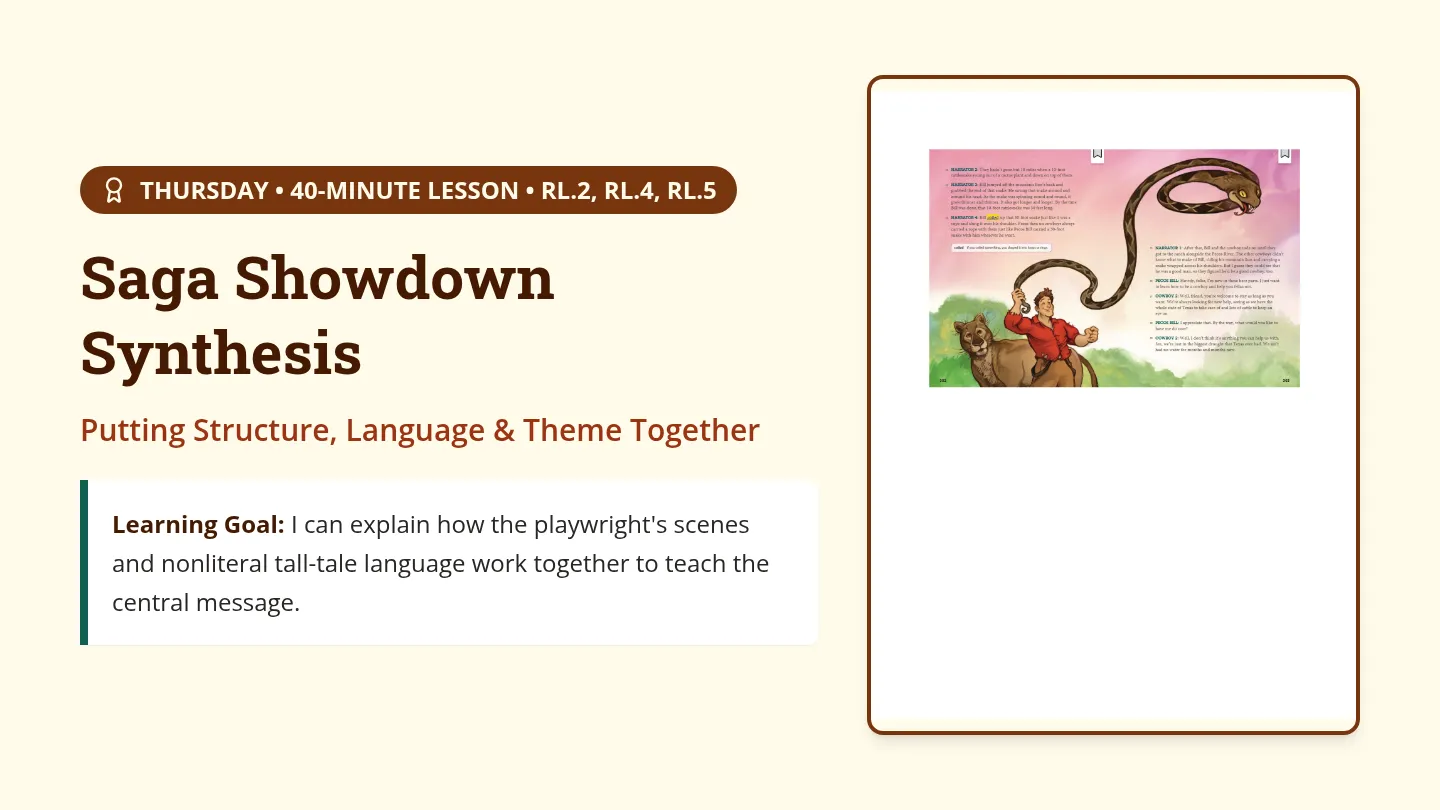
Saga Showdown Slides THURSDAY • 40-MINUTE LESSON • RL.2, RL.4, RL.5
Saga Showdown Synthesis
Putting Structure, Language & Theme Together
Learning Goal: I can explain how the playwright's scenes and nonliteral tall-tale language work together to teach the central message.
Three Standards, One Big Picture (10 Min)
Monday (RL.5)
Structure
Each scene builds on the one before it like stepping stones.
Tuesday (RL.4)
Word Choice
Nonliteral exaggerations make Bill's actions unforgettable.
Wednesday (RL.2)
Central Message
Courage and creative thinking solve giant problems.
I DO — WATCH ME CONNECT ALL THREE (5 MIN)
How Structure + Language = Message
Teacher Model: "In the ranch scene (RL.5), the drought problem builds on Bill's earlier rattlesnake lasso scene. When the narrator says Bill 'roped up all the water from the Rio Grande' (RL.4 nonliteral), it proves the central message (RL.2) that creative problem-solving can beat even an impossible problem!"
WE DO — PARTNER SYNTHESIS (10 MIN)
Analyze the Tornado Climax Together
Look at pages 304–305: Bill rides the tornado like "the meanest bull at a rodeo" until it rains out the Grand Canyon.
Higher-Order Question:
Why did the playwright put the tornado scene after the drought scene, and how does the "meanest bull" comparison prove Bill's courage?
YOU DO — FINAL SHOWDOWN (15 MIN)
Your Turn on the Worksheet
Part 1: Compare two scenes and explain how the earlier scene made the later one possible (RL.5).
Part 2: Write a short paragraph explaining how the author's tall-tale words (RL.4) and story events (RL.2) work together.
Part 3: Use the defined writing lines and sentence stems to build a strong response!
Saga Showdown Worksheet Thursday • AZ 3.RL.2, 3.RL.4, 3.RL.5 • Synthesis
Saga Showdown Synthesis
Name: ______________________ Date: ___________
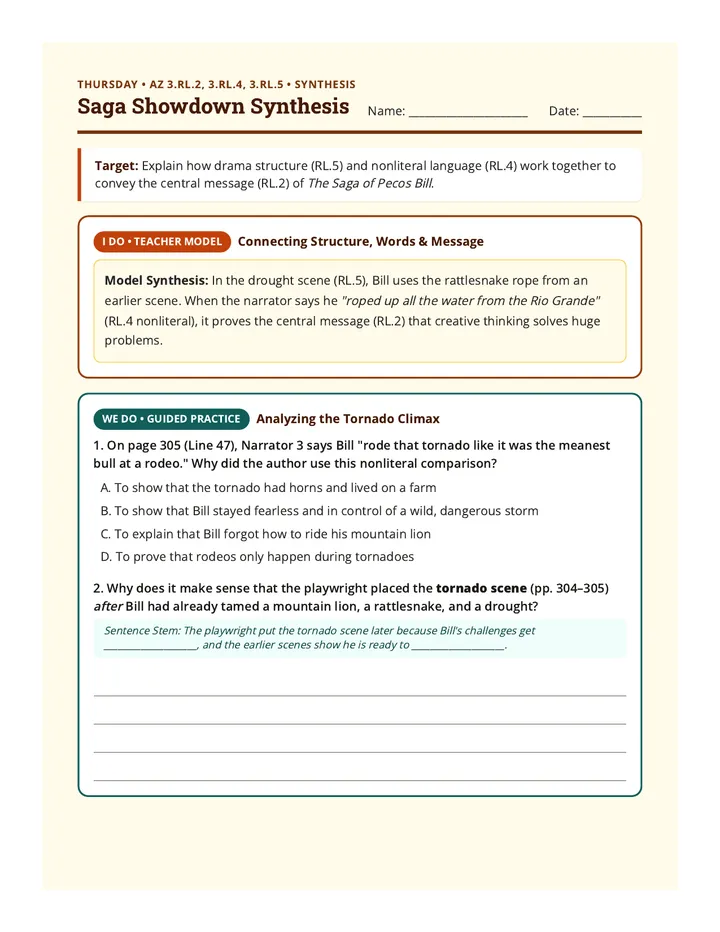
Target: Explain how drama structure (RL.5) and nonliteral language (RL.4) work together to convey the central message (RL.2) of The Saga of Pecos Bill .
I Do • Teacher Model Connecting Structure, Words & Message
Model Synthesis: In the drought scene (RL.5), Bill uses the rattlesnake rope from an earlier scene. When the narrator says he "roped up all the water from the Rio Grande" (RL.4 nonliteral), it proves the central message (RL.2) that creative thinking solves huge problems.
We Do • Guided Practice Analyzing the Tornado Climax
1. On page 305 (Line 47), Narrator 3 says Bill "rode that tornado like it was the meanest bull at a rodeo." Why did the author use this nonliteral comparison?
A. To show that the tornado had horns and lived on a farm
B. To show that Bill stayed fearless and in control of a wild, dangerous storm
C. To explain that Bill forgot how to ride his mountain lion
D. To prove that rodeos only happen during tornadoes
2. Why does it make sense that the playwright placed the tornado scene (pp. 304–305) after Bill had already tamed a mountain lion, a rattlesnake, and a drought?
Sentence Stem: The playwright put the tornado scene later because Bill's challenges get ____________________, and the earlier scenes show he is ready to ____________________.
Saga Showdown Synthesis — Page 2
AZ 3.RL.2, 4, 5 • Independent Synthesis
You Do • Final Showdown Write Your Tall-Tale Analysis
3. Choose one exaggeration from the play (for example: "hit the ground so hard... Death Valley" or "washed out the Grand Canyon" ). How does that nonliteral phrase make the ending more exciting than a literal sentence?
Sentence Stem: I chose the phrase "____________________." It makes the ending more exciting because ____________________.
4. Big Question: Write a short paragraph explaining how The Saga of Pecos Bill teaches its central message. Include: (1) how the scenes build on each other, (2) one example of nonliteral language, and (3) what lesson readers learn.
Sentence Stems: The Saga of Pecos Bill teaches the central message that ____________________. First, the play's scenes build from ____________________ to ____________________. Also, the author uses nonliteral language like "____________________" to show ____________________. This proves that ____________________.
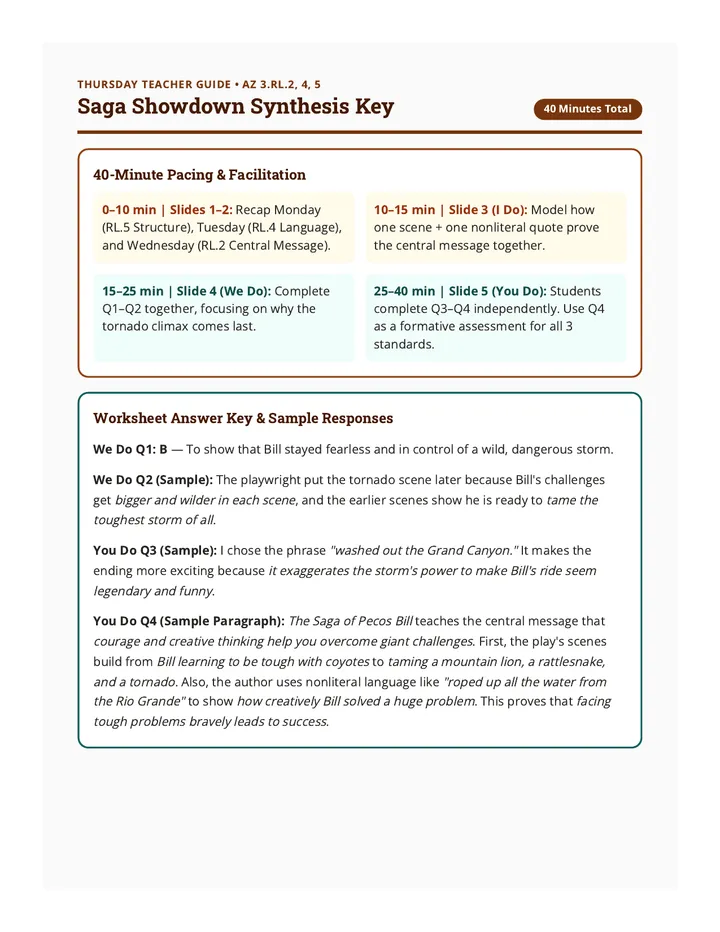
Saga Showdown Teacher Guide Thursday Teacher Guide • AZ 3.RL.2, 4, 5
Saga Showdown Synthesis Key
40 Minutes Total
40-Minute Pacing & Facilitation
0–10 min | Slides 1–2: Recap Monday (RL.5 Structure), Tuesday (RL.4 Language), and Wednesday (RL.2 Central Message).
10–15 min | Slide 3 (I Do): Model how one scene + one nonliteral quote prove the central message together.
15–25 min | Slide 4 (We Do): Complete Q1–Q2 together, focusing on why the tornado climax comes last.
25–40 min | Slide 5 (You Do): Students complete Q3–Q4 independently. Use Q4 as a formative assessment for all 3 standards.
Worksheet Answer Key & Sample Responses
We Do Q1: B — To show that Bill stayed fearless and in control of a wild, dangerous storm.
We Do Q2 (Sample): The playwright put the tornado scene later because Bill's challenges get bigger and wilder in each scene , and the earlier scenes show he is ready to tame the toughest storm of all .
You Do Q3 (Sample): I chose the phrase "washed out the Grand Canyon." It makes the ending more exciting because it exaggerates the storm's power to make Bill's ride seem legendary and funny .
You Do Q4 (Sample Paragraph): The Saga of Pecos Bill teaches the central message that courage and creative thinking help you overcome giant challenges . First, the play's scenes build from Bill learning to be tough with coyotes to taming a mountain lion, a rattlesnake, and a tornado . Also, the author uses nonliteral language like "roped up all the water from the Rio Grande" to show how creatively Bill solved a huge problem . This proves that facing tough problems bravely leads to success .