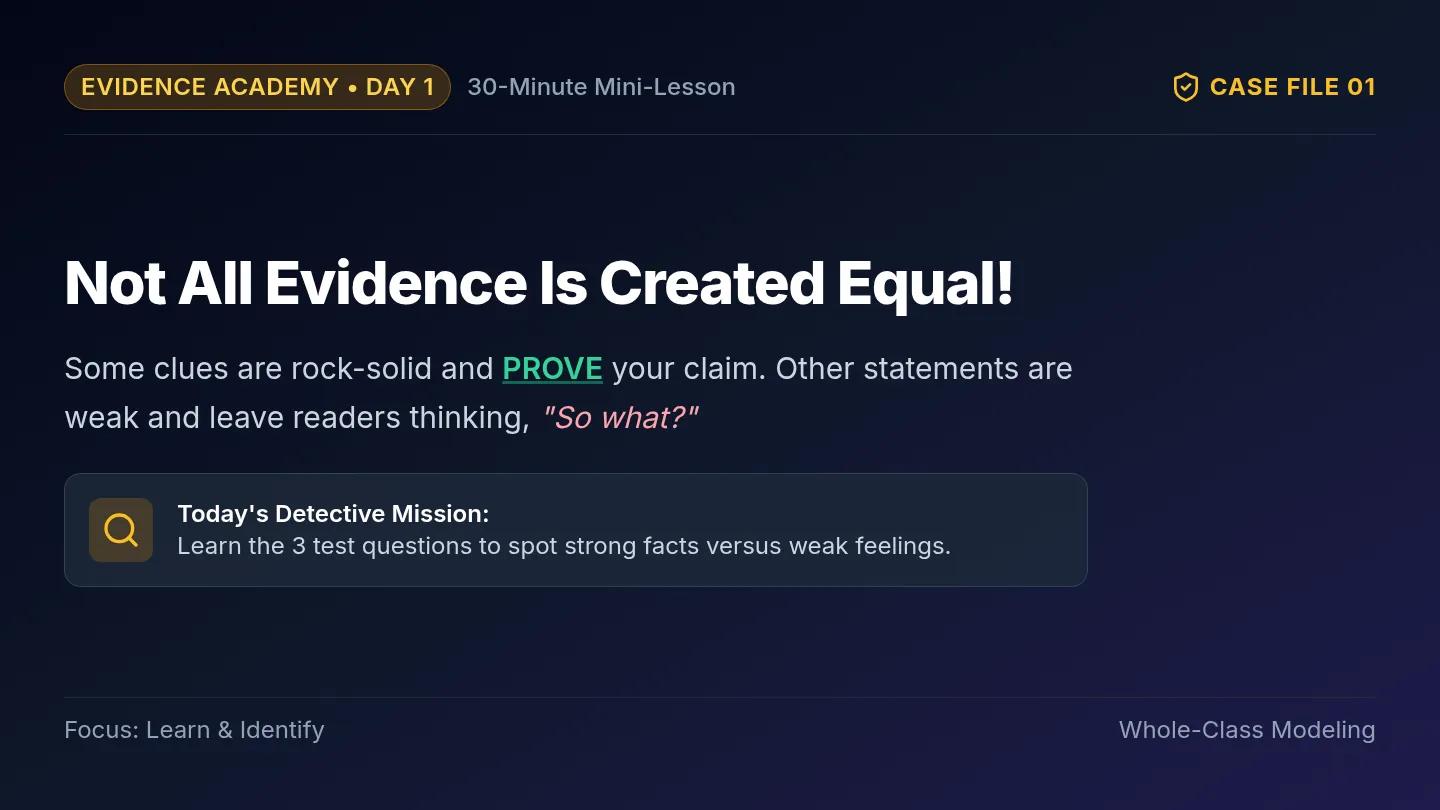
Central Idea Slides Key Comprehension Routine • Day 1
EL Module 2: Animal Defenses
Keys to Literacy: Top-Down Webs & Two-Column Notes
Central Idea Expedition
Mastering main ideas and key supporting details using Joan Sedita's Top-Down Topic Web and Two-Column Notes.
1
Top-Down Web
Topic at peak, details branch down
2
Two-Column Notes
Main ideas (Left), Details (Right)
3
Categorize Details
Label armor, spines, & shells
Key Routine Tool #1
The Top-Down Topic Web
Top of the Web: Broad Topic (1-2 Words) Physical Animal Defenses
Central Idea Umbrella Sentence
"Prey animals have evolved physical body armor, such as keratin scales and bony shells, to protect their soft bodies from predator attacks."
Subtopic 1: Pangolin Scales
Sharp keratin armor coils into a ball
Subtopic 2: Armadillo Carapace
Bony plates interlock to seal out teeth
Sedita's Rule: Topic is at the top. The central idea is the umbrella message connecting every branch!
Key Routine Tool #2
Two-Column Notes System
Two-Column Notes for Close Reading
The most effective way to separate main claims from supporting evidence.
L
Left: Main Ideas
Write the big concept or category:
"Pangolins use interlocking scales for defense."
• Stated in full sentences or key concept phrases
R
Right: Key Details
Write bulleted text evidence:
• Scales made of tough keratin protein (Par. 2)
• Rolls into sphere to protect soft belly
• Sharp edges cut predator gums
Note-Taking Check: Never write full paragraphs on the right—use brief, punchy bullet points!
Routine Action Plan
Keys to Comprehension
Your 3-Step Key Comprehension Mission
01
Preview & Topic Web
Read text title and headings. Place the broad topic at the top of your web.
02
Two-Column Notes
Read closely. Record main ideas on the left and bulleted armor details on the right.
03
Synthesize Central Idea
Formulate the umbrella central idea statement using your notes.
Ready to construct your Top-Down Web and Two-Column Notes?
Open Worksheet Part 1
Central Idea Worksheet Key Comprehension Routine • Day 1
Central Idea Expedition
Name:
Date:
Keys to Literacy: Read closely to build a Top-Down Topic Web and take Two-Column Notes on physical defenses.
Lexile: 790L
Built to Survive: Physical Defenses of the Animal Kingdom
Informational Science Text
[1] In the unforgiving wild, prey animals face relentless threats from hungry carnivores. Without sharp predatory fangs or blinding sprint speeds, many small mammals have evolved extraordinary physical defenses —specialized bodily armor, shields, and spines engineered to withstand lethal attacks. Rather than fleeing, these resilient creatures rely on tough external anatomy to keep predators at bay.
[2] Consider the pangolin, an unusual mammal native to Africa and Asia. The pangolin is enveloped from snout to tail in large, overlapping scales made of hardened keratin —the same fibrous protein found in human fingernails and rhino horns. When stalked by apex predators such as lions or leopards, the pangolin tucks its defenseless soft belly inward and coils into a tight, impenetrable sphere. The razor-sharp edges of its interlocking scales can easily slice a predator’s gums, forcing frustrated carnivores to abandon their hunt.
[3] Similarly, the three-banded armadillo of South America relies on structural body armor called a carapace . Constructed from plates of dermal bone covered in leathery skin, this flexible shield covers its back, head, and tail. While most armadillo species can only crouch flat against the ground, the three-banded armadillo can roll into a completely sealed ball. Its specialized triangular head and tail plates fit together like interlocking puzzle pieces, leaving zero flesh exposed to claws or teeth.
[4] Fascinatingly, pangolins can consume up to seventy million ants and termites every year using a sticky tongue longer than their entire torso. Yet, regardless of their feeding habits or quiet nocturnal lifestyles, it is their miraculous physical armor that guarantees their species' survival in hostile landscapes.
1
Top-Down Topic Web (Pre-Reading & Gist)
Fill in the hierarchical levels of Sedita's Top-Down Topic Web based on your first read:
Top (Broad Topic):
Subtopic 1 (Mammal A):
Subtopic 2 (Mammal B):
Key Routine • Two-Column Notes & Synthesis Page 2 of 2
2
Two-Column Notes: Main Ideas & Key Details
Use Joan Sedita's Two-Column format. Write main idea statements in the left column and bulleted evidence details in the right column.
Main Ideas (Left Column)
Key Supporting Details (Right Column)
Pangolin Main Defense Idea:
Bulleted Details (Keratin & Coiling):
Armadillo Main Defense Idea:
Bulleted Details (Carapace & Seal):
3
Synthesize: Umbrella Central Idea Sentence
Review your Two-Column Notes. What is the author's overarching central idea that covers both animals?
4
Trivia vs. Key Detail Sifting
Why should the fact that pangolins eat 70 million ants (Paragraph 4) be excluded from your Two-Column Notes on physical defenses?
Sedita Routine Strategy Check:
Topic at peak of Web Main idea in Left Column Key details bulleted in Right Column
Central Idea Teacher Guide Teacher Facilitation Guide • Day 1
Central Idea Expedition
Key Routine • CCSS RI.4.2
Pacing: 45 Minutes
Sedita Routine Pillar
Top-Down Topic Web (hierarchical preview) & Two-Column Notes (Main Idea left, Details right).
Module 2 Context
EL Education Animal Defenses: Physical armor, keratin scales, and bony carapaces.
Target Vocabulary
Top-down hierarchy, two-column notes, keratin, carapace, interlocking, physical defense.
Instructional Pacing Breakdown
10m: Web Modeling
Display Slides 1-2. Model placing the broad topic at the top of the Sedita Top-Down Web.
12m: Read 1 & Web
Choral read passage. Students record topic and two subtopics in their Top-Down Web.
15m: Two-Column Notes
Pairs record main ideas on the left and bulleted armor evidence on the right.
8m: Umbrella Synthesis
Students synthesize notes into an umbrella central idea statement. Review trivia filter.
Teacher Think-Aloud Script (Two-Column Note Taking)
"Class, in Joan Sedita's Two-Column Notes, we never copy whole paragraphs! Look at the left column: I write the big main idea—'Pangolins roll into keratin spheres for defense.' Now on the right column, I only write concise bulleted details: 'overlapping keratin scales,' 'protects soft belly,' 'sharp edges cut predator gums.' If a detail doesn't explain physical defense, like eating 70 million ants, it doesn't belong in our notes!"
Annotated Exemplar Key & Expected Student Responses
Routine Section Exemplar Student Response Sedita Routine Check
Top-Down Web Top: "Physical Animal Defenses." Subtopic 1: "Pangolin Scales." Subtopic 2: "Armadillo Carapace." Check hierarchy: broad topic at peak, subtopics branching.
Two-Column Notes: Left Pangolins use keratin scales to roll into armored balls. Armadillos use interlocking carapaces to seal out teeth. Must be full conceptual main idea statements.
Two-Column Notes: Right • Overlapping keratin scales (Par. 2) • Tucks soft belly inward • Bony plates interlock like puzzle (Par. 3) Concise bullet points citing paragraph source evidence.
Umbrella Central Idea "Pangolins and armadillos rely on specialized physical armor like keratin scales and bony carapaces to seal their bodies into impenetrable shields against predators." Umbrella connects both subtopics into one central claim.
Key Routine Scaffolding: Provide pre-printed Two-Column Note organizers with the Left Column filled, prompting students to locate 2-3 bulleted details on the Right.
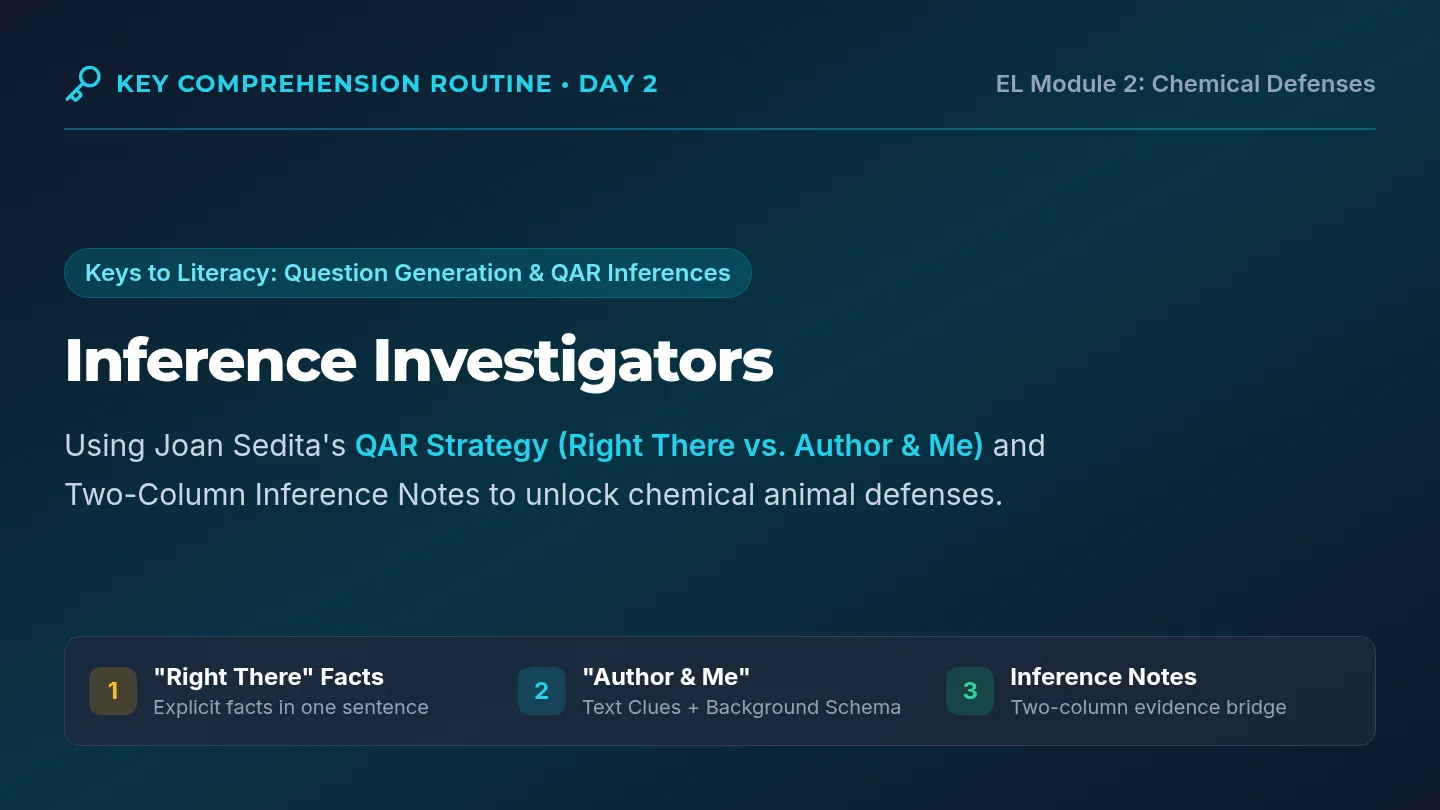
Inference Clues Slides Key Comprehension Routine • Day 2
EL Module 2: Chemical Defenses
Keys to Literacy: Question Generation & QAR Inferences
Inference Investigators
Using Joan Sedita's QAR Strategy (Right There vs. Author & Me) and Two-Column Inference Notes to unlock chemical animal defenses.
1
"Right There" Facts
Explicit facts in one sentence
2
"Author & Me"
Text Clues + Background Schema
3
Inference Notes
Two-column evidence bridge
QAR Strategy (Sedita Routine)
Where Is the Answer Found?
1
"Right There" (In the Text)
The answer is explicitly stated in a single sentence. You can point your finger directly at it!
Example Question:
"What temperature does the beetle's spray reach?"
Direct answer: Exactly 212°F (Paragraph 3).
2
"Author & Me" (Inference)
The answer is implicit! You must combine clues from the author with your personal knowledge.
Example Question:
"Why does the beetle store chemicals separately?"
Inference: To prevent boiling steam from exploding inside itself!
Key Comprehension Rule: An "Author & Me" inference requires BOTH text clues and your schema!
Key Routine Tool
Two-Column Inference Notes
Two-Column Notes for Deductions
Connecting explicit text facts to your logical conclusions.
L
Left: Text Clues & Quote
What the author directly tells you:
"Poison frog skin is bright neon-yellow and orange instead of green camouflage." (Par. 4)
R
Right: Schema & Inference
What you deduce using your schema:
"Bright colors warn predators from a distance, so the frog avoids ever being bitten."
Citation Check: Always cite the paragraph number next to your text clues on the left!
Case File Routine
Chemical Defenses
Sedita QAR Mission
Chemical Warfare Inferences
Today we investigate how animals use chemistry to defend themselves. You will classify questions into "Right There" vs. "Author & Me" and record your evidence in Two-Column Inference Notes!
Investigation 1: Bombardier beetle dual chambers.
Investigation 2: Poison dart frog warning hues.
Ready to take Two-Column Inference Notes?
Turn to Evidence Detective Worksheet
Evidence Detective Worksheet Key Comprehension Routine • Day 2
Evidence Detective Worksheet
Name:
Date:
Keys to Literacy: Use Sedita's QAR routine (Right There vs. Author & Me) to make text-based inferences.
Lexile: 800L
Chemical Warfare: Toxins and Boiling Sprays in the Wild
Informational Science Text
[1] When physical shields and armor are not enough, certain vulnerable animals manufacture their own potent weapons using internal chemistry. Chemical defenses allow relatively small, fragile organisms to repel predators many times their size through venomous bites, toxic secretions, or searing sprays. These chemical weapons can stun, sicken, or permanently blind attacking carnivores.
[2] One of the most jaw-dropping chemical engineers in the insect world is the bombardier beetle. Inside its tiny abdomen are two separate storage chambers: one containing hydrogen peroxide and the other containing hydroquinones. As long as these compounds remain isolated, the beetle remains completely unharmed. However, when gripped by a hungry toad or spider, the beetle contracts muscular valves, funneling both chemicals into a reinforced reaction chamber filled with catalytic enzymes.
[3] An instantaneous, violent chemical reaction ignites. The liquid heats rapidly to the boiling point of water—212°F (100°C)—generating pressurized steam. With an audible pop, the beetle fires a rapid series of boiling, noxious chemical pulses from a flexible abdominal turret. The beetle can swivel its nozzle 360 degrees, blasting scalding fluid directly into the eyes and mouth of its assailant. In agonizing pain, the predator drops the beetle and frantically retreats.
[4] Other creatures take a preventative chemical approach. The golden poison dart frog of Colombia secretes a deadly batrachotoxin across its skin, capable of stopping a predator’s heart within minutes. Rather than hiding, this amphibian advertises its lethal chemistry with vivid neon-yellow and electric-orange skin—a defensive phenomenon called aposematic coloration . In the rainforest, bright warning hues signal an unmistakable message to hungry birds and mammals: eat me and you will not survive.
1
QAR Analysis: Right There vs. Author & Me
Classify each question according to Joan Sedita's QAR categories:
1. "What two chemicals are stored inside the bombardier beetle's abdomen?"
"Right There" (In Text) "Author & Me" (Inference)
2. "Why is aposematic warning color more useful for a poison frog than green camouflage?"
"Right There" (In Text) "Author & Me" (Inference)
Key Routine • Two-Column Inference Notes Page 2 of 2
2
Two-Column Notes: Text Clues & "Author & Me" Inferences
In Joan Sedita's routine, record explicit text quotes on the left, then connect your schema to draw an "Author & Me" inference on the right.
Left: Text Clues & Quotes (Par. #)
Right: Schema + Author & Me Inference
Quote: Isolated Chemicals (Par. 2):
Inference: Why keep them separated?
Quote: Neon Warning Skin (Par. 4):
Inference: Why warn rather than hide?
3
Question Generation: Write Your Own "Author & Me" Question
Write one inferential question about chemical defenses that requires both the text and a reader's thinking:
4
Constructed Defense: Citing Text Evidence
Based on Paragraph [3], what can you infer about whether a predator that has been blasted once by a bombardier beetle would attack another one? Defend your inference citing evidence.
QAR Inference Check:
Direct quote in Left Column Schema explicitly used in Right Column Paragraph cited: [ # ]
Evidence Detective Teacher Guide Teacher Facilitation Guide • Day 2
Inference Investigators
Key Routine • CCSS RI.4.1
Pacing: 45 Minutes
Sedita Routine Pillar
Question Generation & QAR: "Right There" (explicit) vs. "Author & Me" (inferential deduction).
Module 2 Context
EL Education Chemical Defenses: Bombardier beetle boiling spray & poison frog warnings.
Core Tool
Two-Column Inference Notes: Text Clues & Quotes (Left), Schema & Inferences (Right).
Instructional Pacing Breakdown
10m: QAR Teach
Review Slides 1-3. Contrast "Right There" finger facts with "Author & Me" clues.
12m: Read & Check
Shared read text. Students classify Questions 1 & 2 on Page 1 into QAR types.
15m: Inference Notes
Pairs record text quotes on left and schema-backed inferences on right.
8m: Question Gen
Students generate an original "Author & Me" question and defend constructed response.
Teacher Think-Aloud Script (Author & Me Inferences)
"Class, when answering an 'Author & Me' question, the author gives us clues, but WE have to supply the bridge. In our Two-Column Notes, my left column has the author's words: 'Hydroperoxide and hydroquinones stay in separate chambers.' Now on the right column, I bring my schema: 'Mixing them creates 212°F boiling steam.' My 'Author & Me' inference is: The beetle evolved separate chambers to keep from exploding itself from the inside out!"
Annotated Exemplar Key & Scoring Criteria
Worksheet Item Exemplar Student Response Diagnostic Check
QAR Check (Page 1) 1: "Right There" (directly stated in Par. 2). 2: "Author & Me" (requires inference). Distinguishes literal vs. inferential QAR types.
Inference Notes: Row 1 Left: Compounds isolated (Par. 2). Right: Separate chambers prevent the boiling steam reaction from injuring the beetle. Must connect storage isolation to internal self-preservation.
Inference Notes: Row 2 Left: Neon warning skin (Par. 4). Right: Warns predators from a distance so frog is never bitten in the first place. Connects bright coloration to proactive deterrence.
Constructed Defense "Based on par. [3], an attacker would not strike again. The text states the 212°F spray causes 'agonizing pain' in the eyes and mouth, causing predators to 'frantically retreat.'" 2 pts: Valid behavioral deduction + direct citation of [Par. 3].
Key Routine Differentiation: QAR Stem: "The author tells me in paragraph [X] that _______. Because I know that _______, I can infer that _______."
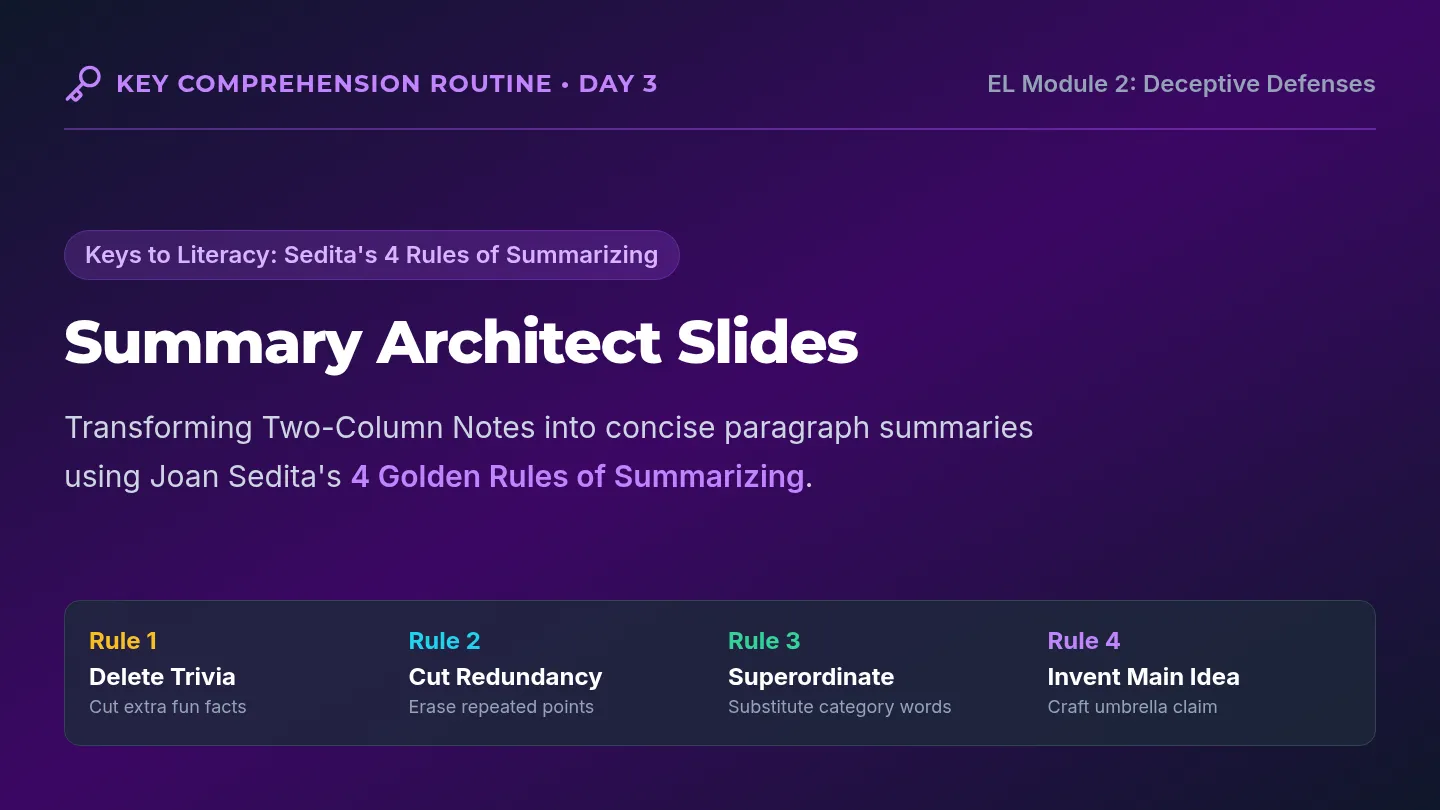
Summary Architect Slides Key Comprehension Routine • Day 3
EL Module 2: Deceptive Defenses
Keys to Literacy: Sedita's 4 Rules of Summarizing
Summary Architect Slides
Transforming Two-Column Notes into concise paragraph summaries using Joan Sedita's 4 Golden Rules of Summarizing.
Rule 1
Delete Trivia
Cut extra fun facts
Rule 2
Cut Redundancy
Erase repeated points
Rule 3
Superordinate
Substitute category words
Rule 4
Invent Main Idea
Craft umbrella claim
Joan Sedita's Rulebook
4 Rules of Summarizing
1
Delete Trivia & Side Notes
Cut minor details like discovery dates, exact measurements, and cool facts that don't explain the main survival mechanism.
Cut: "Found in Sulawesi waters in 1998." (Trivia)
2
Delete Redundant Repetitions
If the author explains that octopuses change color and then repeats it three times in different paragraphs, state it once!
Rule: One clear sentence covers color-shifting.
3
Substitute Superordinate Terms
Replace long lists with a broad category word! This is Sedita's most powerful secret for summarizing.
Instead of: "sea snakes, lionfish, and stingrays"
4
Invent Central Idea Sentence
Combine the topic and the overarching defense strategy into a single umbrella opening sentence.
Sentence 1: "The mimic octopus survives by..."
Superordinate Power: A superordinate category shrinks 10 words into 1-2 words!
The Sedita Bridge
Notes to Summary
From Two-Column Notes to Summary
How to turn your bulleted notes into a polished 4-sentence paragraph.
Step 1: Your Two-Column Notes
• Main Idea: Mimic octopus uses shape-shifting.
• Chromatophores change color & texture.
• Impersonates sea snakes & lionfish.
• Predators fear venom & retreat.
Step 2: Apply 4 Rules & Draft
"In 'Masters of Deception,' the author demonstrates that prey animals survive by tricking predator senses. The mimic octopus alters its skin using chromatophores. It contorts its body to imitate venomous marine predators. This deception protects it without armor or poison."
Sedita Test: Zero personal opinions ("I think"), zero trivia, 100% objective!
Capstone Routine
Keys to Comprehension
The 4-Rule Summary Showcase
Apply Joan Sedita's 4 Rules of Summarizing to your notes on the mimic octopus, filter out trivia, substitute superordinate terms, and write your master paragraph!
Ready to apply the 4 Rules of Summarizing?
Open Summary Builder Worksheet
Summary Builder Worksheet Key Comprehension Routine • Day 3
Summary Builder Worksheet
Name:
Date:
Keys to Literacy: Apply Joan Sedita's 4 Rules of Summarizing to condense text into an objective summary.
Lexile: 810L
Masters of Deception: Mimicry and Camouflage in the Wild
Informational Science Text
[1] Not every prey animal possesses thick bone armor or searing chemical sprays. Instead, millions of species survive through the art of biological deception. Deceptive defenses trick a predator’s senses through two primary strategies: camouflage , which conceals an animal within its background, and mimicry , where a harmless organism actively copies the appearance or behavior of a dangerous, toxic species.
[2] The undisputed king of underwater deception is the mimic octopus (Thaumoctopus mimicus ), native to the shallow coastal waters of Indonesia. While most octopuses simply blend into surrounding rocks, the mimic octopus possesses elastic muscles and specialized pigment cells called chromatophores that alter skin color, pattern, and texture in milliseconds. Remarkably, this soft-bodied cephalopod impersonates up to fifteen different venomous sea creatures depending on what predator threatens it.
[3] When approached by an aggressive damselfish, the octopus buries six of its arms into the sand, extending two banded arms in opposite directions. It ripples these arms with yellow and black stripes, perfectly imitating a venomous banded sea snake—the damselfish’s mortal enemy. When hunting in open water where it risks attack from barracudas, the octopus pulls its arms back and glides with undulating fins, transforming itself into a spiky, poisonous lionfish.
[4] Marine scientists first documented the mimic octopus in 1998, noting that it grows to roughly two feet in length. By fooling predators into believing they are confronting deadly venom rather than an easy meal, the mimic octopus proves that behavioral deception is one of nature’s most ingenious survival mechanisms.
1
Sedita's Summarizing Filter (Rules 1-3)
Rule 1: Delete Trivia (1 fact to erase):
Which discovery or measurement fact from Par. 4 is trivia?
Rule 3: Superordinate Category Substitution:
Substitute a category word for "banded sea snakes and lionfish":
Key Routine • Rule 4 & Summary Composition Page 2 of 2
2
Rule 4: Invent or Select a Main Idea Sentence
Craft an overarching opening sentence that states the author's primary claim about deceptive defense mechanisms:
3
Drafting Your Master 4-Sentence Summary Paragraph
Combine your opening sentence with 2 essential details (using your superordinate category term) and conclude with survival significance:
4
Sedita 4-Rules Author Checklist
Rule 1: All trivia deleted
Rule 2: Redundancy cut
Rule 3: Superordinate term used
Rule 4: Clear main idea stated
Key Comprehension Capstone: You have mastered Top-Down Webs, Two-Column Notes, QAR, and the 4 Rules of Summarizing!
Summary Architect Teacher Guide Teacher Facilitation Guide • Day 3
Summary Architect Guide
Key Routine • CCSS RI.4.2
Pacing: 45 Minutes
Sedita Routine Pillar
The 4 Rules of Summarizing: Delete Trivia, Delete Redundancy, Superordinate Terms, Invent Main Idea.
Module 2 Context
EL Education Deceptive Defenses: Mimic octopus camouflage, chromatophores, and mimicry.
Core Tool
Two-Column Notes Synthesis to 4-sentence objective summary paragraph.
Instructional Pacing Breakdown
10m: 4 Rules Teach
Display Slides 1-3. Model substituting superordinate terms for specific animal lists.
12m: Read & Filter
Read passage. Guide students to apply Rules 1-3 on Page 1 of the worksheet.
15m: Summary Draft
Partners draft 4-sentence summary using superordinate term and invented main idea.
8m: Sedita Audit
Pairs audit drafts using the 4-Rules Checklist. Celebrate capstone completion.
Teacher Think-Aloud Script (Superordinate Substitution)
"Class, look at Rule 3: Substitute Superordinate Terms. Paragraph 3 lists 'banded sea snakes and spiky lionfish.' If we list every animal, our summary becomes too long and clunky! What is the broader category that describes all of them? They are 'venomous marine predators.' By replacing the list with this one category term, our summary stays concise, punchy, and clear!"
Annotated Exemplar Summary & Sedita 4-Rules Scoring Guide
Exemplar 4-Sentence Student Summary:
[Rule 4 - Main Idea]: In "Masters of Deception," the author demonstrates that soft-bodied prey animals survive by using camouflage and mimicry to deceive predator senses. [Sentence 2 - Mechanism]: The mimic octopus relies on specialized chromatophore pigment cells to instantly alter its skin color and texture. [Rule 3 - Superordinate Term]: When threatened, it contorts its flexible arms to impersonate venomous marine predators such as sea snakes and lionfish. [Sentence 4 - Significance]: By tricking attackers into fleeing, this behavioral defense ensures survival without armor or poison.
4 - Master Architect Clear main idea, superordinate term used, 0 trivia, 4 sentences.
3 - Proficient Accurate summary; lists specific animals instead of category term.
2 - Developing Includes personal opinion or contains trivial dates/numbers.
1 - Novice Incomplete retelling or lists random disconnected facts.
Key Routine Differentiation: Superordinate Bank: Provide category cards (e.g., "predators," "chemical weapons," "body armor") for students who struggle to invent category labels.