Day 1 Elephant Dilemma Lesson Plan Grade 4 Close Reading • 4-Day Sequence • Teacher Guide
Day 1: Introduction & An Elephant's Dilemma
Text Chunk 1
Pages 4–10 (Lexile 910L)
Learning Objectives
Chunking Text: Break informational text into manageable sections using headings and subtopics.Main Idea & Details: Identify the main idea of the Introduction and "An Elephant's Dilemma" using key text evidence.Vocabulary: Distinguish between instincts and emotions using context clues and the glossary.
Book Focus Question
"Do animals feel emotions?"
Author: Kira Freed
45-Minute Pacing Guide
Time
Lesson Phase
Teacher & Student Actions
0–8 min
Hook & Vocab Preview
Introduce the Focus Question. Poll students: Can animals feel love? Preview 4 Chunk 1 words: instincts, abandon, loyalty, compassion (p. 2 & p. 20).
8–20 min
Chunk 1A: Introduction (pp. 4–5)
Read pp. 4–5 aloud. Model how to "chunk" by stopping at the end of the Introduction. Contrast the pet owner vs. scientist viewpoints. Complete Part 1 of the worksheet together.
20–35 min
Chunk 1B: An Elephant's Dilemma (pp. 6–10)
Students read pp. 6–10 in pairs (or guided group). Pause at p. 7 to discuss Echo's dilemma. Have students underline or note 2 key details that show Echo's care for Ely.
35–45 min
Main Idea & Wrap-Up
Students independently complete the Main Idea box and comprehension questions on the Day 1 Worksheet. Share 1–2 student main idea statements aloud.
Chunking Protocol & Guided Questions
Chunk 1A: Introduction (pp. 4–5)
Ask: What is the disagreement between pet owners and many scientists?Think-Aloud: "Before I read the animal stories, I stop here to ask: What is the author's big claim? "
Chunk 1B: Echo & Ely (pp. 6–10)
Ask (p. 7): Why was staying with Ely a dangerous choice for Echo?Ask (p. 10): How does Ely's story support the author's claim about love?
Materials Needed: Animals Feel Emotions (pp. 2–10), Day 1 Student Worksheet Page 1 of 2
Day 1: Differentiation & Answer Key
Teacher Reference
Scaffolds & Support
Audio/Echo Reading: Pair striving readers or read Chunk 1B in a small teacher-led group, pausing after each page to summarize in 5 words or fewer.Sentence Frame for Main Idea: "This section is mostly about _______ who _______, which shows _______." Glossary Bookmark: Keep p. 20 open so students can check instincts and abandon while reading.
Extension Challenge
Scientist's Counterargument: Ask early finishers to write 2 sentences from a scientist's perspective explaining how Echo's behavior could be called an instinct instead of love.Text Feature Check: Have students explain how the photo captions on pp. 6–10 add information not in the main paragraphs.
Day 1 Student Worksheet Answer Key
Sample Exemplary Responses
Chunk 1A: Introduction (pp. 4–5)
1. Pet Owners vs. Scientists: Pet owners and people who work with animals believe animals feel love and other emotions. Many scientists disagree and say those behaviors are instincts —behaviors animals do without thinking to stay alive.
2. Main Idea of the Introduction: Although many scientists believe animals only act on instinct, the author believes real-life animal stories prove animals can feel love and emotions.
Chunk 1B: An Elephant's Dilemma (pp. 6–10)
3. Main Idea: Echo, the female herd leader, risked her own life by staying behind with her newborn calf Ely until he could walk, showing deep love and devotion.
4. Two Supporting Details (any two):
Echo refused to abandon Ely when the rest of the herd left to find food and water.
Echo and her daughter Enid moved Ely to a small mud hole to splash him with water even when they ran out of food and water.
Echo stayed patiently for three days until Ely could stand on his front legs and walk.
5. Why was Echo's choice a "dilemma"? As the head female, the herd depended on Echo for leadership, and staying in one hot place without food or water put her life at risk—but leaving meant abandoning her helpless calf.
6. Vocabulary in Context (abandon ): To leave behind. Echo refused to leave Ely behind even when he couldn't stand or nurse.
Wild Hearts Reading • Day 1 Teacher Guide Page 2 of 2
Elephant Dilemma Worksheet Name: ____________________________________
Date: ___________________
Day 1 • Text Chunking & Main Idea
Introduction & An Elephant's Dilemma
Reading Pages
pp. 4–10
Chunking Strategy: Good readers break long nonfiction texts into smaller chunks . After each chunk, pause and ask: "What is this section mostly about?"
Chunk 1A: Introduction (Pages 4–5)
Stop & Think
1. Compare the two points of view from page 4. What does each group believe about animals?
Pet Owners & Animal Workers
Many Scientists (Instincts)
2. What is the main idea of the Introduction (pages 4–5)?
Word Watch: What does instincts mean on page 4?
Animals Feel Emotions • Day 1 Page 1 of 2
Chunk 1B • Pages 6–10
An Elephant's Dilemma
Read pages 6–10 carefully. Look for how Echo responds when her newborn calf, Ely, cannot stand up.
3. Identify the main idea of "An Elephant's Dilemma" (pp. 6–10).
4. List two supporting details from the text that prove your main idea.
Detail 1
Detail 2
5. Why was Echo's decision on page 7 called a dilemma (a difficult choice)?
6. On page 7, the text says Echo refused to abandon Ely. What does abandon mean, and what did Echo do instead?
Animals Feel Emotions • Day 1 Page 2 of 2
Day 2 Penguin Parenting Lesson Plan Grade 4 Close Reading • 4-Day Sequence • Teacher Guide
Day 2: Unlikely Bonds & Penguin Parenting
Text Chunk 2
Pages 11–14
Learning Objectives
Chunking Sidebars: Recognize that boxed sidebars ("Mom and Baby?", p. 11) are separate text chunks with their own main idea.Main Idea & Details: Determine the main idea of "Penguin Parenting" and cite specific actions that show parental care.Idioms & Vocabulary: Interpret ecstatically (p. 13) and the phrase "going the extra mile" (p. 14).
Key Vocabulary
devoted (p. 11)migrate (p. 12)ecstatically (p. 13)brutal (p. 13)
45-Minute Pacing Guide
Time
Lesson Phase
Teacher & Student Actions
0–6 min
Recap & Vocab
Briefly review Day 1's main idea (Echo & Ely). Preview ecstatically ("extremely joyfully") and devoted . Point out the gray sidebar box on p. 11.
6–16 min
Chunk 2A: Mom and Baby? (p. 11)
Read p. 11 together. Explain why sidebars are their own chunk. Students identify the main idea of Owen and Mzee's story and complete Questions 1–2.
16–33 min
Chunk 2B: Penguin Parenting (pp. 12–14)
Partner read pp. 12–14. Students track the sequence of how Snow and Ice care for their egg and chick (May/June → winter → August).
33–45 min
Main Idea & Comprehension
Students independently complete the "Penguin Parenting" main idea, supporting details, and comprehension questions (Questions 3–6).
Chunking Protocol & Guided Questions
Chunk 2A: Mom and Baby? (p. 11)
Ask: Why does the author put a question mark in the title "Mom and Baby?"Connect: How is Owen's need for Mzee similar to Ely's need for Echo?
Chunk 2B: Snow & Ice (pp. 12–14)
Ask (p. 13): Why do Snow and Ice sing together for up to an hour when the egg is laid?Ask (p. 14): What sacrifices do both parents make to keep the chick alive?
Materials Needed: Animals Feel Emotions (pp. 11–14), Day 2 Student Worksheet Page 1 of 2
Day 2: Differentiation & Answer Key
Teacher Reference
Scaffolds & Support
Timeline Visual: Sketch a quick 3-step timeline on the board (May/June → Winter → August) to help students track Snow and Ice's turns.Idiom Support: Explain that "going the extra mile" is an idiom meaning putting in extra effort—and penguins literally travel 50–100 miles!
Extension Challenge
Cross-Text Comparison: Have students compare Echo's parenting with Snow and Ice's parenting in 2–3 sentences. What is one similarity and one difference?Debate Prompt: Ask: Could a scientist argue that penguin huddling is an instinct, while singing to the egg is an emotion? Why?
Day 2 Student Worksheet Answer Key
Sample Exemplary Responses
Chunk 2A: Mom and Baby? (p. 11)
1. Main Idea: After losing his mother in a tsunami, a young hippo named Owen formed a close, loving bond with a 100-year-old tortoise named Mzee who acted as his substitute mom.
2. Why is Owen and Mzee's bond "unlikely"? They are completely different species (a baby hippopotamus and a 100-year-old tortoise), yet they became devoted and inseparable companions.
Chunk 2B: Penguin Parenting (pp. 12–14)
3. Main Idea: Emperor penguin parents Snow and Ice work together and make huge sacrifices to protect, warm, and feed their egg and chick in Antarctica's harsh climate.
4. Two Supporting Details (any two):
Ice balances the egg on his feet and eats nothing for nearly four months through a brutal winter while Snow travels up to 50 miles to the ocean to feed.
Snow and Ice sing ecstatically when the egg is laid and again when Snow returns to hear the chick peeping.
Mom and Dad take turns traveling to the ocean so the chick is always kept warm and safe by one parent.
5. Vocabulary (ecstatically ): Extremely joyfully. Ice sings ecstatically as soon as he sees the egg, showing excitement and love.
6. Author's Meaning ("going the extra mile"): It means doing far more than expected—both literally traveling up to 50–100 miles in freezing weather and sacrificing food and comfort to care for their chick.
Wild Hearts Reading • Day 2 Teacher Guide Page 2 of 2
Penguin Parenting Worksheet Name: ____________________________________
Date: ___________________
Day 2 • Text Chunking & Main Idea
Unlikely Bonds & Penguin Parenting
Reading Pages
pp. 11–14
Chunking Tip: Notice the gray box on page 11 ("Mom and Baby?"). A sidebar is its own short chunk! Read it separately and find its main idea before moving on to the penguins.
Chunk 2A: Mom and Baby? (Page 11)
Sidebar Chunk
1. What is the main idea of the sidebar "Mom and Baby?" (page 11)?
2. Why does the author call Owen and Mzee an "unlikely pair" ? Use details from page 11.
Preview Chunk 2B (Pages 12–14):
Before reading "Penguin Parenting," write one thing you already know about how Emperor penguins survive in Antarctica.
Animals Feel Emotions • Day 2 Page 1 of 2
Chunk 2B • Pages 12–14
Penguin Parenting
Read pages 12–14. Pay attention to how Snow and Ice care for their egg and chick from May through August.
3. Identify the main idea of "Penguin Parenting" (pp. 12–14).
4. List two supporting details that show how Snow and Ice care for their egg or chick.
Detail 1
Detail 2
5. On page 13, Ice begins singing ecstatically when he sees the egg. What does ecstatically mean?
6. On page 14, the author writes that Snow and Ice give new meaning to "going the extra mile." What does this phrase mean in the story?
Animals Feel Emotions • Day 2 Page 2 of 2
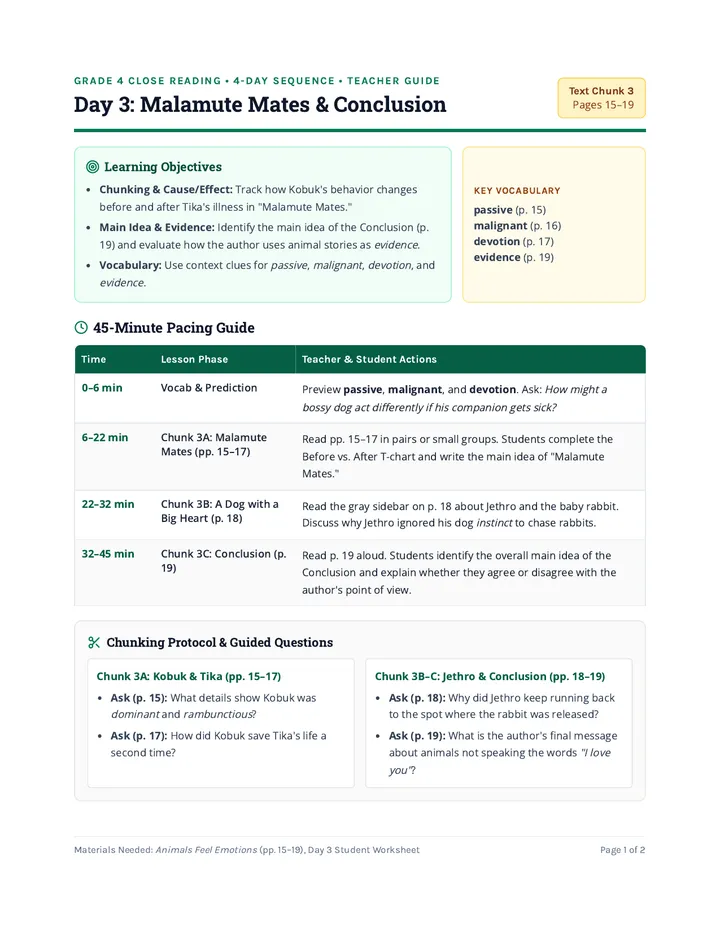
Day 3 Malamute Mates Lesson Plan Grade 4 Close Reading • 4-Day Sequence • Teacher Guide
Day 3: Malamute Mates & Conclusion
Text Chunk 3
Pages 15–19
Learning Objectives
Chunking & Cause/Effect: Track how Kobuk's behavior changes before and after Tika's illness in "Malamute Mates."Main Idea & Evidence: Identify the main idea of the Conclusion (p. 19) and evaluate how the author uses animal stories as evidence .Vocabulary: Use context clues for passive , malignant , devotion , and evidence .
Key Vocabulary
passive (p. 15)malignant (p. 16)devotion (p. 17)evidence (p. 19)
45-Minute Pacing Guide
Time
Lesson Phase
Teacher & Student Actions
0–6 min
Vocab & Prediction
Preview passive , malignant , and devotion . Ask: How might a bossy dog act differently if his companion gets sick?
6–22 min
Chunk 3A: Malamute Mates (pp. 15–17)
Read pp. 15–17 in pairs or small groups. Students complete the Before vs. After T-chart and write the main idea of "Malamute Mates."
22–32 min
Chunk 3B: A Dog with a Big Heart (p. 18)
Read the gray sidebar on p. 18 about Jethro and the baby rabbit. Discuss why Jethro ignored his dog instinct to chase rabbits.
32–45 min
Chunk 3C: Conclusion (p. 19)
Read p. 19 aloud. Students identify the overall main idea of the Conclusion and explain whether they agree or disagree with the author's point of view.
Chunking Protocol & Guided Questions
Chunk 3A: Kobuk & Tika (pp. 15–17)
Ask (p. 15): What details show Kobuk was dominant and rambunctious ?Ask (p. 17): How did Kobuk save Tika's life a second time?
Chunk 3B–C: Jethro & Conclusion (pp. 18–19)
Ask (p. 18): Why did Jethro keep running back to the spot where the rabbit was released?Ask (p. 19): What is the author's final message about animals not speaking the words "I love you" ?
Materials Needed: Animals Feel Emotions (pp. 15–19), Day 3 Student Worksheet Page 1 of 2
Day 3: Differentiation & Answer Key
Teacher Reference
Scaffolds & Support
Contrast Clues: Help students contrast dominant vs. passive on p. 15 using gestures or simple synonyms (bossy vs. quiet/gentle).Evidence Frame: "I agree/disagree with the author because in the text, _______."
Extension Challenge
Index & Text Features: Have students use the Index on p. 20 to locate all pages about dogs (pp. 15–18) and orphanage (pp. 11, 18) and explain how those topics connect.
Day 3 Student Worksheet Answer Key
Sample Exemplary Responses
Chunk 3A: Malamute Mates (pp. 15–17)
1. Before vs. After Tika's Illness: Before: Kobuk was dominant, grabbed all the attention, insisted on going out the door first, and often knocked Tika down. After: Kobuk stayed by Tika's side day and night, groomed her face and ears, watched over her attentively, and woke Anne up in time to save Tika's life.
2. Main Idea of "Malamute Mates": Even though Kobuk was usually a bossy, rambunctious dog, he showed deep worry and devotion to his mate Tika when she became seriously ill.
Chunk 3B: A Dog with a Big Heart (p. 18)
3. How Jethro acted against instinct: Most dogs have an instinct to chase small animals, but Jethro gently rescued an orphaned baby rabbit, watched over her box for two weeks, and kept returning to her release spot hoping for a reunion.
Chunk 3C: Conclusion (p. 19)
4. Main Idea of the Conclusion: Even though animals cannot speak the words "I love you," their loyalty, devotion, and compassion provide strong evidence that they can and do feel love.
5. Author's Evidence (Opinion + Text Support): Answers will vary, but students should state whether they agree or disagree with Kira Freed and cite at least one specific story (Echo & Ely, Owen & Mzee, Snow & Ice, Kobuk & Tika, or Jethro & the rabbit).
Wild Hearts Reading • Day 3 Teacher Guide Page 2 of 2
Malamute Mates Worksheet Name: ____________________________________
Date: ___________________
Day 3 • Text Chunking & Main Idea
Malamute Mates & Conclusion
Reading Pages
pp. 15–19
Chunk 3A • Pages 15–17
Malamute Mates
Read pages 15–17. Notice how Kobuk's behavior toward Tika changes after she gets sick.
1. Compare Kobuk's behavior before and after Tika's tumor was discovered (pp. 15–17).
Before Tika Got Sick (p. 15)
After Tika Got Sick (pp. 16–17)
2. What is the main idea of "Malamute Mates" (pp. 15–17)?
Animals Feel Emotions • Day 3 Page 1 of 2
Chunk 3B: A Dog with a Big Heart (Page 18)
Sidebar Chunk
3. Most dogs have an instinct to chase small animals. How did Jethro's actions toward the baby rabbit show compassion instead?
Chunk 3C: Conclusion (Page 19)
Final Chunk
4. What is the main idea of the Conclusion on page 19?
5. Do you agree or disagree with the author's point of view that animals feel love? Use evidence from at least one story in the book to support your answer.
Animals Feel Emotions • Day 3 Page 2 of 2
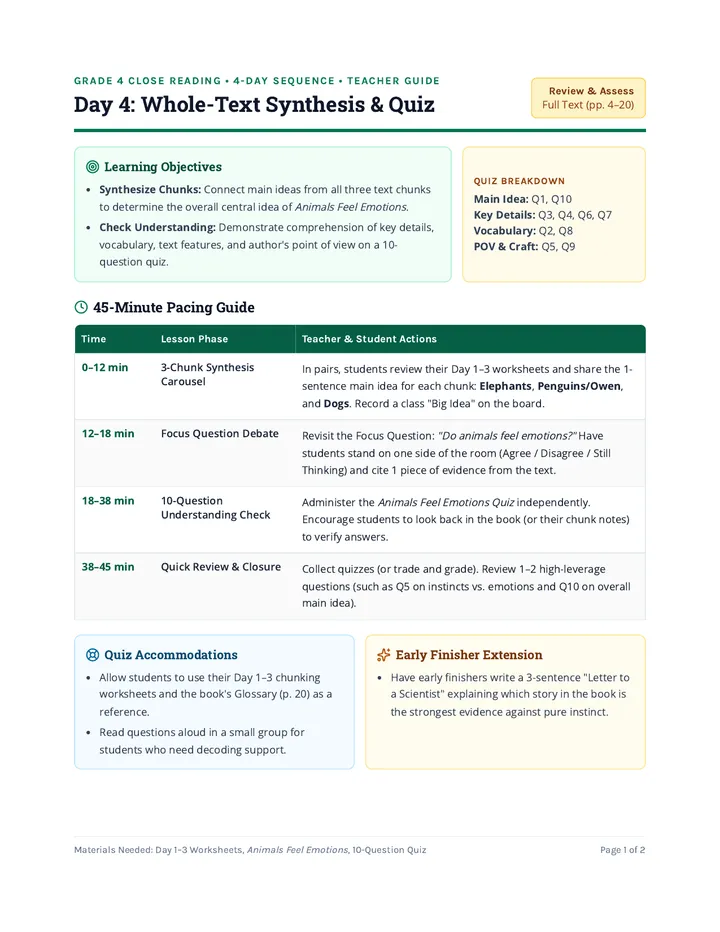
Day 4 Understanding Check Lesson Plan Grade 4 Close Reading • 4-Day Sequence • Teacher Guide
Day 4: Whole-Text Synthesis & Quiz
Review & Assess
Full Text (pp. 4–20)
Learning Objectives
Synthesize Chunks: Connect main ideas from all three text chunks to determine the overall central idea of Animals Feel Emotions .Check Understanding: Demonstrate comprehension of key details, vocabulary, text features, and author's point of view on a 10-question quiz.
Quiz Breakdown
Main Idea: Q1, Q10Key Details: Q3, Q4, Q6, Q7Vocabulary: Q2, Q8POV & Craft: Q5, Q9
45-Minute Pacing Guide
Time
Lesson Phase
Teacher & Student Actions
0–12 min
3-Chunk Synthesis Carousel
In pairs, students review their Day 1–3 worksheets and share the 1-sentence main idea for each chunk: Elephants , Penguins/Owen , and Dogs . Record a class "Big Idea" on the board.
12–18 min
Focus Question Debate
Revisit the Focus Question: "Do animals feel emotions?" Have students stand on one side of the room (Agree / Disagree / Still Thinking) and cite 1 piece of evidence from the text.
18–38 min
10-Question Understanding Check
Administer the Animals Feel Emotions Quiz independently. Encourage students to look back in the book (or their chunk notes) to verify answers.
38–45 min
Quick Review & Closure
Collect quizzes (or trade and grade). Review 1–2 high-leverage questions (such as Q5 on instincts vs. emotions and Q10 on overall main idea).
Quiz Accommodations
Allow students to use their Day 1–3 chunking worksheets and the book's Glossary (p. 20) as a reference.
Read questions aloud in a small group for students who need decoding support.
Early Finisher Extension
Have early finishers write a 3-sentence "Letter to a Scientist" explaining which story in the book is the strongest evidence against pure instinct.
Materials Needed: Day 1–3 Worksheets, Animals Feel Emotions , 10-Question Quiz Page 1 of 2
10-Question Multiple-Choice Answer Key
Teacher Reference
#
Answer
Skill
Text Evidence & Explanation
1
B
Author's Claim
p. 4–5: The author states she is convinced animals feel love and other emotions, contrasting with scientists who call them instincts.
2
C
Vocabulary
p. 4 & p. 20: Instincts are behaviors animals do without thinking that are designed to keep them alive.
3
A
Key Detail
p. 7–9: Echo risked her life by staying behind without food or water for days until Ely could stand and walk.
4
D
Sidebar Detail
p. 11: After being separated from his mother in a tsunami, Owen the hippo bonded with a 100-year-old tortoise named Mzee.
5
B
Key Detail
p. 13: Ice balances the egg on his feet and eats nothing for nearly four months through winter while Snow feeds in the ocean.
6
C
Main Idea
pp. 12–14: "Penguin Parenting" mainly explains how both Emperor penguin parents work together and sacrifice to keep their chick safe.
7
A
Cause & Effect
p. 16–17: After Tika got cancer and had her leg amputated, Kobuk stayed by her side, groomed her, and woke Anne to save her life.
8
D
Vocabulary
p. 16 & p. 20: Malignant means dangerous or deadly (Tika's tumor was malignant).
9
C
Author's Evidence
p. 18: Jethro ignored the dog instinct to chase animals and instead rescued and watched over an orphaned baby rabbit.
10
B
Overall Main Idea
p. 19: Across the entire book, real-life stories of elephants, penguins, hippos, and dogs provide evidence that animals can feel love and devotion.
Wild Hearts Reading • Day 4 Teacher Guide Page 2 of 2
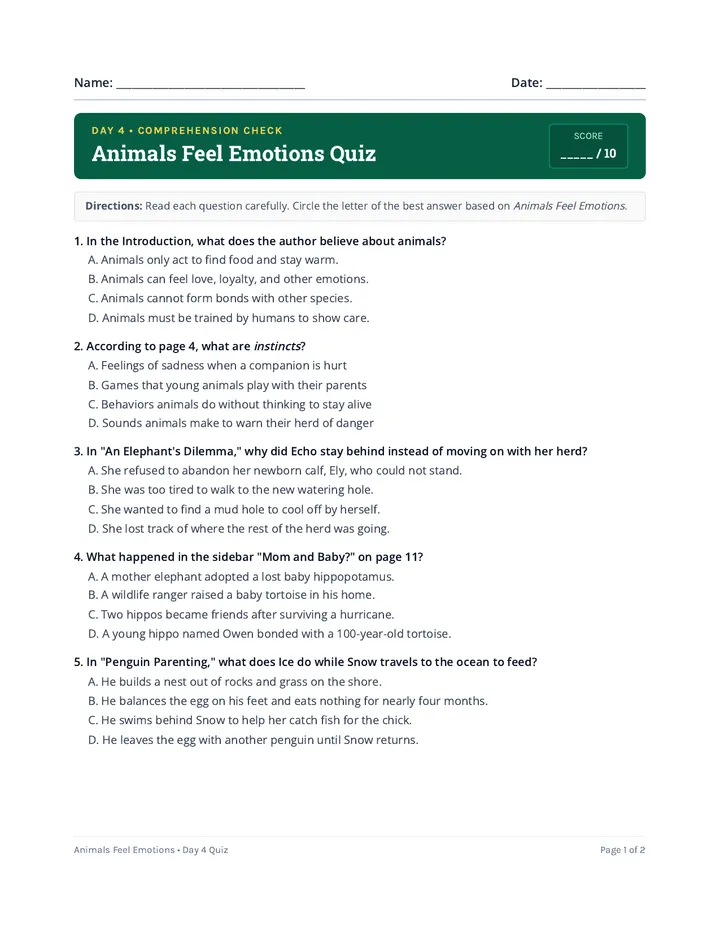
Animals Feel Emotions Quiz Name: ____________________________________
Date: ___________________
Day 4 • Comprehension Check
Animals Feel Emotions Quiz
Score
_____ / 10
Directions: Read each question carefully. Circle the letter of the best answer based on Animals Feel Emotions .
1. In the Introduction, what does the author believe about animals?
A. Animals only act to find food and stay warm.
B. Animals can feel love, loyalty, and other emotions.
C. Animals cannot form bonds with other species.
D. Animals must be trained by humans to show care.
2. According to page 4, what are instincts ?
A. Feelings of sadness when a companion is hurt
B. Games that young animals play with their parents
C. Behaviors animals do without thinking to stay alive
D. Sounds animals make to warn their herd of danger
3. In "An Elephant's Dilemma," why did Echo stay behind instead of moving on with her herd?
A. She refused to abandon her newborn calf, Ely, who could not stand.
B. She was too tired to walk to the new watering hole.
C. She wanted to find a mud hole to cool off by herself.
D. She lost track of where the rest of the herd was going.
4. What happened in the sidebar "Mom and Baby?" on page 11?
A. A mother elephant adopted a lost baby hippopotamus.
B. A wildlife ranger raised a baby tortoise in his home.
C. Two hippos became friends after surviving a hurricane.
D. A young hippo named Owen bonded with a 100-year-old tortoise.
5. In "Penguin Parenting," what does Ice do while Snow travels to the ocean to feed?
A. He builds a nest out of rocks and grass on the shore.
B. He balances the egg on his feet and eats nothing for nearly four months.
C. He swims behind Snow to help her catch fish for the chick.
D. He leaves the egg with another penguin until Snow returns.
Animals Feel Emotions • Day 4 Quiz Page 1 of 2
Animals Feel Emotions Quiz (continued)
Questions 6–10
6. What is the main idea of "Penguin Parenting" (pages 12–14)?
A. Emperor penguins slide on their bellies to travel faster on ice.
B. Antarctica has the coldest and windiest winters on Earth.
C. Emperor penguin parents work together and sacrifice to keep their chick safe.
D. Penguin chicks hatch in August after spending winter in an egg.
7. In "Malamute Mates," how did Kobuk change after Tika became sick?
A. He stayed by her side, groomed her gently, and alerted Anne to save her life.
B. He kept knocking her down so he could go outside first.
C. He refused to eat his meals until Tika returned from the vet.
D. He hid in another room because he was afraid of the tumor.
8. On page 16, the text says Tika's tumor turned out to be malignant . What does malignant mean?
A. Small and harmless
B. Easy to cure
C. Swollen with air
D. Dangerous and deadly
9. How does the story "A Dog with a Big Heart" (page 18) support the author's point of view?
A. It shows that dogs need humans to teach them how to share.
B. It proves that rabbits and dogs are natural enemies in the wild.
C. It shows a dog acting with gentleness and care instead of following hunting instincts.
D. It explains why Marc Bekoff adopted two dogs from the Humane Society.
10. Which sentence best states the overall main idea of the entire book?
A. Scientists and pet owners will never agree on how animals think.
B. Real-life stories of animals caring for one another give strong evidence that animals feel love.
C. Elephants, penguins, and dogs are the only animals that take care of their babies.
D. Animals cannot speak human words, so we cannot know what they are thinking.
Animals Feel Emotions • Day 4 Quiz Page 2 of 2