Standard Showdown Task Cards
Standard Showdown
Grade 8 NC ELA Mastery • Page 1 of 4
✂️ CUT ALONG DASHED LINES
CARD 01 NC.RI.8.1
The Great Dismal Swamp
The Great Dismal Swamp Canal, constructed in the late 18th century, was hand-dug by enslaved laborers. The swamp itself served as an important refuge for "maroons"—people who escaped enslavement and established hidden, self-sufficient communities deep in the dense, waterlogged forests. Excavations reveal they constructed raised wooden platforms to keep their dwellings dry in the marshy terrain.
Which detail BEST supports the inference that maroon communities were highly organized and adaptable?
A The canal was hand-dug in the late 18th century by enslaved laborers.
B Maroons built raised wooden platforms to overcome waterlogged terrain.
C The swamp was located near the border of NC and Virginia.
D Maroons established hidden communities in the dense forests.
CARD 02 NC.RI.8.2
Glowing Oceans
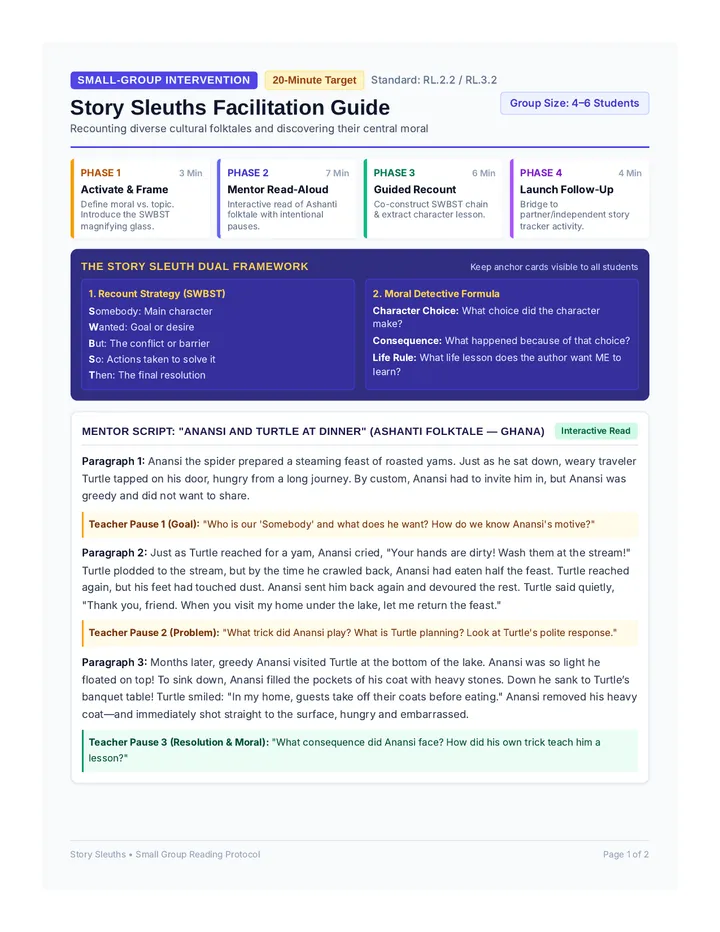
Bioluminescence is the production of light by living organisms. In deep-sea ecosystems, where sunlight never penetrates, up to 90% of creatures produce light. This phenomenon serves vital survival functions, including luring prey, distracting predators, and signaling potential mates. For example, the anglerfish uses a glowing lure to attract unsuspecting smaller fish in the absolute darkness.
Which statement best summarizes the central idea of the passage?
A Bioluminescence is a chemical reaction that occurs inside deep-sea creatures.
B Anglerfish utilize glowing lures to attract smaller fish for food.
C Light production is a critical adaptation that helps deep-sea organisms survive.
D Deep-sea environments are dark except for the light produced by creatures.
CARD 03 NC.RI.8.3
Currents of Innovation
Thomas Edison championed Direct Current (DC), which ran continuously in a single direction but could only travel about a mile before losing strength. Nikola Tesla advocated for Alternating Current (AC), which reverses direction periodically and can travel over massive distances at high voltages. While Edison’s DC was safer for home use, Tesla’s AC system became the standard for modern power grids due to its long-range transmission.
How does the author distinguish between Edison's DC system and Tesla's AC system?
A By highlighting Edison's system as safer for long-range transmission.
B By contrasting DC's short-range limits with AC's high-voltage efficiency.
C By explaining that Edison's system was developed long after Tesla's.
D By showing that both systems were equally adopted for modern power grids.
CARD 04 NC.RI.8.4
Digital Locks
Cryptography, the art of writing and solving codes, is the bedrock of modern digital security. To protect sensitive data, protocols utilize cryptographic algorithms to scramble legible text into ciphertext, rendering it unreadable to unauthorized parties. Only those possessing the specific digital key can decrypt the ciphertext back into its original, coherent state.
As used in the passage, what does the word "scramble" most nearly mean?
A To blend ingredients into a unified mixture.
B To physically climb quickly over rough, rocky terrain.
C To transform clear information into an encoded, chaotic form.
D To compete aggressively with others for a scarce resource.
NC Standard Showdown • Prepared for Grade 8 ELA Retesting & Mastery
Standard Showdown
Grade 8 NC ELA Mastery • Page 2 of 4
✂️ CUT ALONG DASHED LINES
CARD 05 NC.RI.8.5
Geothermal Power
Unlike fossil fuels, which release greenhouse gases, geothermal energy taps the earth's natural heat. Water is pumped deep underground, where extreme heat turns it into steam. This steam spins massive turbines to generate electricity. Once cooled, the water is pumped back down, creating a continuous, closed-loop cycle that produces clean power with minimal environmental footprint.
How does the author organize the paragraph to explain geothermal energy?
A By presenting a chronological history of geothermal plants.
B By comparing the direct costs of geothermal energy to solar and wind.
C By detailing the step-by-step process of converting heat to electricity.
D By identifying major geographic regions where geothermal is accessible.
CARD 06 NC.RI.8.6
The Cosmos Cost
Critics argue that the billions spent on space exploration should be spent on solving terrestrial issues, such as poverty. However, this view is incredibly shortsighted. Every dollar invested in NASA yields returns in the form of spin-off technologies—including water purification, medical imaging, and solar innovations—that improve human life daily. Space exploration is an investment in our collective future.
What is the author's primary purpose in writing this passage?
A To advocate for space funding by showing its practical benefits on Earth.
B To critique NASA's budget decisions regarding deep-space probes.
C To provide an objective, neutral overview of space technology.
D To argue that solving poverty is less important than exploration.
CARD 07 NC.RI.8.8
Silent Classrooms
Implementing a school-wide smartphone ban is highly effective for boosting academic performance. A landmark study of peer-reviewed data showed that schools enacting mobile bans saw test scores rise by an average of 6.4%. Critics claim that phones are valuable learning tools, but the evidence is clear: the constant pull of notifications is an obstacle teenagers cannot easily overcome.
Which claim in the passage is supported by empirical, factual evidence?
A Smartphone bans are the single most effective way to improve schools.
B Teenagers' attention spans are incapable of resisting social alerts.
C Schools that enacted bans saw test scores rise by an average of 6.4%.
D Smartphones should be utilized as primary tools in modern classrooms.
CARD 08 NC.RL.8.1
Excerpt from "The Crossing"
Sarah stared at the wooden footbridge. The river beneath it was swollen, angry, and churning with mud. Her knuckles turned white as she squeezed the straps of her backpack. "We don't have another choice," Liam called over the roar of the water, stepping onto the shaking planks. Sarah closed her eyes, took a breath, and stepped forward, keeping her eyes fixed on the opposite bank.
Which detail BEST supports the inference that Sarah is terrified of crossing the river?
A She looked at the wooden footbridge stretching over the river.
B Liam called out to her over the deafening roar of the water.
C Her knuckles turned white as she squeezed her backpack straps.
D She kept her eyes fixed on the opposite bank of the river.
NC Standard Showdown • Prepared for Grade 8 ELA Retesting & Mastery
Standard Showdown
Grade 8 NC ELA Mastery • Page 3 of 4
✂️ CUT ALONG DASHED LINES
CARD 09 NC.RL.8.2
Excerpt from "The Potter's Clay"
For weeks, Mateo’s clay collapsed on the wheel. Each failure left a gray puddle and a sense of defeat. His grandfather watched silently, then whispered: "The clay isn't rejecting you, Mateo. It is testing whether your hands have learned to listen." On the forty-first attempt, Mateo stopped forcing the shape. He relaxed his shoulders, closed his eyes, and let the wheel spin. The clay rose, smooth and steady, under his palms.
Which theme is most clearly developed in this narrative passage?
A Hard work guarantees immediate financial success and wealth.
B Mastery requires patience, resilience, and learning to listen and adapt.
C True artists must work in absolute isolation to create quality work.
D Older generations are always superior at physical crafts than youths.
CARD 10 NC.RL.8.3
Excerpt from "The Pitch"
"We have thirty seconds left, Julian. Just pass me the ball!" Maya hissed, her face flushed. Julian bounced the ball twice, his eyes locked on the heavy defender blocking his path to the hoop. "I've got the shot, Maya. Trust me," he murmured, his voice flat and detached. Maya gritted her teeth and stepped back. Julian drove left, ignored her wide-open stance, and launched a desperate, fading shot that bounced harmlessly off the rim.
What does the dialogue and action reveal about the conflict?
A Maya is insecure about her skills and relies too heavily on Julian.
B Julian's calm demeanor reflects superior teamwork and trust in Maya.
C Julian's individualistic drive and confidence clash with Maya's teamwork.
D Both characters are eager to pass the ball but are blocked by defense.
CARD 11 NC.RL.8.4
Excerpt from "The Foundry"
The factory was a colossal, iron-jawed beast that swallowed workers every morning at dawn and spat them out, soot-stained and exhausted, at dusk. Inside its ribcage of steel beams, the rhythmic thrum of the steam pistons was a heavy heartbeat that dictated the pace of every human hand. Clara stood at her station, her ears ringing, feeling like a tiny gear in a machine too vast to comprehend.
What is the primary impact of the extended metaphor comparing the factory to a beast?
A It emphasizes high wages and benefits provided to the staff.
B It highlights the cold, consuming, and dehumanizing industrial workplace.
C It illustrates the factory's advanced technology and structural design.
D It suggests that workers feel a biological connection to machinery.
CARD 12 NC.RL.8.5
Excerpt from "The Letter"
The sun was setting peacefully over the orchard, casting long, golden shadows across the porch. Inside, Clara hummed a soft tune while setting the table for three. She expected her brothers home by dark. A sudden, sharp knock shattered the quiet. On the threshold stood a mud-splattered courier holding a wax-sealed envelope. Clara tore it open; her humming stopped instantly, the paper slipping from her trembling fingers.
How does the author use structure in this passage to build tension?
A By starting with a chaotic scene and moving to a peaceful finish.
B By contrasting a peaceful domestic setting with a sudden, tense event.
C By using a flashback to explain the history of Clara’s brothers.
D By focusing on a long, descriptive physical profile of the courier.
NC Standard Showdown • Prepared for Grade 8 ELA Retesting & Mastery
Standard Showdown
Grade 8 NC ELA Mastery • Page 4 of 4
✂️ CUT ALONG DASHED LINES
CARD 13 NC.RL.8.6
Excerpt from "The Secret Passage"
Arthur smiled proudly as he patted the ancient brick wall. "This fort has stood for three centuries without a single breach. We are completely safe here," he assured his companions. Outside, hidden behind the thick ivy growing on the eastern rampart, Marcus was already sliding the loose stone aside, revealing the long-forgotten escape tunnel that led directly into Arthur's private chambers.
How does the author utilize point of view to create suspense in this passage?
A By letting the reader know Marcus is breaching the fort while Arthur is unaware.
B By telling the story from Arthur's perspective to highlight internal fears.
C By keeping Marcus's actions completely hidden from both characters and reader.
D By demonstrating that Arthur knows about the tunnel and has set a trap.
CARD 14 NC.L.8.4
Vocabulary Detective
The archaeologist noted that the plastic water bottle found deep within the ancient tomb excavation was a jarring anachronism, completely out of place for a burial site dating back to 2500 BCE. It was clear that a modern looter had recently left it behind.
Based on context and the Greek root chron (time), what is an "anachronism"?
A A highly valuable artifact stolen from an ancient civilization.
B Something that is chronologically out of its proper historical time.
C A specialized scientific tool used to excavate deep underground ruins.
D A sacred offering left for historical deities in religious sites.
CARD 15 NC.L.8.5
Shades of Meaning
READ THE ANALOGY:
SKEPTICAL : INCREDULOUS :: CAUTIOUS : ________
Which word best completes the analogy by matching the relationship (synonyms of increasing intensity)?
A Careless
B Brave
C Petrified
D Reckless
CARD 16 NC.L.8.1
Grammar Combat
READ THE SENTENCE:
"Screaming in excitement, the fans rushed onto the field to celebrate the historic victory."
What is the function of the verbal phrase "Screaming in excitement"?
A It is a gerund phrase acting as the subject of the sentence.
B It is an infinitive phrase acting as an adverb modifying "rushed".
C It is a participial phrase acting as an adjective modifying "fans".
D It is a prepositional phrase acting as a noun direct object.
NC Standard Showdown • Prepared for Grade 8 ELA Retesting & Mastery