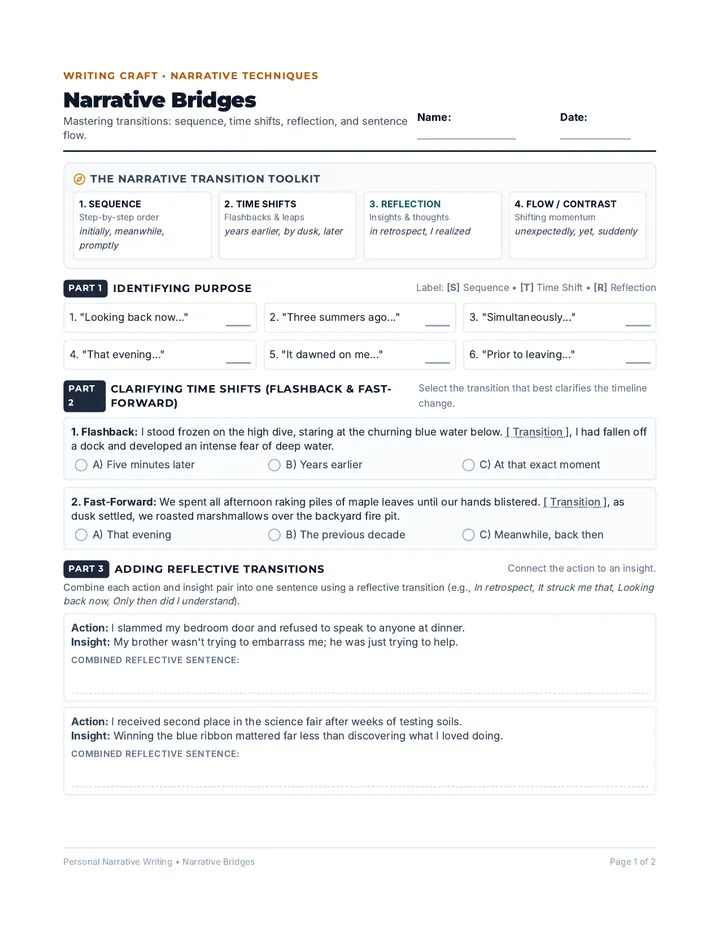
Narrative Bridges WorksheetWriting Craft • Narrative Techniques Narrative Bridges Mastering transitions: sequence, time shifts, reflection, and sentence flow. Name: Date: The Narrative Transition Toolkit 1. Sequence Step-by-step order initially, meanwhile, promptly 2. Time Shifts Flashbacks & leaps years earlier, by dusk, later 3. Reflection Insights & thoughts in retrospect, I realized 4. Flow / Contrast Shifting momentum unexpectedly, yet, suddenly Part 1 Identifying Purpose Label: [S] Sequence • [T] Time Shift • [R] Reflection 1. "Looking back now..." 2. "Three summers ago..." 3. "Simultaneously..." 4. "That evening..." 5. "It dawned on me..." 6. "Prior to leaving..." Part 2 Clarifying Time Shifts (Flashback & Fast-Forward) Select the transition that best clarifies the timeline change. 1. Flashback: I stood frozen on the high dive, staring at the churning blue water below. [ Transition ], I had fallen off a dock and developed an intense fear of deep water. A) Five minutes later B) Years earlier C) At that exact moment 2. Fast-Forward: We spent all afternoon raking piles of maple leaves until our hands blistered. [ Transition ], as dusk settled, we roasted marshmallows over the backyard fire pit. A) That evening B) The previous decade C) Meanwhile, back then Part 3 Adding Reflective Transitions Connect the action to an insight. Combine each action and insight pair into one sentence using a reflective transition (e.g., In retrospect, It struck me that, Looking back now, Only then did I understand). Action: I slammed my bedroom door and refused to speak to anyone at dinner. Insight: My brother wasn't trying to embarrass me; he was just trying to help. Combined reflective sentence: Action: I received second place in the science fair after weeks of testing soils. Insight: Winning the blue ribbon mattered far less than discovering what I loved doing. Combined reflective sentence: Personal Narrative Writing • Narrative Bridges Page 1 of 2 Narrative Bridges • Page 2 Revision for Flow & Application Student Name: Part 4 Revise for Flow: Escaping the "And Then..." Trap Eliminate repetitive sequence words. The excerpt below relies heavily on repetitive "then" phrasing. Rewrite it into a smooth narrative paragraph using varied sequence words, a time shift, and improved sentence variety. Weak Draft (Choppy & Repetitive): "We packed the car at sunrise. Then we drove for six hours straight. Then my dad missed the exit to the campsite. And then it started pouring rain. After that, we had to set up our tent in the mud in total darkness. Then I realized I forgot my sleeping bag." Your Revised Narrative Paragraph (Vary openings and connect events smoothly): Part 5 Write Your Own Narrative Scene Apply all four transition skills in context. Write a short personal narrative excerpt (4–6 sentences) about a memorable surprise, mistake, or accomplishment. Include the three required transition types below: ✓ Sequence Word Smoothly orders events ✓ Time Shift Jump forward or back ✓ Reflective Pivot Shares a realization Narrative Transition Self-Audit Sequence Transition used: Time Shift phrase used: Reflective phrase used: Personal Narrative Writing • Narrative Bridges Page 2 of 2
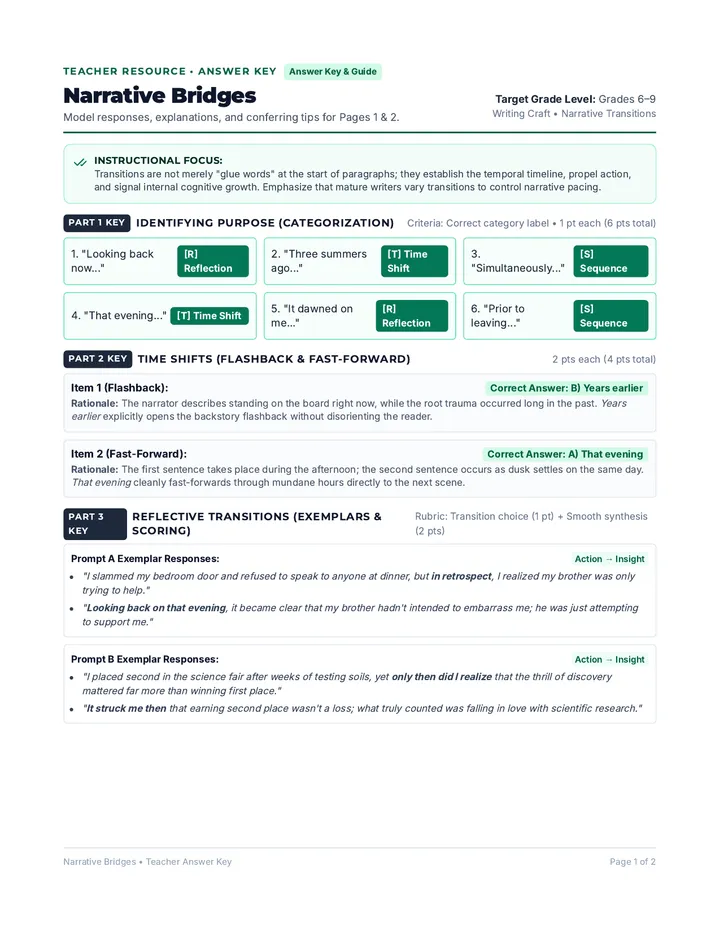
Narrative Bridges Answer KeyTeacher Resource • Answer Key Answer Key & Guide Narrative Bridges Model responses, explanations, and conferring tips for Pages 1 & 2. Target Grade Level: Grades 6–9 Writing Craft • Narrative Transitions Instructional Focus: Transitions are not merely "glue words" at the start of paragraphs; they establish the temporal timeline, propel action, and signal internal cognitive growth. Emphasize that mature writers vary transitions to control narrative pacing. Part 1 Key Identifying Purpose (Categorization) Criteria: Correct category label • 1 pt each (6 pts total) 1. "Looking back now..." [R] Reflection 2. "Three summers ago..." [T] Time Shift 3. "Simultaneously..." [S] Sequence 4. "That evening..." [T] Time Shift 5. "It dawned on me..." [R] Reflection 6. "Prior to leaving..." [S] Sequence Part 2 Key Time Shifts (Flashback & Fast-Forward) 2 pts each (4 pts total) Item 1 (Flashback): Correct Answer: B) Years earlier Rationale: The narrator describes standing on the board right now, while the root trauma occurred long in the past. Years earlier explicitly opens the backstory flashback without disorienting the reader. Item 2 (Fast-Forward): Correct Answer: A) That evening Rationale: The first sentence takes place during the afternoon; the second sentence occurs as dusk settles on the same day. That evening cleanly fast-forwards through mundane hours directly to the next scene. Part 3 Key Reflective Transitions (Exemplars & Scoring) Rubric: Transition choice (1 pt) + Smooth synthesis (2 pts) Prompt A Exemplar Responses: Action → Insight "I slammed my bedroom door and refused to speak to anyone at dinner, but in retrospect, I realized my brother was only trying to help." "Looking back on that evening, it became clear that my brother hadn't intended to embarrass me; he was just attempting to support me." Prompt B Exemplar Responses: Action → Insight "I placed second in the science fair after weeks of testing soils, yet only then did I realize that the thrill of discovery mattered far more than winning first place." "It struck me then that earning second place wasn't a loss; what truly counted was falling in love with scientific research." Narrative Bridges • Teacher Answer Key Page 1 of 2 Teacher Answer Key • Page 2 Revision Exemplars & Evaluation Rubric Total Points: 25 Points Part 4 Key The "And Then..." Rescue (Revision Models) Worth: 5 pts (Variety, sentence rhythm, clarity) Students must eliminate the robotic repetition of "then" by combining clauses with participial phrases, prepositional time markers, and varied sentence openers. Exemplar Model A (Pacing with Complex Sentences): "After packing the car at sunrise, we embarked on a grueling six-hour drive. Disaster struck when my dad took a wrong turn off the highway, just as dark rainclouds broke overhead. By the time we arrived, we had no choice but to pitch our tent in pitch-black mud. Only after crawling inside did I make a horrifying discovery: my sleeping bag was still sitting on my bedroom floor." • Uses prepositional starter ("After packing...") • Time shift ("By the time...") • Reflective pivot ("Only after...") Exemplar Model B (Action-Oriented Flow): "We hit the road at dawn for what was supposed to be a straightforward six-hour drive. Unfortunately, Dad missed the campsite exit just before a sudden downpour drenched the mountain. Without daylight or shelter, we struggled to secure the stakes in the freezing mud. It wasn't until everything was unpacked that I realized I had left my sleeping bag behind." Part 5 Key Original Narrative Scene Evaluation Worth: 10 pts (3 pts transitions + 4 pts flow + 3 pts self-audit) Annotated High-Scoring Benchmark Passage: "My knees knocked together as I stepped onto the auditorium stage. Initially [Sequence], my voice was a barely audible squeak. Two months earlier [Time Shift], I would have fled into the hallway in tears. Instead, I took a deep breath, found my mom in the third row, and delivered my speech with conviction. Looking back now [Reflection], I see that true bravery isn't never feeling terrified; it is choosing to speak anyway." Skill Domain Exemplary (4–3 pts) Developing (2–1 pts) Transition Integration Includes sequence, time shift, and reflection naturally; avoids formulaic sentence starts. Missing one transition type, or transitions feel forced and disconnected from narrative. Temporal Clarity Time leaps (flashback or fast-forward) are unmistakable and orient the reader immediately. Timeline jumps abruptly; reader is confused about when events occurred. Rhythm & Flow Sentences vary in length and structure; zero repetitive "and then" structures. Multiple sentences start with the same sequence words; repetitive cadence. Quick Conferring Prompts: If stuck on reflection: Ask, "What do you understand about that situation now as an older narrator that you couldn't understand right then?" If stuck on time shifts: Ask, "Did something in your past cause you to feel that way? Let's take the reader back there for one sentence." Narrative Bridges • Teacher Answer Key Page 2 of 2
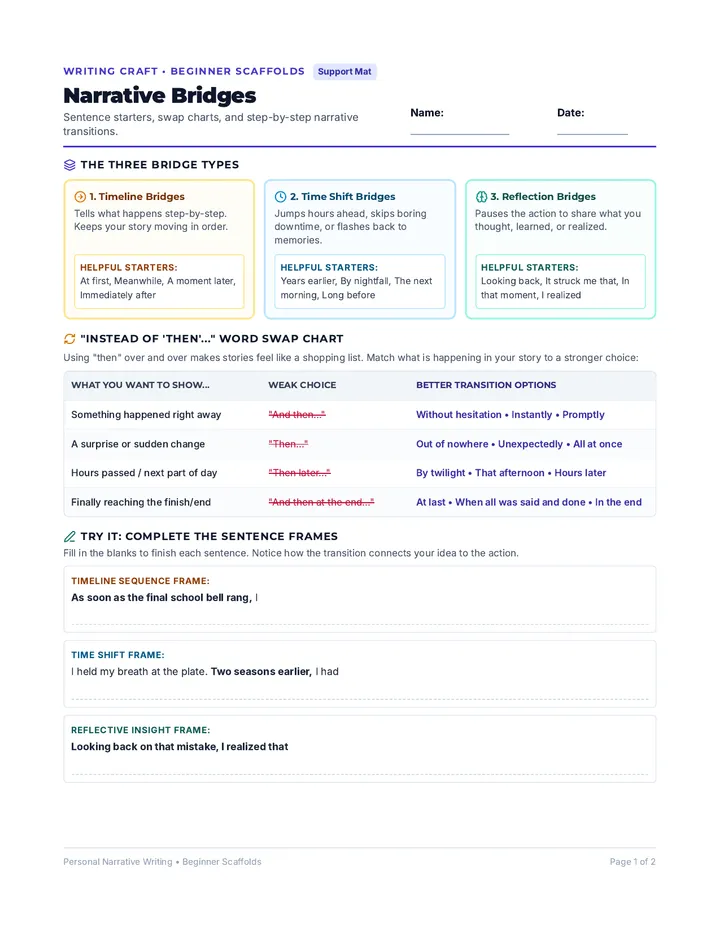
Narrative Bridges Scaffold HandoutWriting Craft • Beginner Scaffolds Support Mat Narrative Bridges Sentence starters, swap charts, and step-by-step narrative transitions. Name: Date: The Three Bridge Types 1. Timeline Bridges Tells what happens step-by-step. Keeps your story moving in order. Helpful Starters: At first, Meanwhile, A moment later, Immediately after 2. Time Shift Bridges Jumps hours ahead, skips boring downtime, or flashes back to memories. Helpful Starters: Years earlier, By nightfall, The next morning, Long before 3. Reflection Bridges Pauses the action to share what you thought, learned, or realized. Helpful Starters: Looking back, It struck me that, In that moment, I realized "Instead of 'Then'..." Word Swap Chart Using "then" over and over makes stories feel like a shopping list. Match what is happening in your story to a stronger choice: What you want to show... Weak Choice Better Transition Options Something happened right away "And then..." Without hesitation • Instantly • Promptly A surprise or sudden change "Then..." Out of nowhere • Unexpectedly • All at once Hours passed / next part of day "Then later..." By twilight • That afternoon • Hours later Finally reaching the finish/end "And then at the end..." At last • When all was said and done • In the end Try It: Complete the Sentence Frames Fill in the blanks to finish each sentence. Notice how the transition connects your idea to the action. Timeline Sequence Frame: As soon as the final school bell rang, I Time Shift Frame: I held my breath at the plate. Two seasons earlier, I had Reflective Insight Frame: Looking back on that mistake, I realized that Personal Narrative Writing • Beginner Scaffolds Page 1 of 2 Narrative Bridges • Scaffold Practice Guided Cloze & Sentence Builder Student Name: Part A: Guided Narrative Fill-In Read the short story below. Choose the most fitting transition from the Word Bank to fill in each numbered line. Word Bank Options (Use each once): [A] Without warning [B] Months earlier [C] In that moment, I saw [D] By the time we finished My hands shook as I opened my art folder in front of the whole class. 1. _______________, I had accidentally spilled black ink across my entire canvas and wanted to quit painting forever. I held my breath and lifted my redesigned piece toward the window. 2. _______________, the room erupted in loud clapping. 3. _______________ answering questions, my face was bright red with pride. 4. _______________ that mistakes aren't ruined work—they are just surprising beginnings. Part B: The 3-Step Bridge Builder Build a mini 3-sentence story using the structured prompts below. Write one clear sentence for each step. Step 1: Set the Opening Action Starter: "It all started when..." or "Early on Saturday..." Step 2: Add a Time Shift or Surprise Starter: "Without warning..." or "A few hours later..." Step 3: End with a Reflective Realization Starter: "Looking back, I learned..." or "Only then did I understand..." My Transition Check I avoided repeating "then" I showed when things happened I shared what I learned/realized Personal Narrative Writing • Beginner Scaffolds Page 2 of 2