Lenny.com
Explore
Create
ActivitiesNewMathEnglish Language ArtsScience & EngineeringSocial StudiesGlobal LanguagesHealth & Physical EducationSpecial EducationCounseling & Life SkillsArts & CreativityESL
Lenny.com
Lenny.com
Explore
Create
ActivitiesNewMathEnglish Language ArtsScience & EngineeringSocial StudiesGlobal LanguagesHealth & Physical EducationSpecial EducationCounseling & Life SkillsArts & CreativityESL
Lenny.com
Lenny.com

Solutions

Lenny for EducatorsLenny for SchoolsLenny for Districts

Product

ExploreSign inCreateSupportAbout

Resources

Getting startedMTSS Acceleration Program

Newsletters

School Funding Newsletter

© 2026 Lenny Learning Inc.

TermsPrivacyAccessibility
LinkedInInstagramX
Lenny
English Language ArtsPhonics & Reading FoundationsLetter IdentificationLearn Letters A-ZLowercase and Uppercase LettersConsonants and VowelsLetter-Sound AssociationsLetter-Sound Associations: LowercaseLetter-Sound Associations: UppercaseBeginning and Ending SoundsRhymingBlending And SegmentingShort VowelsShort Vowel SoundsConsonant BlendsConsonant DigraphsBlends, Digraphs, and TrigraphsDigraphs, Blends, and Silent LettersLong Vowel SoundsLong Vowel PatternsShort and Long VowelsShort and Long Vowel PatternsSilent EVowel SoundsVowel TeamsR-Controlled VowelsDiphthongs: Oi, Oy, Ou, OwVariant VowelsVariant, Diphthong, And R Vowel PatternsSoft G And CSight WordsIrregular WordsWord RecognitionSyllablesSyllable TypesTwo-Syllable WordsMultisyllabic WordsPhoneme ManipulationDecodable TextsVocabularyAction WordsQuestion WordsNouns and AdjectivesClassify WordsCompound WordsSynonyms and AntonymsHomophonesHomophones and HomonymsShades of MeaningContext CluesPrefixes and SuffixesGreek and Latin RootsAnalogiesIdioms and AdagesForeign Words and ExpressionsWord Choice and UsageReference SkillsReading ComprehensionRead-Along Literary TextsRead-Along Informational TextsReality vs. FictionStory ElementsCharacterSequenceMain IdeaCause And EffectCompare And ContrastReading StrategiesText StructureAuthor's PurposeAuthor's Purpose And ToneAuthor's PerspectivePoint Of ViewThemeInference And ThemeInference And AnalysisPoetry ElementsLiterary DevicesAnalyzing LiteratureAnalyzing Informational TextsComparing TextsAudience, Purpose, And ToneBusiness DocumentsNovel StudyNonfiction Book StudyGrammar & MechanicsSentencesNounsVerbsAdjectivesPronounsCapitalizationPunctuationContractionsConjunctionsPrepositionsArticlesAdjectives And AdverbsVerb TypesVerb TensePronouns And AntecedentsPronoun TypesSubject-Verb AgreementDirect And Indirect ObjectsSentences, Fragments, And Run-OnsPhrases And ClausesCommasSemicolons, Colons, And CommasDashes, Hyphens, And EllipsesSpellingAbbreviationsFormattingVerb Tense And MoodMisplaced ModifiersWritingDescriptive DetailsCreative WritingOpinion WritingTopic SentencesOrganizing WritingLinking WordsSentence VarietyIntroductions And ConclusionsPersuasive And Opinion WritingExpository WritingPersuasive StrategiesDeveloping And Supporting ArgumentsTopic Sentences And Thesis StatementsSummarizingResearch SkillsEditing And RevisingActive And Passive Voice=Writing Clearly And ConciselyDebate & Public SpeakingPublic Speaking BasicsPersuasive TechniquesClaims and EvidenceTypes of ArgumentsReasoning TypesLogical FallaciesTopic ResearchOrganizing EvidenceDebate Speech OrganizationAttacking and Defending ArgumentsClash and EngagementImpact CalculusQuestioning and Cross-ExaminationCritical ThinkingInformal LogicFormal LogicInductive Reasoning

Literacy Station Quest

A comprehensive 5th grade beginning-of-year literacy station rotation package featuring scaffolded independent stations, an informational text close read, syllable division work, morphology practice, and a weekly station menu.

CConstantina

Literacy Station Quest

A comprehensive 5th grade beginning-of-year literacy station rotation package featuring scaffolded independent stations, an informational text close read, syllable division work, morphology practice, and a weekly station menu.

CConstantina

t u l i p Word 2

Try: "TOO-lip" or "TULL-ip"?

First syllable is: [ OPEN • CLOSED ]

r o b i n Word 3

Try: "ROE-bin" or "ROB-in"?

First syllable is: [ OPEN • CLOSED ]

f o c u s Word 4

Try: "FOE-kus" or "FOCK-us"?

First syllable is: [ OPEN • CLOSED ]

Part C • Mini Science Text: Desert Hunters

4 VCV Words in Action

In the hot desert, a tiny spider sits inside a shaded rock. The air is completely silent under the blazing solar rays. When prey moves, the spider makes a rapid attack before returning to its cool shelter.

Part D • Detective Sentence Builder

Write your sentence on the spaced lines

Sentence 1 (Use an OPEN syllable word like silent, solar, climate):

Sentence 2 (Use a CLOSED first syllable word like planet, solid, rapid):

Station 1 Finished! Check your Station Menu. Page 2 of 2

B. To inform how animal traits inspire inventions.

C. To persuade kids to stop riding trains.

Prove your answer: Use this sentence frame to cite text evidence: "I know the purpose is to ________ because the text shows ________."

2 Evaluating Supporting Details

Read each detail from the passage. Rate its evidence value:

Detail A: "Japan's engineers remodeled train noses to match the kingfisher's beak, making them silent and fast."

Strong Supporting Detail Minor Extra Fact

Detail B: "An engineer who redesigned the train loved birdwatching on the weekends."

Strong Supporting Detail Minor Extra Fact

Detail C: "Microscopic gecko toe hairs inspired tape that sticks in space without any messy glue."

Strong Supporting Detail Minor Extra Fact

3 Detective Explanation (Write on the spaced lines)

Use text evidence

Question: Which animal adaptation (the gecko's hairs OR the kingfisher's beak) is the most powerful example of biomimicry? Explain why using evidence from the text.

Sentence Starter: "In my opinion, the ________ is the most powerful example because ________."

✓ Station 2 Finished! Check your station menu box. Page 2 of 2

RECONSTRUCT

Prefix: re- (again)
Base: construct (to build)
Meaning together:  

Word: PROTECTIVE

Base: protect (to guard)
Suffix: -ive (tending to)
Meaning together:  

Part E • Author's Science Sentences (Spaced Handwriting Lines)

Pick 1 word family • Write 2 sentences using different family members

My Chosen Family: STRUCT family PROTECT family

Sentence 1 (Use the base word or one family member):

Sentence 2 (Use a DIFFERENT word from the same family to explain your idea):

✓ Station 3 Finished! Mark your Station Quest tracker. Page 2 of 2

Part 2: Evaluating Supporting Details Table

Detail A (Train Noses):
✓ STRONG Supporting Detail
Directly proves real-world engineering result.

Detail B (Weekend Birdwatching):
✓ Minor Extra Fact
Interesting personal detail, but not proof.

Detail C (Microscopic Gecko Hairs):
✓ STRONG Supporting Detail
Explains the scientific mechanism of adhesion.

Part 3 Explanation Rubric: Full credit requires naming one animal, stating the invention it inspired, and connecting it to solving a real human problem (e.g., sticking tape in space or quieting loud trains).

3

Station 3 Key: Word Family Lab

Morphology & Related Words

Page 1 Family Solutions:

  • STRUCT 1: structure
  • STRUCT 2: construct
  • STRUCT 3: destruction
  • PROTECT 1: protective
  • PROTECT 2: protection
  • PROTECT 3: unprotected

Page 2 Context & Equations:

  • Context 1: construct (verb)
  • Context 2: unprotected (adjective)
  • Context 3: naturalist (noun/person)
  • Deconstruct: reconstruct = to build again; protective = tending to guard or keep safe.

Scaffolding Menu for Struggling Learners Supports Independence Without Lowering Rigor

Visual Highlighting: Give students yellow and blue highlighters. Yellow for vowels (Station 1), blue for key evidence sentences (Station 2).

Sentence Strips: Pre-write sentence frame starters on laminated desktop strips for students who need extra writing guidance.

Peer Accountability: Pair struggling readers with an on-level buddy for soft choral reading before working on handwriting lines independently.

Literacy Station Quest • Complete Teacher Facilitation Package Page 2 of 2
You might also like

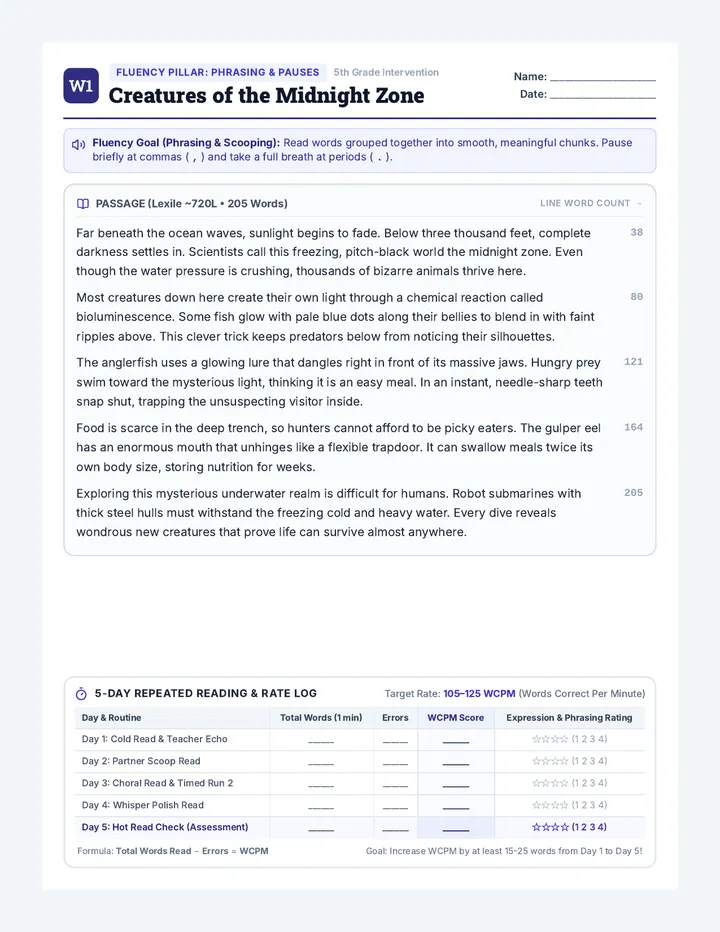
Ocean Abyss Fluency Passage

Fluency Flight Academy

A comprehensive four-week reading fluency intervention sequence designed for fifth-grade students needing targeted support in accuracy, pacing, expression, and comprehension. Each week focuses on an essential fluency pillar paired with high-interest non-fiction passages, structured daily practice routines, and progress-monitoring running records.

KM

Kelly Messer

10
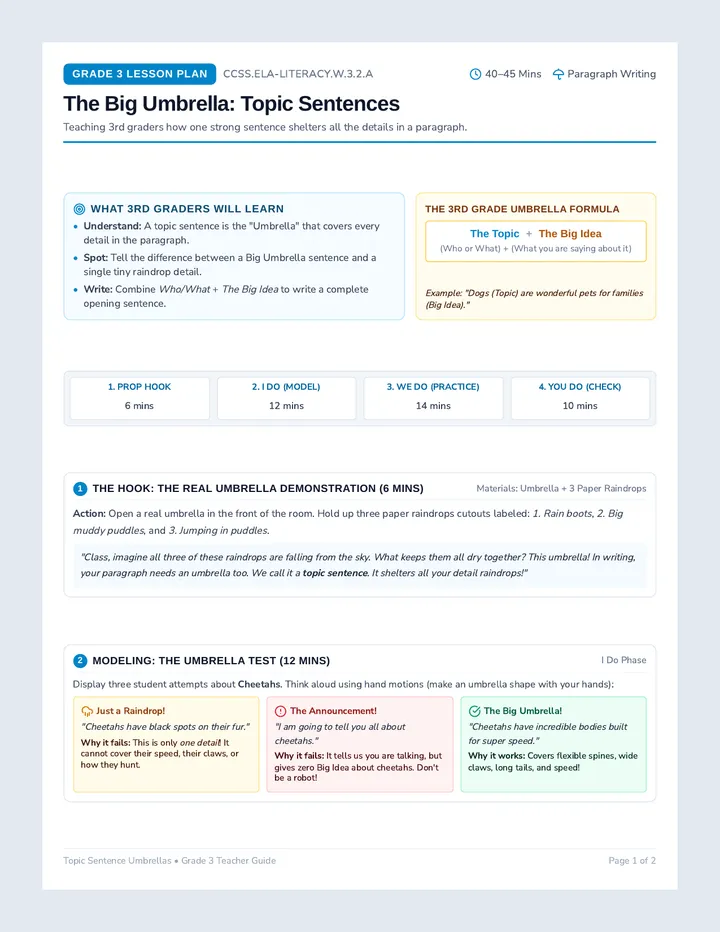
Topic Sentence Lesson Plan

Topic Sentence Umbrellas

A 3rd-grade targeted writing lesson introducing topic sentences through the engaging 'Umbrella' metaphor. Students learn to combine a clear topic with a main idea, spot too-small detail sentences, and write strong paragraph openers.

SW

Suzanne Wolski

3
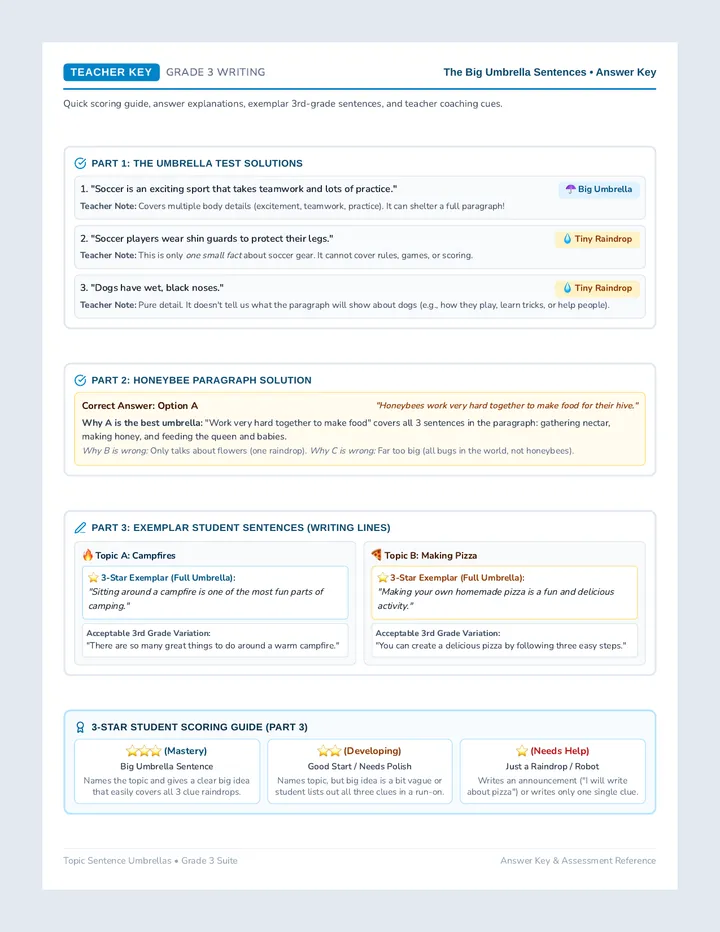
Topic Sentence Answer Key

Topic Sentence Answer Key

A Grade 3 teacher answer key and assessment guide featuring answers for the umbrella test, paragraph selection rationale, exemplar student sentences for campfires and pizza, and a friendly 3-star scoring rubric.

SW

Suzanne Wolski

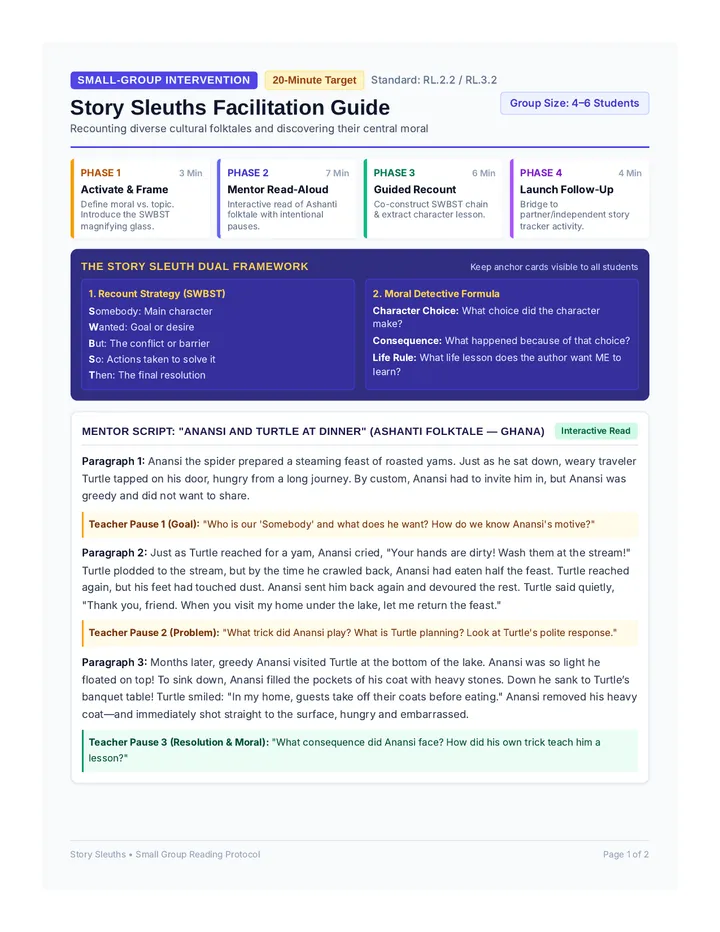
Story Sleuths Facilitation Guide

Story Explorers

An interactive, high-impact reading comprehension unit targeting core foundational literature standards. Students master recounting diverse folktales, extracting central morals, and analyzing how characters respond to major events and challenges.

S

Squiretak

8
Sonic Verse Slides

Sonic Verse

A high-energy 7th-grade ELAR lesson exploring poetic sound devices including alliteration, consonance, assonance, onomatopoeia, and rhyme variations. Students examine auditory textures in verse, dissect classic and modern mentor lines, and craft their own sound-driven poetry.

C

callawayj

3
Topic Sentence Builder Worksheet

Topic Sentence Builder Worksheet

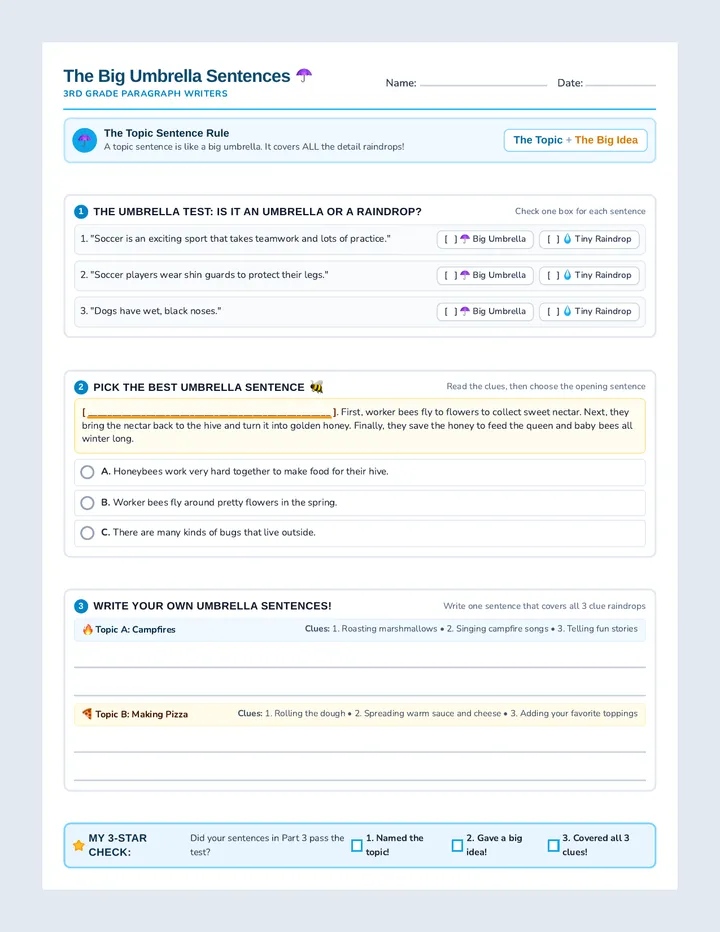
A Grade 3 printable student practice worksheet featuring the Big Umbrella metaphor, identifying umbrella vs. raindrop sentences, choosing the best topic sentence for a honeybee paragraph, and writing original umbrella sentences with generous writing lines.

SW

Suzanne Wolski

Lemonade Verbs Slides

Reading Writing Workshop

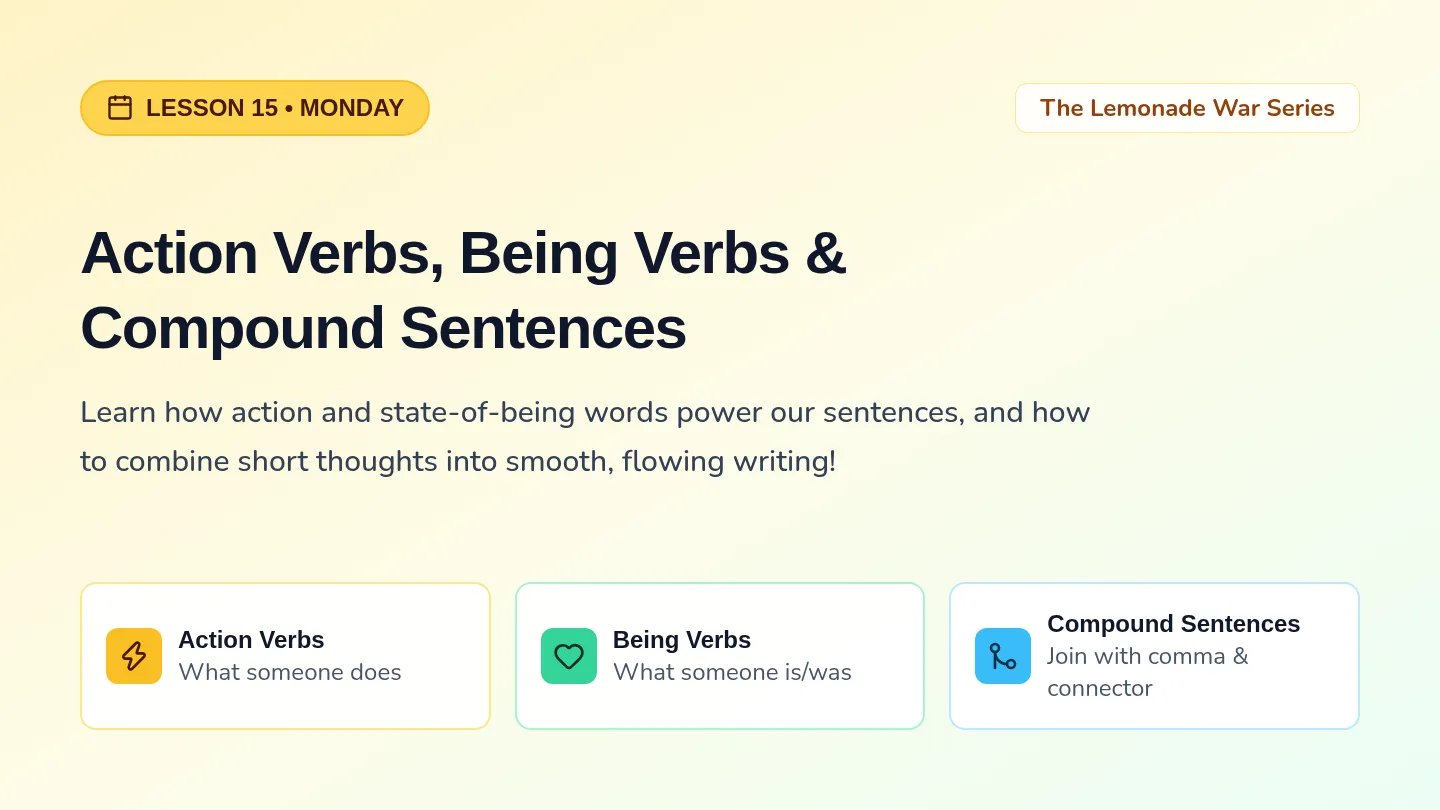
An engaging elementary English Language Arts unit connecting grammar mechanics, mentor texts, vocabulary, and sensory descriptive writing.

B

Bhoovaragavaswamym

8
Usher Response Prompts Handout

House of Usher Analysis

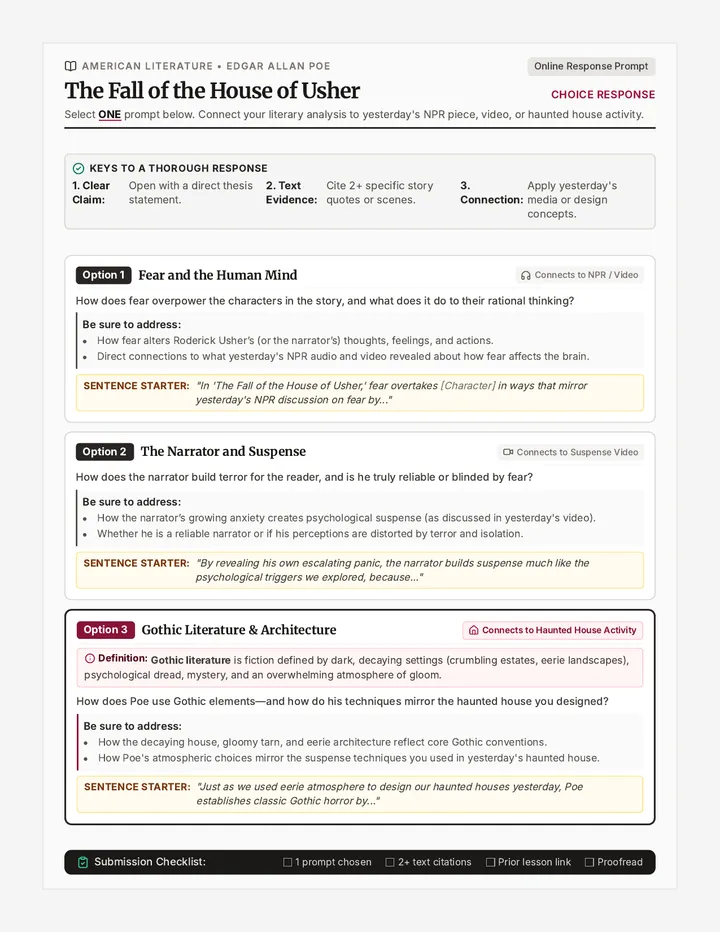
A high school English Language Arts lesson examining fear, unreliable narration, and Gothic conventions in Edgar Allan Poe's classic short story 'The Fall of the House of Usher'. Students synthesize psychological concepts, media analysis, and creative architecture into a text-based analytical response.

AC

Alison Crabtree

2
Topic Sentence Lesson Plan

Topic Sentence Lesson Plan

A 2-page Grade 3 teacher lesson plan using the Big Umbrella metaphor to teach topic sentences, featuring explicit modeling with physical props, guided partner practice, common elementary writing misconceptions, and a 3-minute quick check.

SW

Suzanne Wolski

Paw Print Teacher Guide

Vowel Team Aw Pathways

A comprehensive structured literacy sequence targeting the vowel team 'aw', offering dual instructional pathways using both the Classic Orton-Gillingham 7-step routine and the 10-part Wilson Reading System (WRS) framework.

KW

Kellie Walsh

10
Mythic Seasons Lesson Plan

3- Mythic Seasons

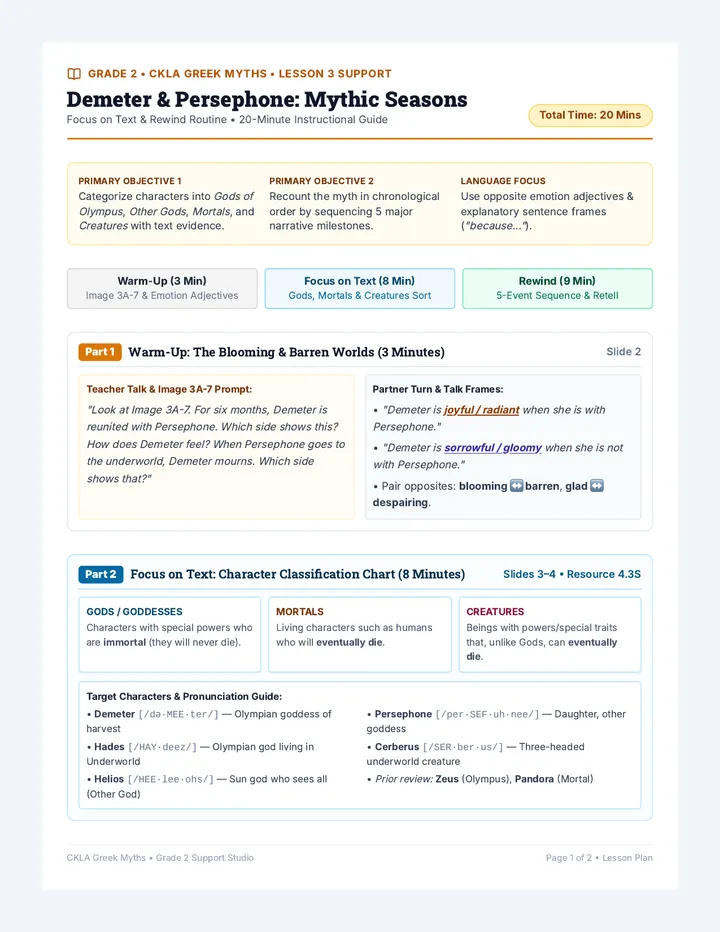
A targeted 20-minute Grade 2 Core Knowledge Language Arts lesson exploring the Greek myth of Demeter and Persephone through character categorization (gods, mortals, creatures) and chronological event sequencing.

R

Rebecca.Holland

5
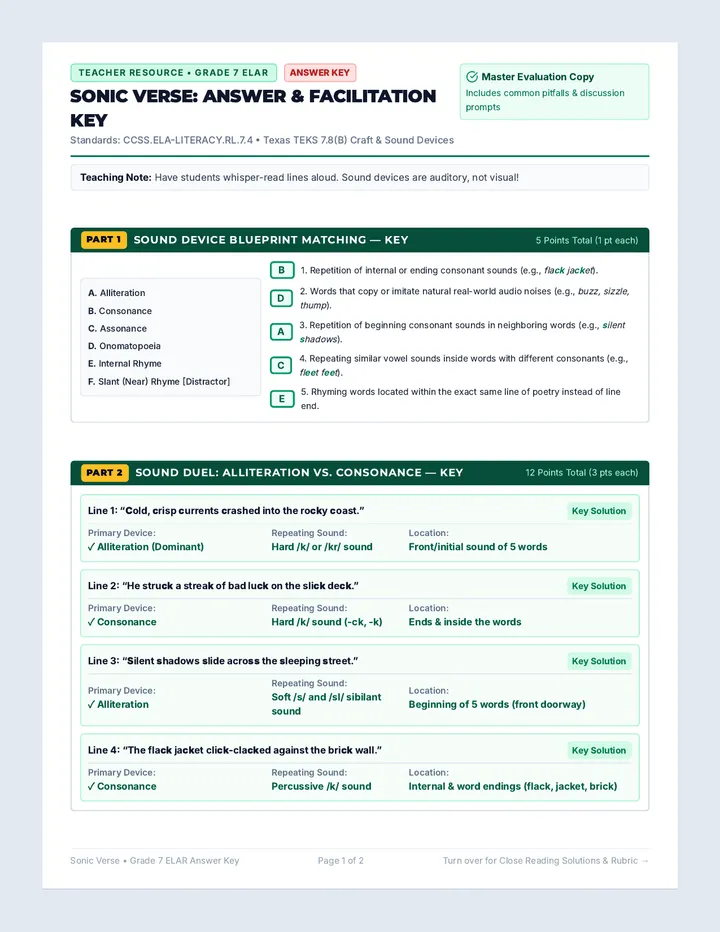
Sonic Verse Answer Key

Sonic Verse Answer Key

A 2-page teacher answer key and scoring guide providing complete solutions, exemplar responses, misconception alerts, and rubric criteria for the Sonic Verse Worksheet.

C

callawayj