Latin America TSIA2 Slides
TSIA2 ELAR Review Reading • Revising • Editing
World Geography Passage
Passage-Based Masterclass
Latin America Physical Geography
10 authentic TSIA2-style questions with detailed answer keys, grammatical rationales, and high-impact test-taking hints.
R
Questions 1–4
Reading Comprehension
REV
Questions 5–7
Revising for Clarity
ED
Questions 8–10
Editing Conventions
Question 1 TSIA2 Domain: Reading Comprehension
Focus: Central Idea
Which statement best expresses the central idea of the entire passage?
A
The Amazon River and Andes Mountains make South America the most hazardous region in the Western Hemisphere.
B
Latin America features diverse physical geography, including mountains, plains, major rivers, and altitude-driven climates.
C
Agricultural production in Latin America is confined to low-elevation crops like sugarcane and cacao beans.
D
The Caribbean islands formed solely through volcanic eruptions that severed Central America from South America.
Identify the choice that encompasses all major sections rather than a single supporting detail.
Answer & Analysis Question 1 • Central Idea
Correct Choice: B
Why Option B Is Correct
The passage systematically surveys Latin America's landforms (mountains and plains), water systems (rivers, Lake Titicaca, Angel Falls), and diverse climates shaped by elevation and rainforests. Option B accurately summarizes the entire scope of the text.
Distractor Breakdown
- A: Too narrow and unsupported; the text highlights physical scale, not danger.
- C: Factually inaccurate; higher elevations produce coffee, corn, and wheat.
- D: Misinterprets paragraph 2 and invents a false claim about severing landmasses.
TSIA2 Strategy Hint: The "Umbrella" Test
A central idea choice must act like an umbrella that shelters every paragraph. If an option only covers one paragraph or introduces extreme language ("confined," "solely"), eliminate it!
TSIA2 Prep • Reading Skills
Question 2 TSIA2 Domain: Reading Comprehension
Focus: Vocabulary in Context
Passage Context (Paragraph 4):
"Angel Falls can be found in Venezuela. It is the world’s tallest uninterrupted waterfall, dropping nearly 2/3 of a mile down a rocky cliff in Canaima National Park."
As used in this sentence, the word "uninterrupted" most nearly means:
A
Flowing with pure, drinkable water all year long without pollution
B
Plunging continuously in a single sheer drop without hitting intermediate ledges
C
Remaining completely unaffected by dry weather seasons or regional droughts
D
Accessible for continuous boat travel and commercial navigation
Look at the prefix "un-" (not) and the root "interrupt" (broken up), paired with "dropping nearly 2/3 of a mile down a rocky cliff."
Answer & Analysis Question 2 • Context Clues
Correct Choice: B
Why Option B Is Correct
The text specifies that the waterfall drops "nearly 2/3 of a mile down a rocky cliff." In geology and water geography, an uninterrupted waterfall drops in one unbroken vertical plunge rather than cascading across multiple staggered tiers or steps.
Distractor Breakdown
- A & C: Describe water purity or seasonal flow volume, which have nothing to do with physical unbroken descent.
- D: Confuses Angel Falls with Lake Titicaca, which the passage earlier describes as navigable by boat.
TSIA2 Strategy Hint: Substitution Method
Replace the target word with your own definition in the sentence. "Dropping nearly 2/3 of a mile down a cliff without breaking or stopping" perfectly matches Choice B!
TSIA2 Prep • Vocabulary in Context
Question 3 TSIA2 Domain: Reading Comprehension
Focus: Inference & Synthesis
Based on the "Climate and Vegetation" section, what can the reader reasonably infer about the relationship between physical geography and agriculture in Latin America?
A
Farmers cultivate identical crops across the region because tropical temperatures remain uniform regardless of terrain.
B
As elevation increases, temperatures cool, creating distinct vertical agricultural zones suited for specific crops.
C
High-altitude mountain peaks are the most fertile zones for growing heat-dependent crops such as sugarcane and cacao.
D
Freezing conditions at high altitudes make agricultural production entirely impossible across Latin America.
Review paragraph 5: how do low elevations differ from higher elevations in crops and temperature?
Answer & Analysis Question 3 • Inference
Correct Choice: B
Why Option B Is Correct
The passage states: "Elevation, however, affects climates... Land at low elevations is hot and humid [sugarcane, bananas, cacao]... At higher elevations, climate becomes milder and temperatures cooler [coffee, corn, wheat]." This directly supports the concept of elevation-tiered agriculture.
Distractor Breakdown
- A: Directly contradicts the text ("variety of climates," "Elevation affects climates").
- C: Reverses the facts; sugarcane and cacao grow in hot lowlands, not high mountains.
- D: Overstates the claim; high elevations grow coffee, corn, and wheat before reaching snow lines.
TSIA2 Strategy Hint: Watch for Extreme Words
Words like "identical," "entirely impossible," and "most fertile" are red flags on reading questions. TSIA2 correct answers often use measured, balanced language like "suited for specific crops."
TSIA2 Prep • Text Evidence & Inference
Question 4 TSIA2 Domain: Reading Comprehension
Focus: Author's Purpose & Text Details
Why does the author include the detail that Lake Titicaca "sits at an elevation of more than 12,000 feet" and "can still be used for boat travel"?
A
To highlight the remarkable and unusual physical setting of this navigable freshwater lake
B
To explain why water levels in the Amazon River basin remain remarkably consistent
C
To demonstrate that high altitudes prevent humans from conducting trade and travel
D
To argue that Lake Titicaca is the primary source of water for Venezuela's Angel Falls
Notice the author's exclamation mark ("more than 12,000 feet!") indicating wonder at its height and usability.
Answer & Analysis Question 4 • Author's Purpose
Correct Choice: A
Why Option A Is Correct
The author introduces Lake Titicaca as "the highest lake in the world that can still be used for boat travel" and emphasizes its 40+ islands and 12,000-foot altitude with an exclamation mark. The author's clear purpose is to showcase this extraordinary geographic record.
Distractor Breakdown
- B & D: Create unsubstantiated geographic connections between Lake Titicaca, the Amazon basin, and Angel Falls.
- C: Stems from the opposite idea; the text proves boat travel IS possible even at 12,000 feet.
TSIA2 Strategy Hint: Connect Author Tone to Purpose
Pay close attention to superlatives ("highest," "tallest," "longest") and punctuation. They reveal when an author intends to emphasize uniqueness or extreme natural features.
TSIA2 Prep • Author's Craft & Purpose
Question 5 TSIA2 Domain: Revising for Clarity & Structure
Focus: Sentence Combining
Original Sentences (Paragraph 1):
"The Isthmus of Panama connects Central America to South America. An isthmus is a narrow strip of land that links two larger landmasses."
Which is the most effective way to combine these sentences into a single, concise sentence without changing the meaning?
A
The Isthmus of Panama connects Central America to South America, and an isthmus is a narrow strip of land linking two larger landmasses.
B
Connecting Central America to South America, an isthmus is a narrow strip of land that is formally called the Isthmus of Panama.
C
The Isthmus of Panama, a narrow strip of land linking two larger landmasses, connects Central America to South America.
D
Because an isthmus links two larger landmasses, Central America and South America are thus connected by the Isthmus of Panama.
Look for an appositive phrase that embeds the definition smoothly without unnecessary words.
Answer & Analysis Question 5 • Sentence Combining
Correct Choice: C
Why Option C Is Correct
Option C turns the definition into a concise appositive phrase ("a narrow strip of land linking two larger landmasses") set off by commas. It eliminates the repetitive noun "an isthmus" and maintains the clear subject-verb structure of the main clause.
Distractor Breakdown
- A: Repetitive and clumsy; uses a weak coordinating conjunction without reducing wordiness.
- B: Creates a misplaced modifier implying all isthmuses connect Central and South America.
- D: Faulty cause-and-effect ("because... thus"); overly wordy and stiff.
TSIA2 Strategy Hint: The Power of Appositives
When two sentences share a noun and one sentence merely defines that noun, TSIA2 revising questions frequently favor an appositive reduction: [Noun], [Definition], [Verb + Rest].
TSIA2 Prep • Sentence Combining
Question 6 TSIA2 Domain: Revising for Clarity & Structure
Focus: Transitional Cohesion
Text Context: Transition between Paragraph 2 & 3
[Mountains section ending: "...earthquakes are common in these mountainous areas."]
[Plains section beginning: "Vast plains cover other areas of Latin America. You will find plains along the coasts..."]
The writer wants to add a transitional sentence at the start of the Plains section. Which choice best links the discussion of mountains to the discussion of plains?
A
In sharp contrast to these rugged highlands, expansive flatlands also define large portions of the Latin American landscape.
B
Furthermore, high mountain chains are far more majestic than any boring grasslands located in Argentina.
C
For example, plains are completely flat and consequently never experience volcanic activity or tectonic changes.
D
As a direct result of mountain formation, millions of residents had to relocate from the coast to the llanos.
What logical relationship exists between high, rugged mountains and broad, flat plains? (Contrast!)
Answer & Analysis Question 6 • Transitions
Correct Choice: A
Why Option A Is Correct
The previous paragraph focused on elevated volcanic chains and mountains. The upcoming paragraph discusses vast grasslands and coastal flatlands. Option A creates a smooth, logical contrast bridge ("In sharp contrast to these rugged highlands... expansive flatlands").
Distractor Breakdown
- B: Introduces an inappropriate subjective opinion ("far more majestic," "boring") inconsistent with informative text.
- C: "For example" is the wrong relationship; plains are not an example of mountains.
- D: Fabricates historical cause-and-effect information absent from the text.
TSIA2 Strategy Hint: Check the Logical Bridge
Good transitions do two things simultaneously: they refer back to the preceding idea ("rugged highlands") and lead forward into the next topic ("expansive flatlands"). Look for dual-action bridges!
TSIA2 Prep • Transitional Cohesion
Question 7 TSIA2 Domain: Revising for Clarity & Structure
Focus: Sentence Precision & Variety
Original Excerpt (Paragraph 6):
"Rain forests cover the lowland areas of Latin America. They are rainy and hot all the time. Rain forests have more kinds of plants and animals than anywhere else on earth."
Which revision best improves the sentence variety, conciseness, and academic tone of these sentences?
A
Covering Latin America's lowlands, rain forests feature a consistently hot, rainy climate that sustains unmatched biodiversity.
B
Lowlands have rain forests that are very wet and super hot, and there are tons of wild critters and trees living there.
C
They are rainy and hot all the time, and rain forests cover lowlands, so rain forests have more plants and animals on earth.
D
Rain forests cover the lowlands, and they are rainy and hot, while having more types of plants and animals than everywhere.
Look for the choice that replaces choppy, repetitive short sentences with sophisticated academic phrasing.
Answer & Analysis Question 7 • Precision & Flow
Correct Choice: A
Why Option A Is Correct
The original three sentences are repetitive and juvenile in rhythm ("They are... Rain forests have..."). Option A begins with a participial phrase ("Covering Latin America's lowlands"), combines climate and ecology into a single fluid sentence, and elevates the vocabulary with "sustains unmatched biodiversity."
Distractor Breakdown
- B: Uses overly informal, colloquial language ("super hot," "tons of wild critters").
- C: Creates an ambiguous pronoun ("They") at the beginning and remains repetitious.
- D: Awkward and ungrammatical conjunction usage ("while having... than everywhere").
TSIA2 Strategy Hint: Eliminating Monotony
When consecutive sentences start with the exact same subject-verb pattern (Noun + verb, Pronoun + verb, Noun + verb), look for revisions that open with an introductory phrase (participle or preposition) to vary sentence rhythm.
TSIA2 Prep • Academic Style
Question 8 TSIA2 Domain: Editing Conventions
Focus: Capitalization Rules
Original Sentence (Paragraph 2):
"Volcanic Activity and earthquakes are common in these mountainous areas of Latin America."
What change, if any, should be made to this sentence?
A
Change Activity to lowercase activity
B
Change earthquakes to capitalized Earthquakes
C
Change mountainous to capitalized Mountainous
D
Make no change
Is "activity" part of a proper noun or title, or is it a common noun?
Answer & Analysis Question 8 • Capitalization
Correct Choice: A
Why Option A Is Correct
In this sentence, "volcanic activity" refers to a general physical phenomenon, not a specific proper title, agency, or named geological event. While "Volcanic" is capitalized solely because it starts the sentence, "activity" is a common noun and must remain lowercase.
Distractor Breakdown
- B & C: "Earthquakes" and "mountainous" are standard common nouns and adjectives; capitalizing them would introduce new errors.
- D: Incorrect because the original text contains a typographical capitalization error in "Activity."
TSIA2 Strategy Hint: Common vs. Proper Nouns
Only capitalize specific names of people, places, languages, and formal organizations. Geographic terms like "mountains," "rivers," "plateaus," and "activity" stay lowercase unless part of an official name (e.g., Rocky Mountains, Canaima National Park).
TSIA2 Prep • Capitalization Conventions
Question 9 TSIA2 Domain: Editing Conventions
Focus: Punctuation (Dashes & Appositives)
Original Sentence (Paragraph 2):
"Along the west coast of South America, you will find the Andes — the world’s longest mountain chain."
Which of the following offers an acceptable punctuation alternative to the em-dash (—) in this sentence?
A
Along the west coast of South America, you will find the Andes; the world’s longest mountain chain.
B
Along the west coast of South America, you will find the Andes, the world’s longest mountain chain.
C
Along the west coast of South America: you will find the Andes the world’s longest mountain chain.
D
Along the west coast of South America, you will find the Andes; being that it is the world's longest mountain chain.
What punctuation mark can set off a non-essential appositive at the end of a complete sentence?
Answer & Analysis Question 9 • Appositive Punctuation
Correct Choice: B
Why Option B Is Correct
The phrase "the world's longest mountain chain" is a non-restrictive appositive modifying "the Andes." Both an em-dash and a comma are standard, correct punctuation marks used to introduce appositive phrases at the end of a sentence.
Distractor Breakdown
- A & D: A semicolon (;) requires an independent clause (complete sentence) on both sides; "the world's longest mountain chain" lacks a predicate verb.
- C: A colon cannot separate an introductory prepositional clause from the main verb, and it omits necessary punctuation before the appositive.
TSIA2 Strategy Hint: The Semicolon Test
Never pick a semicolon unless both sides can stand alone as complete grammatical sentences. If either side is just a descriptive phrase or dependent clause, a semicolon is guaranteed to be wrong!
TSIA2 Prep • Punctuation Rules
Question 10 TSIA2 Domain: Editing Conventions
Focus: Subject-Verb Agreement
Sentence Adapted from Paragraph 4:
"The Amazon, along with its hundreds of winding tributaries, [carry / carries] twenty percent of the world’s unfrozen freshwater into the ocean."
Which verb form correctly completes this sentence according to Standard English conventions?
A
carry, because the plural noun "tributaries" sits immediately preceding the verb
B
carries, because the true subject "The Amazon" is singular and governs the verb
C
are carrying, because the phrase "along with" functions as a compound "and"
D
have carried, because multiple bodies of water constitute the grammatical actor
Cross out the intervening prepositional phrase between commas: ", along with its hundreds of winding tributaries, "
Answer & Analysis Question 10 • Subject-Verb Agreement
Correct Choice: B
Why Option B Is Correct
The simple subject of the sentence is "The Amazon," which is third-person singular. Phrases introduced by "along with," "as well as," "in addition to," or "together with" are parenthetical prepositional phrases; they do not compound the subject. Therefore, the singular verb carries is required.
Distractor Breakdown
- A: Falls for the "proximity trap" (matching the verb to the plural object of the preposition "tributaries").
- C & D: Incorrectly treat "along with" as a coordinating conjunction like "and." Only "and" creates a compound plural subject.
TSIA2 Strategy Hint: Ignore the Middle Noise!
When you see commas setting off phrases like "as well as...", "along with...", or "including...", physically cross them out. Read: "The Amazon [carries] twenty percent..." to find the correct verb instantly!
TSIA2 Prep • Agreement Rules
Summary TSIA2 ELAR Core Takeaways
Ready for Test Day
Reading
- • Check the entire passage for central idea, not just one paragraph.
- • Beware of absolute qualifiers like "only," "never," and "completely."
- • Substitute your own synonym to verify vocabulary in context.
Revising
- • Favor concise appositives over repetitive compound sentences.
- • Match transitions to true logic (contrast, cause-effect, addition).
- • Eliminate informal slang in favor of academic, precise language.
Editing
- • Common nouns stay lowercase unless part of an official proper name.
- • Both sides of a semicolon MUST be full independent clauses.
- • Cross out intervening phrases ("along with") to locate the true subject.
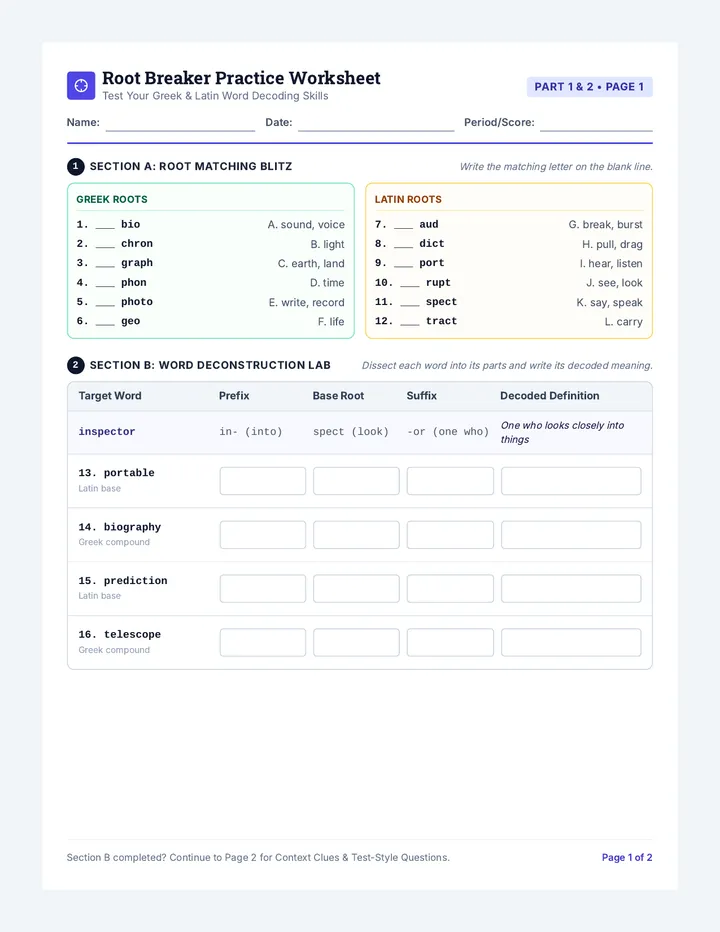
Next Step: Complete the companion 3-page student worksheet and check your answers!