Symbolism Analysis Slides 7th Grade ELA • The Great Gatsby
Gatsby Symbolism Blueprint
How to write a body paragraph that zooms in on symbols and zooms out to Fitzgerald's message about social class
Review: Chapters 1–3 Evidence Rule: Chapters 1–2 Only
Today's Goal
From Symbol Detective to Essay Writer
Learning Target: I can write a body paragraph with two quotes from Chapters 1–2 that explains how Fitzgerald uses symbols to show differences between rich and poor.
1. Review
Recall big symbols from Ch. 1–3
2. Pick Quotes
Choose 2 quotes from Ch. 1–2
3. Zoom In/Out
Explain word clues + big message
4. Write
Put it all into one paragraph
Quick Review
Symbols We've Seen in Chapters 1–3
Chapter 1
Green Light & Mansion
The glowing green light stands for Gatsby's hopes. Tom's giant mansion stands for "Old Money" families who were born rich.
Chapter 2
Valley of Ashes & Eyes
The gray, dusty wasteland shows how hard workers suffer. The giant billboard eyes feel like someone is watching a broken world.
Chapter 3 (Review Only)
Gatsby's Party & Books
Wild parties and real, unread books show how "New Money" tries to impress people and buy respect.
Evidence Rule
Use Quotes from Chapters 1–2 Only
Pick From Here (Ch. 1–2)
• Ch. 1: Tom & Daisy's huge red-and-white mansion
• Ch. 1: The single green light across the water
• Ch. 2: The Valley of Ashes & "ash-gray men"
• Ch. 2: The giant eyes of Dr. T.J. Eckleburg
• Ch. 2: Myrtle's crowded apartment in the city
Leave Chapter 3 Out
Reviewing Chapter 3 helps us remember the whole story so far, but your paragraph today must use two quotes from Chapters 1–2 only.
Why? It proves how early Fitzgerald starts showing the gap between social classes!
Paragraph Blueprint
4 Steps to a Strong Body Paragraph
01
Topic Sentence (Your Main Idea)
Name the book, the symbols in Ch. 1–2, and what they show about social class.
02
Quote #1 + Zoom In
Share your first Ch. 1–2 quote, then zoom in on specific words or details.
03
Quote #2 + Zoom In
Share your second Ch. 1–2 quote, then zoom in on how Fitzgerald describes it.
04
Zoom Out (Big Message)
Step back and explain Fitzgerald's message about rich vs. working-class people.
Thinking Like a Writer
Zoom In vs. Zoom Out
Zoom In: Word Clues
Look closely at the quote like a magnifying glass. Ask:
• Which exact words, colors, or sizes stand out?
• What picture or feeling does Fitzgerald create?
• Don't just retell the plot—explain the clue!
Zoom Out: Big Message
Pull back to see the big picture about social class. Ask:
• What is Fitzgerald saying about the rich vs. the poor?
• Who has an easy life, and who gets hurt?
• Why do these two symbols matter together?
7th Grade Model
See How It Fits Together (Ch. 1–2)
[Topic Sentence] In Chapters 1 and 2 of The Great Gatsby , Fitzgerald uses two very different places to show the unfair gap between the rich and the working class.
[Quote 1 + Zoom In] In Chapter 1, Nick visits Tom's "cheerful red-and-white Georgian Colonial mansion" with a lawn stretching "a quarter of a mile." The word "cheerful" and the huge size make rich people's lives look bright, easy, and powerful.
[Quote 2 + Zoom In] On the other hand, Chapter 2 introduces the "valley of ashes," where "ash-gray men" work in dust. Calling the workers "ash-gray" makes them seem worn out and invisible, as if they are turning into the dirt itself.
[Zoom Out] By putting these two symbols side by side, Fitzgerald shows that wealthy people enjoy comfort while working-class people pay the price.
Writing Time
Your Turn: Draft on Your Organizer
Two Quotes: Both quotes come from Chapters 1 or 2.
Zoom In Twice: Point out exact words or details after each quote.
Zoom Out: End with Fitzgerald's big message about social class.
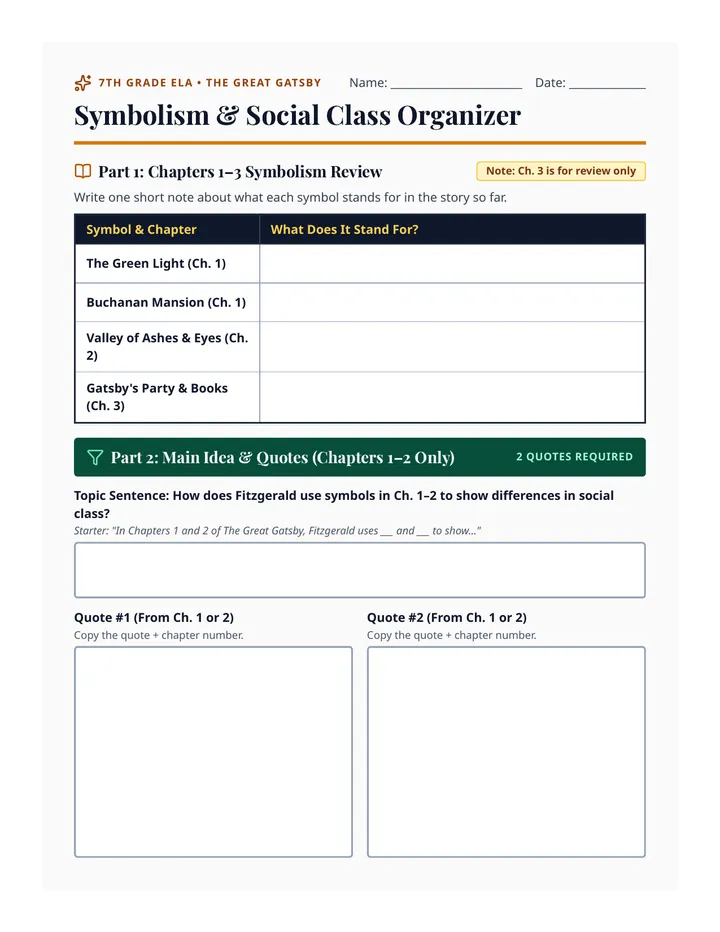
Symbolism Paragraph Organizer 7th Grade ELA • The Great Gatsby
Name: ________________________ Date: ______________
Symbolism & Social Class Organizer
Part 1: Chapters 1–3 Symbolism Review
Note: Ch. 3 is for review only
Write one short note about what each symbol stands for in the story so far.
Symbol & Chapter
What Does It Stand For?
The Green Light (Ch. 1)
Buchanan Mansion (Ch. 1)
Valley of Ashes & Eyes (Ch. 2)
Gatsby's Party & Books (Ch. 3)
Part 2: Main Idea & Quotes (Chapters 1–2 Only)
2 Quotes Required
Topic Sentence: How does Fitzgerald use symbols in Ch. 1–2 to show differences in social class?
Starter: "In Chapters 1 and 2 of The Great Gatsby, Fitzgerald uses ___ and ___ to show..."
Quote #1 (From Ch. 1 or 2)
Copy the quote + chapter number.
Quote #2 (From Ch. 1 or 2)
Copy the quote + chapter number.
Part 3: Zoom In (Word Clues) & Zoom Out (Big Message)
Zoom In #1: Explain Quote #1's word clues.
Starter: "The word '___' makes it seem..."
Zoom In #2: Explain Quote #2's word clues.
Starter: "Fitzgerald describes ___ as '___' to show..."
Zoom Out: What is Fitzgerald's big message about rich vs. working-class people?
Starter: "Together, these symbols show that Fitzgerald believes social class..."
Part 4: Write Your Body Paragraph
Topic Sentence + Quote 1 & Zoom In + Quote 2 & Zoom In + Zoom Out
Put all your pieces together into one smooth paragraph below.
Symbolism Teacher Guide 7th Grade Teacher Facilitation Guide
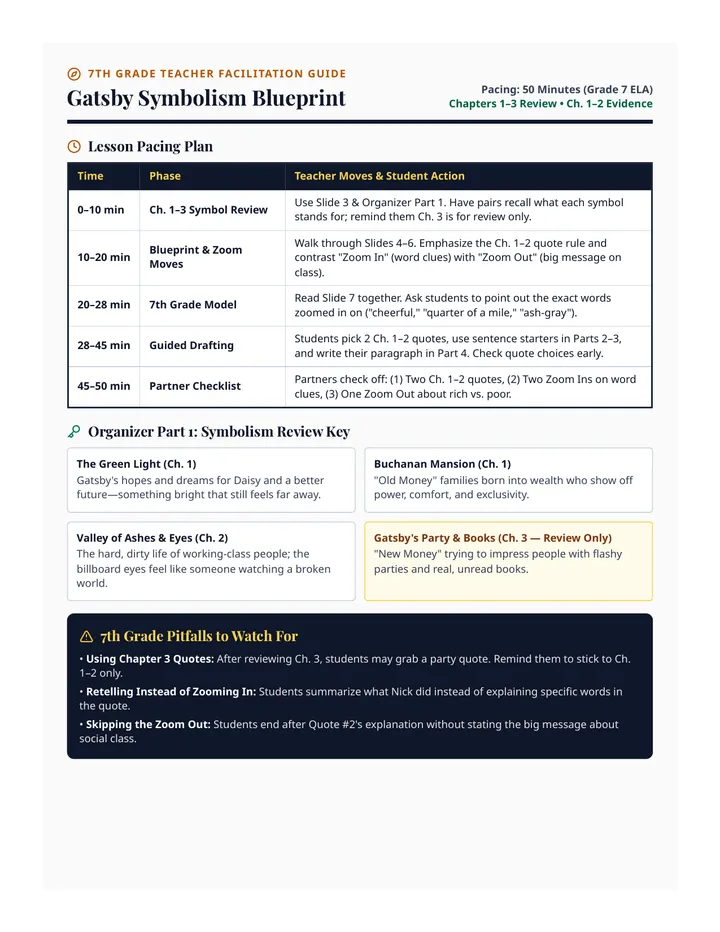
Gatsby Symbolism Blueprint
Pacing: 50 Minutes (Grade 7 ELA)
Chapters 1–3 Review • Ch. 1–2 Evidence
Lesson Pacing Plan
Time
Phase
Teacher Moves & Student Action
0–10 min
Ch. 1–3 Symbol Review
Use Slide 3 & Organizer Part 1. Have pairs recall what each symbol stands for; remind them Ch. 3 is for review only.
10–20 min
Blueprint & Zoom Moves
Walk through Slides 4–6. Emphasize the Ch. 1–2 quote rule and contrast "Zoom In" (word clues) with "Zoom Out" (big message on class).
20–28 min
7th Grade Model
Read Slide 7 together. Ask students to point out the exact words zoomed in on ("cheerful," "quarter of a mile," "ash-gray").
28–45 min
Guided Drafting
Students pick 2 Ch. 1–2 quotes, use sentence starters in Parts 2–3, and write their paragraph in Part 4. Check quote choices early.
45–50 min
Partner Checklist
Partners check off: (1) Two Ch. 1–2 quotes, (2) Two Zoom Ins on word clues, (3) One Zoom Out about rich vs. poor.
Organizer Part 1: Symbolism Review Key
The Green Light (Ch. 1)
Gatsby's hopes and dreams for Daisy and a better future—something bright that still feels far away.
Buchanan Mansion (Ch. 1)
"Old Money" families born into wealth who show off power, comfort, and exclusivity.
Valley of Ashes & Eyes (Ch. 2)
The hard, dirty life of working-class people; the billboard eyes feel like someone watching a broken world.
Gatsby's Party & Books (Ch. 3 — Review Only)
"New Money" trying to impress people with flashy parties and real, unread books.
7th Grade Pitfalls to Watch For
• Using Chapter 3 Quotes: After reviewing Ch. 3, students may grab a party quote. Remind them to stick to Ch. 1–2 only.
• Retelling Instead of Zooming In: Students summarize what Nick did instead of explaining specific words in the quote.
• Skipping the Zoom Out: Students end after Quote #2's explanation without stating the big message about social class.
Annotated 7th Grade Exemplar
Ch. 1–2 Evidence
Topic Sentence In Chapters 1 and 2 of The Great Gatsby , F. Scott Fitzgerald uses two very different places to show the unfair gap between the rich and the working class.
Quote #1 + Zoom In In Chapter 1, Nick visits Tom Buchanan's home, a "cheerful red-and-white Georgian Colonial mansion" with a lawn stretching "a quarter of a mile." The word "cheerful" and the huge size of the yard make rich people's lives look bright, easy, and powerful, as if they own everything around them.
Quote #2 + Zoom In On the other hand, Chapter 2 introduces the "valley of ashes," where "ash-gray men" work in clouds of dust. Calling the workers "ash-gray" makes them seem worn out and invisible, almost as if they are turning into the dirt itself.
Zoom Out (Social Class) By putting these two symbols side by side, Fitzgerald shows that wealthy people enjoy beauty and comfort while working-class people pay the price.
7th Grade Differentiation & Supports
Extra Scaffolds for Emerging Writers & ELL Students
• Pre-Highlighted Quotes: Give students a curated strip of 4–5 short Ch. 1–2 quotes to choose from so they can focus on Zoom In and Zoom Out.
• Sentence Starters: Point students to the italic starters printed directly above each box on the organizer.
Challenge for Early Finishers
Ask early finishers to pair a big setting symbol (like the Valley of Ashes) with a smaller object symbol (like Myrtle's crowded apartment furniture in Ch. 2 or Daisy's floating white curtains in Ch. 1) and add a transition sentence comparing the two.