Inkwell Test Prep Guide
Reading & Writing Review
Test Prep Toolkit
Name:
Date:
Use this quick-reference guide to review the four core skills on your upcoming reading and writing test, then apply each strategy in the practice section.
1. Reading Comprehension
Main Idea & Details
Ask: "What is this passage mostly about?" Supporting details are the facts or examples that prove the main idea.
Making Inferences
Read between the lines:
Text Clues + Background Knowledge = Inference
Author's Purpose (PIE)
- Persuade: Convince the reader to think or act.
- Inform: Teach facts or explain a topic.
- Entertain: Tell a story for enjoyment.
2. Vocabulary in Context
IDEAS Context Clues
- I – Inference: Use surrounding sentences to guess.
- D – Definition: The meaning is stated right there.
- E – Example: Look for such as or for example.
- A – Antonym: Look for opposite words (but, unlike).
- S – Synonym: A similar word appears nearby.
Word Parts
Break unfamiliar words into prefixes (un-, re-, pre-), roots, and suffixes (-ful, -less, -tion) to unlock meaning.
3. Grammar & Mechanics
Complete Sentences
Every sentence needs a subject, a verb, and a complete thought. Watch out for fragments (incomplete) and run-ons (fused sentences).
Subject-Verb Agreement
Singular subjects take singular verbs (The tree grows). Plural subjects take plural verbs (The trees grow).
Essential Comma Rules
- Items in a series (roots, soil, and water).
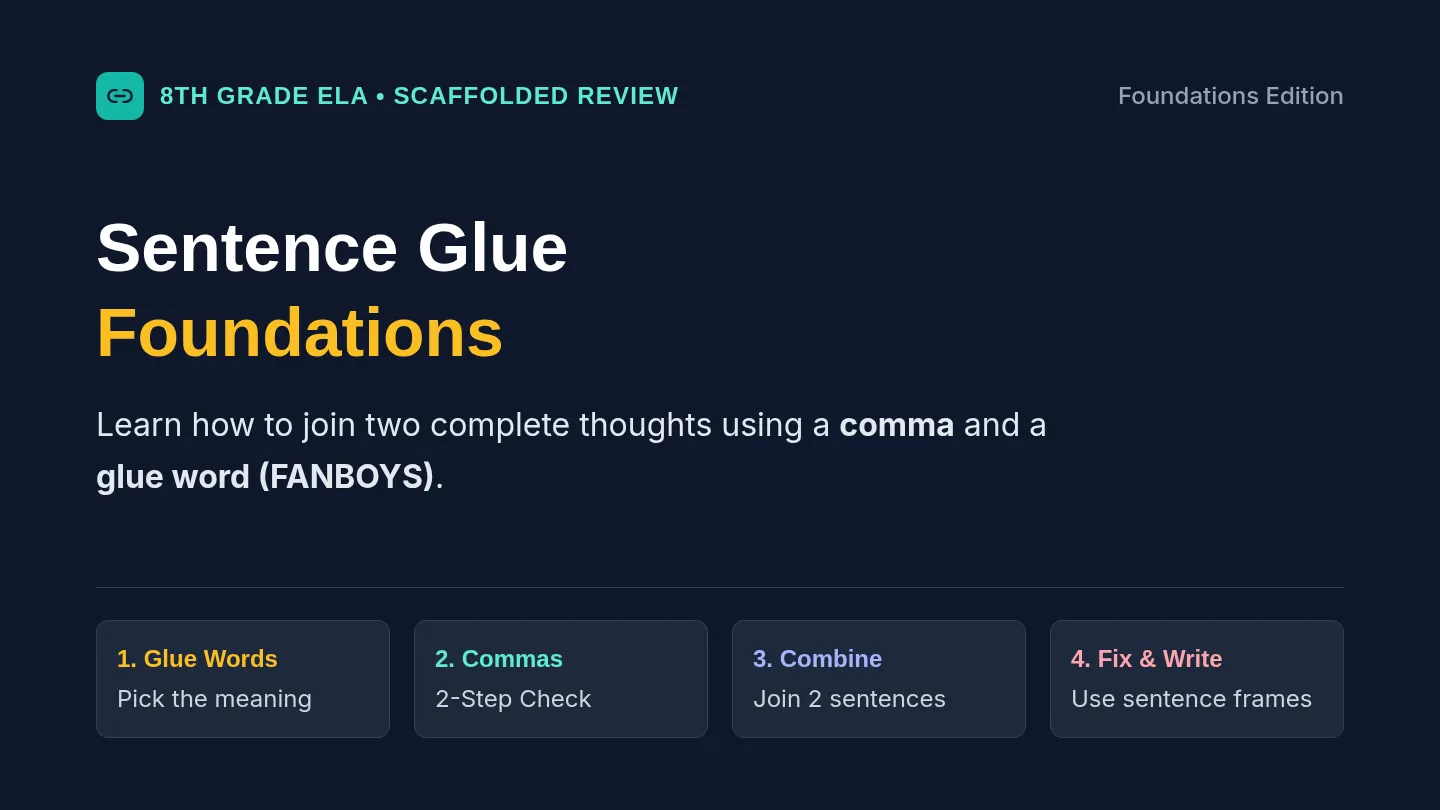
- Before FANBOYS joining two complete sentences.
- After introductory phrases (Deep underground, ...).
4. Written Response (RACE)
R
Restate the question as a statement so your topic is clear.
A
Answer every part of the prompt directly and accurately.
C
Cite evidence from the text ("According to the passage...").
E
Explain how your evidence proves your answer in your own words.
Test-Day Strategy Check
-
Read the questions first so you know what clues to hunt for.
-
Eliminate obviously wrong choices before picking the best answer.
-
Always go back to the text to verify your evidence.
Practice Section • Part 1
Reading Passage & Comprehension
Read the passage carefully, then answer Questions 1–3.
The Secret Language of Trees
When you walk through a quiet forest, the trees appear to stand alone, competing for sunlight and water. Yet beneath the forest floor, a hidden world connects them. Scientists have discovered that trees link their roots through vast underground networks of microscopic fungi. Researchers often nickname this system the "Wood Wide Web" because it works much like the internet.
Through these fungal threads, trees trade vital nutrients such as carbon, nitrogen, and water. The largest, oldest trees in the forest—known as "mother trees"—play an especially generous role. Because their tall crowns reach high into the canopy, mother trees absorb abundant sunlight and produce extra sugar. They pump this surplus energy through the fungal network to nourish shaded saplings that cannot yet reach the sun.
Trees also use this underground highway to send urgent warnings. When insects attack a pine tree, for example, it releases chemical signals into the fungal network. Neighboring trees receive the alert and immediately boost their own chemical defenses, making their leaves taste bitter before the pests even arrive. Far from being solitary rivals, forest trees thrive by cooperating in a silent, underground community.
Part A
Reading Comprehension
1. What is the main idea of the passage?
A. Microscopic fungi can damage tree roots underground.
B. Forest trees survive by sharing nutrients and warnings underground.
C. Pine trees are the only trees that can fight off hungry insects.
D. Tall trees block sunlight so smaller saplings cannot grow.
2. Based on the passage, what can you infer happens if a mother tree is cut down?
A. Nearby saplings may struggle to get enough energy to survive.
B. Neighboring trees will stop needing water from the soil.
C. Insects will no longer be able to find pine trees in the forest.
D. The fungal network will turn into solid rock underground.
3. What is the author's primary purpose for writing this passage?
A. To persuade readers to plant pine trees in their yards
B. To entertain readers with a fictional story about talking trees
C. To inform readers about how trees communicate and cooperate
D. To warn hikers about dangerous fungi on forest trails
Practice Section • Part 2
Vocabulary & Grammar
Complete Questions 4–10.
Part B
Vocabulary in Context
4. In paragraph 2, what does the word surplus mean?
A. missing
B. extra
C. harmful
D. hidden
5. In paragraph 3, which word helps you understand the meaning of solitary?
A. cooperating
B. bitter
C. chemical
D. urgent
6. What context clue in paragraph 2 helps you figure out what saplings are?
Part C
Grammar & Mechanics
7. Which sentence is punctuated correctly?
A. Deep underground roots fungi and water work together.
B. Deep underground, roots, fungi, and water work together.
C. Deep underground roots, fungi and, water work together.
D. Deep, underground roots fungi, and water work together.
8. Choose the verb that correctly completes the sentence: "The tall mother trees ______ extra sugar to nearby saplings."
A. sends
B. sending
C. send
D. was sending
9. Fix the run-on sentence below by rewriting it as two complete sentences or adding a comma and a conjunction (and, but, so).
Insects attacked the pine tree it released a chemical warning.
10. Fix the sentence fragment below so that it is a complete thought.
Connected by tiny threads beneath the dark forest floor.
Practice Section • Part 3
Extended Written Response
Use the RACE strategy for Question 11.
Part D
Plan & Write Your Response
11. How do trees in a forest help one another survive? Use at least two details from "The Secret Language of Trees" to support your answer.
Quick RACE Organizer (Jot Notes)
R + A: Restate & Answer
C + E: Two Text Details & Explanation
Final Written Response
RACE Self-Check:
Restated prompt Answered completely Cited 2 details Explained evidence