Co-Teaching Routine GuideCo-Teaching Instructional Framework Opening Routines & Co-Teaching Integration Subject: ELA Grade 7/8 • Text: Freak the Mighty, Ch. 7 • Focus: Context Clues Routine Time: 12 Min Recommended Placement in Lesson Flow: Place all three elements as the structured Bell-to-Bell Opening Routine (First 12 Minutes) immediately before the Anticipatory Set: 1. Announcements (2 min) → 2. Writing the Quote (4 min) → 3. Daily Grammar Practice (6 min). This builds focus, introduces chapter themes, and reviews sentence mechanics before vocabulary study. 1 Announcements & Agenda Setting 2 Min Model: One Teach, One Support Strategic Purpose: Frame the day, display MVP expectations, and transition without losing academic momentum. Regular Teacher (Lead) Projects visible agenda, target dates, and homework board. Delivers brisk, whole-class procedural announcements (< 90 sec). Signals students to open notebooks directly to Quote prompt. Inclusion Teacher (Support) Verifies IEP visual schedules, planners, and accessibility tools. Silently redirects off-task students at classroom perimeter. Distributes accommodated notebooks and pre-sharpened materials. 2 Writing the Quote (Thematic Quickwrite) 4 Min Model: Team Teaching / Scribe Strategic Tie-in: Freak's quote from Ch. 7: “Amazing perspective up here. This is what you see all the time.” Previews vocabulary and themes. Regular Teacher (Facilitator) Presents the quote with a 3-minute quickwrite reflection prompt. Unpacks literal meaning; highlights the root idea of "perspective". Calls on one student to share insight to transition forward. Inclusion Teacher (Scaffolder) Writes sentence starter on board: "Freak means that when Max carries him..." Provides pre-printed quote strips for students with fine-motor needs. Scribes or prompts 2–3 students needing verbal reflection before writing. 3 Daily Grammar Practice (DGP Mentor Sentence) 6 Min Model: Interactive Duet Strategic Tie-in: Mentor sentence from Ch. 7: “Now I’m running at a full gallop, weaving through the crowd.” Directly previews target word gallop. Regular Teacher (Lead Analyst) Guides grammatical task of the day (e.g., parts of speech, verbs/participles). Asks rapid check questions: "Where is the subject? What action is occurring?" Paces the exercise strictly (3 min student attempt, 3 min debrief). Inclusion Teacher (Visual Modeler) Live color-codes on display (blue=nouns, green=verbs, yellow=phrases). Distributes colored highlighters and guided templates with word banks. Monitors targeted IEP students; provides instant corrective feedback. Direct Transition into Lesson: Regular teacher pivots from DGP sentence to Anticipatory Set question: "Notice how Max was running to help Freak? That brings us right into our big question about teamwork..." Page 1 of 2 Master Instructional Matrix Bell-to-Bell Co-Teaching Execution Plan Seamless distribution of responsibilities across General Education and Inclusion Specialists Gen Ed Teacher Inclusion Teacher Phase & Time Co-Teaching Model Regular Teacher Role Inclusion Teacher Role 1. Opening Routines (Min 0–12) Announce • Quote • DGP Team / Assist Whole class lead Leads announcements, times quote quickwrite, and conducts whole-group DGP mentor sentence breakdown. Circulates with modified materials, projects visual color coding, and scaffolds sentence starters for struggling writers. 2. Anticipatory Set (Min 12–15) Discussion • Target Duet / Choral Shared dialogue Poses hook question on teamwork; facilitates whole-group sharing and connects to Max & Freak in Ch. 7. Leads class in choral reading of Learning Target; points to visual anchor chart showing the 5 word-detective steps. 3. I DO: Model (Min 15–27) Read Ch. 7 • Gunky & Blubbering One Teach, One Observe/Assist Think-aloud Reads chapter aloud with vocal pacing; models think-aloud for gunky and blubbering, encircling clues. Live-maps clues on the graphic organizer board; prompts EC students with wait time; records observational IEP data. 4. WE DO: Guided (Min 27–47) Converging • Swaggering • Gallop Station / Parallel or Duet Tiered questioning Guides high-level inferential reasoning; leads class analysis of physical character motion and dialogue clues. Provides tiered sentence frames; manages response cards/whiteboards; supports small group needing pre-encircled hints. 5. YOU DO: Practice (Min 47–67) 5 Target Words • Web Alternative Teaching / Pull Targeted support Monitors on-level/advanced tiers; probes deeper word connections and trajectory/perspective nuances. Hosts a flexible small-group table with modified word webs (reduced choices, enlarged text, oral dictation options). 6. Exit Ticket & Wrap (Min 67–75) 5 Steps • Reflection Dual Station / Assist Formative review Administers Level 0 exit ticket; delivers closing reflection on reading independently without a dictionary. Reads prompts aloud to students with read-aloud accommodation; collects data on the 5-point success criteria. Parity in the Room Both teachers' names on board; shared discipline and praise; neither is seen as an "aide." Unified Color Code Maintain consistent colors across DGP and Context Clues (yellow=target words, green=clues). Seamless Handoffs Use scripted verbal cues between transitions so students recognize both as authoritative co-leaders. Co-Teaching Companion • Freak the Mighty Ch. 7 Context Clues Page 2 of 2
Word Detective Steps Anchor ChartReading Strategy Anchor Chart BECOME A WORD DETECTIVE! 5 Steps to Uncover Unfamiliar Words Using Context Clues Detective Goal No Dictionary First! 1 First READ Read & reread the sentence containing the word. 2 Next NOTICE Spot words or phrases that provide hints. 3 Then ENCIRCLE Draw circles around high-value clue words. 4 After That ORGANIZE Transfer clue words into your Word Web. 5 Finally INFER Make an educated guess in your own words. 1 Step 1: Read the Entire Sentence Don't freeze when you see an unfamiliar word! Reread the full sentence and the sentence right before or after it. Look for context 2 Step 2: Notice Surrounding Clues Ask: What are characters doing, feeling, or saying? What does the setting look like? What sounds are described? Gather evidence 3 Step 3: Encircle Key Context Clues Use a pencil or green highlighter to encircle only the clue words. Don't circle the whole sentence! Circle hints 4 Step 4: Organize Clues in the Word Web Write the mystery word in the center circle. Branch out your encircled clues into the surrounding boxes. Map clues 5 Step 5: Infer Meaning (Educated Guess) Combine all branches: "Based on these clues, what must this word mean?" Test your definition back in the sentence! Make your guess Case File Model Freak the Mighty • Chapter 7 Demonstration in Action “I almost lose it right there, taking that first step, because it’s a GUNKY pond and the mud is really oozy and deep and it sucks right up to my knees.” Word Web Evidence: Clue 1: “mud” & “pond” Clue 2: “oozy and deep” Clue 3: “sucks to knees” Clue 4: “taking first step” Inferred Meaning: Thick, slimy, sticky mud that traps your feet! Word Detective Rule: Authors leave clues on purpose. Collect the clues, map them, and trust your evidence! Yellow = Word Green = Clues
Word Detective Starters HandoutWriter's Toolkit • Inclusion Scaffold Word Detective Sentence Starters Freak the Mighty • Chapter 7 Name: Date: Period: A Opening Routine: Quote Quickwrite & Grammar Bellringer Support Writing the Quote: Freak’s “Perspective” • When Freak says this quote, he means that ________. • Freak’s perspective changes because Max ________. • This quote shows teamwork because together they can ________. Daily Grammar Practice (DGP Sentence) • In this sentence, the subject is ________ because it is the person doing the action. • The action verb is ________, which tells what happened. • The word ________ describes how the character was moving. B Context Clues: Noticing & Encircling Evidence Steps 2 & 3 Character Actions & Motion • The author says the character is ________, which shows movement. • The clue word “________” shows how fast they are going. Feelings & Tone • The text says the character feels ________ because ________. • The word “________” shows that Tony D. and his gang are dangerous. Setting & Description • The pond is described as ________, so the setting is dirty and thick. • Surrounding words like “________” paint a picture of the scene. C Inferring Meaning: Writing Your Educated Guess Steps 4 & 5 Tier 1: Basic Educated Guess Stems • Based on the clues in my word web, [word] probably means ________________________. • I think [word] means ________________________ because the text says ________________________. Tier 2: Explaining & Justifying Clues • The clue “________” supports my guess because it describes how ________________________. • When I put the clues “____” and “____” together, it proves the word means ________________. D Exit Ticket: Summarizing the 5 Steps & Reflection Formative Assessment Sequential Summary Frames: First, I should read the sentence to see what is happening. Next, I should notice words and phrases that give hints. Then, I should encircle the important context clues. After that, I should organize the clues in my word web. Finally, I should infer the meaning with an educated guess. Reflection Question Starter: “Why look for context clues before using a dictionary?” • It is important to look for context clues first because it helps me understand the author's meaning without interrupting my reading. Word Detective Self-Check: Did my educated guess make sense when I read the sentence again? □ Yes, it fits! □ I used clues
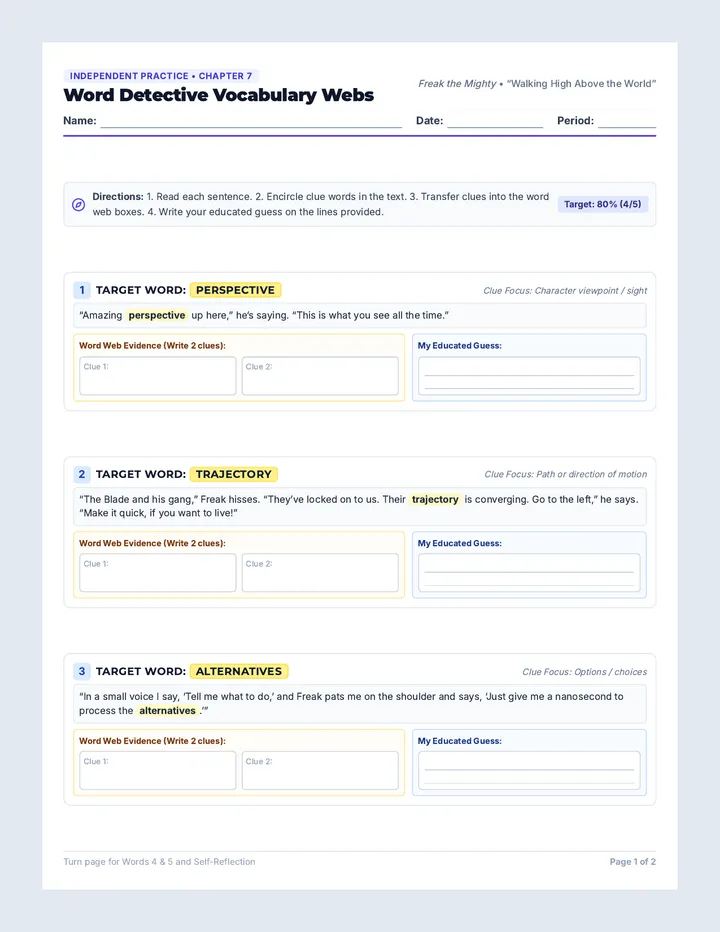
Word Detective Practice WorksheetIndependent Practice • Chapter 7 Word Detective Vocabulary Webs Freak the Mighty • “Walking High Above the World” Name: Date: Period: Directions: 1. Read each sentence. 2. Encircle clue words in the text. 3. Transfer clues into the word web boxes. 4. Write your educated guess on the lines provided. Target: 80% (4/5) 1 Target Word: PERSPECTIVE Clue Focus: Character viewpoint / sight “Amazing perspective up here,” he’s saying. “This is what you see all the time.” Word Web Evidence (Write 2 clues): Clue 1: Clue 2: My Educated Guess: 2 Target Word: TRAJECTORY Clue Focus: Path or direction of motion “The Blade and his gang,” Freak hisses. “They’ve locked on to us. Their trajectory is converging. Go to the left,” he says. “Make it quick, if you want to live!” Word Web Evidence (Write 2 clues): Clue 1: Clue 2: My Educated Guess: 3 Target Word: ALTERNATIVES Clue Focus: Options / choices “In a small voice I say, ‘Tell me what to do,’ and Freak pats me on the shoulder and says, ‘Just give me a nanosecond to process the alternatives.’” Word Web Evidence (Write 2 clues): Clue 1: Clue 2: My Educated Guess: Turn page for Words 4 & 5 and Self-Reflection Page 1 of 2 Word Detective Practice • Independent Practice (Continued) Student: 4 Target Word: BUGLE Clue Focus: Sound / signaling object “‘Wait,’ Freak says. ‘The cavalry is coming, can’t you hear that bugle?’” Surrounding clue: Freak is whistling and the police siren spotlight settles on the pond. Word Web Evidence (Write 2 clues): Clue 1: Clue 2: My Educated Guess: 5 Target Word: CAVALRY Clue Focus: Group coming to rescue “‘Wait,’ Freak says. ‘The cavalry is coming, can’t you hear that bugle?’ Freak is whistling and the cop car spotlight comes beaming around the pond...” Word Web Evidence (Write 2 clues): Clue 1: Clue 2: My Educated Guess: Detective Strategy Reflection Self-Assessment Reflection Prompt: Explain how collecting context clues in a word web helped you make sense of an unfamiliar word without checking a dictionary first: Mastery Check (Teacher/Self): 1. Perspective 2. Trajectory 3. Alternatives 4. Bugle 5. Cavalry Score: ___ / 5 Freak the Mighty • Chapter 7 Context Clues Assessment Page 2 of 2
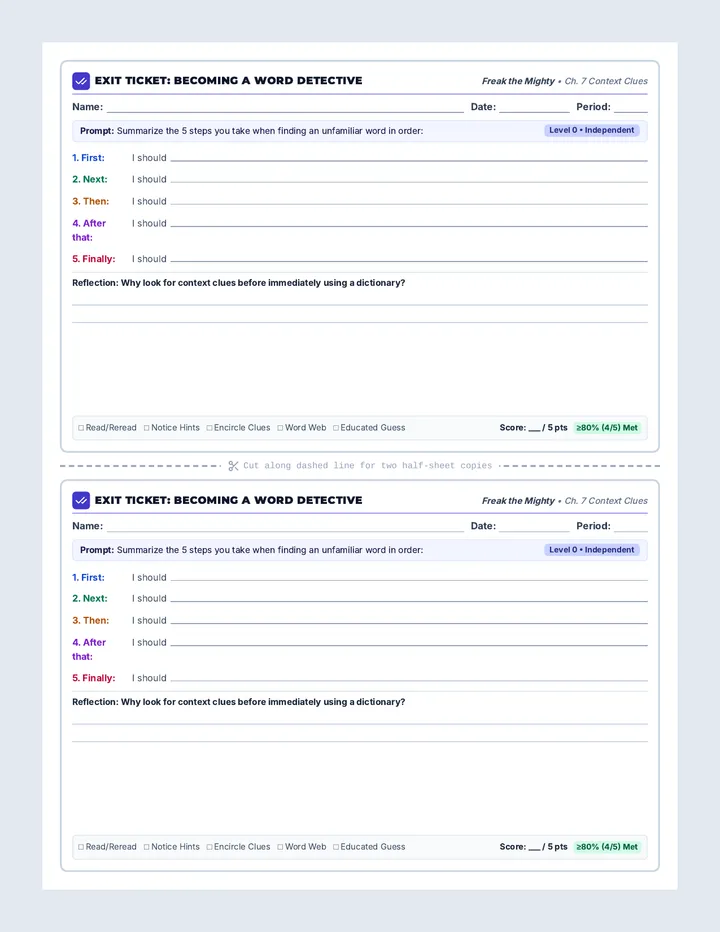
Word Detective Exit TicketEXIT TICKET: Becoming a Word Detective Freak the Mighty • Ch. 7 Context Clues Name: Date: Period: Prompt: Summarize the 5 steps you take when finding an unfamiliar word in order: Level 0 • Independent 1. First: I should 2. Next: I should 3. Then: I should 4. After that: I should 5. Finally: I should Reflection: Why look for context clues before immediately using a dictionary? □ Read/Reread □ Notice Hints □ Encircle Clues □ Word Web □ Educated Guess Score: ___ / 5 pts ≥80% (4/5) Met Cut along dashed line for two half-sheet copies EXIT TICKET: Becoming a Word Detective Freak the Mighty • Ch. 7 Context Clues Name: Date: Period: Prompt: Summarize the 5 steps you take when finding an unfamiliar word in order: Level 0 • Independent 1. First: I should 2. Next: I should 3. Then: I should 4. After that: I should 5. Finally: I should Reflection: Why look for context clues before immediately using a dictionary? □ Read/Reread □ Notice Hints □ Encircle Clues □ Word Web □ Educated Guess Score: ___ / 5 pts ≥80% (4/5) Met
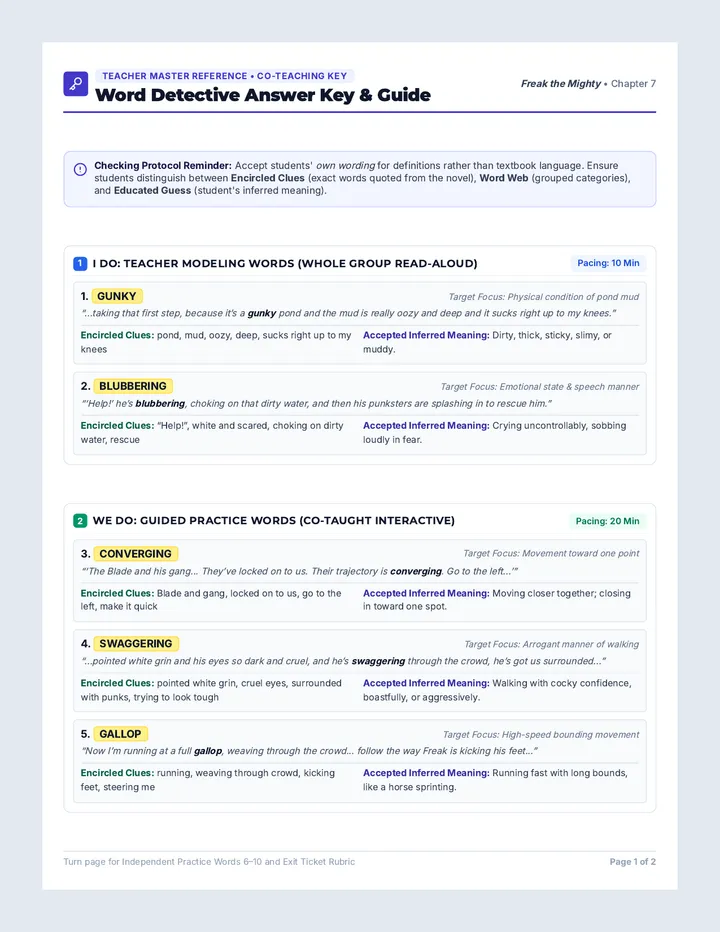
Word Detective Master KeyTeacher Master Reference • Co-Teaching Key Word Detective Answer Key & Guide Freak the Mighty • Chapter 7 Checking Protocol Reminder: Accept students' own wording for definitions rather than textbook language. Ensure students distinguish between Encircled Clues (exact words quoted from the novel), Word Web (grouped categories), and Educated Guess (student's inferred meaning). 1 I DO: Teacher Modeling Words (Whole Group Read-Aloud) Pacing: 10 Min 1. GUNKY Target Focus: Physical condition of pond mud “...taking that first step, because it’s a gunky pond and the mud is really oozy and deep and it sucks right up to my knees.” Encircled Clues: pond, mud, oozy, deep, sucks right up to my knees Accepted Inferred Meaning: Dirty, thick, sticky, slimy, or muddy. 2. BLUBBERING Target Focus: Emotional state & speech manner “‘Help!’ he’s blubbering, choking on that dirty water, and then his punksters are splashing in to rescue him.” Encircled Clues: “Help!”, white and scared, choking on dirty water, rescue Accepted Inferred Meaning: Crying uncontrollably, sobbing loudly in fear. 2 WE DO: Guided Practice Words (Co-Taught Interactive) Pacing: 20 Min 3. CONVERGING Target Focus: Movement toward one point “‘The Blade and his gang... They’ve locked on to us. Their trajectory is converging. Go to the left...’” Encircled Clues: Blade and gang, locked on to us, go to the left, make it quick Accepted Inferred Meaning: Moving closer together; closing in toward one spot. 4. SWAGGERING Target Focus: Arrogant manner of walking “...pointed white grin and his eyes so dark and cruel, and he’s swaggering through the crowd, he’s got us surrounded...” Encircled Clues: pointed white grin, cruel eyes, surrounded with punks, trying to look tough Accepted Inferred Meaning: Walking with cocky confidence, boastfully, or aggressively. 5. GALLOP Target Focus: High-speed bounding movement “Now I’m running at a full gallop, weaving through the crowd... follow the way Freak is kicking his feet...” Encircled Clues: running, weaving through crowd, kicking feet, steering me Accepted Inferred Meaning: Running fast with long bounds, like a horse sprinting. Turn page for Independent Practice Words 6–10 and Exit Ticket Rubric Page 1 of 2 Word Detective Master Key • YOU DO Words & Assessment Solutions Student Worksheet Evaluation 3 YOU DO: Independent Student Practice Key (Worksheet) Goal: ≥80% (4/5) Target Word Acceptable Encircled Clues Word Web Focus Accepted Inferred Meaning 1. PERSPECTIVE “up here”, “this is what you see all the time” Viewpoint / visual height A way of seeing things; point of view or visual angle. 2. TRAJECTORY “locked on to us”, “converging”, “go to the left”, “make it quick” Path / route of motion The path or curved direction that a moving object/person takes. 3. ALTERNATIVES “tell me what to do”, “process”, “nanosecond” Options / choices Different choices or possible courses of action available. 4. BUGLE “cavalry is coming”, “can’t you hear”, “whistling”, “cop car” Sound / horn instrument A small brass horn/instrument used to sound signals or alerts. 5. CAVALRY “is coming”, “bugle”, “cop car spotlight”, “rescue” Rescuing unit / helpers A group of soldiers or rescue responders arriving to save someone. 4 Exit Ticket Answer Key & 5-Point Scoring Checklist Formative Check Chronological Sequence Expected Order: 1. First: Read or reread the sentence containing the word. 2. Next: Notice surrounding words and phrases that give hints. 3. Then: Encircle the important context clues. 4. After that: Organize the clues into a word web. 5. Finally: Infer the meaning by making an educated guess. 5-Point Rubric Breakdown: 1 pt: Mentions reading/rereading. 1 pt: Identifies noticing hints. 1 pt: Mentions encircling clue words. 1 pt: Mentions organizing into word web. 1 pt: Mentions making educated guess. Mastery: 4/5 points (80% accuracy) Reflection Question Model Answer: Looking for context clues first helps you stay engaged in the story without breaking comprehension flow, and it helps you understand the author's specific figurative or tone-based meaning which a dictionary cannot provide. Inclusion Progress Monitoring: Record Exit Ticket scores directly into IEP tracking sheets for vocabulary decoding objectives. Benchmark: Goal Met (≥80%) Freak the Mighty Ch. 7 • Complete Lesson Suite Key Page 2 of 2