Text Features Anchor Chart
Reading Toolkit • Nonfiction Skills
TEXT FEATURES ANCHOR CHART
Feature Detective Guide
Nonfiction text features are tools authors use to organize facts, highlight key ideas, and help readers understand information quickly!
1
TITLE
Topic Clue
The name of an entire text or article, located right at the very top.
Why use it? Tells what the entire passage is going to be about.
Reader Tip: Read it first to predict what details will follow.
2
BOLD PRINT
Key Word
Thicker, darker words that stand out from the rest of the sentences.
Why use it? Signals new vocabulary or essential terms to remember.
Reader Tip: Slow down! Look for its definition in the text or glossary.
3
DIAGRAM
Visual Guide
A drawing, photo, or detailed sketch showing how something looks or works.
Why use it? Makes complex facts and physical parts easier to see.
Reader Tip: Look closely at shapes, cutaways, and arrangements.
4
LABEL
Part Namer
Words or phrases with lines pointing directly to specific parts of a picture.
Why use it? Names exact pieces so you know precisely what is what.
Reader Tip: Follow the line or arrow from the word to the target object.
Mentor Model
See the Features Working Together in an Article!
Notice how each feature supports your reading
Feature 1 Incredible Honeybees: Nature's Super Pollinators
TITLE: Big Topic
Honeybees are social insects that live in large colonies. Worker bees fly from flower to flower gathering sweet nectar, which provides energy for the whole hive.
As bees drink, golden dust called pollen sticks to their fuzzy bodies and helps plants make seeds!
Feature 2 BOLD PRINT makes words like nectar and pollen jump out because they are vital science terms!
Feature 3 DIAGRAM
Visual Drawing
BODY
Feature 4 LABEL: Antenna
Feature 4 LABEL: Wing
Diagram + Labels: Work together so you can see where each bee part is located!
Detective Strategy: How to Use Features When You Read
Step 1: Preview
Read the Title first to understand the topic before reading paragraphs.
Step 2: Spot Bold Words
When you hit Bold Print, reread the sentence to unlock key vocabulary.
Step 3: Connect Visuals
Follow lines from each Label to its part in the Diagram.
Feature Hunt Worksheet
Feature Finders Practice
Name: Date: Score: /10
FEATURE HUNT WORKSHEET
Use your text feature detective skills to identify, match, and analyze how authors share information.
Student Activity
1 Part 1: Match the Feature to Its Job
Write the correct letter (A, B, C, or D) in each box
1. Title
2. Bold Print
3. Diagram
4. Label
A. Words pointing to specific parts of a picture or drawing.
B. A drawing or sketch that shows what something looks like or how it works.
C. Tells the main topic of the text right at the very top.
D. Darker, thicker letters that highlight key vocabulary words.
2 Part 2: Read the Nonfiction Text
Observe the title, bold words, diagram, and labels
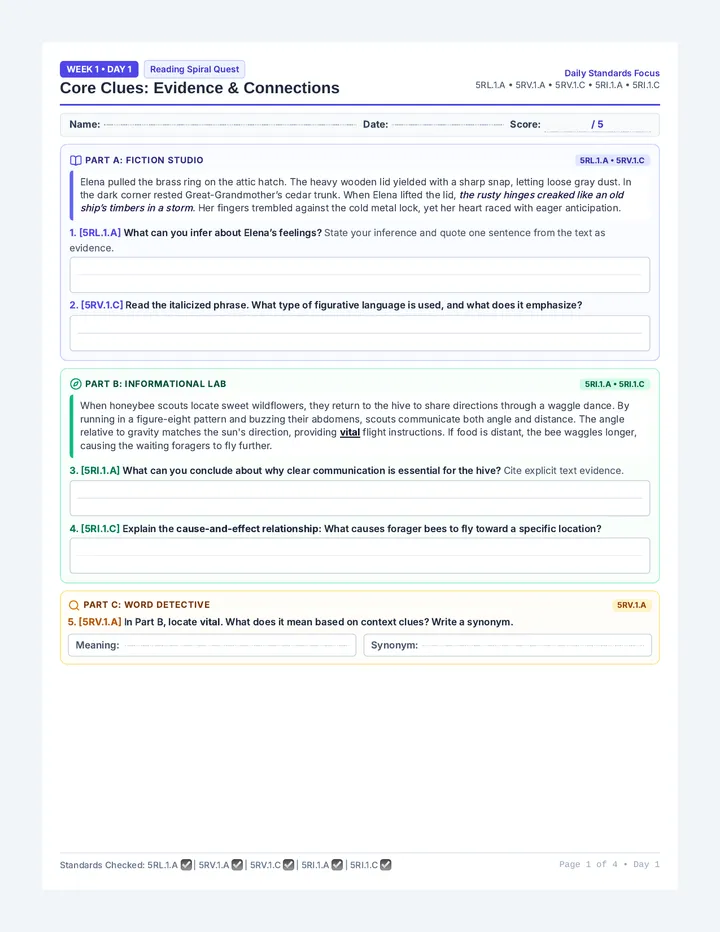
Underwater Gliders: The Giant Manta Ray
Giant manta rays are harmless ocean acrobats. They propel themselves using wide pectoral fins that beat gracefully like wings through deep water.
Unlike many stingrays, manta rays do not possess a sharp venomous stinger. Instead, they glide peacefully with open mouths to filter-feed on microscopic ocean creatures called plankton.
Diagram: Manta Ray Anatomy
Label A Cephalic Fin
Label B Pectoral Fin
Label C Filter Mouth
Label D Whip-Like Tail
3 Part 3: Text Feature Investigation Questions
Answer in complete thoughts
1. TITLE: Write the full title of the passage. Before reading the paragraph, what did the title tell you?
2. BOLD PRINT: Locate the word in bold print that explains what manta rays eat. Write the word and why the author put it in bold:
3. DIAGRAM & LABELS: Look at the diagram. Which label names the large wing-like fin, and how does the diagram help you understand it?
4. THINK LIKE AN AUTHOR: Why is pairing a diagram with labels more helpful to a reader than using words alone?