Evidence Detectives Slides CASE FILE 104 • INTERVENTION LAB Reading Comprehension • Fiction
Cracking the Case:
Evidence Behind the Inference
An inference without evidence is just a wild guess. Learn how to locate, prove, and defend your reading conclusions like a master detective.
Step 1: Detect Step 2: Cite Proof Step 3: Justify
Evidence Detectives Unit
The Detective Formula
Core Concept
TEXT CLUES
Words, actions, dialogue, and details directly written on the page.
MY SCHEMA
What you already know about how people act and how life works.
=
INFERENCE
A logical conclusion the author didn't spell out directly.
The Golden Rule: You cannot arrest a suspect without physical evidence. You cannot make an inference without exact words from the story!
Case Passage • “The Midnight Clockmaker”
Model Text (I Do)
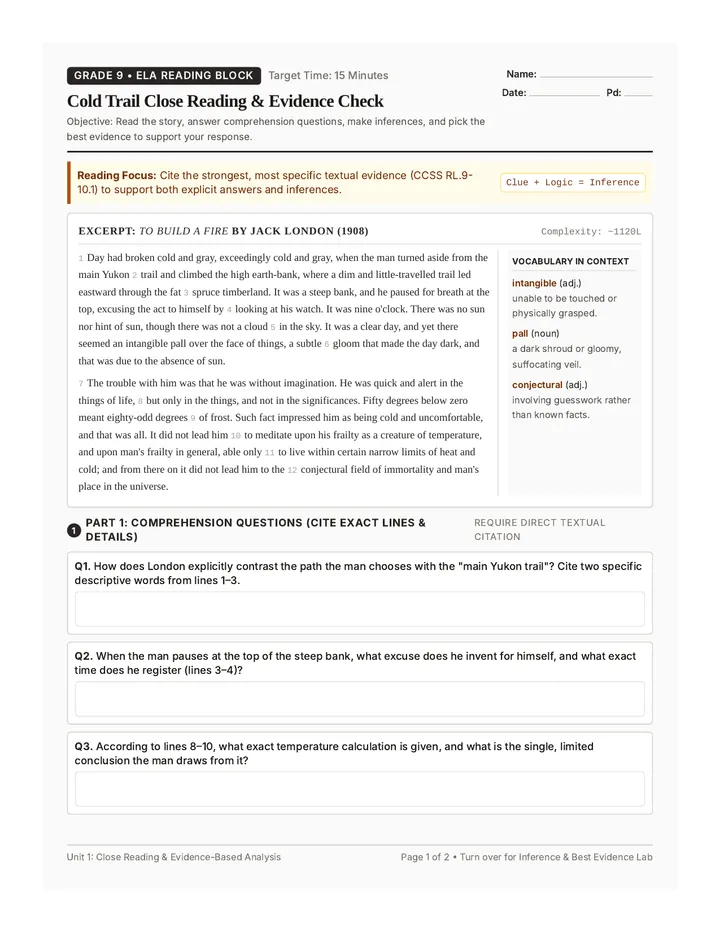
¶ 1 When the clock tower struck midnight, Silas pushed his gold spectacles up his nose and hastily jammed a velvet pouch beneath the floorboards. His hands trembled so violently that he dropped his iron screwdriver twice.
¶ 2 Outside the shop window, heavy boots crunched on the gravel alley. Silas immediately blew out his single oil lantern, held his breath, and backed into the darkest shadow behind the grandfather clock.
Target Question: How is Silas feeling in this scene, and how do you know?
Let's inspect the evidence together →
Teacher Think-Aloud • Weighing the Proof
Modeling
STRONG EVIDENCE
“His hands trembled so violently that he dropped his iron screwdriver twice... held his breath, and backed into the darkest shadow.”
Direct specific action
Why it works: Trembling hands and holding breath specifically show panic and fear.
WEAK EVIDENCE
“When the clock tower struck midnight, Silas pushed his gold spectacles up his nose.”
Irrelevant background detail
Why it fails: Adjusting glasses happens at any time; it does not prove Silas was terrified or hiding!
KEY TEST
Ask yourself: “Does this specific line directly cause or prove my inference, or is it just nearby words?”
Guided Practice • You Be the Detective
We Do
¶ 3 Fourteen-year-old Toby stood on the workshop doorstep. His chin remained tilted upward, but his fingers twisted the frayed seam of his winter coat over and over until the stitching snapped.
¶ 4 “I know what you locked away, Master Silas,” Toby whispered. He cleared his throat loudly, stood on his tiptoes to appear taller, and refused to look at the dark alley behind him.
Inference Given: Turn & Talk with your partner
“Toby is trying to act confident and brave, but he is secretly nervous.”
Which exact phrase from the passage proves Toby is nervous? Which proves he wants to look brave?
Evidence Solved • Two Sides of Toby
Solution Check
INFERENCE 1: ACTING BRAVE
Exact Text Evidence:
“His chin remained tilted upward...”
“...stood on his tiptoes to appear taller...”
Connection: These are deliberate postures people make when trying to appear dominant and unafraid.
INFERENCE 2: SECRETLY NERVOUS
Exact Text Evidence:
“...fingers twisted the frayed seam... until the stitching snapped.”
“...refused to look at the dark alley behind him.”
Connection: Unconscious fidgeting and avoiding dark spaces show anxiety and fear leaking out.
Notice: A complete answer names the line AND explains what it reveals!
Your Detective Protocol • Independent Practice
Ready for Packet
01
State the Claim
What is the story suggesting about the character, setting, or conflict that is NOT directly said?
Define the inference first
02
Cite Direct Proof
Put quotation marks around the exact phrase or detail. No vague paraphrases or whole-page guesses!
Use direct quotes
03
Build the Bridge
Use the sentence starter:
Connect proof to thought
Next Step: Open your Practice Packet to Case File #104.
Grab your pencil and magnifying glass!
Evidence Detectives Practice Packet Case File #104: Evidence Investigator
Objective: Identify and cite exact text evidence to prove inferences in fiction
STUDENT PACKET
Detective Name:
Date:
Class Period:
FORMULA:
Text Clues + Schema = Inference (Proof-Based)
Mystery Case: “The Brass Pocketwatch” • Part 1
Read and underline clues
[1] Master Vance paced back and forth across the Persian carpet in his study, wringing his handkerchief until the lace tore. Every time the floorboards creaked, he flinched and cast a frantic glance toward the mahogany cabinet by the window. The lock on the cabinet drawer had not been picked; instead, the wood around the brass keyhole was violently splintered.
[2] Apprentice Detective Maya knelt down on the hearthrug. Outside, an autumn downpour lashed the glass, yet right beside the window sill lay a scattering of dried pine needles and a pair of damp, muddy boot prints pointing strictly into the room. No wet footprints led back out toward the hallway door.
[3] “My grandfather’s pocketwatch was inside that drawer,” Vance stammered, pointing a shaking finger. “It controls the gear train for the city bell tower! Whoever took it knew exactly where I kept it.” Maya noted that Vance’s tea cup on the writing desk was ice cold, coated with a thick film of dust, and the velvet curtains behind the desk were swaying slightly, even though the window latch was fastened tight.
Section 1: Guided Detective Log (Find the Supporting Evidence)
1 Inference Provided: “Master Vance is feeling deeply panicked about the theft.”
A. Exact Quotation / Evidence from Paragraph 1:
B. Why this proves panic:
2 Inference Provided: “The intruder entered through the window and may still be hidden nearby.”
A. Cite TWO pieces of physical text evidence (Paragraphs 2 or 3):
B. Connect evidence to inference:
Evidence Detectives Intervention • Case File #104 Turn to Page 2 for Independent Practice → Page 1 of 2
Case File #104 • Independent Investigation
Name:
Mystery Case: “The Brass Pocketwatch” • Part 2
Solve the mystery using text proof
[4] Maya turned swiftly as the study door creaked open. In stepped Mr. Henderson, Vance’s assistant. He wore a crisp tweed vest, but around his neck hung a wool scarf with a jagged triangle torn freshly from its hem. A potent smell of strong peppermint lozenges trailed behind him.
[5] “Terrible news about the watch, sir,” Henderson said smoothly. “I’ve been down in the furnace room scrubbing coal all morning. Haven’t left the cellar once since dawn.” As he spoke, he patted his coat pocket, where a round, heavy object produced a distinct metallic clinking sound.
[6] Maya looked down at Henderson’s leather boots. They were bone dry, polished to a gleaming amber shine, without a single speck of black coal dust. Behind him, on the carpet near the study window, Maya spotted a single dropped green peppermint lozenge and a tiny scrap of matching green wool snagged on the splintered drawer.
3 EVIDENCE SHOWDOWN: Which sentence BEST proves Henderson is lying about being in the furnace room?
A) “He wore a crisp tweed vest, but around his neck hung a wool scarf with a jagged triangle torn freshly from its hem.”
B) “Maya looked down at Henderson’s leather boots. They were bone dry, polished to a gleaming amber shine, without a single speck of black coal dust.”
C) “As he spoke, he patted his coat pocket, where a round, heavy object produced a distinct metallic clinking sound.”
D) “Terrible news about the watch, sir, Henderson said smoothly.”
4 DETECTIVE CRACKDOWN: Construct your complete evidence-based inference.
Step 1: Your Inference (Who took the watch, and how does the author reveal it?):
Step 2: Direct Text Quote (Copy the exact sentence from the story that confirms your claim):
Step 3: Reasoning (Complete the bridge: “This quote proves my inference because...”):
Detective Evidence Checklist • Self Check Before Turning In:
Direct quote used Proof directly matches claim Reasoning explains “Why”
Evidence Detectives Intervention • Case File #104 Complete • Ready for Exit Ticket Page 2 of 2
Evidence Detectives Exit Ticket Evidence Mastery Exit Ticket • Case File #104
5 MIN CHECK Score: / 4
Student Name:
Date:
Period:
Micro-Story: “The Whispering Greenhouse”
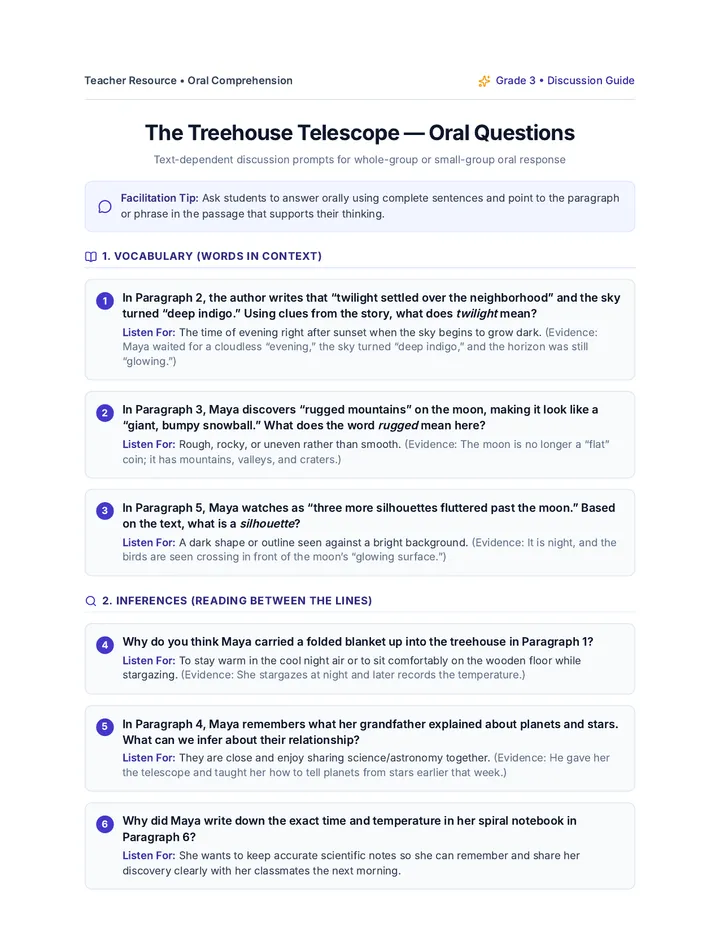
[1] Clara tiptoed past the rusted padlocks dangling open from the greenhouse gate. Inside, amid rows of wilting orchids, a porcelain flowerpot lay shattered on the damp brick path, its potting soil still wet and freshly scattered.
[2] Clara crouched down. Beneath the broken shards was a silver trowel with fresh soil caked on its blade, alongside a small, crumpled envelope addressed to her brother Julian, postmarked that very morning.
1. Which sentence from the story provides the BEST evidence that Julian was recently digging in the greenhouse?
A) “Clara tiptoed past the rusted padlocks dangling open from the greenhouse gate.”
B) “Beneath the broken shards was a silver trowel with fresh soil caked on its blade, alongside a small, crumpled envelope addressed to her brother Julian...”
C) “Inside, amid rows of wilting orchids, a porcelain flowerpot lay shattered on the damp brick path...”
2. Inference Prompt: Did this disturbance happen days ago, or just minutes before Clara arrived? Quote ONE exact phrase and explain how it proves your answer.
Exact Quote:
Reasoning (Why it proves it):
Detective Confidence: [ ] 1 Need Help [ ] 2 Getting There [ ] 3 Master Detective Ticket A
Cut Along Dashed Line (2 Copies Per Sheet)
Evidence Mastery Exit Ticket • Case File #104
5 MIN CHECK Score: / 4
Student Name:
Date:
Period:
Micro-Story: “The Whispering Greenhouse”
[1] Clara tiptoed past the rusted padlocks dangling open from the greenhouse gate. Inside, amid rows of wilting orchids, a porcelain flowerpot lay shattered on the damp brick path, its potting soil still wet and freshly scattered.
[2] Clara crouched down. Beneath the broken shards was a silver trowel with fresh soil caked on its blade, alongside a small, crumpled envelope addressed to her brother Julian, postmarked that very morning.
1. Which sentence from the story provides the BEST evidence that Julian was recently digging in the greenhouse?
A) “Clara tiptoed past the rusted padlocks dangling open from the greenhouse gate.”
B) “Beneath the broken shards was a silver trowel with fresh soil caked on its blade, alongside a small, crumpled envelope addressed to her brother Julian...”
C) “Inside, amid rows of wilting orchids, a porcelain flowerpot lay shattered on the damp brick path...”
2. Inference Prompt: Did this disturbance happen days ago, or just minutes before Clara arrived? Quote ONE exact phrase and explain how it proves your answer.
Exact Quote:
Reasoning (Why it proves it):
Detective Confidence: [ ] 1 Need Help [ ] 2 Getting There [ ] 3 Master Detective Ticket B
Evidence Detectives Answer Key Teacher Answer Key • Evidence Detectives
Case File #104 Intervention Guide • Practice Packet & Exit Ticket Solutions
Teacher Guide
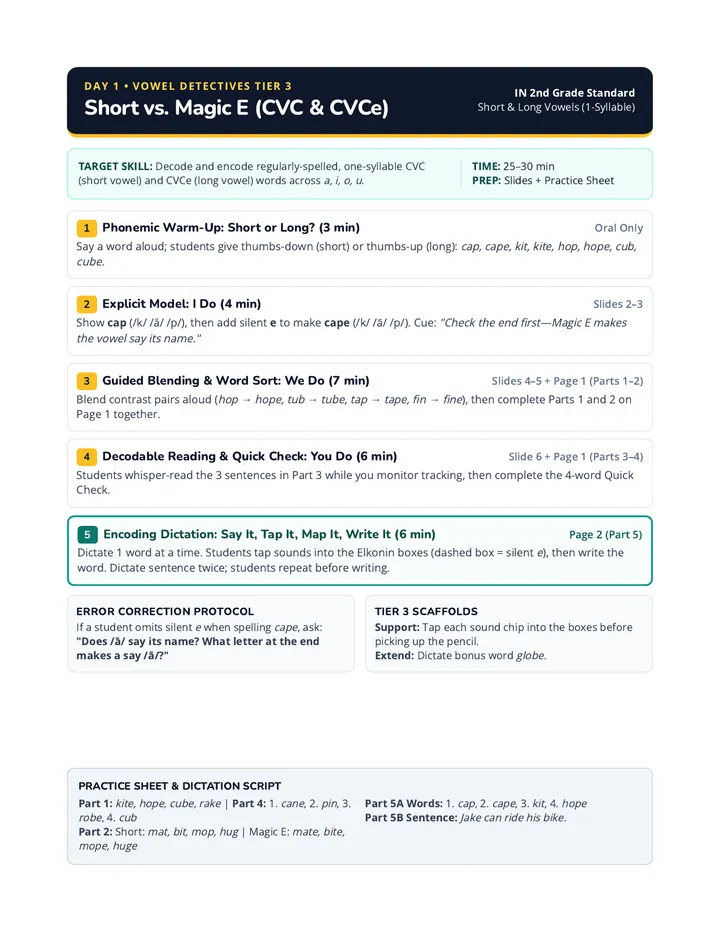
1. Mini-Lesson (5 min) Teach formula: Clues + Schema = Inference. Contrast weak vs. strong quotes.
2. Guided Log (8 min) Model bracketed paragraphs. Emphasize physical verbs and sensory clues.
3. Independent (12 min) Students solve Henderson mystery and complete 3-step proof bridge.
4. Exit Ticket (5 min) Cut 2-up slips. Require direct quotes with quotation marks.
Packet Page 1 Solutions: Guided Detective Log The Brass Pocketwatch (Part 1)
Question 1 (Vance’s Panic):
Acceptable Evidence: “...wringing his handkerchief until the lace tore” OR “Every time the floorboards creaked, he flinched and cast a frantic glance...” OR “pointing a shaking finger.”Exemplar Reasoning: Physical actions like tearing a handkerchief, flinching at small noises, and trembling hands are involuntary physical reactions that show extreme anxiety and fear.
Question 2 (Intruder Through Window):
Two Physical Clues: (1) “...scattering of dried pine needles and a pair of damp, muddy boot prints pointing strictly into the room” AND (2) “...the velvet curtains behind the desk were swaying slightly, even though the window latch was fastened tight.”Exemplar Connection: Muddy bootprints pointing only inward prove entry from outside, while fluttering curtains indicate someone recently disturbed the window area or is hiding behind them.
Packet Page 2 Solutions: Independent Investigation The Brass Pocketwatch (Part 2)
Question 3 Multiple Choice: CORRECT ANSWER: B
Distractor Analysis: Option B directly contradicts his claim of shoveling dirty coal in a dark cellar all morning. (Options A, C, and D describe clothing, noises, and dialogue, but B is the definitive physical proof of his lie.)
Question 4 Constructed Response (3-Part Bridge):
Inference: Mr. Henderson stole the pocketwatch and broke into the cabinet.Direct Quote: “...patting his coat pocket, where a round, heavy object produced a distinct metallic clinking sound” OR “a tiny scrap of matching green wool snagged on the splintered drawer.”Reasoning: A torn piece of green wool on the broken drawer matches Henderson’s torn scarf, and the metallic clinking in his pocket matches the heavy brass pocketwatch.
Exit Ticket Answer Key • “The Whispering Greenhouse” 4 Points Total
Item 1 (Multiple Choice - 2 pts):
Answer: B
Finding a silver trowel with fresh soil alongside an envelope specifically addressed to Julian directly ties him to the fresh digging.
Item 2 (Quote & Reason - 2 pts):
Inference: Happened recently (minutes ago).Quote: “potting soil still wet and freshly scattered” OR “envelope... postmarked that very morning.”Reasoning: Wet potting soil dries rapidly once exposed to air; morning postmark proves same-day presence.
Rapid Teacher Intervention • What to Watch For:
Misconception: Students cite general background facts instead of proof (e.g., “He wore a tweed vest”).Immediate Correction Prompt: “Does a tweed vest prove a crime happened, or does it just tell us what he wore? What specific physical clue connects to the broken cabinet?”
Evidence Detectives Intervention Resource Teacher Reference Only Answer Key