Stormy Parlor Reading Handout Grade 9 • ELA Reading Block Target Time: 15 Minutes
Stormy Parlor Close Reading & Evidence Check
Objective: Read the story, answer comprehension questions, make inferences, and pick the best evidence to support your response.
Name:
Date: Pd:
Reading Focus: Cite the strongest, most specific textual evidence (CCSS RL.9-10.1) to support both explicit answers and inferences.
Clue + Logic = Inference
Excerpt: The Monkey's Paw by W.W. Jacobs (1902)
Complexity: ~1080L
1Without, the night was cold and wet, but in the small parlour of Laburnam Villa the blinds were drawn and 2the fire burned brightly. Father and son were at chess, the former, who possessed ideas about the game 3involving radical changes, putting his king into such sharp and unnecessary perils that it even provoked 4comment from the white-haired old lady knitting placidly by the fire.
5"Hark at the wind," said Mr. White, who, having seen a fatal mistake after it was too late, was amiably 6desirous of preventing his son from seeing it.
7"I'm listening," said the latter, grimly surveying the board as he stretched out his hand. "Check."
8"I should hardly think that he'd come to-night," said his father, with his hand poised over the board.
9"Mate," replied the son.
10"That's the worst of living so far out," bawled Mr. White, with sudden and unlooked-for violence; "of all the 11beastly, slushy, out-of-the-way places to live in, this is the worst. Pathway's a bog, and the road's a torrent."
Vocabulary in Context
radical (adj.)
placidly (adv.)
amiably (adv.)
torrent (noun)
1 Part 1: Comprehension Questions (Cite Exact Lines & Details) Require direct textual citation
Q1. How does Jacobs contrast the setting outside Laburnam Villa with the parlor inside? Cite specific details from lines 1–2.
Q2. Why does Mr. White suddenly say, "Hark at the wind," in line 5? Cite the narrator's exact explanation from lines 5–6.
Q3. Immediately after his son says "Mate" (line 9), how does Mr. White react, and what two specific complaints does he shout about the house's location (lines 10–11)?
Unit 1: Close Reading & Evidence-Based Analysis Page 1 of 2 • Turn over for Inference & Best Evidence Lab
Analytical Depth
Inference Lab: Making Inferences & Picking Best Evidence
CCSS.ELA-LITERACY.RL.9-10.1
2 Inference Architecture: Clue + Logic = Inference
Best Text Clue (Exact Quote)
+ Logical Reasoning
= Evidence-Based Inference
"putting his king into such sharp and unnecessary perils" (line 3)
A chess player who takes needless, reckless risks with his most important piece likely acts impulsively in real life too.
Mr. White is a thrill-seeker who acts before thinking through dangerous consequences.
3 Part 2: Pick the Best Evidence & Support Your Inference Circle strongest quote + explain
Inference 1 (Character Psychology): Circle the best piece of textual evidence that supports this inference: "Mr. White hates losing and tries to distract people from his own mistakes."
A. "the blinds were drawn and the fire burned brightly" (lines 1–2)
B. "having seen a fatal mistake... desirous of preventing his son from seeing it" (lines 5–6)
C. "knitting placidly by the fire" (line 4)
Why is your chosen quote the strongest evidence?
Inference 2 (Father–Son Contrast): How does the son's personality differ from Mr. White's during the chess game? Pick the best quote from lines 7–9 to prove your claim.
Best Quoted Evidence (with line #):
My Inference & Reasoning:
Inference 3 (Foreshadowing & Mood): What does Mr. White's sudden outburst in lines 10–11 suggest about how he handles frustration—and how might that cause trouble later? Pick the best quote and explain.
Best Quoted Evidence (with line #):
My Inference & Reasoning:
CRAFT BRIDGE Mentor Takeaway for Your Narrative Writing Reading → Narrative Craft
Jacobs hooks readers with sensory contrast (cold storm vs. warm fire), varies sentence length (short "Mate." vs. long descriptions), and uses dialogue to expose character flaws. Use these moves—plus internal dialogue—as you revise your introduction and write the middle of your story!
Stormy Parlor Close Reading & Inference Handout Page 2 of 2 • Transition to Narrative Workshop
Story Blueprint Planning Worksheet Narrative Workshop Multi-Paragraph Planning
Narrative Story Blueprint & Architecture
Plan your multi-paragraph narrative: setting, sequencing organization, sensory details, varied sentences, dialogue, and internal dialogue.
Name:
Date: Pd:
1 Step 1: Topic, Core Conflict & Point of View
Anchor your narrative focus
My Story Premise & Central Conflict (1–2 sentences):
Point of View (POV):
1st Person (I, we)
3rd Person Limited (he, she)
2 Step 2: Sequencing Organization (Beginning → Middle → End)
1. Introduction (Revise)
Hook, character, sensory setting, and baseline tone.
2. Middle: Rising Action
Inciting obstacle, dialogue, and escalating tension.
3. Climax Peak
Decisive turning point or highest moment of pressure.
4. Resolution & Shift
Aftermath, internal realization, or consequence.
3 Step 3: Setting & Sensory Details Palette
Ground your introduction and middle scenes in vivid sensory details:
👁 Sight & Light Colors, shadows, weather
👂 Sound & Silence Echoes, pitch, volume
✋ Touch & Temp Textures, heat, numbness
👃 Smell & Air Aroma, dampness, fumes
⚡ Internal / Gut Pulse, adrenaline, dread
Unit 1: Multi-Paragraph Narrative Architecture Page 1 of 2 • Turn over for Dialogue, Syntax & Checklist
Craft Arsenal
Dialogue, Sentence Variety & Narrative Checklist
Intro Revision + Middle Launch
4 Dialogue & Internal Dialogue Planner
Use both to drive the middle of your story
Spoken Dialogue (External)
Reveals conflict or character voice. Use quotation marks and a new paragraph per speaker.
Draft 1–2 lines of dialogue for your middle scene:
Internal Dialogue (Unspoken Thought)
Shows the protagonist's private fear, doubt, or realization without quotation marks.If the latch snaps now, I'm trapped out here until morning.
Draft 1–2 internal thoughts to build tension:
Sequencing Transitions Bank Star 3 to use
Chronological:
At dawn, moments before, concurrently, as seconds ticked away, eventually
Sudden Shifts / Tension:
Without warning, in an instant, abruptly, mid-stride, out of the periphery
Spatial Movement:
Across the threshold, beneath the canopy, flanking the path, beyond the ridge
Varied Sentence Structures Alternate lengths
1. Short & Punchy (Simple):
"The engine sputtered. Silence followed."
2. Compound (Coordination):
"The wind whipped the canvas, but he refused to let go."
3. Complex (Subordinating Starter):
"Although the shadows lengthened, she kept running."
✓ Master Narrative Writing Checklist Use when revising intro & drafting middle
Engaging hook & revised introduction
Setting atmosphere with 2+ sensory details
Logical sequencing organization & transitions
Varied sentence structures (short + complex)
Spoken dialogue (properly punctuated)
Internal dialogue showing character thoughts
Workshop Action Plan: Intro Revision → Middle of Story
Complete before drafting
Jot down 1 specific upgrade you will make to your introduction (e.g., stronger sensory detail or varied sentence), and the exact event that kicks off the middle of your story:
My Introduction Revision Target:
How the Middle of My Story Begins:
Story Blueprint Planning Worksheet Page 2 of 2 • Move to Final Project Writer Checklist & Drafting Sheet
Narrative Launch Teacher Guide Teacher Facilitation Guide Grade 9 • ELA Reading & Writing
Narrative Workshop: Inference, Revision & Rising Action
Dual-Focus Session: Close Reading of The Monkey's Paw & Best Evidence Selection + Intro Revision & Middle-of-Story Launch.
Duration: 35–45 Mins
Model: Gradual Release
Reading Objective
Students read a complex story excerpt (The Monkey's Paw ), answer explicit comprehension questions, make logical inferences, and pick the best textual evidence to support their responses.
Writing Objective
Students plan and write a multi-paragraph narrative with setting, sequencing organization, sensory details, varied sentences, dialogue, and internal dialogue—revising their introduction before starting the middle.
⏱ Instructional Pacing Roadmap
Time
Phase & Focus
Teacher & Student Actions
0:00–6:00
Close Read & Q1–Q3
Frame vocabulary and model annotating Jacobs's excerpt. Students answer 3 comprehension questions citing exact line numbers.
6:00–14:00
Inference & Best Evidence
Teach Clue + Logic = Inference and how to distinguish strong vs. weak quotes. Students complete Inference Lab 1–3.
14:00–20:00
Craft & Dialogue (I Do)
Bridge Jacobs's sensory contrast, sentence rhythm, and character-revealing dialogue to narrative writing. Model spoken vs. internal dialogue.
20:00–27:00
Intro Revision (We Do)
Guide students to audit their introduction against the Writer Checklist and revise 2–3 sentences for sensory detail or varied syntax.
27:00–40:00
Begin Middle (You Do)
Students use sequencing transitions to draft the middle of their story, weaving in spoken dialogue, internal dialogue, and varied sentences.
🗣 Gradual Release Facilitation Scripts (Teacher Talk)
I DO (Teacher Modeling) Revising an Intro & Adding Dialogue / Internal Dialogue
"Look at my first draft intro: 'It was cold on the fire escape.' That tells, it doesn't show. I'm revising it to: 'The iron rungs burned through my leather gloves.' Now, to launch the middle, I'll add a transition—'Without warning, the latch groaned'—and pair spoken dialogue with an internal thought so the reader feels my panic."
WE DO (Guided Practice) Picking Best Evidence & Upgrading Intro Lines
"In Inference 1, why is Option B ('preventing his son from seeing it') stronger evidence than Option A ('blinds were drawn')? Turn and tell your partner. Now look at your own introduction: circle one flat sentence you will upgrade with sensory detail or a varied sentence starter before starting the middle."
YOU DO (Independent Workshop) Intro Revision → Middle-of-Story Drafting
"Complete your targeted introduction revision in Part A, then use a sequencing transition to launch the middle of your story in Part B. Make sure your middle scene includes at least one line of spoken dialogue, one internal thought, and a mix of short and complex sentences. Check off your Writer's Checklist as you go."
Narrative Launch Teacher Facilitation Guide Page 1 of 2 • Turn over for Answer Key & Exemplars
Teacher Reference
Answer Key & Narrative Exemplars
Formative Evaluation Guide
1 Part 1: Comprehension Answer Key (The Monkey's Paw)
Q1 Key (Setting Contrast): Outside, "the night was cold and wet," whereas inside the small parlor, "the blinds were drawn and the fire burned brightly" (lines 1–2).
Q2 Key (Distraction): He says it because, "having seen a fatal mistake after it was too late," he was "amiably desirous of preventing his son from seeing it" (lines 5–6).
Q3 Key (Outburst & Complaints): He "bawled... with sudden and unlooked-for violence," complaining that "Pathway's a bog, and the road's a torrent" (lines 10–11).
2 Part 2: Inference & Best Evidence Key
Inference 1 Key (Best Evidence): Correct Choice: B ("having seen a fatal mistake... desirous of preventing his son from seeing it," lines 5–6). It directly shows him hiding a blunder. (Choice A is setting; Choice C describes the mother.)
Inference 2 Exemplar (Father–Son Contrast): Best Quote: "'I'm listening,' said the latter, grimly surveying the board... 'Check.'" (line 7) or "'Mate,' replied the son." (line 9). Inference: Unlike his impulsive, blustering father, the son is calm, focused, and observant.
Inference 3 Exemplar (Foreshadowing & Mood): Best Quote: "bawled Mr. White, with sudden and unlooked-for violence" (line 10). Inference: He blames outside forces when his risky plans fail, foreshadowing reckless choices when higher stakes arise.
3 Exemplar: Revised Introduction → Middle of Story Launch
[Revised Intro] The iron rungs of the fire escape burned through my leather gloves as Chicago breathed icy gusts of diesel and salt below. [Middle Launch] Without warning, the steel latch groaned behind me. I froze. If that heavy door locks, nobody will hear me from the street, I thought, my pulse hammering against my ribs. "Hey! Hold the door!" I shouted, lunging toward the frame.
Sensory: Burning iron, diesel, pulse.
Sequence: "Without warning."
Syntax: 2-word "I froze." + complex.
Internal: Italicized fear thought.
Dialogue: "Hey! Hold the door!"
Scaffolds for Striving Learners
Provide an inference stem: "The best quote is '___' because it shows..." For writing, let students highlight one transition and one dialogue line before drafting.
Extensions for Advanced Writers
Challenge students to weave internal dialogue directly between lines of spoken dialogue to show contrast between what a character says and truly thinks.
Teacher Guide: Narrative Foundations Page 2 of 2 • ELA Curriculum Ready
Narrative Launch Slides Grade 9 ELA Reading & Writing Workshop
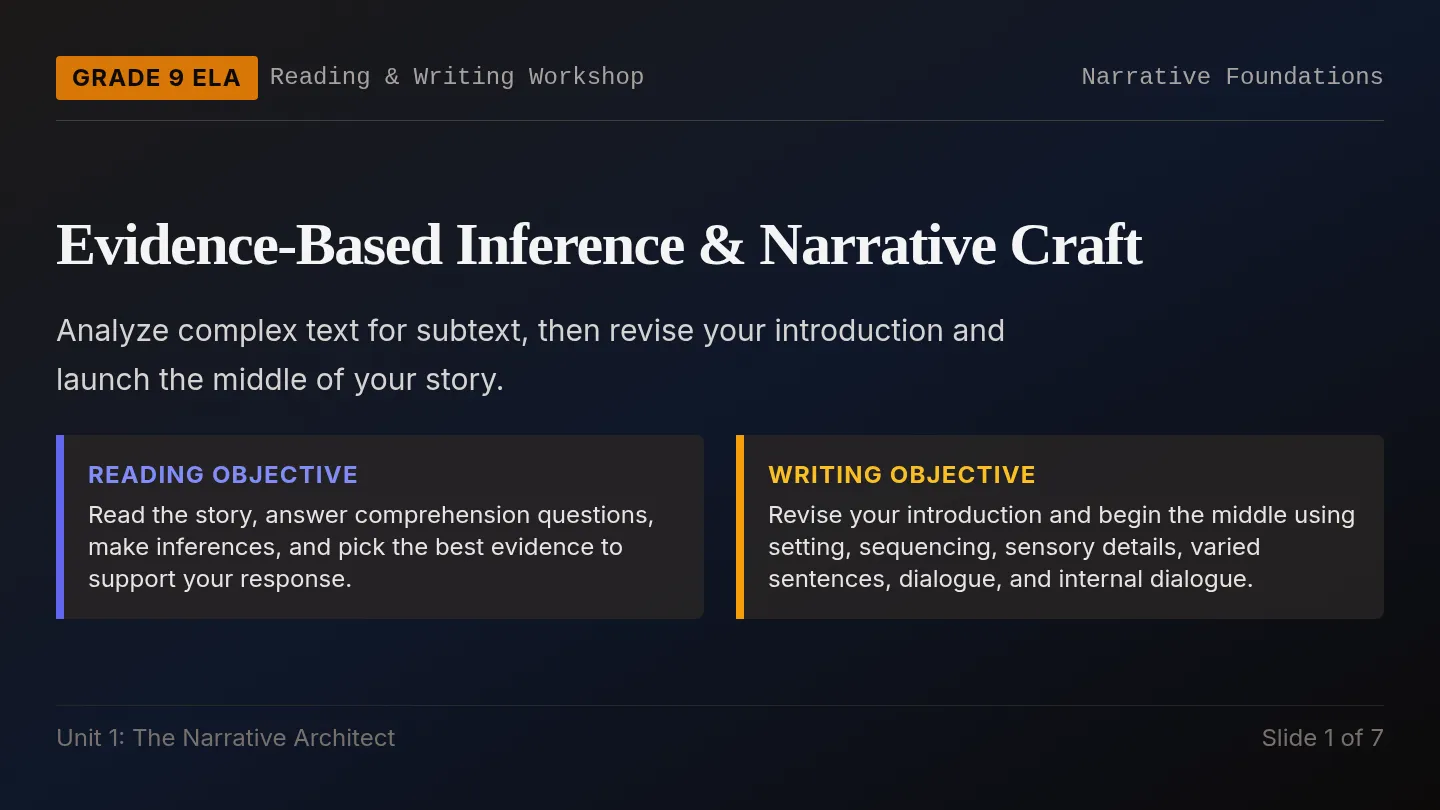
Narrative Foundations
Evidence-Based Inference & Narrative Craft
Analyze complex text for subtext, then revise your introduction and launch the middle of your story.
Reading Objective
Read the story, answer comprehension questions, make inferences, and pick the best evidence to support your response.
Writing Objective
Revise your introduction and begin the middle using setting, sequencing, sensory details, varied sentences, dialogue, and internal dialogue.
Unit 1: The Narrative Architect Slide 1 of 7
Part 1 • Reading Strategy CCSS.ELA-LITERACY.RL.9-10.1
Inference + Picking the Best Evidence
A strong inference is built on the most specific quote—not just any detail from the page.
Step 1
Best Text Clue
Pick the quote that directly proves the hidden mood or motive.
Step 2
Logical Reason
Connect the author's word choice to human psychology.
Step 3
Solid Inference
State the deeper truth revealed beneath the surface.
Evidence Test: Ask yourself: "Does this quote prove my claim, or is it just background setting detail?"
Inference & Best Evidence Lab Slide 2 of 7
Mentor Text Analysis The Monkey's Paw by W.W. Jacobs
"Without, the night was cold and wet, but in the small parlour... the fire burned brightly... 'Mate,' replied the son."
3 Craft Moves to Use in Your Story:
1. Sensory Setting
Jacobs contrasts the cold, wet storm outside with the warm fire inside.
2. Sentence Rhythm
Long descriptive lines contrast with the sharp, 1-word punch of "Mate."
3. Dialogue & Flaws
Spoken dialogue ("Hark at the wind") exposes Mr. White's pride and impatience.
From Reader to Writer Slide 3 of 7
Part 2 • Narrative Craft I DO • Craft Modeling
Dialogue vs. Internal Dialogue
Use both spoken words and unspoken thoughts to bring the middle of your story to life.
Spoken Dialogue (External)
Words spoken aloud between characters. Reveals conflict, urgency, and personality.
"Don't let go of the rail!" Maya shouted over the wind.
Rule: Use quotation marks and start a new line for each new speaker.
Internal Dialogue (Thought)
The protagonist's private thoughts, fears, or realizations inside their head.
If the steel latch snaps now, I'm trapped out here until morning.
Rule: No quotation marks; weave thoughts right into the action.
Dialogue & Inner Voice Slide 4 of 7
Workshop Step 1 WE DO • Intro Revisions
Make Revisions on Your Introduction
Before moving to the middle, upgrade your opening using these 4 targeted revision moves:
1. Sharpen the Hook
Cut slow warm-up sentences; drop the reader straight into action, sensory shock, or thought.
2. Layer Sensory Setting
Replace generic words ("cold," "loud") with 2+ vivid physical senses.
3. Vary Sentence Structure
Combine choppy lines into a complex sentence, or add one punchy 3-word sentence.
4. Hint at Stakes
Add a line of internal dialogue that hints at what could go wrong next.
Revise Part A on Your Checklist Sheet Slide 5 of 7
Workshop Step 2 YOU DO • Begin the Middle
Begin the Middle of Your Story
Use sequencing organization to bridge from your revised introduction into rising action:
Sequencing Transitions
Time: Moments later, as seconds ticked away
Sudden Shift: Without warning, abruptly, mid-stride
Space: Across the threshold, beneath the ledge
Middle Scene Must-Haves
1. Introduce the first real complication or obstacle.
2. Include at least 1 line of spoken dialogue.
3. Show 1 internal thought reacting to the pressure.
Draft Part B on Your Checklist Sheet Slide 6 of 7
Self-Audit Writing Checklist
Narrative Writing Checklist
✓
Setting & Senses: Vivid place + 2+ sensory details
✓
Sequencing: Clear order & transition phrases
✓
Varied Sentences: Short punchy + complex clauses
✓
Spoken Dialogue: Punctuated & moves plot
✓
Internal Dialogue: Unspoken thoughts & stakes
✓
Intro → Middle: Revised hook + rising action
Check off every item as you revise and draft! Slide 7 of 7
Final Project Writer Checklist Final Writing Project Multi-Paragraph Narrative
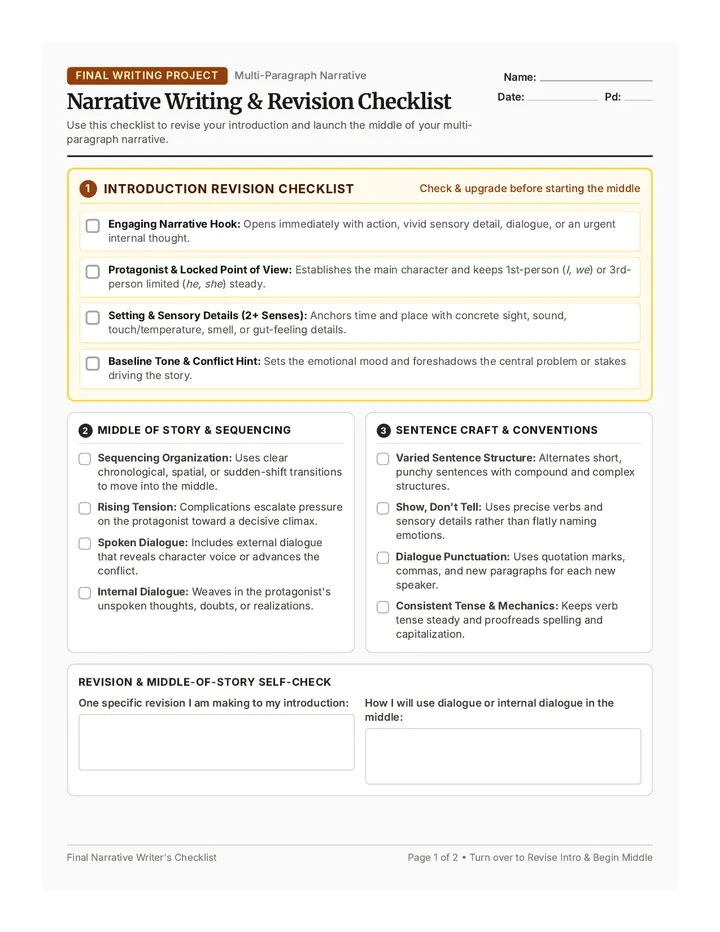
Narrative Writing & Revision Checklist
Use this checklist to revise your introduction and launch the middle of your multi-paragraph narrative.
Name:
Date: Pd:
1 Introduction Revision Checklist
Check & upgrade before starting the middle
Engaging Narrative Hook: Opens immediately with action, vivid sensory detail, dialogue, or an urgent internal thought.
Protagonist & Locked Point of View: Establishes the main character and keeps 1st-person (I, we ) or 3rd-person limited (he, she ) steady.
Setting & Sensory Details (2+ Senses): Anchors time and place with concrete sight, sound, touch/temperature, smell, or gut-feeling details.
Baseline Tone & Conflict Hint: Sets the emotional mood and foreshadows the central problem or stakes driving the story.
2 Middle of Story & Sequencing
Sequencing Organization: Uses clear chronological, spatial, or sudden-shift transitions to move into the middle.
Rising Tension: Complications escalate pressure on the protagonist toward a decisive climax.
Spoken Dialogue: Includes external dialogue that reveals character voice or advances the conflict.
Internal Dialogue: Weaves in the protagonist's unspoken thoughts, doubts, or realizations.
3 Sentence Craft & Conventions
Varied Sentence Structure: Alternates short, punchy sentences with compound and complex structures.
Show, Don't Tell: Uses precise verbs and sensory details rather than flatly naming emotions.
Dialogue Punctuation: Uses quotation marks, commas, and new paragraphs for each new speaker.
Consistent Tense & Mechanics: Keeps verb tense steady and proofreads spelling and capitalization.
Revision & Middle-of-Story Self-Check
One specific revision I am making to my introduction:
How I will use dialogue or internal dialogue in the middle:
Final Narrative Writer's Checklist Page 1 of 2 • Turn over to Revise Intro & Begin Middle
Writing Workshop
Revise Your Introduction & Begin the Middle
Step 1: Revise • Step 2: Draft Middle
Dialogue & Thought
• Spoken: "Wait here," he muttered.
• Internal: What if it's too late?
• Rule: New speaker = new line
Transition Bank
• Time: Moments later, at dawn
• Shift: Without warning, abruptly
• Space: Across the hall, beyond
Sentence Mix Goal
• 1 short, punchy sentence
• 1 compound sentence (and / but )
• 1 complex starter (Although / As )
Part A: Revise Your Introduction (Targeted Upgrade)
Strengthen 2–3 sentences
Rewrite or upgrade key lines from your introduction below to sharpen your hook, add sensory setting details, or vary your sentence structure.
Part B: Begin the Middle of Your Story (Rising Action)
Include transition + dialogue + internal dialogue
Launch the middle of your narrative! Use a sequencing transition to introduce the rising obstacle, and weave in sensory details, varied sentences, spoken dialogue, and internal dialogue.
Quick Craft Self-Audit
Sensory Setting
Sequencing
Varied Syntax
Dialogue
Internal Thought
Final Project Writer Checklist & Drafting Sheet Page 2 of 2 • Continue Drafting in Writer's Notebook