Standards and Load Critique Guide Teacher Diagnostic & Revision Brief
Standards & Cognitive-Load Critique
Grade 4 ELA • Week 15
60-Min Daily Block
PART 1
Grade 4 Standards Alignment Gaps
1. RI.4.8 — Over-indexing on Persuasive Ranking Over Point-to-Evidence Mapping
Gap: Original Day 1–3 tasks jump straight to ranking "Steel vs. Wobbly Legs" (closer to Grade 5/6) before verifying students can map which reason/evidence supports which specific point.
Fix: Sequence Day 1–2 around Point → Reason → Evidence mapping using the Plug-In Test ([Point] + BECAUSE + [Evidence]), then introduce strength comparison on Day 3.
2. W.4.1 (a–f) — Counterargument Requirement Exceeds Grade 4 & Omits Revision
Gap: Requiring a counterargument rebuttal for 3/3 mastery on Day 4 and Day 5 reflects Grade 7 (W.7.1a), not Grade 4. Meanwhile, W.4.1f (planning, revising, editing) was squeezed out by a 30-minute seminar.
Fix: Align the core 3-point rubric to Grade 4 W.4.1a–e (opinion, grouped reasons, text evidence, linking words, conclusion), mark counterarguments as an optional Challenge Extension , and protect 7 min for partner revision.
3. SL.4.1 (a–d) & SL.4.3 — High Transition Load & Passive Outer Circle in Fishbowl
Gap: Moving chairs into Fishbowl circles wastes instructional time, leaves half the class passive, and lacks explicit SL.4.1b norms or SL.4.3 point-to-evidence tracking.
Fix: Replace the Fishbowl with a Four Corners Evidence Pitch : students huddle by chosen reason, deliver 60-sec cited pitches, and log 2 other corners' proof on a Peer Evidence Log.
PART 2
Cognitive-Load Bottlenecks (Extraneous Load)
Original Bottleneck
Why It Overloads Grade 4
Redesigned Solution
7 Simultaneous Annotation Codes
Blue tabletops, Pink [R]/[E]/★, Yellow vocab, Chunk-Sum-Pic (≤6 words + 5-sec sketch), and Plug-In Test exceed working memory.
2-Step Routine: 1) Underline Claim (Blue) & Box Evidence [E]; 2) 3–5 word margin gist.
12+ Multi-Morpheme Vocab Words
Breaking down 4–5 words per passage mid-read fractures comprehension of the author's argument.
2–3 High-Leverage Words/Text: Quick 20-sec context-clue check using embedded appositives/dashes.
Split-Attention Packet Layout
Teacher scripts, answer keys, and student worksheets are interleaved in one 24-page file with tiny answer lines.
Separate Print-Ready Files: Clean student packets with wide margins and full white writing boxes.
Evidence Detectives Casebook • Critique & Revision Brief Page 1 of 2
PART 3
60-Minute Pacing & Instruction Redesign
The original plan packed 5–6 rapid transitions into every 60-minute block, leaving insufficient time for modeling, Kidney Table support, and Day 4/5 writing. Below is how each day was streamlined to protect germane cognitive load .
Day
Original Pacing Issue
Streamlined 60-Min Flow
Day 1
6 transitions; 3-min card sort + 8-min debrief + 11-min model + 9-min dialogue + 20-min Activity A + Exit Ticket.
4 Focused Blocks: Hook Sort & Debrief (12m) → I Do Model ¶1–2 (15m) → Partner Activity A + Kidney Table (25m) → Exit Check (8m).
Day 2
Dense 3-part CFU dialogue plus 4-question Activity B (whole-group + partner + 2 independent) in 26 minutes.
Gradual Release: Warm-Up (5m) → We Do ¶3–4 + Model Inference (15m) → Activity B + Kidney Table (32m) → Exit Ticket (8m).
Day 3
Full read-aloud, 5-word vocab, full close read, 2-column organizer, ranking, AND 2 Fishbowl questions in one block.
Depth Over Rush: Principal Pitch Hook (6m) → Read-Aloud & Partner Close Read (20m) → Ranking & Pitch Note (26m) → Ticket (8m).
Day 4
Two-round Fishbowl + Whisper Feedback + Self-Check (30m) AND full W.4.1 opinion piece + 4-part self-audit (30m).
Realistic Split: Four Corners Huddle, Pitches & Peer Log (26m) → Planner & Draft W.4.1 Paragraph (27m) → Partner Check (7m).
Day 5
Warm Read (6 MC) + Cold Read (6 MC) + full W.4.1 Constructed Response + Cursive Reflection in 60 min.
Protected Testing Time: Directions (4m) → Warm Read (18m) → Cold Read (22m) → Item 13 Writing (16m). (Cursive moved to morning work.)
Redesigned Lesson Bundle (6 Print-Ready Materials)
1. Streamlined Five Day Lesson Plan
Clean 5-day pacing, simplified 2-step annotation key, Four Corners protocol, and small-group moves.
2. Evidence Stress Test Card Sort
Unlabeled student cut-out cards for Day 1 (no bracketed answers!) plus a Tabletop sorting mat.
3. Dreams and Recess Student Packet
Days 1–3 passages with wide annotation margins, Activities A & B, and the 2-Column Tabletop Organizer.
4. Four Corners and Writing Packet
Day 4 huddle planner, SL.4.3 Peer Evidence Log, W.4.1 planner, lined draft page, and checklist.
5. Day Five EOG Assessment Packet
Day 5 Warm Read & Cold Read passages, 12 neutral-styled MC items, and a lined Item 13 response page.
6. Complete Teacher Answer Key
All activity keys, Day 5 rationales & misconceptions, W.4.1 3-point rubric, and <70% reteach protocol.
Evidence Detectives Casebook • Critique & Revision Brief Page 2 of 2
Streamlined Five Day Lesson Plan Grade 4 ELA • Week 15 Extension
Evidence Detectives Casebook
60-Min Daily Block
Days 1–4 Instruction + Day 5 EOG
Focus Standards: RI.4.8 (Explain how reasons & evidence support points), RI.4.1 (Explicit & inferential comprehension), RI.4.4 / L.4.4 (Context clues), SL.4.1a–d & SL.4.3 (Four Corners debate & tracking speaker evidence), W.4.1a–f (Opinion writing).
Essential Question: How does an author use specific reasons and concrete evidence to prove a point, and how do readers evaluate which evidence is strongest?
Learning Target: "I can map an author's claim to its supporting reasons and evidence, test whether evidence truly proves the point, and defend my own opinion using cited text proof."
Proficiency Goal: ≥ 70% (11/15 pts) on Day 5 EOG Assessment & ≥ 2/3 on the Grade 4 W.4.1 Rubric.
LOW-LOAD ROUTINE Simplified 2-Step Annotation & Plug-In System
Step 1: Claim (Blue)
Underline the author's main point or claim in Blue . (Draw a quick tabletop ═══ if helpful.)
Step 2: Proof (Amber/Pencil)
Box concrete evidence [E] (studies, numbers, expert quotes) & jot a 3–5 word gist in the margin.
The Plug-In Test (RI.4.8)
Test: [Claim] + BECAUSE + [Evidence] . If it doesn't prove the claim, it's a Broken Leg!
Point-of-Use Vocabulary (2–3 High-Leverage Words Per Text)
Text
Target Words
20-Second Context-Clue Check (During Read)
Understanding Dreams (Days 1–2)
subconscious, consolidate, cognitive
Use embedded dash/comma appositives: sub- (under) + "—the hidden part..." ; consolidate = "—or strengthen and organize—" ; cognitive = ", or thinking and problem-solving," .
The Benefits of Recess (Day 3)
sedentary, stimulate, mandatory
Use dash definitions & contrast clues: sedentary = "—or inactive, sitting—" ; stimulate = wakes up alertness vs. fatigued ; mandatory = "—required rather than optional—" .
Core Domain Terms (Anchor Chart)
Claim, Reason, Evidence (Steel / Wobbly / Broken)
Steel Leg: Verifiable data/study/expert. Wobbly Leg: Vague generalization. Broken Leg: True fact that fails the BECAUSE Plug-In Test.
Evidence Detectives Casebook • Streamlined 5-Day Lesson Plan Page 1 of 4
DAY 1 (60 Min): Mapping Claims, Reasons & Concrete Evidence
RI.4.8 • RI.4.1
Materials: Evidence Stress-Test Card Sort (1 envelope/pair) + Dreams & Recess Student Packet (pp. 1–2).
1. Hook & Debrief (Min 1–12): Pairs sort 8 unlabeled sleep cards into Tabletop Claim , Reasons , Evidence , and Broken Legs (irrelevant facts) . Debrief using the Plug-In Test: "Does 'Deep sleep helps students remember BECAUSE pillows are filled with feathers' prove the claim? No—throw it out!"
2. I Do Modeling — "Understanding Dreams" ¶1–2 (Min 13–27): Display passage. Model the 2-step routine: underline ¶1's claim in Blue ("Scientists believe dreaming plays an essential role..." ). In ¶2, box the 35% sleep study [E] , do a 20-sec context check on consolidate , and write a 4-word margin gist ("Sleep locks in memories" ). Run 1 quick CFU: "How does the 35% study prove dreaming helps the brain?"
3. Partner Practice — Activity A & Kidney Table (Min 28–52): Partners complete Activity A (¶1–2 Claim, Reason, Evidence, Plug-In Test, & DOK 3 comparison). Kidney Table: Pull developing readers for echo-reading ¶1–2 and physical strip-matching before writing.
4. Exit Ticket (Min 53–60): On a sticky note, students write 2 sentences: "What evidence in ¶2 proves sleep strengthens memory, and how does it pass the Plug-In Test?"
DAY 2 (60 Min): Multi-Clue Inferences & Independent Extraction
RI.4.1 • RI.4.8 • RI.4.4
Materials: Dreams & Recess Student Packet (pp. 1, 3) + Day 1 Exit Ticket sort.
1. Warm-Up — "Upgrade the Wobbly Leg" (Min 1–5): Board Claim: "Dreaming helps humans solve difficult problems." Wobbly Leg: "Sometimes people wake up with good ideas." Partners turn-and-talk: "What Steel Leg evidence would make this believable?"
2. We Do Modeling — "Understanding Dreams" ¶3–4 (Min 6–20): Read ¶3–4 together. Underline ¶3's claim in Blue ("safe practice space" ) and box the neurologist explanation [E] . Quick 20-sec context check on cognitive (comma appositive in ¶4). Model 1 inference using Text Clues + Schema = Inference (why keeping a bedside notebook helps inventors).
3. Gradual Release — Activity B & Kidney Table (Min 21–52): Complete Q1 together, Q2 with a partner, and Q3–Q4 independently (starting answers with "In paragraph __..." ). Kidney Table: Pull Day 1 Exit Ticket bubble students to use 3-Box Inference Strips (Text Clue + Schema = Inference ) for Q2–Q3.
4. Exit Ticket (Min 53–60): Quick check: "Which evidence is stronger—the 35% puzzle study (¶2) or the neurologist explanation (¶3)? Write 1 sentence explaining why."
Evidence Detectives Casebook • Streamlined 5-Day Lesson Plan Page 2 of 4
DAY 3 (60 Min): Evaluating Evidence Strength & Pitch Prep
RI.4.8 • SL.4.1a
Materials: Dreams & Recess Student Packet (pp. 4–5: "The Benefits of Recess" + 2-Column Organizer).
1. Hook — "Principal Pitch Showdown" (Min 1–6): Compare Pitch A ("We love kickball" ) vs. Pitch B ("Brain research proves outdoor movement boosts concentration 25%" ). Students explain why Pitch B persuades Principal Davis.
2. Teacher Read-Aloud & Partner Close Read (Min 7–26): Read "The Benefits of Recess" aloud for fluency (RF.4.5) without giving away claims. Partners apply the 2-step routine: underline ¶1's claim in Blue , box concrete evidence [E] in ¶2–4, jot 3–5 word margin gists, and check sedentary , stimulate , and mandatory via dash/contrast clues.
3. Organizer, Ranking & Pitch Prep (Min 27–52): Partners transfer ¶2, ¶3, and ¶4 onto the 2-Column Tabletop Organizer, rank #1 (Strongest Steel Leg) to #3 (Weakest/General Leg), and draft one 60-second pitch note for tomorrow's Four Corners Debate. Kidney Table: Co-construct 1 verified quote card with developing speakers.
4. Corner Ticket (Min 53–60): Students write their #1 strongest reason and exact statistic/quote to bring to their corner tomorrow.
DAY 4 (60 Min): Four Corners Evidence Pitch & W.4.1 Writing
SL.4.1a–d • SL.4.3 • W.4.1
Materials: Four Corners & Writing Packet (pp. 1–2) + Day 3 Recess Organizer + 4 Corner Signs.
1. Four Corners Evidence Pitch (Min 1–26): Post 4 signs (Corner 1: Physical Health ¶2 , Corner 2: Brain Focus ¶3 , Corner 3: Social Skills ¶4 , Corner 4: Need Stronger Proof ). Students move to their chosen corner and huddle (5 min) to pick their #1 quote/stat. Each corner delivers a 60-sec Evidence Pitch while classmates log 2 other corners on their Peer Evidence Log (SL.4.3) (12 min). Wrap up with a 3-min reflection/self-check (SL.4.1d) & return to seats.
2. Opinion Planning & Drafting — W.4.1 (Min 27–53): Prompt: "Should schools have longer daily recess?" Students spend 5 min transferring their best 2 reasons & statistics into the W.4.1 Planner, then 21 min drafting a grouped opinion paragraph with linking words (First of all, Furthermore, According to paragraph __, For these reasons ) and a conclusion. (Optional Extension: address the test-prep time concern.)
3. Partner Check & Revise — W.4.1f (Min 54–60): Partners use the 4-box Student Checklist (Opinion, 2 Text Reasons/Stats, Linking Words, Conclusion) to spot 1 quick revision before turning in.
Evidence Detectives Casebook • Streamlined 5-Day Lesson Plan Page 3 of 4
DAY 5 (60 Min): End-of-Week EOG-Style Assessment
RI.4.1 • RI.4.4 • RI.4.8 • W.4.1
Materials: EOG-Style Assessment Packet (pp. 1–5) | Digital Option: SchoolNet Quick Check "The Wagon Road" (ID: 6339753 / CODE: RI48PRACT).
4 Min
18 Min
22 Min
16 Min
Teacher Administration Script: "Evidence Detectives, today you will show independent mastery. Follow along silently as I read Passage 1 aloud once to orient us—no discussion yet. Then annotate Passage 1 and answer Items 1–6. Next, complete Passage 2 completely on your own (Items 7–12), just like on the NC EOG. Run the Plug-In Test silently before bubbling! Finally, use the planning box and lined page for Item 13."
Post-Test Analysis & Small-Group Reteach (See It / Name It / Do It)
1. See It: Compare Warm Read (Passage 1) vs. Cold Read (Passage 2) accuracy. Watch for students choosing true background facts ("Broken Legs") that fail the Plug-In Test ([Claim] + BECAUSE + [Evidence]) or missing Part B evidence pairing (Item 10).
2. Name It: "A detail can be 100% true in the passage and still be a Broken Leg if it does not directly prove the author's specific claim via the Plug-In Test."
3. Do It: Pull students scoring below 70% (<11/15 points) into a 15-minute reteach using 1 Claim card and 3 candidate evidence strips, requiring oral Plug-In Test verification before selecting an answer.
Evidence Detectives Casebook • Streamlined 5-Day Lesson Plan Page 4 of 4
Evidence Stress Test Card Sort Day 1 Hook • Partner Card Sort
Evidence Stress-Test Cards
Cut along dashed lines (1 set per pair)
Directions: Cut out the 8 cards below. Sort them on your Tabletop & Legs Mat (Page 2): find the 1 Tabletop Claim , separate Reasons from Evidence , toss out any Broken Legs (irrelevant facts), and rank your valid evidence from strongest to weakest!
Card A
"Getting a full night of deep sleep is essential for helping students remember what they learn in school."
Card B
"During sleep, the brain actively sorts, strengthens, and organizes new information from the day."
Card C
"Rested brains can focus longer and solve complex problems without getting overwhelmed."
Card D
"In a controlled sleep study, students who slept eight hours after learning a new puzzle scored 35 percent higher the next morning than students who stayed awake."
Card E
"Brain-scan research by neurologists shows that memory centers in the brain replay daytime lessons during deep REM sleep."
Card F
"Many students say they feel much better in class after going to bed early."
Card G
"Most pillows are filled with soft feathers, cotton, or memory foam."
Card H
"The average human spends about one-third of their entire life asleep."
Evidence Detectives Casebook • Day 1 Card Sort Page 1 of 2
Day 1 Hook • Sorting Mat
Tabletop & Table Legs Mat
Names: ___________________________
1. The Tabletop (Author's Main Claim — 1 Card)
2. Reasons (Why? — 2 Cards)
3. Valid Evidence (Rank #1 → #3)
4. Broken Legs — Fails the Plug-In Test! (2 Cards)
Check: [Claim] + BECAUSE + [Card] . If it doesn't prove the claim, place it here!
Evidence Detectives Casebook • Day 1 Sorting Mat Page 2 of 2
Dreams and Recess Student Packet Days 1–2 Reading Passage
Understanding Dreams
Name: ___________________________
Date: ______________
Step 1: Underline the Claim in Blue . Step 2: Box Evidence [E] & write a 3–5 word gist in the margin.
1 Every night when your body lies still in bed, your brain enters one of its busiest work shifts of the day. While you rest, your subconscious —the hidden part of the mind working below awareness—processes thoughts, emotions, and experiences from your waking hours. Although people once believed dreams were meaningless nighttime movies, scientists now believe dreaming plays an essential role in keeping our brains healthy.
2 First, dreaming helps the brain lock new learning into long-term memory. During deep sleep, the brain works hard to consolidate —or strengthen and organize—memories from the day. Instead of keeping every tiny detail, the brain filters out unimportant clutter and connects key facts to what you already know. In one sleep study, students who slept eight hours after learning a new puzzle scored 35 percent higher the next morning than students who stayed awake.
Chunk 1 Gist (3–5 words)
3 Second, dreams act as a safe practice space where the brain rehearses how to handle stressful problems. For example, people facing a big exam, a musical performance, or an athletic championship often experience vivid —or bright, lifelike—recurring dreams that repeat over and over across many nights. Neurologists , or doctors who study the human brain and nervous system, explain that practicing solutions in a dream helps lower daytime anxiety so people feel calmer when the real event arrives.
4 Finally, dreaming allows the sleeping brain to connect ideas in fresh, creative ways. Because the dreaming mind is not limited by strict daytime rules, it can test unusual combinations and spark cognitive , or thinking and problem-solving, breakthroughs. Throughout history, famous scientists, writers, and artists have discovered solutions to difficult math problems or imagined brand-new inventions immediately after waking from a dream.
Chunk 2 Gist (3–5 words)
Evidence Detectives Casebook • Student Packet Page 1 of 5
Day 1 • Partner Practice (Chunks 1: ¶1–2)
Activity A: Mapping Claims & Evidence
Name: ________________________
1. Author's Main Claim (Paragraph 1 — Underline Blue):
2. Supporting Reason (Why? — Paragraph 2):
3. Concrete "Steel Leg" Evidence [E] (Paragraph 2 — Boxed):
4. Run the Plug-In Test (RI.4.8):
Claim
BECAUSE
Evidence
5. Why is the sleep study in Paragraph 2 stronger evidence than simply saying, "Kids feel tired when they stay up late" ?
Evidence Detectives Casebook • Student Packet Page 2 of 5
Day 2 • Gradual Release (Chunks 2: ¶3–4)
Activity B: Inferences & Evidence
Name: ________________________
TOGETHER
1. Cite the expert explanation in Paragraph 3 that proves dreams act as a "safe practice space."
PARTNER
2. Why would keeping a notebook beside your bed be smart for an inventor or student? (¶3–4)
Text Clue (¶4)
+ My Schema
= Inference
ON YOUR OWN
3. Cite ONE piece of evidence from ¶3 and ONE from ¶4, and explain how they prove dreaming helps people overcome challenges.
ON YOUR OWN
4. Why would skipping the final hours of sleep hurt a student more than just making them sleepy? Cite ¶2 or ¶3.
Evidence Detectives Casebook • Student Packet Page 3 of 5
Day 3 Reading Passage
The Benefits of Recess
Name: ________________________
Step 1: Underline the Claim in Blue . Step 2: Box Evidence [E] & write a 3–5 word gist in the margin.
1 Across the nation, some school districts have shortened or eliminated daily recess to squeeze extra test-preparation minutes into the schedule. However, pediatricians and education researchers agree that daily recess is not a waste of school time; it is an essential part of a child's physical, social, and academic growth. Cutting outdoor play actually harms the very learning goals schools are trying to improve.
¶1 Gist
2 First, daily recess combats sedentary —or inactive, sitting—habits and builds lifelong physical health. Elementary students spend nearly six hours a day sitting at classroom desks. Medical doctors recommend at least 60 minutes of moderate-to-vigorous physical activity every day, and school recess supplies up to 40 percent of a child's daily movement. Running, climbing, and jumping strengthen growing hearts, bones, and muscles in ways indoor lessons never can.
¶2 Gist
3 Furthermore, outdoor movement breaks stimulate brain alertness and dramatically improve classroom concentration. When students sit through back-to-back lessons without a break, their brains become fatigued and distracted. Brain-scan and classroom studies prove that students pay attention 25 percent longer and complete assignments more accurately after a 20-minute outdoor break. Making daily recess mandatory —required rather than optional—ensures every student returns to class ready to learn.
¶3 Gist
4 Finally, unstructured recess gives children vital practice in social problem-solving and teamwork. Unlike adult-led sports or classroom group work, recess allows students to invent games, negotiate rules, and resolve disagreements on their own. Learning to compromise when a kickball call is disputed builds empathy, communication, and leadership skills that prepare students for adulthood.
¶4 Gist
Evidence Detectives Casebook • Student Packet Page 4 of 5
Day 3 • Evidence Ranking & Pitch Prep
Tabletop & Legs Organizer
Name: ________________________
Author's Central Claim / Tabletop (Paragraph 1)
Reason (Why? — [R])
Exact Text Evidence ([E])
Rank (#1–#3)
Paragraph 2 Reason:
|
Evidence [E1]:
|
|
|
Paragraph 3 Reason:
|
Evidence [E2]:
|
|
|
Paragraph 4 Reason:
|
Evidence [E3]:
|
|
Which reason is supported by the strongest evidence (#1), and why?
My 60-Second Pitch Note for Tomorrow's Four Corners Debate (SL.4.1a):
Evidence Detectives Casebook • Student Packet Page 5 of 5
Four Corners and Writing Packet Day 4 • Four Corners Evidence Pitch
Corner Huddle & Peer Evidence Log
Name: ___________________________
Date: ______________
Four Corners Rules (SL.4.1b)
Move silently to the corner with the strongest proof .
In your huddle, everyone helps pick 1 exact stat or quote.
Listen silently during other corners' 60-second pitches.
Pitch & Response Stems (SL.4.1c)
• "Our corner chose paragraph __ because..."
• "This is a Steel Leg because it proves..."
• "I respectfully challenge Corner __ because..."
Step 1: My Corner Huddle Plan (4 Minutes)
Circle Corner: 1 (Health ¶2) | 2 (Focus ¶3) | 3 (Social ¶4) | 4 (Need More Proof)
Our Exact Quote or Statistic (¶ #):
Why This Beats the Other Corners (Plug-In Test):
Step 2: Peer Evidence Log — Track 2 Other Corners (SL.4.3)
Corner #
Reason Pitched
Exact Statistic / Quote Cited
How It Proved the Point
Step 3: Evidence Pitch Reflection & Self-Check (SL.4.1d):
Shared or helped prep a text stat? [ ] Yes [ ] Almost Listened & logged 2 other corners? [ ] Yes [ ] Almost
Which corner had the strongest Steel Leg, and did your mind change? ___________________________________________________
Evidence Detectives Casebook • Day 4 Four Corners & Writing Page 1 of 2
Day 4 • Evidence-Based Opinion Writing (W.4.1)
Recess Opinion Planner & Draft
Name: ________________________
Prompt: Should schools have longer daily recess? Write a well-organized opinion paragraph stating your position and supporting it with at least two grouped reasons and concrete text evidence from The Benefits of Recess . Use linking words and include a concluding statement.
1. My Opinion (W.4.1a)
2. Reason 1 + Stat/Quote
3. Reason 2 + Stat/Quote
Linking Words (W.4.1c): In my opinion, First of all, Furthermore, According to paragraph __, For these reasons | Challenge Extension: Address why recess helps test-prep time!
Partner Check & Revise (W.4.1f):
[ ] Clear opinion statement at the start [ ] At least 2 reasons with exact text stats/quotes [ ] Linking words connect reasons & evidence [ ] Strong concluding statement at the end
Evidence Detectives Casebook • Day 4 Four Corners & Writing Page 2 of 2
Day Five EOG Assessment Packet Day 5 Assessment • Passage 1 (Warm Read)
Why School Gardens Grow Smarter Students
Name: ___________________________
Date: ______________
Directions: Follow along silently as your teacher reads Passage 1 aloud. Then use your 2-step annotation routine (underline Claims, box Evidence [E] ) and run the Plug-In Test silently before answering Items 1–6.
1 Across the country, elementary schools are transforming unused patches of grass into thriving outdoor gardens. Although some critics argue that tending plants takes valuable instructional minutes away from core subjects, growing a school garden is actually one of the most beneficial learning tools a school can offer. When students plant, water, and harvest crops, they deepen their scientific understanding, improve their daily nutrition habits, and develop shared accountability.
2 First, school gardens bring abstract science and math concepts to life through hands-on investigation. Rather than merely reading diagrams of plant life cycles in a textbook, fourth graders observe root systems, pollination, and insect habitats directly in the soil. In a 2024 study of fifteen elementary schools, students who participated in weekly garden lessons scored 22 percent higher on district science assessments than peers who learned exclusively from textbooks. Measuring raised garden beds, calculating soil volume, and graphing weekly rainfall also provide authentic practice with fractions and data analysis.
3 Furthermore, cultivating fresh produce motivates students to make healthier dietary choices. Many children reject unfamiliar vegetables in the cafeteria because they have little connection to how those foods are grown or prepared. However, nutrition researchers discovered that students who harvest their own carrots, spinach, and tomatoes are three times more likely to choose vegetables during school lunch. Experiencing the crisp flavor of freshly picked produce shifts healthy eating from an adult rule into a personal achievement.
4 Finally, maintaining a shared outdoor classroom teaches students teamwork and consistent responsibility. Delicate seedlings cannot survive if classes forget to water them during dry spells or allow invasive weeds to crowd out sunlight. By rotating weekly crew roles—such as moisture monitoring, composting, and harvesting—every student recognizes that their daily effort directly affects the entire school community. Through soil, sunlight, and cooperative labor, school gardens cultivate both nutritious food and confident learners.
Evidence Detectives Casebook • Day 5 EOG Assessment Page 1 of 5
Passage 1 Questions (Items 1–6)
Circle the best answer for each item.
1. What is the meaning of the word beneficial as it is used in paragraph 1?
A) Costly to build and maintain
B) Helpful and rewarding for learners
C) Popular among school critics
D) Difficult to schedule during the day
2. Which detail from paragraph 1 best helps the reader understand the meaning of beneficial ?
A) "transforming unused patches of grass into thriving outdoor gardens"
B) "critics argue that tending plants takes valuable instructional minutes away"
C) "deepen their scientific understanding, improve their daily nutrition habits, and develop shared accountability"
D) "elementary schools are transforming unused patches"
3. How does the author support the point in paragraph 2 that school gardens improve academic learning?
A) By comparing the price of science textbooks to the cost of outdoor garden tools
B) By combining test-score data from a 2024 study with examples of hands-on math and science tasks
C) By explaining how teachers grade students on pulling weeds and watering seedlings
D) By describing the different species of insects that live in school gardens
4. Based on paragraph 3, why are students three times more likely to eat vegetables they harvest themselves?
A) School cafeterias only serve fresh vegetables on days when students work in the garden.
B) Growing and harvesting the crops makes unfamiliar foods feel familiar and rewarding to taste.
C) Carrots, spinach, and tomatoes contain more sugar when grown in school soil.
D) Nutrition researchers require garden students to eat three vegetables at every meal.
5. Based on paragraphs 2 and 4, how do school gardens help students develop scientific habits?
A) Students memorize textbook diagrams and complete weekly spelling quizzes.
B) Students observe living plant systems, measure rainfall, and monitor soil moisture and composting.
C) Students design nutrition posters and present them to cafeteria managers.
D) Students compare farming laws used in different regions of the United States.
6. Which statement best explains how the author supports the overall argument across the passage?
A) The author tells a fictional story about a fourth-grade class that won a gardening contest.
B) The author provides step-by-step instructions for building wooden raised garden beds.
C) The author pairs three distinct benefits with research statistics and concrete classroom examples.
D) The author contrasts schools that have outdoor gardens with schools that have indoor libraries.
Evidence Detectives Casebook • Day 5 EOG Assessment Page 2 of 5
Day 5 Assessment • Passage 2 (Cold Read)
The Secret Defense of the Mimic Octopus
Name: ________________________
Cold Read Directions: Read this passage independently. Annotate the author's points and evidence, then answer Items 7–12 on the next page.
1 In the shallow, murky estuaries of Southeast Asia lives an extraordinary master of disguise: the mimic octopus. Unlike most octopuses that survive by retreating into rocky crevices or shifting skin pigments to blend into coral reefs, the mimic octopus travels across open sandbars by impersonating other dangerous marine animals. Because it outsmarts predators with calculated illusions rather than brute strength, marine biologists consider this creature one of the ocean's cleverest defensive strategists .
2 Whenever a predator approaches, the mimic octopus rapidly reshapes its flexible, boneless body to imitate toxic species. For example, if a territorial damselfish attacks, the octopus tucks six of its arms inside a sandy burrow and stretches two banded arms in opposite directions, mimicking a venomous sea snake. Because damselfish instinctively recognize that sea snakes carry lethal venom, the attacker immediately retreats.
3 Even more remarkably, the mimic octopus selects a different disguise depending on which threat appears. Researchers observed that while gliding over open sand, the octopus flattens its body and pulls its arms together to resemble a poisonous flatfish that glides along the ocean floor. Conversely, when hovering above the seabed, it flares its striped arms outward like the venomous spines of a lionfish. By matching each impersonation to a specific predator, the octopus avoids being eaten without ever engaging in combat.
4 Through ingenious adaptations, the mimic octopus demonstrates that quick intelligence can be just as effective for survival as sharp teeth or armored shells. Studying how this animal deceives hunters helps scientists better understand animal cognition and ocean ecosystems.
Evidence Detectives Casebook • Day 5 EOG Assessment Page 3 of 5
Passage 2 Questions (Items 7–12)
Circle the best answer for each item.
7. Based on paragraph 1, how does the mimic octopus's survival strategy differ from most other octopuses?
A) It lives in freezing Arctic waters instead of warm coastal estuaries.
B) It survives in open sandbars by impersonating dangerous creatures rather than hiding in rocks.
C) It uses sharp teeth and an armored shell to fight off attacking damselfish.
D) It cannot change its body shape when predators swim nearby.
8. What is the meaning of strategists as it is used in paragraph 1?
A) Skilled planners of survival tactics
B) Fast swimmers in deep ocean trenches
C) Poisonous snakes that hunt near coral reefs
D) Biologists who study marine ecosystems
9. Part A: Based on paragraphs 2 and 3, what can be inferred about the mimic octopus?
A) It changes its body shape at random whenever it swims across open sand.
B) It identifies different predators and intentionally chooses the disguise that will deter each one.
C) It uses disguises only when hunting damselfish and lionfish for food.
D) It prefers hiding inside dark coral caves where predators cannot find it.
10. Part B: Which sentence from the passage best supports the answer to Part A?
A) "In the shallow, murky estuaries of Southeast Asia lives an extraordinary master of disguise: the mimic octopus." (paragraph 1)
B) "Whenever a predator approaches, the mimic octopus rapidly reshapes its flexible, boneless body to imitate toxic species." (paragraph 2)
C) "By matching each impersonation to a specific predator, the octopus avoids being eaten without ever engaging in combat." (paragraph 3)
D) "Studying how this animal deceives hunters helps scientists better understand animal cognition and ocean ecosystems." (paragraph 4)
11. Which word from paragraph 4 helps the reader understand the meaning of ingenious ?
A) adaptations
B) intelligence
C) effective
D) ecosystems
12. How does the author support the point in paragraph 4 that "quick intelligence can be just as effective for survival as sharp teeth or armored shells" ?
A) By describing how sharks and whales hunt octopuses in deep ocean trenches
B) By explaining how the octopus analyzes threats and imitates three different toxic animals to escape unharmed
C) By comparing the swimming speed of a sea snake to the speed of a flatfish
D) By showing that octopuses have stronger arms than any other marine animal
Evidence Detectives Casebook • Day 5 EOG Assessment Page 4 of 5
Day 5 Assessment • Item 13 Constructed Response
Evidence-Based Opinion Writing
Name: ________________________
13. Prompt: Based on Passage 1 ("Why School Gardens Grow Smarter Students" ), do you think elementary schools should require every class to participate in a weekly school garden program? Write a well-organized opinion paragraph stating your position and supporting it with at least two reasons and concrete text evidence from the passage. Use linking words and include a concluding statement. (Challenge Extension: Explain why your evidence outweighs critics' concerns about instructional time.)
My Opinion:
Reason 1 + Evidence (¶__):
Reason 2 + Evidence (¶__):
Evidence Detectives Casebook • Day 5 EOG Assessment Page 5 of 5
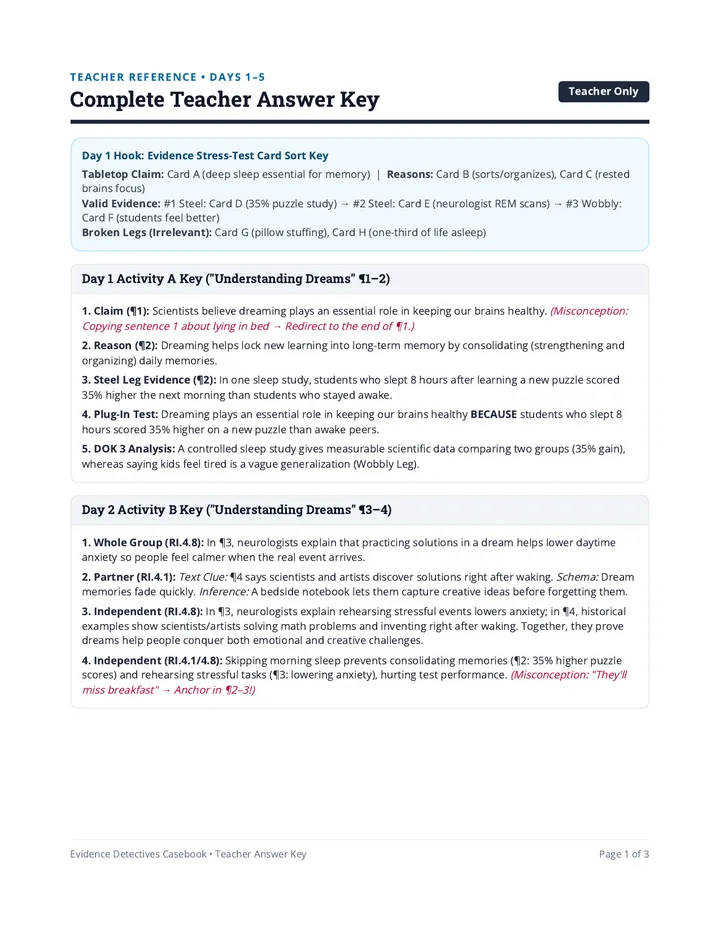
Complete Teacher Answer Key Teacher Reference • Days 1–5
Complete Teacher Answer Key
Teacher Only
Day 1 Hook: Evidence Stress-Test Card Sort Key
Tabletop Claim: Card A (deep sleep essential for memory) | Reasons: Card B (sorts/organizes), Card C (rested brains focus)
Valid Evidence: #1 Steel: Card D (35% puzzle study) → #2 Steel: Card E (neurologist REM scans) → #3 Wobbly: Card F (students feel better)
Broken Legs (Irrelevant): Card G (pillow stuffing), Card H (one-third of life asleep)
Day 1 Activity A Key ("Understanding Dreams" ¶1–2)
1. Claim (¶1): Scientists believe dreaming plays an essential role in keeping our brains healthy. (Misconception: Copying sentence 1 about lying in bed → Redirect to the end of ¶1.)
2. Reason (¶2): Dreaming helps lock new learning into long-term memory by consolidating (strengthening and organizing) daily memories.
3. Steel Leg Evidence (¶2): In one sleep study, students who slept 8 hours after learning a new puzzle scored 35% higher the next morning than students who stayed awake.
4. Plug-In Test: Dreaming plays an essential role in keeping our brains healthy BECAUSE students who slept 8 hours scored 35% higher on a new puzzle than awake peers.
5. DOK 3 Analysis: A controlled sleep study gives measurable scientific data comparing two groups (35% gain), whereas saying kids feel tired is a vague generalization (Wobbly Leg).
Day 2 Activity B Key ("Understanding Dreams" ¶3–4)
1. Whole Group (RI.4.8): In ¶3, neurologists explain that practicing solutions in a dream helps lower daytime anxiety so people feel calmer when the real event arrives.
2. Partner (RI.4.1): Text Clue: ¶4 says scientists and artists discover solutions right after waking. Schema: Dream memories fade quickly. Inference: A bedside notebook lets them capture creative ideas before forgetting them.
3. Independent (RI.4.8): In ¶3, neurologists explain rehearsing stressful events lowers anxiety; in ¶4, historical examples show scientists/artists solving math problems and inventing right after waking. Together, they prove dreams help people conquer both emotional and creative challenges.
4. Independent (RI.4.1/4.8): Skipping morning sleep prevents consolidating memories (¶2: 35% higher puzzle scores) and rehearsing stressful tasks (¶3: lowering anxiety), hurting test performance. (Misconception: "They'll miss breakfast" → Anchor in ¶2–3!)
Evidence Detectives Casebook • Teacher Answer Key Page 1 of 3
Day 3 Key: "The Benefits of Recess" Organizer
Tabletop Claim (¶1): Daily recess is not a waste of school time; it is an essential part of a child's physical, social, and academic growth.
Reason [R]
Exact Evidence [E]
Rank
¶2 Physical Health
Doctors recommend 60 min daily activity; recess supplies up to 40% of a child's daily movement.
#2 (Steel)
¶3 Academic Concentration
Brain-scan & classroom studies prove students pay attention 25% longer & work more accurately after a 20-min break.
#1 (Strongest)
¶4 Social Problem-Solving
General examples of inventing games, negotiating rules, and resolving kickball disputes.
#3 (Wobbly)
DOK 3 Justification: Paragraph 3 is strongest because it pairs brain-scan/classroom studies with measurable data (25% longer attention), whereas ¶4 gives general examples without numbers.
Day 4 Key: Grade 4 W.4.1 Opinion Rubric & Exemplar
3 Points (Mastery)
Clear opinion (W.4.1a); 2+ grouped reasons with exact text stats/quotes (W.4.1b); varied linking words (W.4.1c); concluding statement (W.4.1d).
2 Points (Developing)
States opinion and 1–2 reasons, but includes only 1 concrete text detail, or is missing linking words or a conclusion.
1 Point (Emerging)
States personal preference with zero text evidence, or copies sentences without a clear opinion.
Exemplar 3-Point Student Response (with Challenge Extension):
"In my opinion, schools should definitely provide longer daily recess because it strengthens classroom focus and builds physical health. First of all, brain-scan and classroom studies in paragraph 3 prove that students pay attention 25 percent longer and finish work more accurately after a 20-minute outdoor break, which makes test-prep time more productive. Furthermore, according to paragraph 2, doctors recommend 60 minutes of daily activity, and recess supplies up to 40 percent of a child's daily movement. For these reasons, making longer recess mandatory is one of the smartest investments schools can make."
Evidence Detectives Casebook • Teacher Answer Key Page 2 of 3
Day 5 Assessment Answer Key (Items 1–12 • 15 Pts Total; ≥11/15 = 73%)
Item
Standard
DOK
Key
Rationale & Common Misconception
1
RI.4.4 / L.4.4
2
B
Context clues in ¶1 (deepen understanding, improve nutrition) define beneficial . (Watch for C: "critics" appears earlier.)
2
RI.4.1 / L.4.4
2
C
Exact supporting phrase in ¶1 proving beneficial means helpful/rewarding.
3
RI.4.8
2
B
Tests how author supports ¶2 point (2024 study data + hands-on math/science tasks).
4
RI.4.1
2
B
Synthesizes ¶3 clues (little connection to foods vs. personal achievement).
5
RI.4.1
2
B
Synthesizes scientific habits across ¶2 (observe systems, measure rainfall) & ¶4 (moisture, composting).
6
RI.4.8
3
C
Evaluates overall argumentative structure across all 4 paragraphs.
7
RI.4.1
2
B
Explicit comparison in ¶1 (impersonating creatures vs. hiding in rocky crevices).
8
RI.4.4 / L.4.4
2
A
Context clues (outsmarts predators with calculated illusions ) define strategists .
9
RI.4.1
2
B
Part A inference across ¶2–3. (Watch for A: students miss that each disguise matches a specific predator.)
10
RI.4.1 / RI.4.8
2
C
Part B selects the exact sentence in ¶3 proving Part A.
11
RI.4.4 / L.4.4
2
B
EOG word-relationship item (ingenious → intelligence in ¶4).
12
RI.4.8
3
B
Connects ¶4's concluding claim back to the multi-predator behavioral proof in ¶2–3.
Item 13 (3 Pts — Grade 4 W.4.1a–e Rubric): 3 pts = Clear opinion + 2+ grouped reasons with exact Passage 1 stats + linking words + conclusion. (Challenge Extension: addresses critics' time concerns.)
Exemplar: "In my opinion, elementary schools should require every class to participate in a weekly school garden program because it strengthens academic learning and improves student nutrition. First, paragraph 2 proves that hands-on garden lessons boost science achievement: in a 2024 study of fifteen schools, garden students scored 22 percent higher on science tests than peers using only textbooks. Furthermore, according to paragraph 3, nutrition researchers discovered that students who harvest their own vegetables are three times more likely to choose vegetables at lunch. For these reasons, weekly school gardening belongs in every elementary school."
Evidence Detectives Casebook • Teacher Answer Key Page 3 of 3