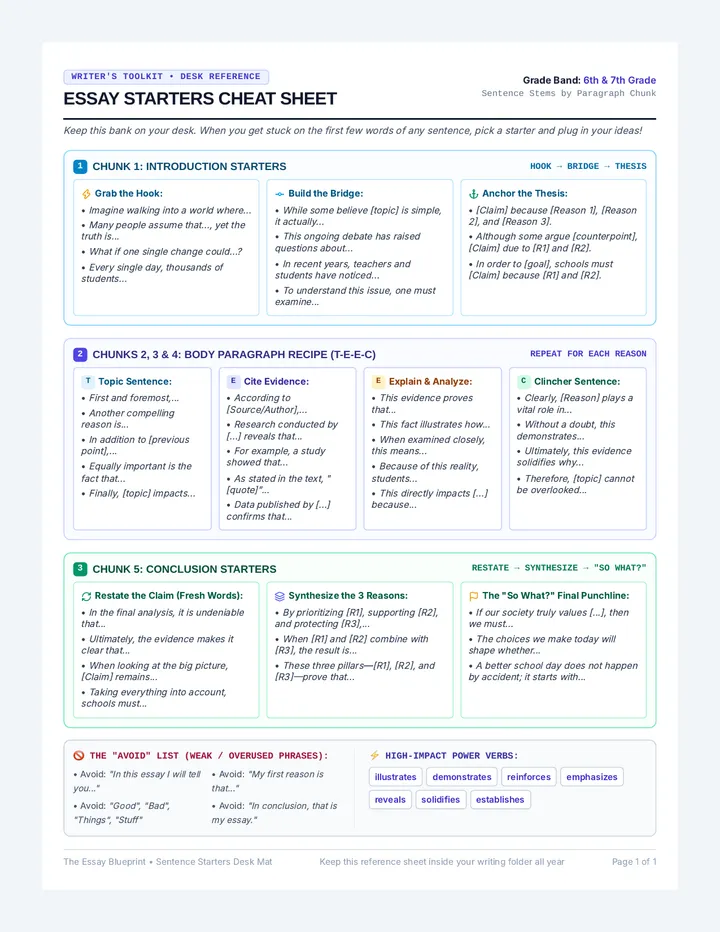
A focused one-period instructional unit for 6th and 7th grade students that demystifies essay writing by breaking five-paragraph essays into manageable, modular components. Includes an engaging slide deck, student guided practice blueprint, exit check, and comprehensive teacher pacing guide.
The Essay Blueprint • Module 01 Keep this organizer in your writing folder for every essay Page 2 of 2
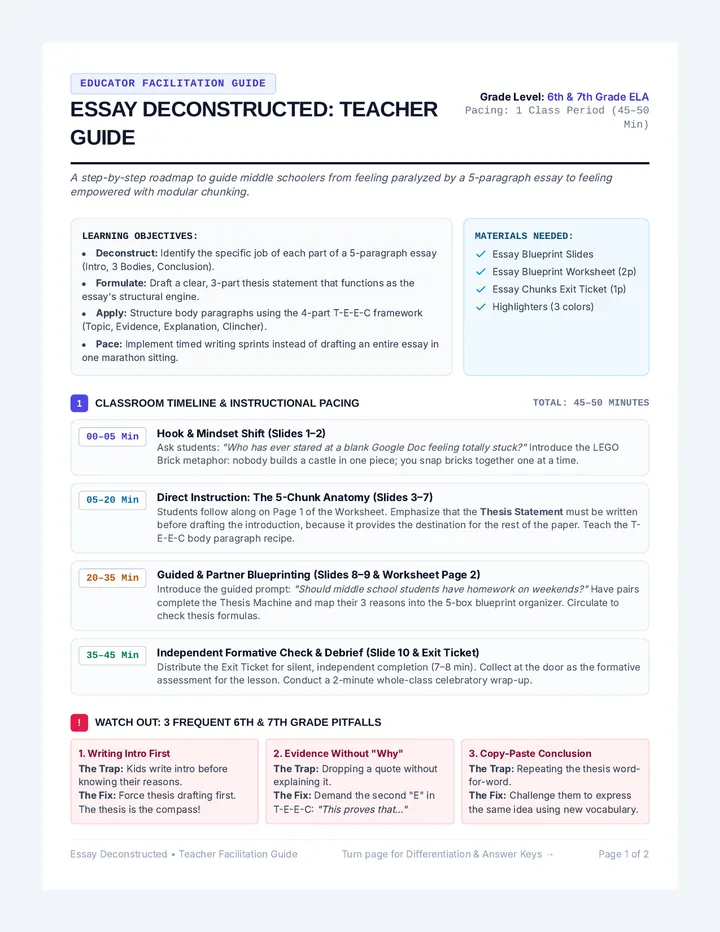
2. Evidence Without "Why"
The Trap: Dropping a quote without explaining it. The Fix: Demand the second "E" in T-E-E-C: "This proves that..."
3. Copy-Paste Conclusion
The Trap: Repeating the thesis word-for-word. The Fix: Challenge them to express the same idea using new vocabulary.
Essay Deconstructed • Teacher Facilitation Guide Turn page for Differentiation & Answer Keys → Page 1 of 2
2
DIFFERENTIATION & COMPLETE ANSWER KEYS
STANDARDS: CCSS.ELA-LITERACY.W.6.1 / W.7.1
Scaffolding & Accommodations (IEP / ML / Struggling)
Sentence Stems Bank: Provide printed sentence starter cards: "One key reason is..." "For instance, research shows..." "This evidence demonstrates that..."
Highlighter Chunk Coding: Have students highlight their notes: Yellow for Hooks, Green for Thesis/Topic, Blue for Evidence, Pink for Explanation.
Chunk Checkpoint System: Require teacher sign-off on Chunk 1 (Thesis) before student moves forward to Body chunks.
Extensions & Advanced Writers
Counterargument Chunk: Convert Body Paragraph 3 into a rebuttal: "While some critics argue that [counterclaim], the reality is [rebuttal]."
Advanced Transitions: Push students beyond simple "First/Second/Finally" to sophisticated transition phrases: "Equally significant..." "Conversely..." "Building upon this..."
Hook Experimentation: Challenge them to write 3 different hook styles (statistic, vivid anecdote, rhetorical question) and select the most persuasive.
✓ EXIT TICKET ANSWER KEY & SCORING RUBRIC
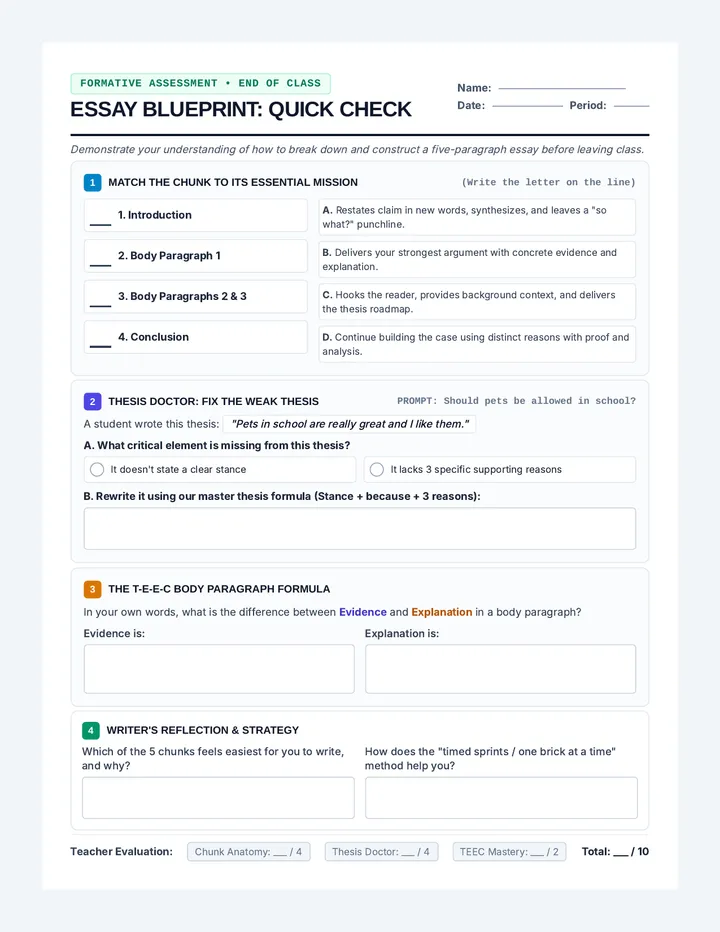
Question 1 (Matching Key):
1. Introduction → C (Hook, context, thesis)
2. Body Paragraph 1 → B (Strongest argument, evidence)
3. Body Paragraphs 2 & 3 → D (Continue case with proof)
4. Conclusion → A (Restate, synthesize, punchline)
Question 2 (Thesis Doctor):
Part A: Correct selection is: "It lacks 3 specific supporting reasons." Part B Exemplar:"Schools should allow pets because animals reduce academic stress, teach responsibility, and encourage empathy."
Question 3 (Evidence vs. Explanation Mastery):
Evidence: Concrete facts, quotes, statistics, or real-life examples from external sources (the "what"). Explanation: The writer's own analytical voice explaining how that evidence proves the thesis claim (the "why it matters").
Chunk 1 (Intro): Hook: Quote about adolescent sleep deficit. Thesis: "Schools should not assign weekend homework because it deprives students of essential rest, creates family conflict, and limits time for physical exercise."
Chunk 2 (Body 1): Reason 1: Sleep & recovery. Evidence: CDC guidelines stating teens need 8–10 hours of rest without late-night stress.
Chunk 3 (Body 2): Reason 2: Family & social bonding. Evidence: Survey data showing weekend academic pressure strains family weekends.
Chunk 4 (Body 3): Reason 3: Physical activity and sports. Evidence: American Heart Association recommendations for daily active movement.
Chunk 5 (Conclusion): Restate claim + "So What?": "Weekends are meant to recharge students so they can return on Monday motivated and focused."
The Essay Blueprint System • Middle School ELA Classroom Ready • Reproducible for educational use Page 2 of 2
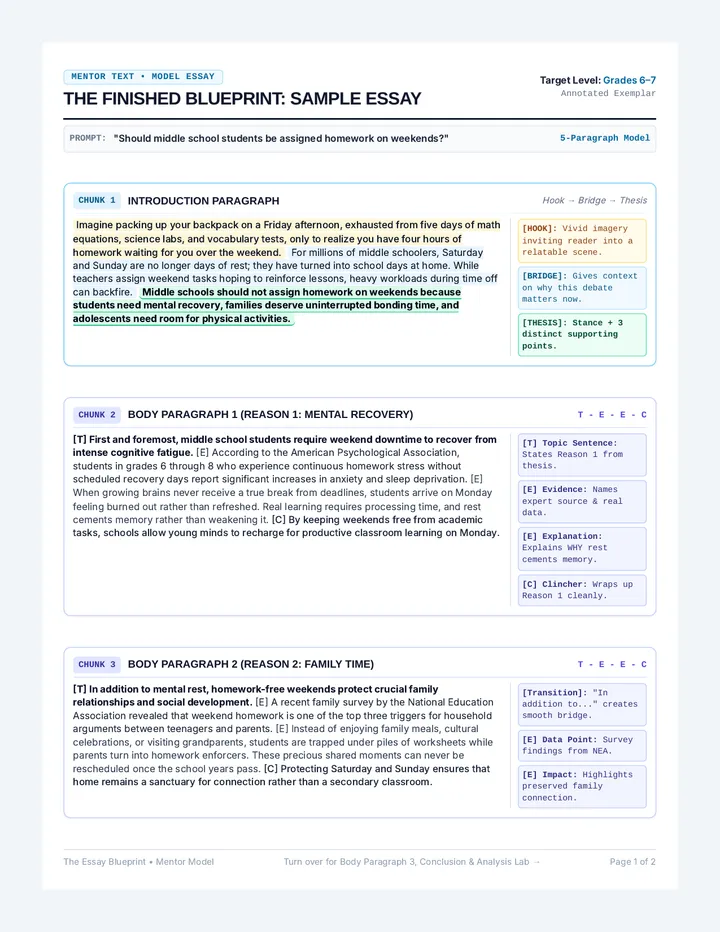
[Transition]: "In addition to..." creates smooth bridge.
[E] Data Point: Survey findings from NEA.
[E] Impact: Highlights preserved family connection.
The Essay Blueprint • Mentor Model Turn over for Body Paragraph 3, Conclusion & Analysis Lab → Page 1 of 2
MODULE 01
SAMPLE ESSAY (CONTINUED) & DECONSTRUCTION LAB
PAGE 2 OF 2
CHUNK 4 BODY PARAGRAPH 3 (REASON 3: PHYSICAL HEALTH & HOBBIES)
T - E - E - C
[T] Finally, leaving weekends open gives middle schoolers necessary time for physical exercise, community sports, and personal creativity. [E] Pediatric guidelines from the Centers for Disease Control recommend at least sixty minutes of vigorous daily physical activity for adolescents, a benchmark fewer than 25% of students currently meet. [E] When students spend forty hours sitting at school desks every week, their bodies crave movement, sports practice, music lessons, and outdoor exploration. These extracurricular passions develop confidence and teamwork skills that no textbook can replicate. [C] Well-rounded individuals grow through rich life experiences outside school walls just as much as through classroom lectures.
[T] Final Reason: Reason 3 from the thesis.
[E] Hard Evidence: CDC recommendation & benchmark.
[E] Argument: Connects health and hobbies to growth.
CHUNK 5 CONCLUSION PARAGRAPH (THE CLINCHER)
Restate → Synthesize → Final Thought
In conclusion, eliminating weekend homework assignments is a necessary step toward building healthier, more balanced middle schoolers. Giving adolescents time off revitalizes their mental stamina, strengthens family bonds, and opens the door for energetic physical recreation. If schools truly wish to foster lifelong learners who arrive each Monday ready to thrive, they must understand that learning does not stop when homework ends—it deepens when students have the time to live full, healthy lives.
[RESTATE]: Says claim in fresh vocabulary.
[SYNTHESIS]: Summarizes the 3 pillars smoothly.
["SO WHAT?"]: Inspiring ending statement.
🔬 MENTOR TEXT STUDY LAB: NOTICE & NOTE
1. Notice Transitions:
Underline the transition phrases starting each body paragraph ("First and foremost," "In addition to," "Finally").
2. Explanation Ratio:
Notice that the writer provides two full sentences of analysis for every single piece of evidence cited.
3. The Conclusion Flip:
Compare Chunk 1's thesis to Chunk 5's opening sentence. The meaning remains intact, but the phrasing is fresh.
The Essay Blueprint • Mentor Model Keep this annotated model essay in your binder as a writing reference Page 2 of 2