English Language Arts Phonics & Reading Foundations Letter Identification Learn Letters A-Z Lowercase and Uppercase Letters Consonants and Vowels Letter-Sound Associations Letter-Sound Associations: Lowercase Letter-Sound Associations: Uppercase Beginning and Ending Sounds Rhyming Blending And Segmenting Short Vowels Short Vowel Sounds Consonant Blends Consonant Digraphs Blends, Digraphs, and Trigraphs Digraphs, Blends, and Silent Letters Long Vowel Sounds Long Vowel Patterns Short and Long Vowels Short and Long Vowel Patterns Silent E Vowel Sounds Vowel Teams R-Controlled Vowels Diphthongs: Oi, Oy, Ou, Ow Variant Vowels Variant, Diphthong, And R Vowel Patterns Soft G And C Sight Words Irregular Words Word Recognition Syllables Syllable Types Two-Syllable Words Multisyllabic Words Phoneme Manipulation Decodable Texts Vocabulary Action Words Question Words Nouns and Adjectives Classify Words Compound Words Synonyms and Antonyms Homophones Homophones and Homonyms Shades of Meaning Context Clues Prefixes and Suffixes Greek and Latin Roots Analogies Idioms and Adages Foreign Words and Expressions Word Choice and Usage Reference Skills Reading Comprehension Read-Along Literary Texts Read-Along Informational Texts Reality vs. Fiction Story Elements Character Sequence Main Idea Cause And Effect Compare And Contrast Reading Strategies Text Structure Author's Purpose Author's Purpose And Tone Author's Perspective Point Of View Theme Inference And Theme Inference And Analysis Poetry Elements Literary Devices Analyzing Literature Analyzing Informational Texts Comparing Texts Audience, Purpose, And Tone Business Documents Novel Study Nonfiction Book Study Grammar & Mechanics Sentences Nouns Verbs Adjectives Pronouns Capitalization Punctuation Contractions Conjunctions Prepositions Articles Adjectives And Adverbs Verb Types Verb Tense Pronouns And Antecedents Pronoun Types Subject-Verb Agreement Direct And Indirect Objects Sentences, Fragments, And Run-Ons Phrases And Clauses Commas Semicolons, Colons, And Commas Dashes, Hyphens, And Ellipses Spelling Abbreviations Formatting Verb Tense And Mood Misplaced Modifiers Writing Descriptive Details Creative Writing Opinion Writing Topic Sentences Organizing Writing Linking Words Sentence Variety Introductions And Conclusions Persuasive And Opinion Writing Expository Writing Persuasive Strategies Developing And Supporting Arguments Topic Sentences And Thesis Statements Summarizing Research Skills Editing And Revising Active And Passive Voice= Writing Clearly And Concisely Debate & Public Speaking Public Speaking Basics Persuasive Techniques Claims and Evidence Types of Arguments Reasoning Types Logical Fallacies Topic Research Organizing Evidence Debate Speech Organization Attacking and Defending Arguments Clash and Engagement Impact Calculus Questioning and Cross-Examination Critical Thinking Informal Logic Formal Logic Inductive Reasoning
Reading Detective Vocabulary A high-yield vocabulary study set designed to master critical question-stem academic terms frequently tested on reading assessments. Features focused word-study puzzles and student-friendly strategy guides.
D destiny.lanier
EOG Vocabulary Word Search Worksheet
A large-format printable word search targeting 25 essential North Carolina EOG reading question-stem vocabulary terms. Features an easy-to-read 20-by-16 letter grid with high-contrast typography, student-friendly checkbox word bank, and minimal negative space.
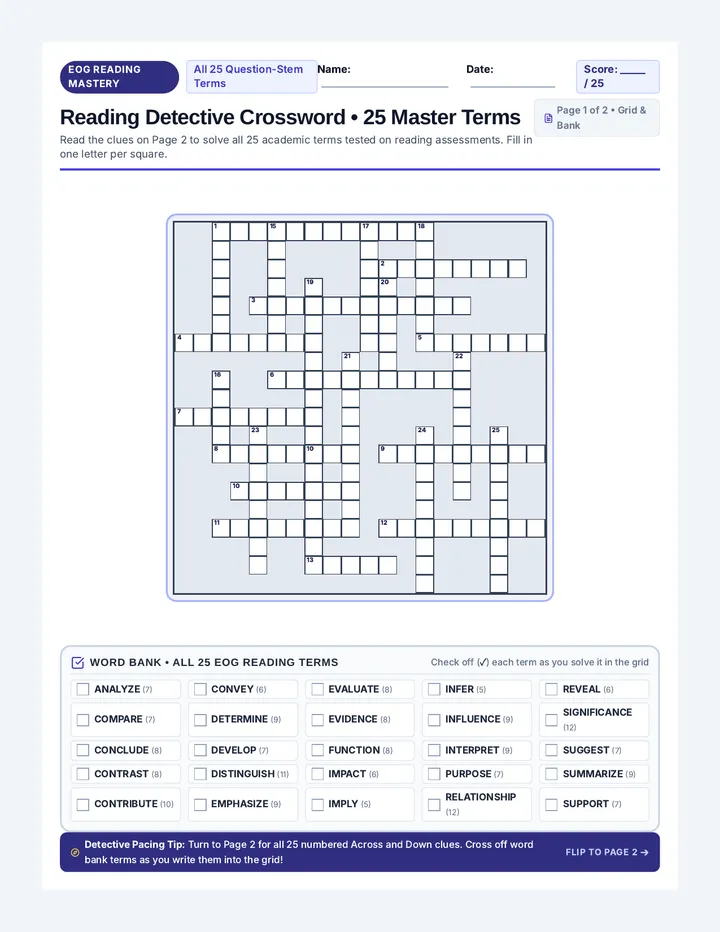
Reading Detective Crossword Worksheet
A comprehensive two-page printable crossword puzzle worksheet featuring all 25 North Carolina EOG reading question-stem vocabulary terms. Page 1 presents a large 20-by-20 grid and a 25-term checkbox word bank; Page 2 provides all 25 numbered Across and Down clues alongside an EOG Question-Stem Decoder guide.
Crossword Master Answer Key
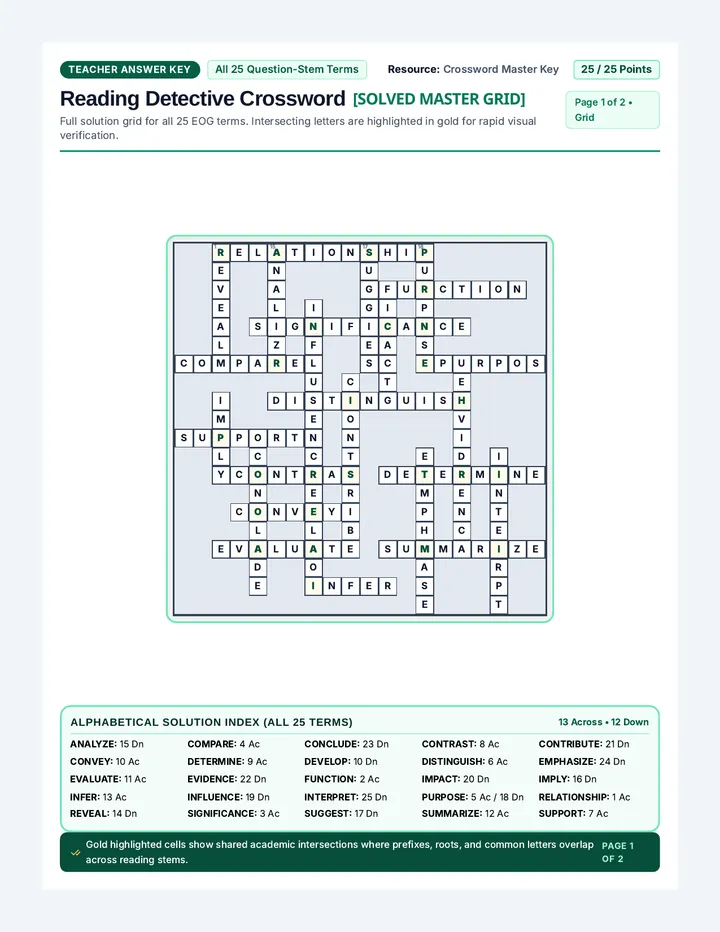
A complete two-page teacher answer key for the 25-term Reading Detective Crossword Worksheet. Page 1 displays the fully solved 20-by-20 grid and alphabetical master index; Page 2 provides bold answers for all 25 clues with test-taking pedagogical notes.
Reading Detective Vocabulary A high-yield vocabulary study set designed to master critical question-stem academic terms frequently tested on reading assessments. Features focused word-study puzzles and student-friendly strategy guides.
D destiny.lanier
EOG Vocabulary Word Search Worksheet EOG Reading Mastery 25 Key Question-Stem Terms
Name:
Date:
Score: _____ / 25
Reading Detective Word Search
Locate all 25 critical vocabulary terms hidden in the puzzle. Words run across (➔), down (⬇), and diagonally (↘).
Letter-Friendly 20×16 Grid
R
E
L
A
T
I
O
N
S
H
I
P
Q
B
K
W
X
J
F
M
T
K
B
G
L
P
C
O
M
P
A
R
E
N
V
Y
W
D
X
C
C
H
A
K
X
B
Q
S
I
G
N
I
F
I
C
A
N
C
E
O
O
I
N
F
E
R
A
V
K
J
L
P
B
X
T
W
H
Y
Q
N
N
D
E
T
E
R
M
I
N
E
Q
X
K
B
W
I
L
F
Z
T
C
V
H
E
O
R
I
M
P
L
Y
G
B
W
K
N
J
U
P
R
L
E
X
M
B
P
I
N
F
L
U
E
N
C
E
T
R
N
A
I
U
V
S
P
S
U
G
G
E
S
T
K
H
Y
D
E
E
C
W
B
D
A
U
H
T
S
U
M
M
A
R
I
Z
E
E
R
V
T
X
U
E
L
P
A
J
C
O
N
V
E
Y
B
K
Q
V
P
E
I
M
T
Q
U
P
S
W
C
O
N
T
R
A
S
T
X
E
R
A
O
F
E
Y
A
O
I
B
P
U
R
P
O
S
E
K
H
L
E
L
N
G
Z
B
T
R
Z
M
E
V
I
D
E
N
C
E
W
O
T
K
F
J
P
K
E
T
E
N
X
I
M
P
A
C
T
Q
B
P
V
Y
H
R
G
A
N
A
L
Y
Z
E
W
R
K
B
C
D
J
F
X
Q
P
T
V
P
X
G
B
W
L
F
K
D
I
S
T
I
N
G
U
I
S
H
M
Word Bank • 25 Reading Question-Stem Terms
Check off (✓) each term as you discover it in the grid
ANALYZE
CONVEY
EVALUATE
INFER
REVEAL
COMPARE
DETERMINE
EVIDENCE
INFLUENCE
SIGNIFICANCE
CONCLUDE
DEVELOP
FUNCTION
INTERPRET
SUGGEST
CONTRAST
DISTINGUISH
IMPACT
PURPOSE
SUMMARIZE
CONTRIBUTE
EMPHASIZE
IMPLY
RELATIONSHIP
SUPPORT
EOG Test Strategy: Look for stems asking what an author suggests , conveys , or what evidence best supports a central idea!
Grade-Level EOG Prep
Reading Detective Crossword Worksheet EOG Reading Mastery All 25 Question-Stem Terms
Name:
Date:
Score: _____ / 25
Reading Detective Crossword • 25 Master Terms
Read the clues on Page 2 to solve all 25 academic terms tested on reading assessments. Fill in one letter per square.
Page 1 of 2 • Grid & Bank
1
15
17
18
2
19
20
3
4
5
21
22
16
6
7
23
24
25
8
10
9
10
11
12
13
Word Bank • All 25 EOG Reading Terms
Check off (✓) each term as you solve it in the grid
ANALYZE (7)
CONVEY (6)
EVALUATE (8)
INFER (5)
REVEAL (6)
COMPARE (7)
DETERMINE (9)
EVIDENCE (8)
INFLUENCE (9)
SIGNIFICANCE (12)
CONCLUDE (8)
DEVELOP (7)
FUNCTION (8)
INTERPRET (9)
SUGGEST (7)
CONTRAST (8)
DISTINGUISH (11)
IMPACT (6)
PURPOSE (7)
SUMMARIZE (9)
CONTRIBUTE (10)
EMPHASIZE (9)
IMPLY (5)
RELATIONSHIP (12)
SUPPORT (7)
Detective Pacing Tip: Turn to Page 2 for all 25 numbered Across and Down clues. Cross off word bank terms as you write them into the grid!
Flip to Page 2 ➔
Clues Dossier 25 Academic Definitions
Page 2 of 2 • Official Clues
Reading Question-Stem Clues (Across & Down)
Match clues to your Page 1 grid by number
ACROSS CLUES 13 Terms
1
How two or more characters, ideas, or events connect or interact across a passage. (12)
2
The specific role, job, or purpose that a phrase or sentence serves in a text. (8)
3
The deeper importance, meaning, or consequence of an event or choice. (12)
4
To examine two or more texts or perspectives to identify how they are alike. (7)
5
The author's primary reason or intent for writing (e.g. inform, persuade). (7)
Crossword Master Answer Key Teacher Answer Key All 25 Question-Stem Terms
Resource: Crossword Master Key
25 / 25 Points
Reading Detective Crossword [SOLVED MASTER GRID]
Full solution grid for all 25 EOG terms. Intersecting letters are highlighted in gold for rapid visual verification.
Page 1 of 2 • Grid
1R
E
L
15A
T
I
O
N
17S
H
I
18P
E
N
U
U
V
A
G
F
U
R
C
T
I
O
N
E
L
I
G
I
P
A
S
I
G
N
I
F
I
C
A
N
C
E
L
Z
F
E
A
S
C
O
M
P
A
R
E
L
S
C
E
P
U
R
P
O
S
U
C
T
E
I
D
I
S
T
I
N
G
U
I
S
H
M
E
O
V
S
U
P
P
O
R
T
N
N
I
L
C
C
T
E
D
I
Y
C
O
N
T
To recognize, explain, or tell apart the key differences between two ideas. (11)
To uphold, defend, or prove a claim using relevant textual details and facts. (7)
To analyze two or more subjects in order to emphasize their distinct differences. (8)
To figure out, establish, or conclude something using evidence and analysis. (9)
To communicate, express, or make a central idea or tone clear to the reader. (6)
To judge, assess, or weigh the effectiveness or soundness of an author's claim. (8)
To briefly restate the main points and essential ideas of a text in your own words. (9)
To deduce meaning or read between the lines using clues + background logic. (5)
To uncover, show, or make known something previously hidden from the reader. (6)
To closely examine each part of a text to see how the whole piece works together. (7)
To hint at, suggest, or express an idea indirectly rather than stating it outright. (5)
To mention, propose, or state an idea as a possibility for the reader to infer. (7)
The author's underlying objective or goal for creating the written work. (7)
To affect, shape, or sway a character's choices, actions, or reader's opinion. (9)
The strong effect, impression, or result that an event or word choice produces. (6)
To add to, assist, or help build up a central idea, theme, or plot progression. (10)
Facts, direct quotes, and details from the passage cited to support an answer. (8)
To arrive at a reasoned final judgment after examining all supporting points. (8)
To place special stress, weight, or prominent focus on a key word or concept. (9)
To explain, translate, or understand the deeper meaning of figurative words. (9)
EOG Question-Stem Decoder: How These Terms Appear on the Test 1. Stems with "Evidence" & "Support" "Which detail from paragraph 3 best supports the idea that...?" (Requires citing concrete text facts).
2. Stems with "Convey" & "Purpose" "How does the author convey his primary purpose in the selection?" (Focuses on tone, word choice, and structure).
3. Stems with "Suggest" & "Infer" "What does the speaker's reaction suggest about her attitude?" (Requires logical deduction from indirect clues).
4. Stems with "Contribute" & "Develop" "How does paragraph 6 contribute to the development of the theme?" (Examines structural progression of ideas).
Double-check your spelling on Page 1 before submitting your completed crossword dossier!
Alphabetical Solution Index (All 25 Terms) 13 Across • 12 Down
Gold highlighted cells show shared academic intersections where prefixes, roots, and common letters overlap across reading stems.
Clues Answer Key 25 Solved Academic Clues
Page 2 of 2 • Solutions Dossier
Solved Clues & Test-Stem Explanations Correct answers in bold with item numbers
ACROSS SOLUTIONS (1-13) 13 Terms
1. RELATIONSHIP (12): How characters/ideas connect across text.
2. FUNCTION (8): The specific role or job a phrase/sentence serves.
3. SIGNIFICANCE (12): The deeper importance or consequence of an action.
4. COMPARE (7): Examine two or more items to identify similarities.
5. PURPOSE (7): Author's primary intent (inform, persuade, entertain).
6. DISTINGUISH (11): Recognize and explain differences between two ideas.
7. SUPPORT (7): Uphold or prove a claim with relevant textual citations.
8. CONTRAST (8): Analyze subjects to emphasize their distinct differences.
9. DETERMINE (9): Figure out or conclude something via close reading.
10. CONVEY (6): Communicate or express a message or tone clearly.
11. EVALUATE (8): Judge or weigh the effectiveness/validity of a claim.
12. SUMMARIZE (9): Restate main points and essential ideas briefly.
13. INFER (5): Deduce meaning by connecting text clues + logic.
DOWN SOLUTIONS (14-25) 12 Terms
14. REVEAL (6): Uncover or disclose something previously hidden.
15. ANALYZE (7): Break down parts to see how the whole piece works.
16. IMPLY (5): Hint at or express an idea indirectly without stating directly.
17. SUGGEST (7): Mention or propose an idea as an implied possibility.
18. PURPOSE (7): Author's underlying objective or goal for creating the text.
19. INFLUENCE (9): Shape, affect, or sway characters' actions or viewpoints.
20. IMPACT (6): Strong impression, effect, or result an event produces.
21. CONTRIBUTE (10): Add to or help develop a central idea or theme.
22. EVIDENCE (8): Quotes, facts, and concrete details cited to prove answers.
23. CONCLUDE (8): Reach a final reasoned judgment after reviewing facts.
24. EMPHASIZE (9): Place special prominence or stress on a key concept.
25. INTERPRET (9): Explain or translate deeper figurative meaning.
Pedagogical Guide: Addressing Common Student Stumbling Blocks Imply vs. Infer Misconception Remind students: Authors and speakers imply (send out clues), while readers and listeners infer (take in clues and deduce meaning).
Compare vs. Contrast Precision On test questions, prompt students to verify whether a stem asks specifically for similarities (compare ) or differences (contrast ).
Function of a Paragraph/Sentence Questions asking for function are asking "What work does this text do?" (e.g. introduces conflict, transitions to a counter-argument).
Textual Evidence Requirement Stems asking for evidence require direct citations from the selection rather than personal opinion or outside assumptions.
Complete 25-Term Teacher Answer Key • EOG Reading Assessment Preparation