DocuLens Viewing Guide
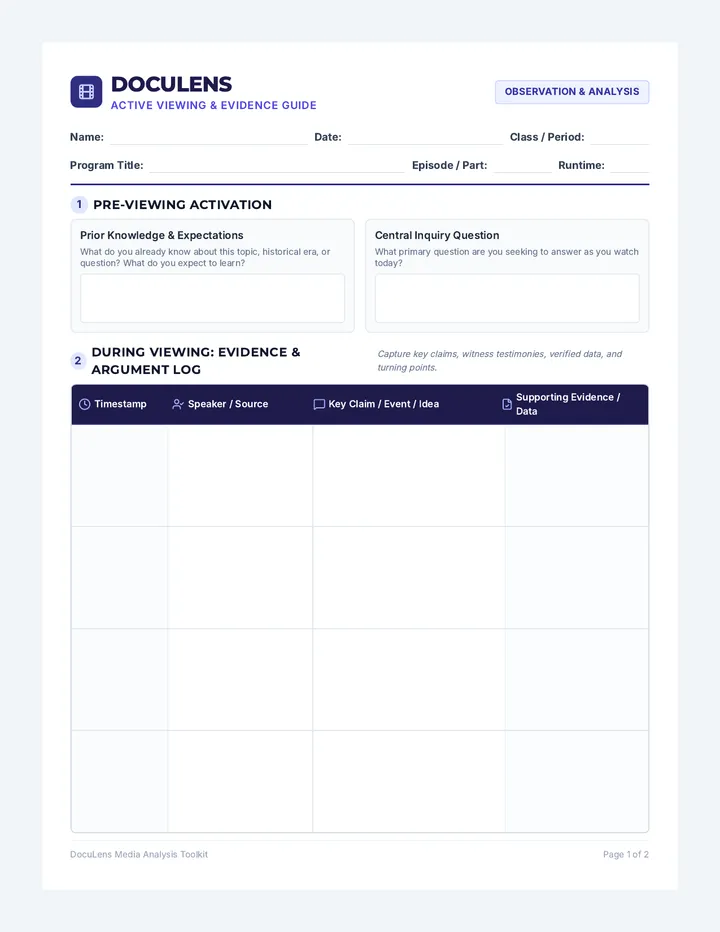
DocuLens
Active Viewing & Evidence Guide
Observation & Analysis
Name:
Date:
Class / Period:
Program Title:
Episode / Part:
Runtime:
1
Pre-Viewing Activation
Prior Knowledge & Expectations
What do you already know about this topic, historical era, or question? What do you expect to learn?
Central Inquiry Question
What primary question are you seeking to answer as you watch today?
2
During Viewing: Evidence & Argument Log
Capture key claims, witness testimonies, verified data, and turning points.
Timestamp
Speaker / Source
Key Claim / Event / Idea
Supporting Evidence / Data
DocuLens Media Analysis Toolkit Page 1 of 2
DocuLens • Part 2: Critical Analysis & Reflection
Post-Screening Synthesis
3
Media Literacy & Perspective Lens
Voices & Perspectives
Whose viewpoints are centered? Whose voices or counter-arguments are omitted?
Cinematic Craft & Tone
How do music, lighting, pacing, or archival footage influence how you feel?
Evidence Credibility
Which factual claim was most compelling? Did any claim feel unsupported or biased?
4
Core Thesis & Key Takeaways
Central Thesis Statement In 1-2 complete sentences, summarize the filmmaker's central argument.
Most Impactful Moment or Revelation
Identify one specific quote, statistic, or image that struck you most and explain why.
Broader Significance / Real-World Link
How does what was shown connect to today's society, politics, science, or your own life?
5
Discussion Sparks & Unresolved Questions
Question for the Class
Draft an open-ended question about this film to spark a debate or discussion.
Question for the Filmmaker or Experts
What remaining question would you ask if you could interview someone featured in the show?
DocuLens Media Analysis Toolkit Page 2 of 2
Documentary Question Worksheet
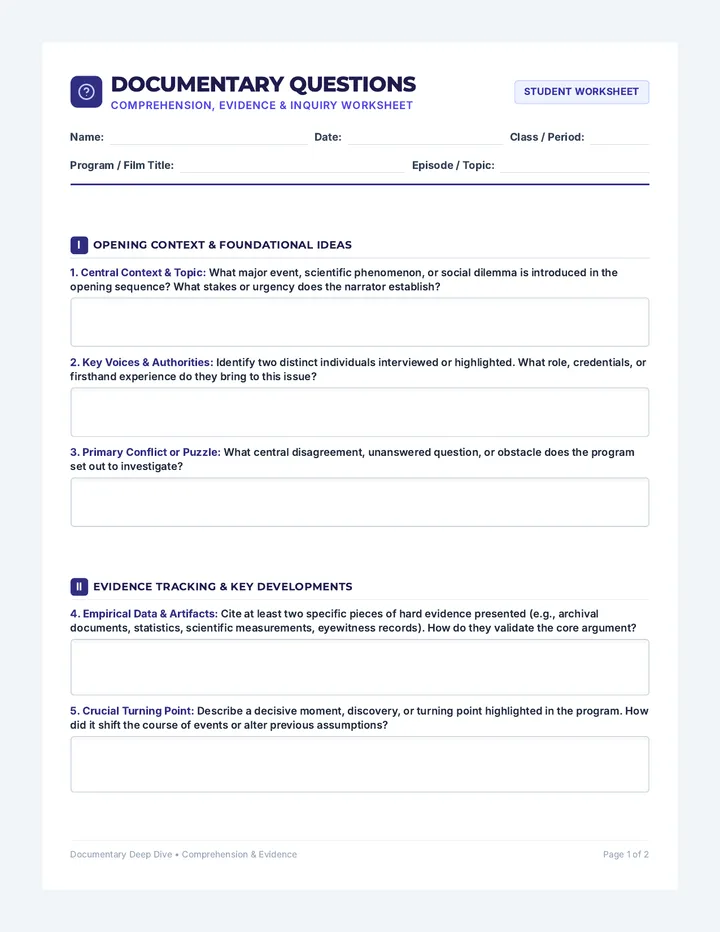
Documentary Questions
Comprehension, Evidence & Inquiry Worksheet
Student Worksheet
Name:
Date:
Class / Period:
Program / Film Title:
Episode / Topic:
I
Opening Context & Foundational Ideas
1. Central Context & Topic: What major event, scientific phenomenon, or social dilemma is introduced in the opening sequence? What stakes or urgency does the narrator establish?
2. Key Voices & Authorities: Identify two distinct individuals interviewed or highlighted. What role, credentials, or firsthand experience do they bring to this issue?
3. Primary Conflict or Puzzle: What central disagreement, unanswered question, or obstacle does the program set out to investigate?
II
Evidence Tracking & Key Developments
4. Empirical Data & Artifacts: Cite at least two specific pieces of hard evidence presented (e.g., archival documents, statistics, scientific measurements, eyewitness records). How do they validate the core argument?
5. Crucial Turning Point: Describe a decisive moment, discovery, or turning point highlighted in the program. How did it shift the course of events or alter previous assumptions?
Documentary Deep Dive • Comprehension & Evidence Page 1 of 2
Documentary Questions • Part 2: Critical Evaluation
Analysis & Synthesis
III
Media Literacy & Rhetorical Analysis
6. Perspective & Bias Check: Which viewpoints receive the most screen time and sympathetic treatment? What counter-arguments or alternate stakeholder perspectives were minimized or absent?
7. Audio-Visual Rhetoric: Select one specific scene. Analyze how the filmmaker utilized non-verbal elements (soundtrack, slow motion, lighting, archival montage) to steer the audience's emotional reaction.
IV
Synthesis & Real-World Application
8. Cause & Enduring Consequence: What underlying systemic, cultural, or scientific factors led to the events depicted? What lasting legacy or modern repercussions remain evident today?
9. Evaluative Extended Response: Based on what you watched, do you believe the filmmaker's central conclusion is fully justified by the evidence presented? If you were to conduct further research, what critical question remains unanswered? Justify your stance with specific examples.
Documentary Deep Dive • Critical Evaluation & Synthesis Page 2 of 2