Lenny.com
Explore
Create
ActivitiesNewMathEnglish Language ArtsScience & EngineeringSocial StudiesGlobal LanguagesHealth & Physical EducationSpecial EducationCounseling & Life SkillsArts & CreativityESL
Lenny.com
Lenny.com
Explore
Create
ActivitiesNewMathEnglish Language ArtsScience & EngineeringSocial StudiesGlobal LanguagesHealth & Physical EducationSpecial EducationCounseling & Life SkillsArts & CreativityESL
Lenny.com
Lenny.com

Solutions

Lenny for EducatorsLenny for SchoolsLenny for Districts

Product

ExploreSign inCreateSupportAbout

Resources

Getting startedMTSS Acceleration Program

© 2026 Lenny Learning Inc.

TermsPrivacyAccessibility
LinkedInInstagramX
Lenny
English Language ArtsPhonics & Reading FoundationsLetter IdentificationLearn Letters A-ZLowercase and Uppercase LettersConsonants and VowelsLetter-Sound AssociationsLetter-Sound Associations: LowercaseLetter-Sound Associations: UppercaseBeginning and Ending SoundsRhymingBlending And SegmentingShort VowelsShort Vowel SoundsConsonant BlendsConsonant DigraphsBlends, Digraphs, and TrigraphsDigraphs, Blends, and Silent LettersLong Vowel SoundsLong Vowel PatternsShort and Long VowelsShort and Long Vowel PatternsSilent EVowel SoundsVowel TeamsR-Controlled VowelsDiphthongs: Oi, Oy, Ou, OwVariant VowelsVariant, Diphthong, And R Vowel PatternsSoft G And CSight WordsIrregular WordsWord RecognitionSyllablesSyllable TypesTwo-Syllable WordsMultisyllabic WordsPhoneme ManipulationDecodable TextsVocabularyAction WordsQuestion WordsNouns and AdjectivesClassify WordsCompound WordsSynonyms and AntonymsHomophonesHomophones and HomonymsShades of MeaningContext CluesPrefixes and SuffixesGreek and Latin RootsAnalogiesIdioms and AdagesForeign Words and ExpressionsWord Choice and UsageReference SkillsReading ComprehensionRead-Along Literary TextsRead-Along Informational TextsReality vs. FictionStory ElementsCharacterSequenceMain IdeaCause And EffectCompare And ContrastReading StrategiesText StructureAuthor's PurposeAuthor's Purpose And ToneAuthor's PerspectivePoint Of ViewThemeInference And ThemeInference And AnalysisPoetry ElementsLiterary DevicesAnalyzing LiteratureAnalyzing Informational TextsComparing TextsAudience, Purpose, And ToneBusiness DocumentsNovel StudyNonfiction Book StudyGrammar & MechanicsSentencesNounsVerbsAdjectivesPronounsCapitalizationPunctuationContractionsConjunctionsPrepositionsArticlesAdjectives And AdverbsVerb TypesVerb TensePronouns And AntecedentsPronoun TypesSubject-Verb AgreementDirect And Indirect ObjectsSentences, Fragments, And Run-OnsPhrases And ClausesCommasSemicolons, Colons, And CommasDashes, Hyphens, And EllipsesSpellingAbbreviationsFormattingVerb Tense And MoodMisplaced ModifiersWritingDescriptive DetailsCreative WritingOpinion WritingTopic SentencesOrganizing WritingLinking WordsSentence VarietyIntroductions And ConclusionsPersuasive And Opinion WritingExpository WritingPersuasive StrategiesDeveloping And Supporting ArgumentsTopic Sentences And Thesis StatementsSummarizingResearch SkillsEditing And RevisingActive And Passive Voice=Writing Clearly And ConciselyDebate & Public SpeakingPublic Speaking BasicsPersuasive TechniquesClaims and EvidenceTypes of ArgumentsReasoning TypesLogical FallaciesTopic ResearchOrganizing EvidenceDebate Speech OrganizationAttacking and Defending ArgumentsClash and EngagementImpact CalculusQuestioning and Cross-ExaminationCritical ThinkingInformal LogicFormal LogicInductive Reasoning

Cyclone Runners

A Grade 5 science-fiction reading comprehension lesson integrating CCSS RL.5.1 and RL.5.2 through extreme weather and climate science. Students analyze text evidence, examine character response to an atmospheric storm crisis, uncover central themes, and master weather science vocabulary.

MWMr Whitfield

Meteorological & Climate Vocabulary Bank (9 Core Terms) Reference for Question 3

Weather: Day-to-day conditions of the atmosphere (rain, temp, wind) at a time/place.

Climate: The average long-term weather pattern of a region over decades.

Air Masses: Huge bodies of air with uniform temperature and moisture throughout.

Thunderstorm: A severe storm created by rising warm air, producing thunder and lightning.

Air Pressure: The downward weight of air pressing on Earth; sudden drops spark storms.

Barometer: A scientific instrument designed to measure atmospheric air pressure.

Thermometer: An instrument used to measure heat energy and thermal temperature.

Wind: Horizontal motion of air rushing from high pressure toward low pressure.

Wind Speed: The velocity of moving air, measured in knots, mph, or km per hour.

Cyclone Runners Expedition • Student Reading Material Turn to Page 2 for Questions 1–6 →

Reading Comprehension & Textual Evidence

Analysis Questions: RL.5.1 & RL.5.2

Student Name:

Standards: RL.5.1 (Q1-Q3) | RL.5.2 (Q4-Q6)

1. [RL.5.1] Quote accurately two exact details from paragraphs 1 or 2 that prove colliding air masses created violent, hazardous flight conditions.

Quote Evidence

Quote 1:

Quote 2:

2. [RL.5.1] What can you infer about Leo's emotional discipline and focus during an emergency? Quote one sentence from paragraph 3 to justify your inference.

Infer & Quote

Inference:

Exact Quote:

3. [Vocab & Tools] In paragraph 2, Leo reads his barometer and thermometer. How do these tools help him evaluate shifting air pressure and rising wind speed?

Context Clues

4. [RL.5.2] Identify the central emergency Leo faces. What two specific actions does he take to overcome this challenge?

Character Response

5. [RL.5.2] What is a central theme of "The Eye of the Gale"? Explain how Leo's experience develops this message.

Theme Analysis

Theme Statement:

Explanation:

6. [RL.5.2] Write a concise 3-4 sentence objective summary of the story using the Somebody-Wanted-But-So-Then framework.

SWBST Summary

Cyclone Runners • RL.5.1 & RL.5.2 Standard Assessment Total Score: _____ / 18 Points

Two Specific Corrective Actions: (1) He calms his panic, takes manual control of the rudder cable, and studies the external cloud thermodynamics; (2) He banks into the rising thermal updraft along the perimeter of the cold downdraft to vault safely into the calm eye.

Cyclone Runners Instructional Resource • Page 1 of 2 Proceed to Page 2 for Theme, Rubric & SWBST →

Educator Scoring Guide (Part II) Theme, Rubric & Summary

Theme Analysis & Rubric Master

Question 5 [RL.5.2 Central Theme] (3 Points) 1.5 pts theme + 1.5 pts explanation

Acceptable Theme Statements (student must express a complete idea, not a single word):

  • "Understanding and respecting the natural physics of weather and climate allows humans to survive violent conditions that overwhelm mechanical technology."
  • "True resilience in a crisis requires calm observation and working with nature's forces rather than attempting to overpower them."

How the Story Conveys This: Leo cannot revive the frozen flight computer with tools; only by reading the barometer, understanding air masses, and riding the thermal updraft does he navigate to safety.

Question 6 [RL.5.2 Objective SWBST Summary] (3 Points) Aligned to SWBST Framework

Exemplar SWBST Response (3-4 Sentences):

Apprentice meteorologist Leo Vance [Somebody] wanted to record air pressure and wind speed data where colliding air masses formed a severe thunderstorm [Wanted], but a violent downdraft and icing disabled his computerized flight controls [But]. Keeping calm, Leo read his mechanical barometer and steered into a rising thermal updraft alongside the downdraft [So]. The warm air carried his glider safely into the calm eye of the hurricane, allowing him to transmit critical climate data to ground command [Then].

CriterionExemplary (3 Pts)Proficient (2 Pts)Developing (0-1 Pt)
RL.5.1 Accurate QuotingDirect quotes copied word-for-word with quotation marks; clearly justifies claim.Relevant evidence cited but missing quotation marks or slightly paraphrased.Inaccurate quote, irrelevant text, or unbacked personal assertion.
RL.5.2 Theme & ResponseArticulates universal life lesson derived from character's response to adversity.States a broad topic (e.g. "weather is powerful") without the deeper lesson.Misidentifies theme as a simple plot event; lacks text support.

Key Concept Clarification:

Help students distinguish weather (daily local conditions) from climate (long-term regional patterns), and emphasize how a falling barometer signals rising wind speed.

Wrap-Up Debrief Prompt:

"How does Leo's reliance on his barometer and cloud physics over electronic computers reinforce the author's message about human understanding of climate?"

Cyclone Runners Complete Instructional Package • Grade 5 Ready for Classroom Assessment & Grading

You might also like

Big Picture Slides

Idea Detectives

A scaffolded, multi-day reading comprehension sequence aligned to Texas TEKS 4.9(D)(i) and designed for fourth-grade special education students. Across three focused lessons, students learn to recognize the characteristics of informational text by distinguishing topics from central ideas, connecting supporting details, and citing text evidence using structured visual frameworks.

G

gonzalezs

10
Structure Showdown Slides

Text Structure Showdown

A low-prep, high-energy review lesson for fifth-grade reading classes covering all six TEKS 5.9D(iii) text structures. Features bright whole-class quiz slides with unrevealed answers, a print-and-go student practice worksheet with generous bubble-in choices, and a complete teacher master key.

ED

Emily Denson

4
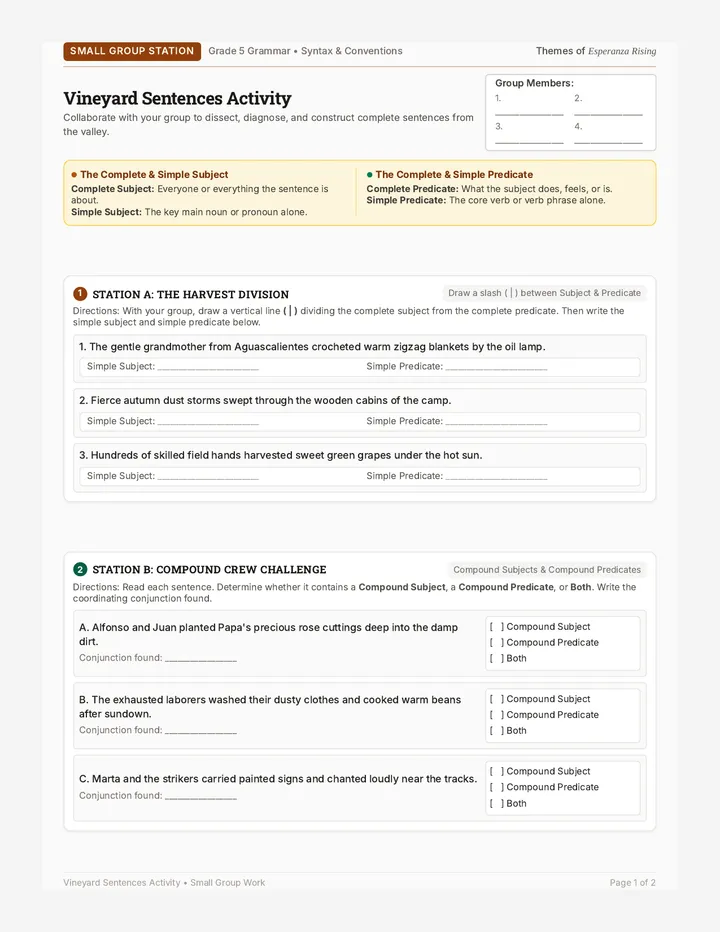
Vineyard Sentences Activity

Vineyard Sentences Activity

A collaborative Grade 5 grammar activity exploring complete and simple subjects and predicates through the themes and setting of Esperanza Rising. Designed for small group stations, it includes sentence division, compound syntax analysis, sentence repair, and a rigorous mastery check.

A

amagalhaes

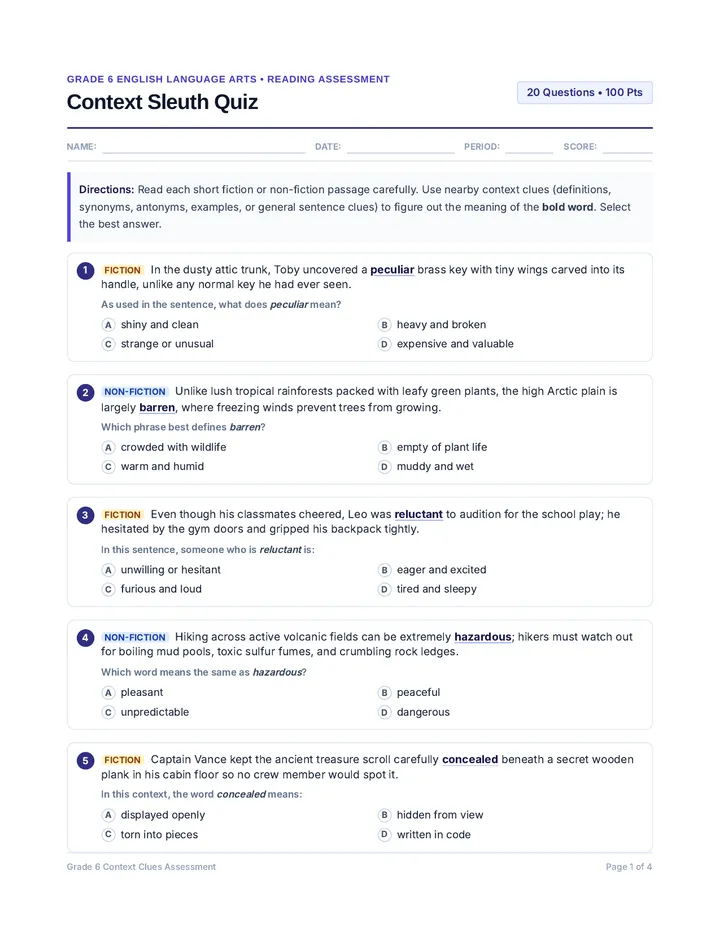
Context Sleuth Quiz

Reading Skill Arsenal

A comprehensive 6th-grade ELA assessment unit focused on foundational reading comprehension, vocabulary acquisition, and literary and informational text analysis across fiction and non-fiction.

SH

Sarah Hunter

6
Essay Architecture Slides

Essay Architecture

A comprehensive 10th-grade expository writing and analysis unit where students dissect high-caliber mentor texts, master defensible thesis construction, weave textual evidence with fidelity, and craft rigorous analytical commentary.

Lenny Avatar
Lenny
4
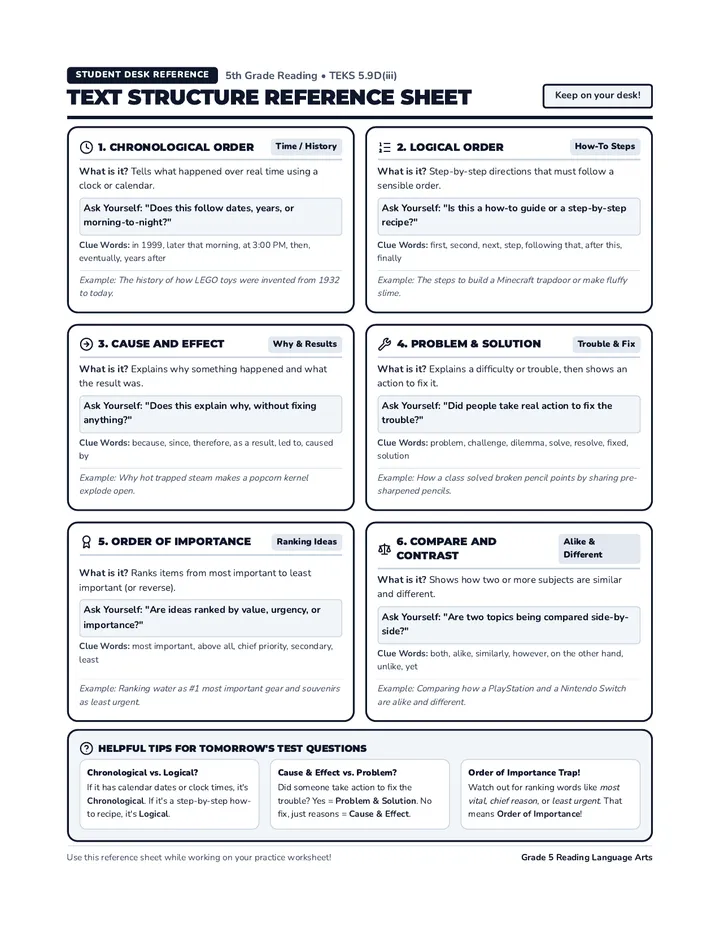
Text Structure Reference Sheet

Text Structure Reference Sheet

A high-contrast, black-and-white print-friendly student desk reference sheet featuring visual icons, simple definitions, and clue-word banks for all six TEKS 5.9D(iii) text structures.

ED

Emily Denson

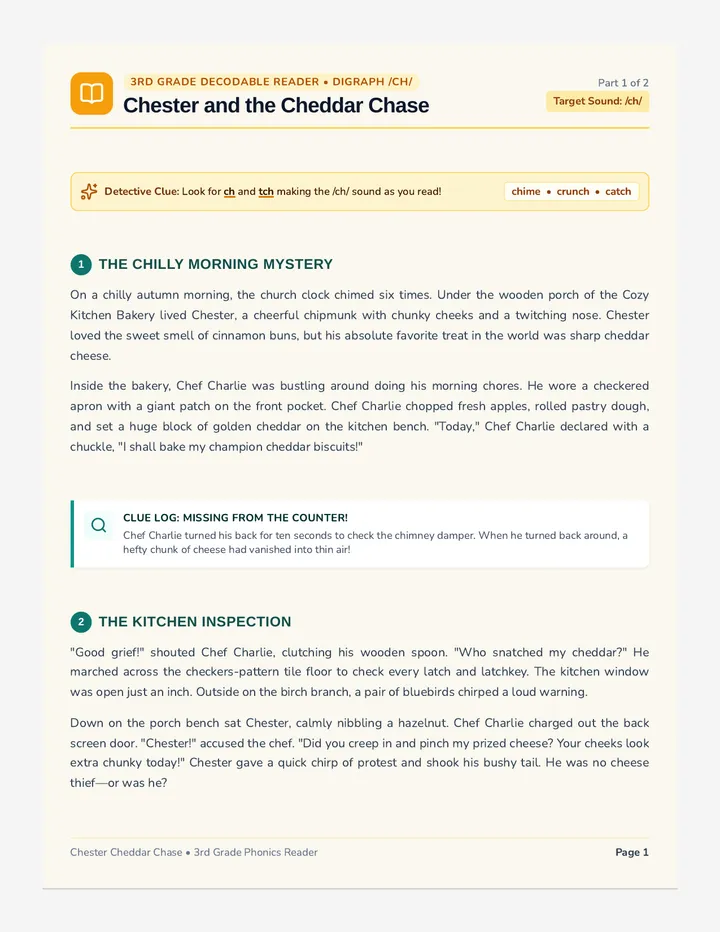
Chester Cheddar Chase Story

Chester Mystery Unit

A comprehensive multi-day third-grade reading, phonics, and writing unit focused on the digraph /ch/, narrative story progression, and mystery dialogue conventions.

V

victoria.lesniak

7
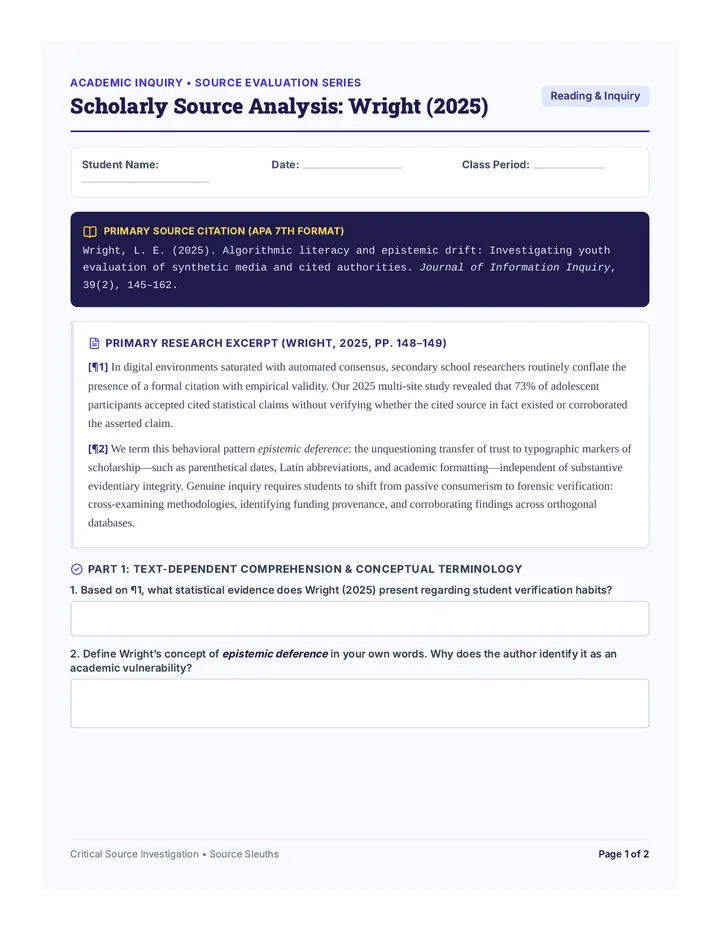
Wright Study Worksheet

Source Sleuths

A rigorous academic inquiry lesson examining Dr. Wright's 2025 research on algorithmic literacy and digital source verification. Students deconstruct scholarly claims, evaluate methodology, and practice proper academic citation.

Lenny Avatar
Lenny
3
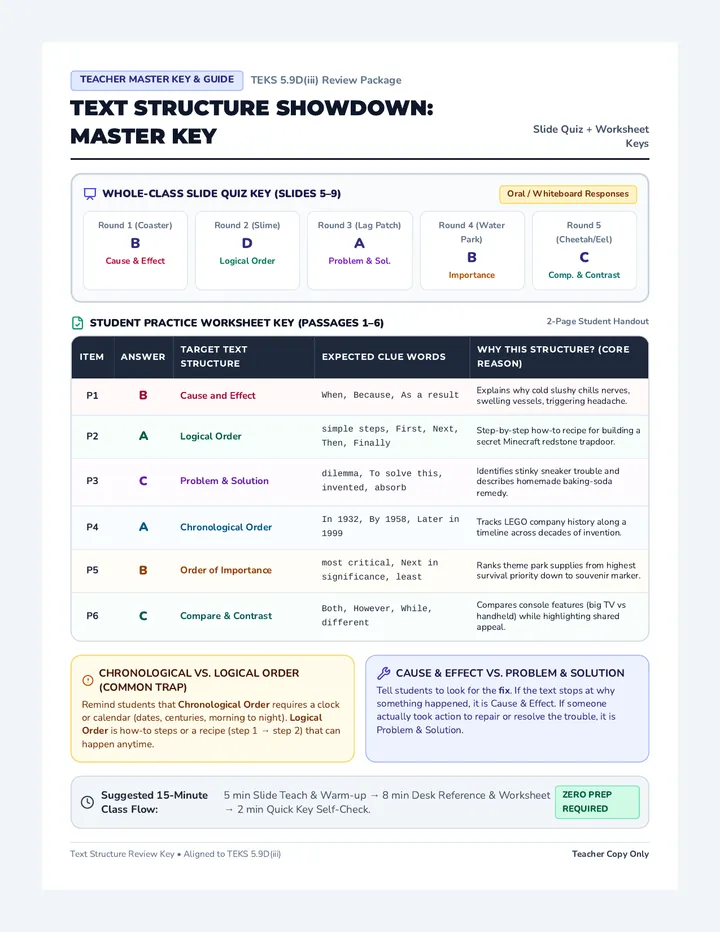
Text Structure Review Key

Text Structure Review Key

A black-and-white print-friendly teacher master key with quick answers for the slide quiz and student worksheet, highlighted clue words, and lower 5th-grade scaffolding notes.

ED

Emily Denson

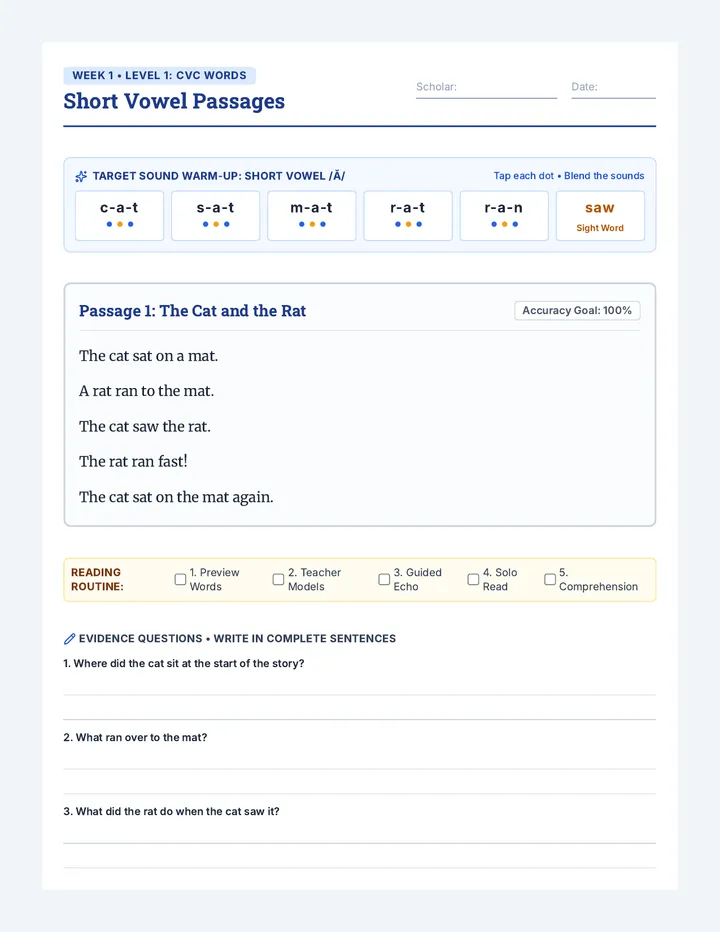
Short Vowel Passages Worksheet

Phonics Scholar Pathway

An eight-week tier-two reading intervention sequence guiding elementary scholars from decodable CVC short vowels through complex multisyllabic words and fluent comprehension. Each week provides structured decodable passages, targeted word banks, text-dependent comprehension questions, and systematic fluency tracking.

B

Bhoovaragavaswamym

8
Poetry Pulse Lesson Plan

Poetry Pulse

A 5-day introductory poetry unit for 7th grade students exploring imagery, sound devices, figurative language, and poetic structure through analysis and creative writing.

AC

Anaissa Carrillo

3
Text Structure Review Worksheet

Text Structure Review Worksheet

A black-and-white print-friendly two-page practice worksheet with lower-reading-level passages, kid-friendly topics (brain freeze, Minecraft, LEGO, pencils), large bubble choices, and wide writing lines.

ED

Emily Denson