Ancient Clams Teacher Guide Tutoring Facilitation Guide • Reading Comprehension
Ancient Clams: Cause & Effect
Focus Text: from 500-Year-Old Clams by Joni Kelly • Target: Grades 3–5
Pacing Guide 35–45 Minutes
Session Sequence & Instructional Moves
Step 1 • 7 Mins
Engage & Hook
Show clam photo. Ask: "How could a creature with no head outlive George Washington and Shakespeare?" Introduce cause (the "why") and effect (the "what happened").
Step 2 • 10 Mins
Targeted Read
Read passage aloud or paired. Have student circle clue words (because, means, so, when ). Focus closely on Paragraphs 3, 4, 5, and 7.
Step 3 • 18 Mins
Hands-On Sort
Cut manipulative clue cards. Student physically pairs causes with effects on Part 1 mat, then constructs the 3-part Ming Mystery sequence chain on Part 2.
Step 4 • 7 Mins
Synthesize
Student verbalizes one complete cause-effect sentence using the frame: "Because [cause], as a result [effect]." Complete quick-check exit question.
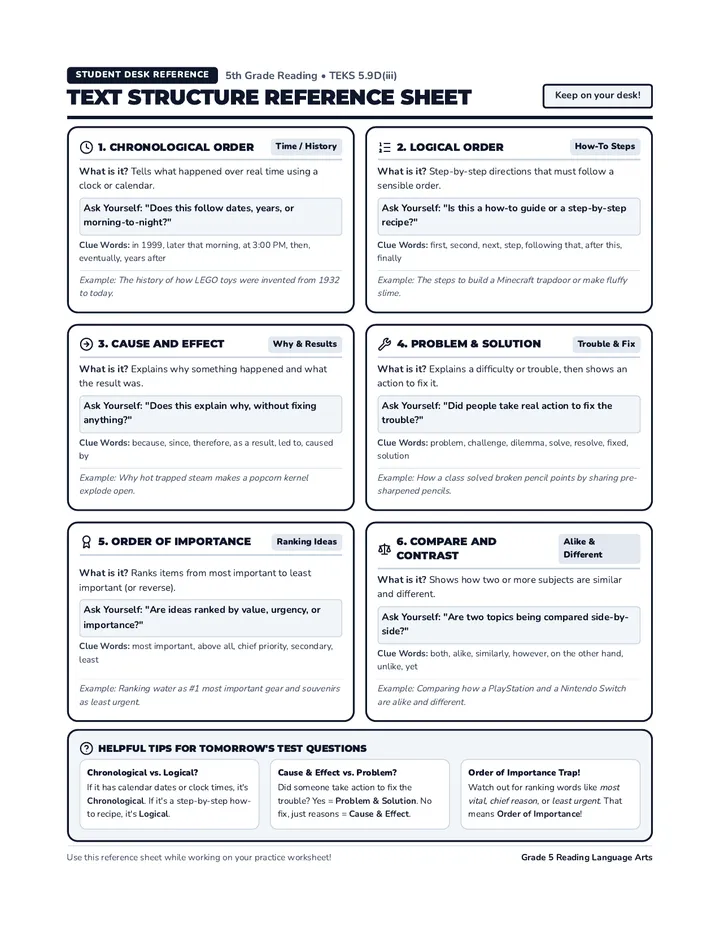
Key Text Relationships in "500-Year-Old Clams"
Informational Text RI.3-5.3
Ref Cause (Why it happened / Trigger) Effect (What happened / Result) Par. 4 The ocean has a warm summer with abundant food. The clam's shell produces a noticeably wider growth ring. Par. 5 Adult clams stop increasing in size, squeezing 500+ rings into under 0.1 inch. Scientists initially miscounted Ming's age as 405 years instead of 507. Par. 7 Ocean quahogs live in frigid deep waters, move very little, and have slow life processes. They expend minimal energy, enabling them to survive for centuries. Par. 8 Clams draw in water to filter plankton and microscopic nutrients. They clean the surrounding ocean water while serving as prey for otters and seabirds.
Tutor Dialogue & Prompting Stems
Prompting the Cause: "Look at Paragraph 4. When we see a really wide ring, what environmental condition in the sea caused that growth?"
Prompting the Effect: "Because adult clam rings are crammed into less than 0.1 inch, what happened when scientists first inspected Ming?"
Disentangling Reversals: "Did the cold water cause slow energy use, or did slow energy use make the ocean cold? How does the text prove which is the cause?"
Connecting Chain Links: "In our 3-step chain, notice how the effect of Step 1 becomes the trigger that forces scientists to take action in Step 2!"
Hands-On Reading Comprehension • Informational Cause & Effect Page 1 of 2
Differentiation, Misconceptions & Assessment
Instructional coaching notes for targeted 1-on-1 and small group intervention
Tutoring Toolkit
Meeting Student Needs (Scaffolding Paths)
Heavy Support (Struggling Readers)
Pre-highlight clue words (so, means, because, when ) in the text.
Provide only 2 matching pairs at a time rather than all 4 at once.
Use the physical cause/effect icon symbols on the cards to guide initial pairing before reading details.
Standard Support (Grade-Level)
Prompt student to read the cause first, then search the story paragraphs for proof of the result.
Require the student to state: "This happened BECAUSE..." in their own words before pasting cards.
Guide student to sequence the 3-step Ming chain chronologically.
Challenge / Extension
Ask: "What would happen to the marine ecosystem if ocean quahogs disappeared?" (Multiple cascade effects).
Have student diagram an additional cause-effect relationship from paragraph 7 regarding Greenland sharks.
Common Student Misconceptions & How to Address Them
× Misconception: Students confuse order in the text with cause and effect sequence . They assume whichever event is written first in a sentence is automatically the cause.
✓ Clarification: Teach the "Time Machine Rule": The Cause always happens first in time, even if the author writes the Effect at the start of the sentence (e.g., "Scientists used a microscope because the rings were tiny" ).
× Misconception: Thinking adult clams stop aging or stop making rings when they stop growing in size.
✓ Clarification: Direct students to Paragraph 5: adult clams stop growing larger in body size, but shell rings keep accumulating in ultra-tight, compressed layers!
Tutoring Diagnostic Checklist (Formative Tracking)
Skill Dimension Beginning (1) Developing (2) Mastery (3) Distinguishing Cause vs. Effect Reverses cause and effect or matches cards randomly. Identifies pairs with tutor prompts; occasionally reverses. Independently identifies which event is trigger and which is outcome. Text-Based Justification Cannot point to where the relationship occurs in the text. Points to general paragraph after guided re-reading. Directly quotes key words from paragraphs 3, 4, 5, or 7. Multi-Step Event Chaining Struggles to order 3 events logically. Orders Ming's age chain correctly with partial assistance. Explains how step 1's effect directly triggers step 2's action.
Ancient Clams Tutoring Bundle • Instructional Coaching Guide Page 2 of 2
Clam Clues Activity Hands-On Reading Lab • Cause & Effect
Clam Clues: Cause & Effect Mat
Explore *500-Year-Old Clams* by Joni Kelly • Cut, match, and chain your discoveries!
Name:
Date:
Directions: Cut out the clue cards from Page 2. In Part 1 , match each Cause card with its correct Effect card and paste or place them in the mats. In Part 2 , link the three Ming story cards into a continuous chronological event chain!
Part 1: Ocean Quahog Cause & Effect Match
Match cards from Section A on Page 2
1
Cause Mat A
leads to
Effect Mat 1
2
Cause Mat B
leads to
Effect Mat 2
3
Cause Mat C
leads to
Effect Mat 3
4
Cause Mat D
leads to
Effect Mat 4
Part 2: The Mystery of Ming's Age • Event Chain
Sequence the 3 Event Chain cards from Section B
Step 1: First Cause Par. 5
Place Event Card 1
↓ triggers action
Step 2: Investigation Par. 5
Place Event Card 2
↓ reveals discovery
Step 3: Final Effect Par. 5
Place Event Card 3
✓ Mystery solved!
Detective Connection Prompt: Why was Ming named "Ming"? Look back at Paragraph 3.
Complete the sentence explaining the cause of the clam's name:
Scientists named the clam Ming because
500-Year-Old Clams Reading Comprehension Lab • Student Mat Page 1 of 2
Clue Cards: Cut & Sort Sheet
Carefully cut along the dashed lines with scissors. Organize before gluing!
Hands-On Manipulatives 11 Cut-Out Cards
Section A: Part 1 Match Cards (Causes & Effects) 4 Causes • 4 Effects (Jumbled)
Clue Card
In 2006, scientists gathered 200 ocean quahogs off the coast of Iceland to study.
Clue Card
The clam shell creates a noticeably wide annual growth ring during that season.
Clue Card
A summer season in the ocean is especially warm and provides abundant food.
Clue Card
They burn minimal energy, enabling them to survive for centuries in the deep sea.
Clue Card
Ocean quahogs live in frigid deep waters, move very little, and have slow life processes.
Clue Card
They clean the surrounding ocean water while serving as food for otters and seabirds.
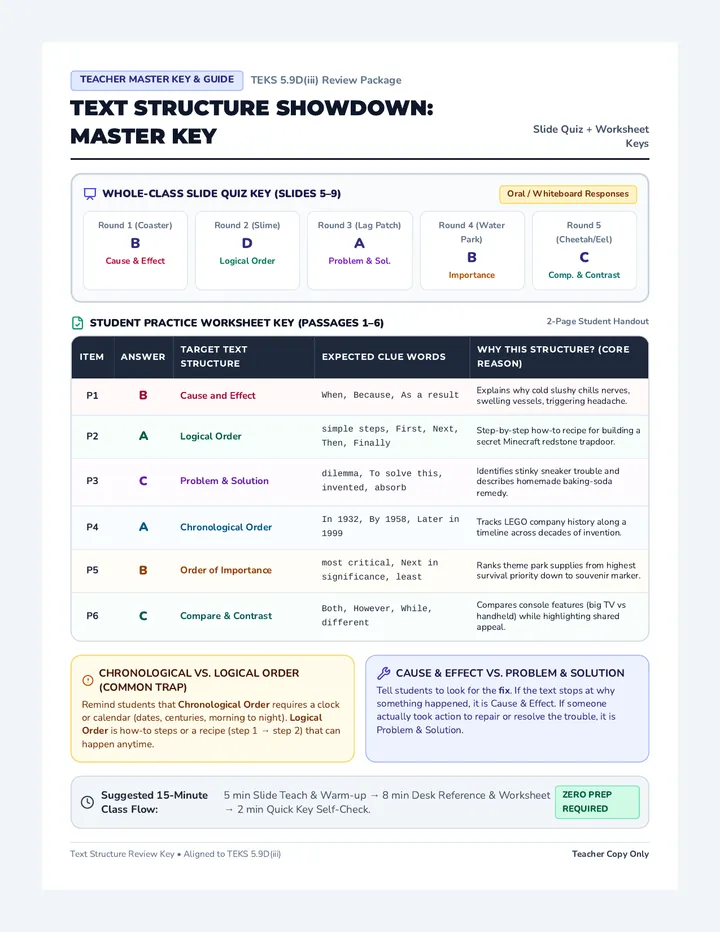
Clam Clues Answer Key Teacher Answer Key & Scoring Guide
Clam Clues Answer Key
Reference for 500-Year-Old Clams Hands-On Activity • Tutoring Verification
Solution Master Parts 1, 2 & Writing
Part 1: Cause & Effect Matching Solutions
4 Matched Pairs
Pair 1 • Text Reference: Paragraph 4 ✓ Growth Rings
Cause (Condition):
“A summer season in the ocean is especially warm and provides abundant food.”
Effect (Result):
“The clam shell creates a noticeably wide annual growth ring during that season.”
Pair 2 • Text Reference: Paragraph 7 ✓ Longevity & Energy
Cause (Condition):
“Ocean quahogs live in frigid deep waters, move very little, and have slow life processes.”
Effect (Result):
“They burn minimal energy, enabling them to survive for centuries in the deep sea.”
Pair 3 • Text Reference: Paragraph 8 ✓ Ecosystem Role
Cause (Action):
“Clams draw in seawater to filter plankton and microscopic food particles.”
Effect (Result):
“They clean the surrounding ocean water while serving as food for otters and seabirds.”
Pair 4 • Text Reference: Paragraph 3 ✓ Discovery of Ming
Cause (Research Action):
“In 2006, scientists gathered 200 ocean quahogs off the coast of Iceland to study.”
Effect (Result):
“Researchers discovered an extraordinary clam that had lived for more than 400 years.”
Part 2: Story Event Chain Solution (Paragraph 5)
Chronological Chain
Step 1: The Cause 1st
Adult clams stop increasing in overall size, but compress 500+ growth rings into under 0.1 inch.
This created microscopic crowding that caused initial miscounting.
Step 2: Investigation 2nd
Scientists re-examined Ming using a high-powered special microscope to count compressed rings.
Advanced magnification allowed them to separate individual lines.
Step 3: Final Effect 3rd
Researchers discovered that Ming was actually 507 years old rather than 405 years old!
Ming earned the record as one of Earth's oldest living animals.
Exemplar Student Responses & Scoring Criteria
Detective Connection Prompt (Page 1):
“Scientists named the clam Ming because it was born during the Ming dynasty, the ruling family of China at that time.”
Accept any response citing paragraph 3 that mentions China, the ruling family/dynasty, or Ming history.
Shell Secrets Writing Center Informational Writing Center • Station Card
Shell Secrets: The T.E.X.T. Strategy
Based on 500-Year-Old Clams by Joni Kelly • Paragraph Writing Station
Writing Station Independent / Pair
Station Mission
Use the evidence from the story to write a high-scoring informational response. Follow the T.E.X.T. strategy anchor below to build your topic sentence, text proof, scientific explanation, and wrap-up conclusion.
The T.E.X.T. Writing Framework
Reference these stems when drafting
T • TOPIC SENTENCE The Hook & Claim
State your main idea clearly. Answer the question in your very first sentence.
Sentence Starters: • “Ocean quahogs are extraordinary marine animals because...”
E • EVIDENCE Text Proof
Give specific facts, measurements, or details directly from the text.
Sentence Starters: • “According to Paragraph 7 of the text, ‘...’”
X • EXPLAIN The Science Connection
Explain why this evidence matters. Connect the cause to its effect.
Sentence Starters: • “This shows that cold water causes their bodies to...”
T • TIE IT UP Conclusion
Wrap up your paragraph by restating the big idea in fresh words.
Sentence Starters: • “In conclusion, these slow-moving clams prove that...”
Choose Your Writing Prompt
Prompt Option A • Science of Longevity:
Based on Paragraph 7, what causes ocean quahogs to live for hundreds of years, and how does saving energy affect their lifespan?
Prompt Option B • The Mystery of Ming:
Based on Paragraphs 4 and 5, how do scientists count growth rings to determine a clam's age, and what caused Ming's age to be recalculated?
Quick Evidence Locker (Facts from the Text)
Par. 4: Rings & Seasons One ring per summer; warm water + abundant food creates wide rings.
Par. 5: Ming's Age 500 rings packed into <0.1 inch; special microscope revealed 507 years.
Par. 7: Cold Deep Ocean Frigid environment, very little movement, slow life processes = minimal energy.
500-Year-Old Clams Writing Center • T.E.X.T. Station Guide Page 1 of 2
Clam Crossword Center Vocabulary Learning Center • Station 3
Clam Clues Crossword
Name:
Date:
quahog iceland microscope species hinge energy rings 7 Story Words
1
2
3
4
5
6
7
ACROSS
3. a scientific magnifying tool used to see 500 compressed rings in Ming’s shell
5. the flexible joint that holds a clam’s two shells together
6. what quahogs use very little of because they move so slowly in cold water
DOWN
1. a long-living species of clam found in the deep, cold Atlantic ocean
2. the cold island nation near where Ming was discovered in 2006
4. different kinds or types of living things (there are over 12,000 for clams!)
7. circular growth layers on a shell that scientists count to determine age
3.RI.4 • 4.RI.4 • 5.RI.4 Page 1 of 2
Teacher Answer Key • Center Station 3
Clam Clues Crossword Solutions
Full solution grid, text citations, and fast-finisher challenge
Solved Reference 100% Verified
Solved Grid Key
Q
U
A
I
H
M
I
C
R
O
S
C
O
P
E
E
G
L
S
A
P
H
I
N
G
E
D
C
I
E
N
E
R
G
Y
S
I
N
G
S
Word Evidence & Paragraph Citations
Word Location Context & Cause/Effect Significance in Text QUAHOG Par. 6 • 1 Down The specific ocean clam species known for extreme longevity (up to 507+ years). ICELAND