Elephant Haven Practice Sheet
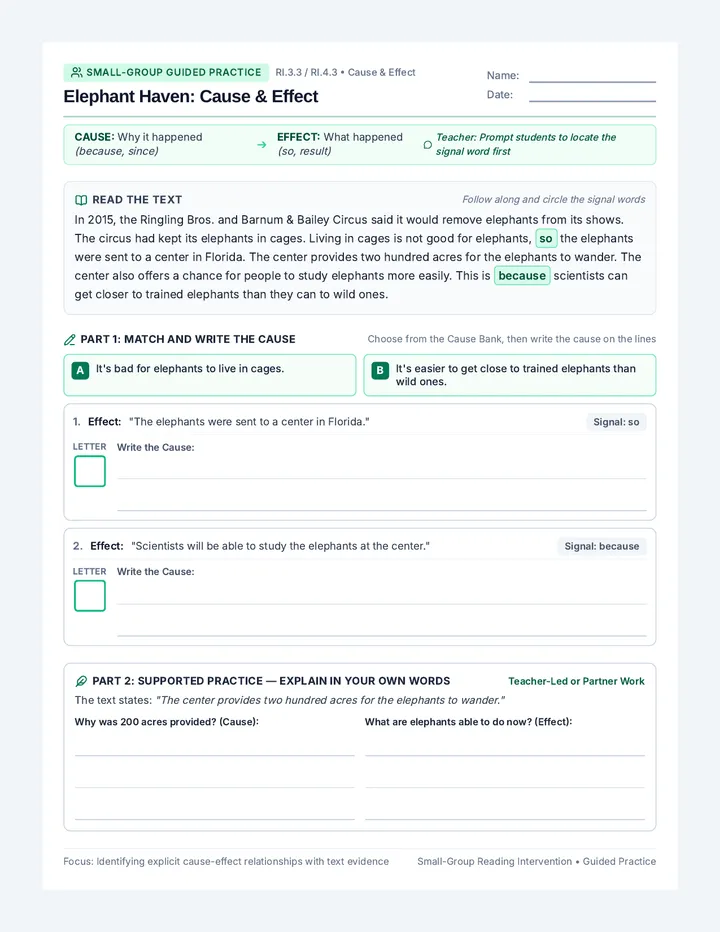
Small-Group Guided Practice RI.3.3 / RI.4.3 • Cause & Effect
Elephant Haven: Cause & Effect
Name:
Date:
CAUSE: Why it happened (because, since) ➔ EFFECT: What happened (so, result)
Teacher: Prompt students to locate the signal word first
Read the Text
Follow along and circle the signal words
In 2015, the Ringling Bros. and Barnum & Bailey Circus said it would remove elephants from its shows. The circus had kept its elephants in cages. Living in cages is not good for elephants, so the elephants were sent to a center in Florida. The center provides two hundred acres for the elephants to wander. The center also offers a chance for people to study elephants more easily. This is because scientists can get closer to trained elephants than they can to wild ones.
Part 1: Match and Write the Cause
Choose from the Cause Bank, then write the cause on the lines
A
It's bad for elephants to live in cages.
B
It's easier to get close to trained elephants than wild ones.
- Effect: "The elephants were sent to a center in Florida."
Signal: so
Letter
Write the Cause:
- Effect: "Scientists will be able to study the elephants at the center."
Signal: because
Letter
Write the Cause:
Part 2: Supported Practice — Explain in Your Own Words
Teacher-Led or Partner Work
The text states: "The center provides two hundred acres for the elephants to wander."
Why was 200 acres provided? (Cause):
What are elephants able to do now? (Effect):
Focus: Identifying explicit cause-effect relationships with text evidence Small-Group Reading Intervention • Guided Practice
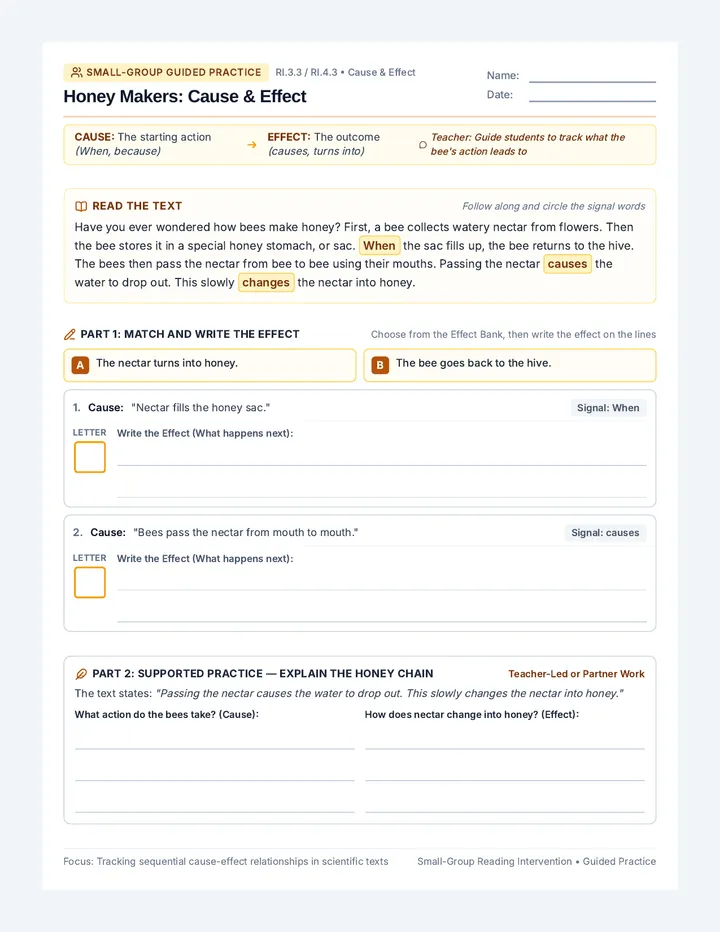
Honey Makers Practice Sheet
Small-Group Guided Practice RI.3.3 / RI.4.3 • Cause & Effect
Honey Makers: Cause & Effect
Name:
Date:
CAUSE: The starting action (When, because) ➔ EFFECT: The outcome (causes, turns into)
Teacher: Guide students to track what the bee's action leads to
Read the Text
Follow along and circle the signal words
Have you ever wondered how bees make honey? First, a bee collects watery nectar from flowers. Then the bee stores it in a special honey stomach, or sac. When the sac fills up, the bee returns to the hive. The bees then pass the nectar from bee to bee using their mouths. Passing the nectar causes the water to drop out. This slowly changes the nectar into honey.
Part 1: Match and Write the Effect
Choose from the Effect Bank, then write the effect on the lines
A
The nectar turns into honey.
B
The bee goes back to the hive.
- Cause: "Nectar fills the honey sac."
Signal: When
Letter
Write the Effect (What happens next):
- Cause: "Bees pass the nectar from mouth to mouth."
Signal: causes
Letter
Write the Effect (What happens next):
Part 2: Supported Practice — Explain the Honey Chain
Teacher-Led or Partner Work
The text states: "Passing the nectar causes the water to drop out. This slowly changes the nectar into honey."
What action do the bees take? (Cause):
How does nectar change into honey? (Effect):
Focus: Tracking sequential cause-effect relationships in scientific texts Small-Group Reading Intervention • Guided Practice