Ancient Clams Reading Packet
GRADE 3 • ELA Standard 3.RI.3 • Cause, Effect & Sequence
Informational Text • Part 1
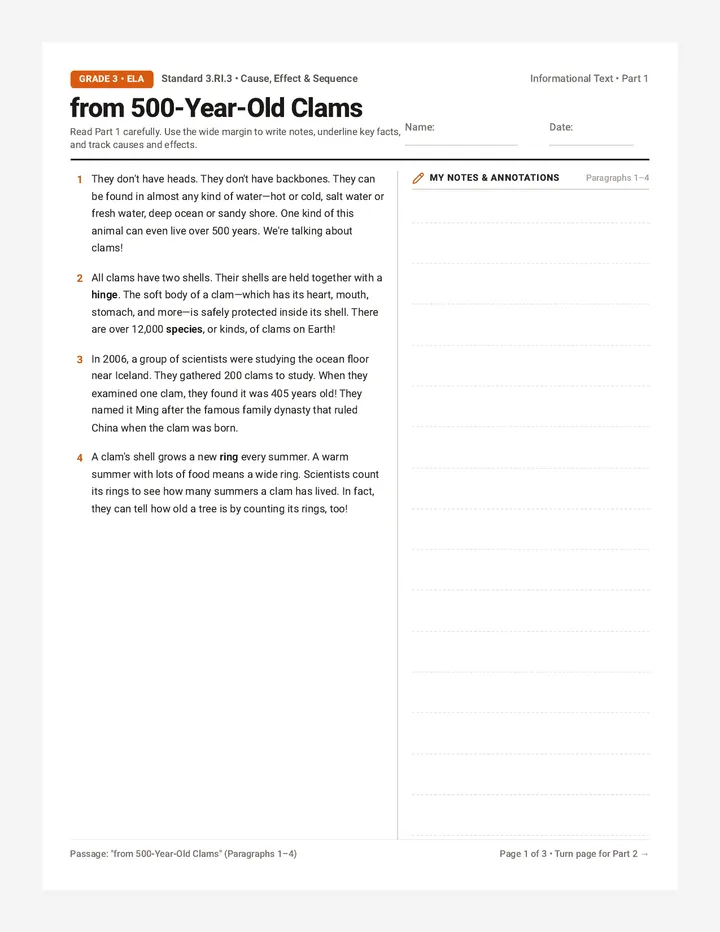
from 500-Year-Old Clams
Read Part 1 carefully. Use the wide margin to write notes, underline key facts, and track causes and effects.
Name:
Date:
1
They don't have heads. They don't have backbones. They can be found in almost any kind of water—hot or cold, salt water or fresh water, deep ocean or sandy shore. One kind of this animal can even live over 500 years. We're talking about clams!
2
All clams have two shells. Their shells are held together with a hinge. The soft body of a clam—which has its heart, mouth, stomach, and more—is safely protected inside its shell. There are over 12,000 species, or kinds, of clams on Earth!
3
In 2006, a group of scientists were studying the ocean floor near Iceland. They gathered 200 clams to study. When they examined one clam, they found it was 405 years old! They named it Ming after the famous family dynasty that ruled China when the clam was born.
4
A clam's shell grows a new ring every summer. A warm summer with lots of food means a wide ring. Scientists count its rings to see how many summers a clam has lived. In fact, they can tell how old a tree is by counting its rings, too!
MY NOTES & ANNOTATIONS
Paragraphs 1–4
Passage: "from 500-Year-Old Clams" (Paragraphs 1–4) Page 1 of 3 • Turn page for Part 2 →
GRADE 3 • ELA Standard 3.RI.3 • Cause, Effect & Sequence
Informational Text • Part 2
from 500-Year-Old Clams (Continued)
Continue reading about ancient ocean quahogs and Ming. Annotate your observations in the margin.
Name:
5
Clams stop growing larger as adults, but they keep adding rings to their shell every year. Because adult shells do not get much bigger, the rings become tightly compressed, with over 500 rings squeezed into less than 0.1 inch! Scientists used a special high-powered microscope to study Ming again. That is when they learned it was actually 507 years old!
6
Some clam species only live a single year. Other kinds, like ocean quahogs, can live a remarkably long time. Ming was an ocean quahog. A 220-year-old ocean quahog was discovered in 1982 off the coast of North America. Another ocean quahog found in 1968 was 374 years old. Scientists believe there are many ancient ocean quahogs living on the chilly ocean floor.
7
Ocean quahogs may live so long partly because of their frigid environment. Many creatures in the deep, cold ocean live a very long time, including 400-year-old Greenland sharks. Ocean quahogs also burn very little energy because they only move a tiny bit and have extremely slow life processes.
8
Clams are very important to their marine ecosystem. They filter and clean ocean water, and they provide food for sea otters, seabirds, and fish. Ocean quahogs are especially exciting for medical researchers: studying how they live for centuries may teach human scientists how the aging process works!
MY NOTES & ANNOTATIONS
Paragraphs 5–8
Passage: "from 500-Year-Old Clams" (Paragraphs 5–8) Page 2 of 3 • Turn page for Comprehension Quiz →
COMPREHENSION QUIZ RI.3.3
Total Score: / 5
from 500-Year-Old Clams • Check For Understanding
Directions: Read each question carefully. Choose the best answer based on evidence from the text.
Name:
Date:
- Which statement BEST describes what causes ocean quahogs to live so long?
A Their frigid environment and extremely slow life processes.
B Their ability to swim quickly away from dangerous predators.
C A shell that doubles in thickness and height every month.
D Moving into warmer sandy beaches during the winter months.
- According to paragraph 4, what causes a clam's shell to form a wide ring?
A A cold, freezing winter with very little food available.
B A warm summer with lots of food.
C The clam moving to deep ocean water near Iceland.
D Scientists counting the rings under a microscope.
- According to paragraph 5, what is an effect of adult clam shells stopping larger growth while still adding rings?
A The hinge breaks and the two shells separate completely.
B The clam loses its soft internal body organs over time.
C The rings become tightly compressed into less than 0.1 inch.
D The rings disappear from the surface of the shell.
- According to paragraph 5, what was the result when scientists studied Ming with a special high-powered microscope?
A They discovered that Ming was actually a Greenland shark.
B They learned that Ming was actually 507 years old.
C They found that Ming had lived inside a fresh water lake.
D They realized the clam shell had no growth rings left.
- According to paragraphs 3–5, which event happened AFTER scientists gathered 200 clams near Iceland, but BEFORE they learned Ming was 507 years old?
A A 220-year-old ocean quahog was found off North America.
B Scientists named the clam Ming and thought it was 405 years old.
C A 374-year-old clam was discovered by researchers in 1968.
D Ming grew its very first ring during the Chinese dynasty.
Passage: "from 500-Year-Old Clams" • Check For Understanding Page 3 of 3 • End of Quiz
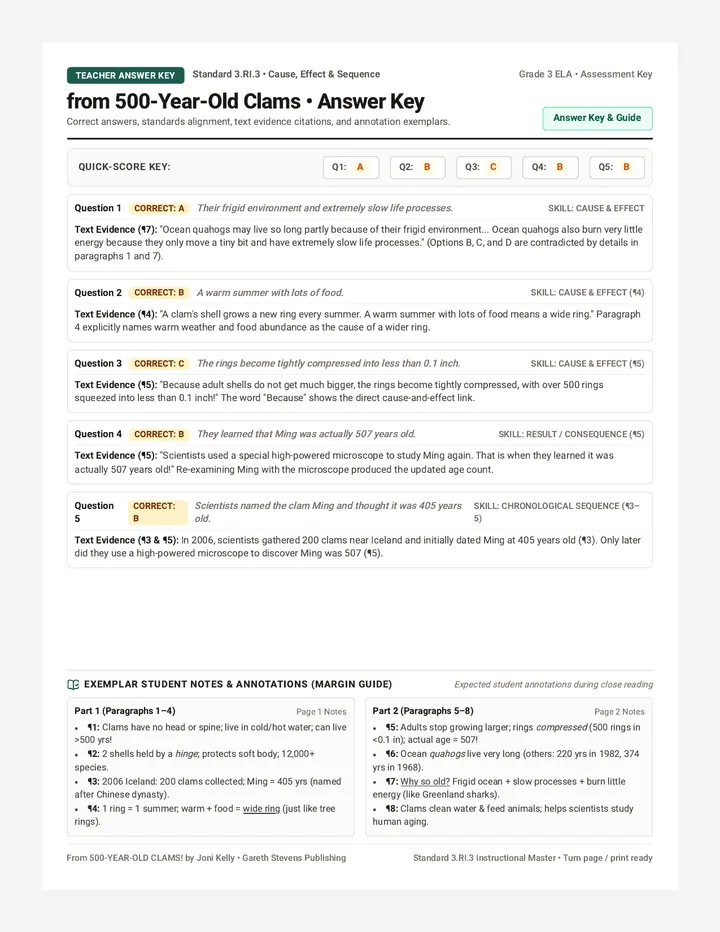
Ancient Clams Answer Key
TEACHER ANSWER KEY Standard 3.RI.3 • Cause, Effect & Sequence
Grade 3 ELA • Assessment Key
from 500-Year-Old Clams • Answer Key
Correct answers, standards alignment, text evidence citations, and annotation exemplars.
Answer Key & Guide
Quick-Score Key:
Q1: A
Q2: B
Q3: C
Q4: B
Q5: B
Question 1 CORRECT: A Their frigid environment and extremely slow life processes.
Skill: Cause & Effect
Text Evidence (¶7): "Ocean quahogs may live so long partly because of their frigid environment... Ocean quahogs also burn very little energy because they only move a tiny bit and have extremely slow life processes." (Options B, C, and D are contradicted by details in paragraphs 1 and 7).
Question 2 CORRECT: B A warm summer with lots of food.
Skill: Cause & Effect (¶4)
Text Evidence (¶4): "A clam's shell grows a new ring every summer. A warm summer with lots of food means a wide ring." Paragraph 4 explicitly names warm weather and food abundance as the cause of a wider ring.
Question 3 CORRECT: C The rings become tightly compressed into less than 0.1 inch.
Skill: Cause & Effect (¶5)
Text Evidence (¶5): "Because adult shells do not get much bigger, the rings become tightly compressed, with over 500 rings squeezed into less than 0.1 inch!" The word "Because" shows the direct cause-and-effect link.
Question 4 CORRECT: B They learned that Ming was actually 507 years old.
Skill: Result / Consequence (¶5)
Text Evidence (¶5): "Scientists used a special high-powered microscope to study Ming again. That is when they learned it was actually 507 years old!" Re-examining Ming with the microscope produced the updated age count.
Question 5 CORRECT: B Scientists named the clam Ming and thought it was 405 years old.
Skill: Chronological Sequence (¶3–5)
Text Evidence (¶3 & ¶5): In 2006, scientists gathered 200 clams near Iceland and initially dated Ming at 405 years old (¶3). Only later did they use a high-powered microscope to discover Ming was 507 (¶5).
Exemplar Student Notes & Annotations (Margin Guide) Expected student annotations during close reading
Part 1 (Paragraphs 1–4) Page 1 Notes
- ¶1: Clams have no head or spine; live in cold/hot water; can live >500 yrs!
- ¶2: 2 shells held by a hinge; protects soft body; 12,000+ species.