| To ease gravity or risk. |
| [ C ] A. Support / Championing |
|
[ Y ] W. Opposition / Denial
|
| 2. Advocacy
Active recommendation of a cause. |
[ A ] B. Exploit / Capitalize
|
[ W ] X. Waste / Squander
|
| 3. Leverage
To use tools for maximum utility. |
[ B ] C. Alleviate / Assuage
|
[ X ] Y. Exacerbate / Intensify
|
| 4. Delegation
Entrusting tasks to a representative. |
[ D ] D. Decentralization / Assignment
|
[ Z ] Z. Retention / Micromanagement
|
EXEMPLAR ANSWERS BELOW:
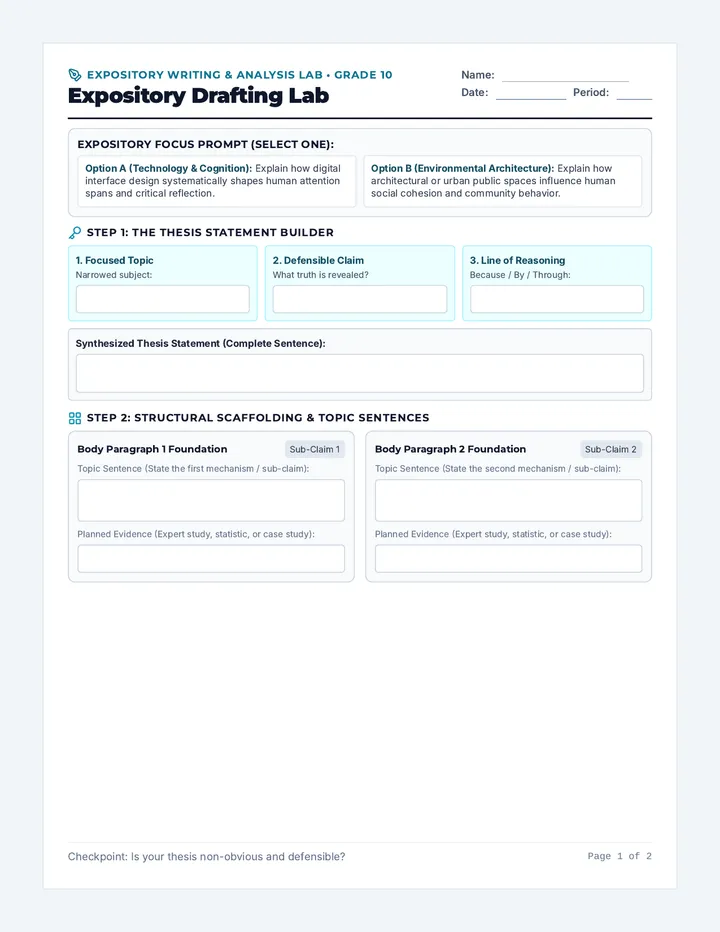
Scale A: Degree of Decision Alignment
Divergent Idea Compromise Alignment Consensus
Question: Why is a "consensus" different from a mere "compromise" in team decision-making?
A compromise requires people to give up core preferences to reach a middle ground. Conversely, a consensus is a deep, unified agreement where all stakeholders feel heard, align on the core vision, and fully support the path forward.
Scale B: Intensity of Resource Usage
Utilization Optimization Leverage
Question: How does "leveraging" an asset differ from simply "using" (utilizing) it?
To utilize an asset is to simply operate it for its basic function. To leverage an asset means using its structural power strategically to amplify the results exponentially, turning a minor resource into massive competitive advantage.
Unit: Workplace & Collaborative Literacy - Answer Key Page 2 of 3
Teacher Reference Manual
ANSWER KEY
True mastery of career vocabulary is demonstrated when you apply vocabulary smoothly within standard business writing. Complete the internal workspace communications below using appropriate professional syntax.
Fill in the blanks with the correct words: Mitigate, Delegation, Alignment, or Synergy.
FROM: Operations Director
TO: Creative Department Leads
SUBJECT: Resource Optimization & Risk Reduction
As we approach our upcoming software release, we must establish clear (1) alignment between our design and coding sprints. To achieve this, I suggest strategic (2) delegation of minor tasks, empowering junior staff to oversee localized testing.
Doing so will help us (3) mitigate the risk of developer burnout and ensure a smooth, prompt rollout. When our creative assets and code come together in unified (4) synergy, the final product will surpass what either team could build alone.
Scenario: Your team is currently facing divergent opinions regarding how to handle a project budget shortfall. Some wish to cut staff, while others prefer to reduce marketing expenses.
EXEMPLAR WRITING MODEL:
Write a short email using the terms Divergent, Consensus, and Leverage correctly in your draft.
Subject: Resolving Group Differences and Moving Forward
Dear Supervisor,
I am writing to update you on our current budget planning. Although our committee members hold highly divergent views regarding whether we should cut department staff or trim marketing campaigns, we are resolving this constructively.
To lead us toward an actionable consensus, I have organized a collaborative workshop. My plan is to leverage our team's data analysts to build a cost-benefit projection model. This strategy will enable us to make an evidence-based decision that everyone supports.
Best regards, [Student Name]
Three Target Words Used
Professional Tone Kept
Constructive Strategy Proposed
Unit: Workplace & Collaborative Literacy - Answer Key Page 3 of 3