Beast From Air Lesson Plan Beast From Air?
Lord of the Flies: Chapter 6 Analysis
30 MINS | 10TH GRADE
Why This Matters
Understanding the psychological impact of fear and symbolism in literature helps students critically analyze human behavior and complex themes, connecting to their own experiences with fear and unknown threats.
Prep & Materials
Lord of the Flies (Chapter 6)
Beast From Air? Slide Deck
Copies of Activity (1 per group)
Copies of Cool Down (1 per student)
Preparation Time
15 Minutes
Objective
Students will analyze Chapter 6 to understand the developing fear among the boys and the symbolic significance of the "beast from air" through textual evidence and collaborative discussion.
Instructional Flow
1
Warm-up & Introduction
5 MIN
• Begin with a quick check-in: "What's the scariest sound you've ever heard when you were alone?" (Brief sharing, 1-2 students).
• Introduce the day's lesson: We're diving into Chapter 6, where the boys encounter a new kind of fear. Today, we'll explore the 'beast from air' and what it truly symbolizes.
• Display the title slide from the Beast From Air? Slide Deck .
2
Chapter 6 Overview & Discussion
10 MIN
• Use the Slide Deck to guide a brief recap: Samneric's encounter, growing fear, Ralph's determination.
• Facilitate discussion using prompts:
"How has the 'beast' evolved in the boys' minds so far?"
"What does the 'beast from air' actually turn out to be? How is this ironic or symbolic?"
"How do fear and imagination work together to create the 'beast'?"
3
Decoding the Beast Activity
10 MIN
• Divide students into small groups (3-4 students).
• Distribute the Beast From Air? Activity worksheet.
• Groups analyze specific quotes to reveal the nature of fear and the 'beast's' symbolism.
• Circulate to provide support and encourage deeper analysis.
4
Share Out & Wrap-up
5 MIN
• Bring the class back together to share one key insight per group.
• Distribute the Chapter 6 Cool Down exit ticket for individual completion.
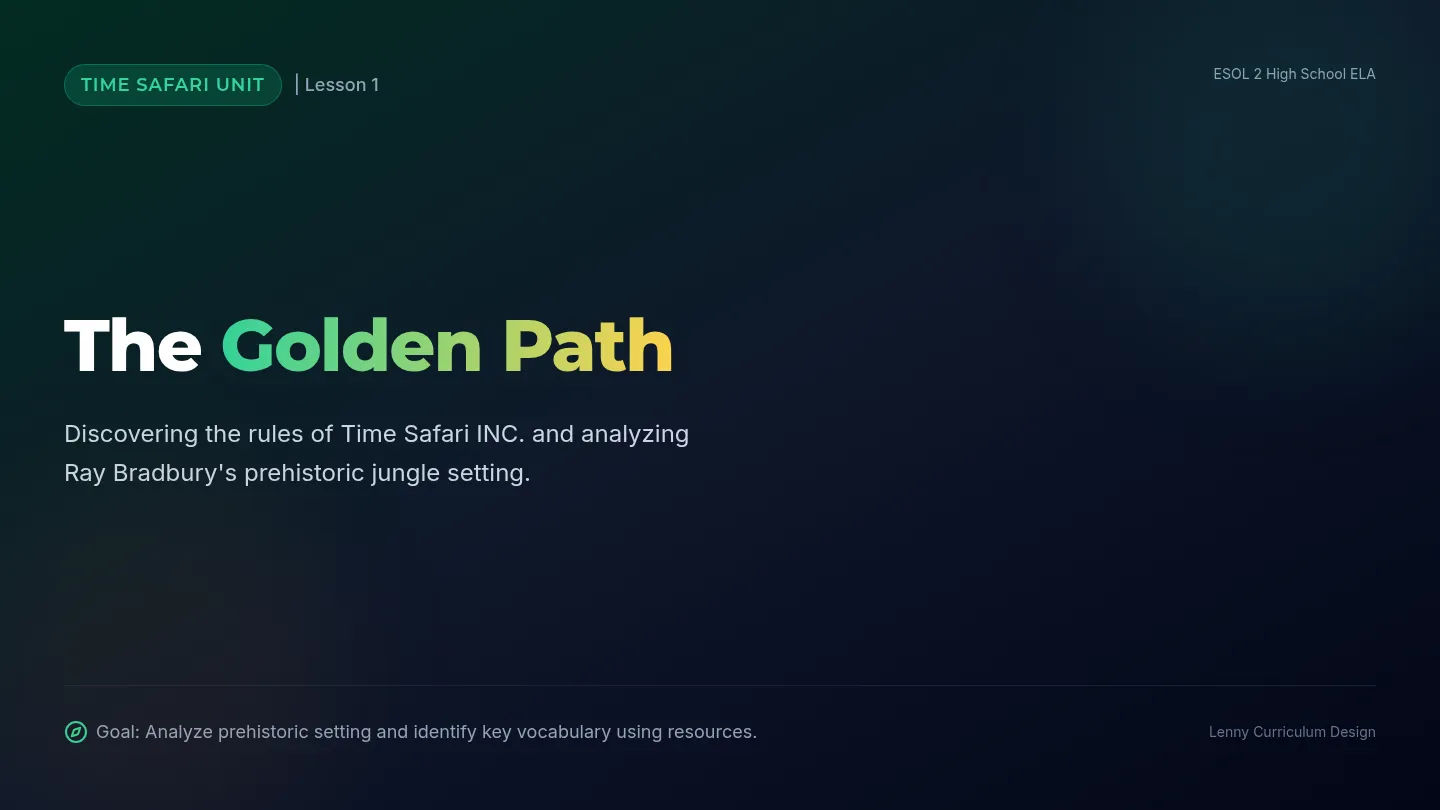
Beast From Air Slide Deck Beast From Air?
Exploring Fear, Symbolism, and Chapter 6
LET'S DIVE IN
Teacher Note: Welcome students and activate prior knowledge about fear.
Warm-Up
What's the scariest sound you've ever heard when you were alone?
Think about a time when your imagination might have made something ordinary seem terrifying.
Share your thoughts with the class...
Chapter 6: Key Events
1
The "sign from the adult world" descends upon the island.
2
Samneric have a terrifying encounter in the dark.
3
Growing fear and panic grip the boys at the assembly.
4
Ralph, Jack, and Roger set out to hunt the "beast."
5
The unsettling discovery at the top of the mountain.
What does this mean for the boys?
What is the Beast?
How has the idea of the "beast" evolved in the boys' minds by Chapter 6?
What does the "beast from air" actually turn out to be? How is this ironic or symbolic?
How do fear and imagination work together to create the "beast" on the island?
Decoding the Beast
Work in your groups to analyze key quotes from Chapter 6.
How do these quotes reveal the nature of the boys' fear and the symbolism of the "beast from air"?
10 MINUTES
WORKSHEET READY
Share Out & Reflect
Group Share
Share one key insight from your group's activity with the class.
Exit Ticket
Complete the Chapter 6 Cool Down reflection individually.
Beast From Air Activity Decoding the Beast
Chapter 6 Textual Analysis Activity
Name:
Instructions: Read each quote. Discuss what it reveals about the boys' growing fear, perception of the beast, and symbolism. Record your insights below.
1
"They were glad to be in the dimness of the shelter, out of the wind and the wet. The fire was dead. They were glad. It was an unlucky thing for the fire to go out, because then they had no means of sending a message to the outside world..."
What does being "glad" reveal about their priorities versus the danger of the fire going out?
How does this quote foreshadow increasing isolation and savagery?
2
"It was dark when Samneric found him... they could just make out that there were wings on the thing. They screamed and ran... They had seen its teeth and its claws and its great bulging head."
How does Golding use imagery here to create fear and mystery around the "beast"?
What details do they focus on, and how might their fear exaggerate these features?
3
"However Simon thought of the beast, there rose before his inward sight the picture of a human at once heroic and sick... He saw a fat, fuzzy object, a bulging forehead... And the beast was out of the air and into the sea."
How does Simon's perception differ from the other boys?
What does "human at once heroic and sick" suggest about the beast and humanity?
4
"Ralph was a specialist in thought now... for the truth was a hard thing, and he did not like it. He could hear the beat of the drums, the shouts of the hunters... He saw a small, red piglet, a stick..."
What is the "truth" that Ralph struggles to grasp, and why is it difficult?
How do the sensory details represent the influence of savagery and breakdown of order?
Chapter 6 Cool Down Exit Ticket
Chapter 6 Cool Down
Reflecting on Fear and the Beast
Student Name:
Date:
Instructions: Reflect on Chapter 6 of Lord of the Flies and answer the following questions to the best of your ability. This is an individual reflection.
1 What is one new insight you gained about the boys' fear or the nature of the "beast" after reading Chapter 6?
2 How does the "beast from air" challenge or confirm your understanding of fear and how it can affect people?
3 If you were on the island, what strategy would you use to confront or understand the fear of the beast?
"I'm frightened. Of us."
Beast From Air Answer Key Answer Key & Teacher Guide
Beast From Air? Activity
TEACHER REFERENCE
Quote 1: The Dead Fire
Priority vs. Danger: The boys prioritize immediate physical comfort (warmth from the rain) over long-term rescue. Being "glad" reveals their regression; they no longer feel the weight of responsibility that Ralph tries to maintain. The "unlucky" nature of the fire highlights their lack of agency—they see it as fate rather than their own failure.
Foreshadowing: The lack of a "message to the outside world" signifies the severance of their connection to civilization. Without the fire, they are truly trapped, which allows the "beast" of their inner savagery to grow unchecked.
Quote 2: Samneric's Beast
Imagery/Mystery: Golding uses gothic elements ("mysterious gloom," "wings," "teeth and claws") to transform a literal object into a supernatural monster. The focus on "wings" and "bulging head" creates a visceral sense of the grotesque.
Fear's Exaggeration: Their fear takes the flapping fabric of the parachute and turns it into "wings," and the dead man's face into a "great bulging head." It shows how fear doesn't just change perception—it invents details to justify the panic.
Quote 3: Simon's Vision
Differing Perception: Simon is the only one who looks inward. While others see an external monster (a beast), Simon sees a "human." He recognizes that the fear is not of a creature, but of the darkness within people.
"Heroic and Sick": This is a key paradox of humanity. "Heroic" represents human potential for nobility, order, and civilization; "sick" represents the inherent darkness and capacity for evil. The beast is humanity's own flawed nature.
Quote 4: Ralph's Struggle
The "Truth": Ralph is beginning to realize that the "beast" isn't something they can hunt or kill—it's the breakdown of the boys themselves. He doesn't "like it" because it means his leadership and his hope for order are failing against an invisible enemy.
Savagery/Order: The "beat of the drums" and "shouts of the hunters" are primal, rhythmic sounds of the mob. The "small, red piglet" and the "stick" (likely the stick sharpened at both ends later) signify the transition from hunting for food to hunting for blood and power.
Discussion Facilitation Tips
Encourage students to find specific adjectives in the text that show fear (e.g., "mysterious," "bulging").
Ask: "If the 'beast' is a dead pilot, why are they so afraid of it?" to guide them toward the idea of imagination .