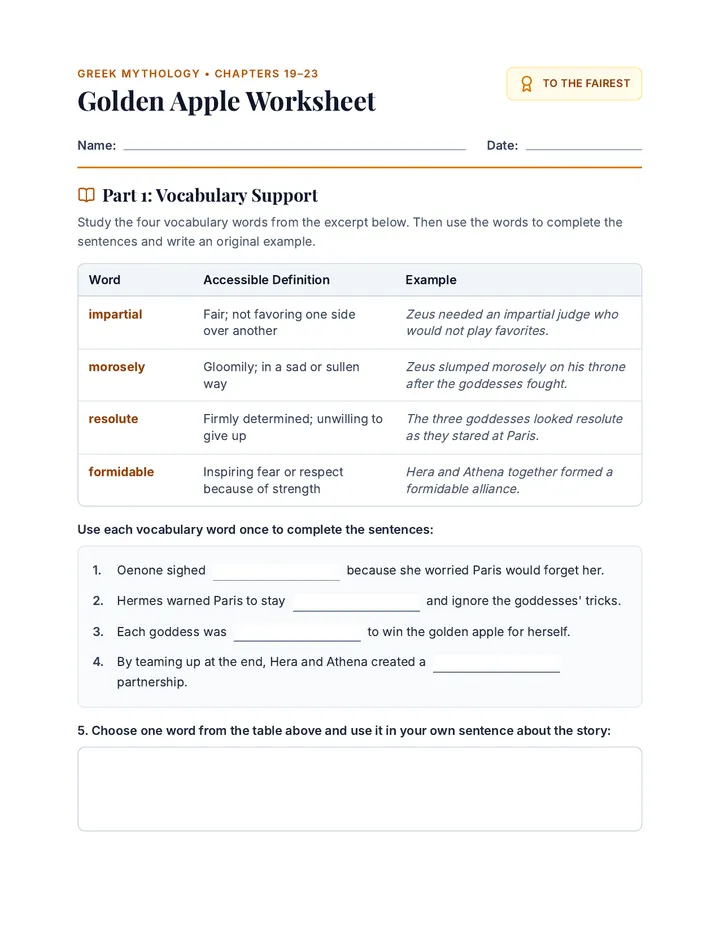
Golden Apple Worksheet
Greek Mythology • Chapters 19–23
Golden Apple Worksheet
To the Fairest
Name:
Date:
Part 1: Vocabulary Support
Study the four vocabulary words from the excerpt below. Then use the words to complete the sentences and write an original example.
| Word |
Accessible Definition |
Example |
| impartial |
Fair; not favoring one side over another |
Zeus needed an impartial judge who would not play favorites. |
| morosely |
Gloomily; in a sad or sullen way |
Zeus slumped morosely on his throne after the goddesses fought. |
| resolute |
Firmly determined; unwilling to give up |
The three goddesses looked resolute as they stared at Paris. |
| formidable |
Inspiring fear or respect because of strength |
Hera and Athena together formed a formidable alliance. |
Use each vocabulary word once to complete the sentences:
Oenone sighed because she worried Paris would forget her.
Hermes warned Paris to stay and ignore the goddesses' tricks.
Each goddess was to win the golden apple for herself.
By teaming up at the end, Hera and Athena created a partnership.
5. Choose one word from the table above and use it in your own sentence about the story:
Golden Apple Worksheet Page 2 • Plot & Character
Part 2: Plot Development & Sequence
Number the events from 1 (first) to 6 (last), then answer the plot inquiries below.
Athena interrupts Hera by claiming Zeus is watching as an eagle, then offers Paris military victories.
Eris throws a golden apple inscribed "To the Fairest" at the feet of Hera, Athena, and Aphrodite.
Aphrodite whispers a secret offer to Paris, and he places the golden apple in her lap.
Hermes flies to Mount Ida to tell Paris that Zeus wants him to judge a beauty contest.
Hera pulls Paris aside and promises him power, riches, and a palace in Troy.
Hera and Athena stand side by side, forming an uneasy alliance after Aphrodite wins.
Objective Inquiry
According to Chapter 19, why did Zeus and Hermes rule out generals and rulers as judges?
Plot Development Inquiry
How does Hermes's vision of Paris on flaming rubble raise the stakes before the contest begins?
Part 3: Character Development & Choices
Complete the chart to compare what each goddess wanted, what she offered Paris, and how Paris reacted.
| Character |
Motive / Goal |
Offer or Action |
Paris's Reaction |
| Hera |
|
|
|
| Athena |
|
|
|
| Aphrodite |
|
|
|
Golden Apple Worksheet Page 3 • Cause, Effect & Inquiry
Part 4: Cause & Effect Chain
Trace how Eris's trick at the wedding sets off a chain of events leading toward future conflict.
Cause 1
Eris is not invited to Peleus's wedding and tosses a golden apple marked "To the Fairest."
Effect 1
Cause 2
Effect 2
Zeus refuses to judge the contest himself and sends Hermes to recruit Paris on Mount Ida.
Cause 3
Paris accepts Aphrodite's secret offer and awards her the golden apple.
Effect 3
Part 5: Text-Based Inquiries
Character Development Inquiry
How does Paris's behavior change from when he swears to Hermes to be fair to when Hera and Aphrodite make their offers?
Inferential Inquiry
Why does Oenone close her eyes "hard" in Chapter 20, and what does Hermes's pity for her suggest about Paris?
Cause & Effect Inquiry
How does the ending of Chapter 23 (Hera and Athena standing arm-in-arm) connect to Hermes's earlier vision of disaster?
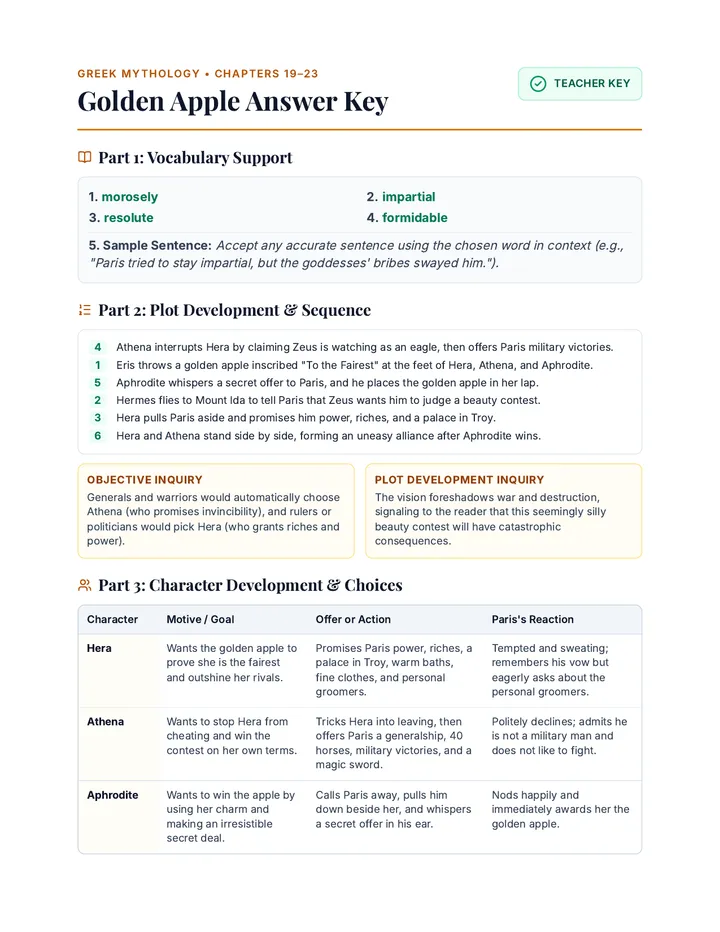
Golden Apple Answer Key
Greek Mythology • Chapters 19–23
Golden Apple Answer Key
Teacher Key
Part 1: Vocabulary Support
-
morosely
-
impartial
-
resolute
-
formidable
5. Sample Sentence: Accept any accurate sentence using the chosen word in context (e.g., "Paris tried to stay impartial, but the goddesses' bribes swayed him.").
Part 2: Plot Development & Sequence
4 Athena interrupts Hera by claiming Zeus is watching as an eagle, then offers Paris military victories.
1 Eris throws a golden apple inscribed "To the Fairest" at the feet of Hera, Athena, and Aphrodite.
5 Aphrodite whispers a secret offer to Paris, and he places the golden apple in her lap.
2 Hermes flies to Mount Ida to tell Paris that Zeus wants him to judge a beauty contest.
3 Hera pulls Paris aside and promises him power, riches, and a palace in Troy.
6 Hera and Athena stand side by side, forming an uneasy alliance after Aphrodite wins.
Objective Inquiry
Generals and warriors would automatically choose Athena (who promises invincibility), and rulers or politicians would pick Hera (who grants riches and power).
Plot Development Inquiry
The vision foreshadows war and destruction, signaling to the reader that this seemingly silly beauty contest will have catastrophic consequences.
Part 3: Character Development & Choices
| Character |
Motive / Goal |
Offer or Action |
Paris's Reaction |
| Hera |
Wants the golden apple to prove she is the fairest and outshine her rivals. |
Promises Paris power, riches, a palace in Troy, warm baths, fine clothes, and personal groomers. |
Tempted and sweating; remembers his vow but eagerly asks about the personal groomers. |
| Athena |
Wants to stop Hera from cheating and win the contest on her own terms. |
Tricks Hera into leaving, then offers Paris a generalship, 40 horses, military victories, and a magic sword. |
Politely declines; admits he is not a military man and does not like to fight. |
| Aphrodite |
Wants to win the apple by using her charm and making an irresistible secret deal. |
Calls Paris away, pulls him down beside her, and whispers a secret offer in his ear. |
Nods happily and immediately awards her the golden apple. |
Golden Apple Answer Key Page 2 • Cause, Effect & Inquiries
Part 4: Cause & Effect Chain
Cause 1
Eris is not invited to Peleus's wedding and tosses a golden apple marked "To the Fairest."
Effect 1 (Sample)
Hera, Athena, and Aphrodite quarrel bitterly, hurl insults, and stop speaking to one another.
Cause 2 (Sample)
Hera pressures Zeus to give her the apple, and Zeus realizes he needs an impartial mortal judge.
Effect 2
Zeus refuses to judge the contest himself and sends Hermes to recruit Paris on Mount Ida.
Cause 3
Paris accepts Aphrodite's secret offer and awards her the golden apple.
Effect 3 (Sample)
Hera and Athena become sore losers and form a formidable, dangerous alliance against Aphrodite and Paris.
Part 5: Text-Based Inquiries (Model Responses)
Character Development Inquiry
How does Paris's behavior change from when he swears to Hermes to be fair to when Hera and Aphrodite make their offers?
At first, Paris earnestly vows with his hand on his heart that he will be impartial. However, once Hera tempts him with luxury and status, he sweats and wavers; by the time Aphrodite whispers her offer, he abandons fairness completely and bolts to her side for personal gain.
Inferential Inquiry
Why does Oenone close her eyes "hard" in Chapter 20, and what does Hermes's pity for her suggest about Paris?
Oenone closes her eyes in pain and fear because she realizes she is about to lose Paris to a goddess. Hermes's pity suggests that Paris is shallow, self-absorbed, and easily tempted—someone who does not truly appreciate Oenone's devotion and will betray her.
Cause & Effect Inquiry
How does the ending of Chapter 23 (Hera and Athena standing arm-in-arm) connect to Hermes's earlier vision of disaster?
Hera and Athena uniting as "sore losers" shows that Paris's choice has turned two powerful goddesses into enemies. Their formidable alliance sets in motion the revenge and conflict that will lead to the flaming rubble and destruction Hermes foresaw.