Main Idea Lesson Plan Unit of Study • Reading Intervention
Main Idea Codebreakers: Lesson Plan
Subject: ELA / Reading Comprehension
Target Group: Middle School (Grade 3 Reading Level)
Duration: 50 Minutes
NC Standard Course of Study
NC.RI.3.2 (Primary Instructional Target):
"Determine the main idea of a text; recount the key details and explain how they support the main idea."
Aligned Middle School Anchor: NC.RI.6.2 (Central idea & supporting details with scaffolded access).
Measurable Lesson Objective
Given high-interest informational paragraphs and a 3-step strategy checklist, students will identify the correct main idea in multiple-choice format with at least 80% accuracy (4/5 correct) and verbally/written construct a central idea statement using a provided sentence stem.
Materials Needed: Main Idea Strategy Slides, Student Codebreakers Worksheet, Highlighter/Pencils, Strategy Anchor Chart
Lesson Phase & Pacing
Explicit Core Instruction (Actions & Teacher Script)
Evidence-Based Practices (EBP)
1. Introduction Hook & Prior Knowledge 5 Minutes
The Mystery Box / Movie Title Analogy:
"Imagine watching a two-hour superhero movie and someone asks what it was about. You wouldn't list every punch—you give the Big Point!"
Introduce the term Main Idea: The single most important thought the author wants you to remember.
EBP: Concrete Analogy & Activating Prior Knowledge
Links abstract comprehension skill to familiar schema (movie synopses, text messages) to lower cognitive load.
2. I Do Teacher-Directed Modeling 10 Minutes
Explicit 3-Step Strategy Routine:
Topic: Who or what is the text mostly about? (1-2 words)
Clues: What do the detail sentences tell us about it?
Formula: Topic + Key Point = Main Idea.
Teacher models with passage "Electric Hunters": thinking aloud, underlining repeated topic words, eliminating overly narrow detail traps.
EBP: Explicit Instruction & Think-Aloud Modeling
Verbalizes metacognitive steps, demonstrates non-examples (detail vs. main idea), and provides an overt 3-step decision rule.
Main Idea Codebreakers • North Carolina Standards-Based Lesson Plan Page 1 of 2
Lesson Implementation (Continued)
We Do • You Do • Assessment
Lesson Phase & Pacing
Explicit Core Instruction (Actions & Teacher Script)
Evidence-Based Practices (EBP)
3. We Do Guided Practice & Co-Construction 15 Minutes
Choral Reading & Strategy Walkthrough:
Display "Robot Dogs to the Rescue". Guide the group through the 3-step checklist.
Prompt: "What is the topic word in every sentence? Why is option A a trap? (It's just one detail, not the whole passage!)."
Students apply Sentence Stem: "The author wrote this text to show that [Topic] is [Key Point]."
EBP: Scaffolded Sentence Stems & Distractor Analysis
Students explicitly dissect distractors (Too Broad vs. Too Narrow Detail vs. True Main Idea) with corrective feedback.
4. You Do Independent Practice 15 Minutes
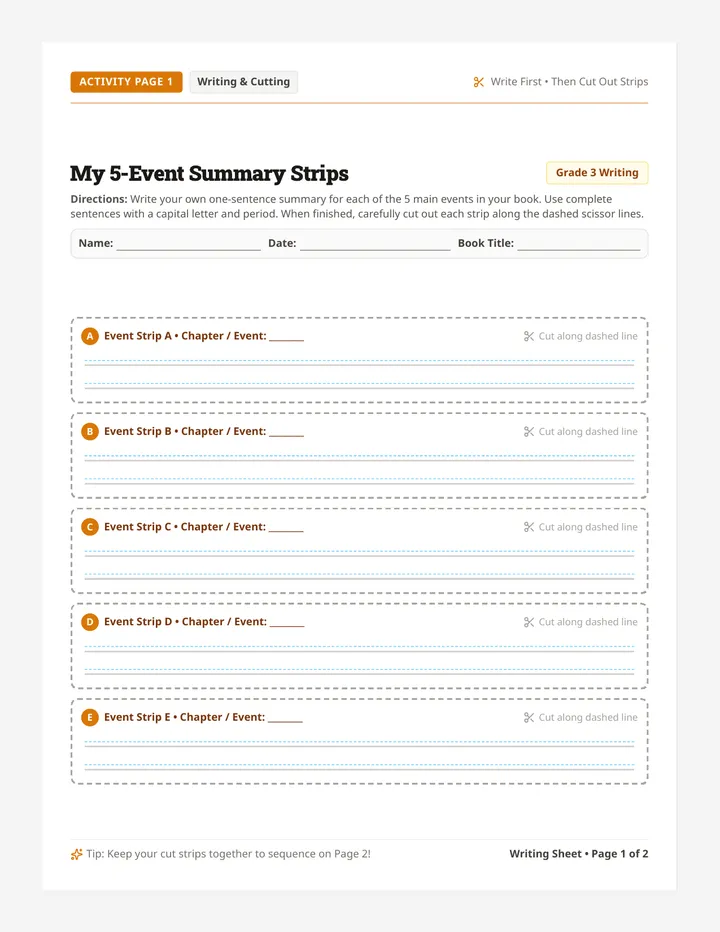
Student Codebreaker Worksheet:
Students independently read high-interest passages ("The Deep Sea Glow" and "Spiders in Space"), check off strategy boxes, and answer multiple-choice questions.
Teacher conducts targeted small-group check-ins for students needing verbal prompting.
EBP: Self-Monitoring Strategy Checklist
Visual checklists prompt students to execute all 3 steps before selecting an answer choice.
5. Closure Summarizing Strategy 5 Minutes
3-2-1 Rapid Code Check:
Students share: 3 steps of the formula, 2 trap answers to watch out for, and 1 main idea sentence from today's text.
EBP: Active Student Synthesis
Solidifies retrieval and verbal rehearsal of strategy steps before ending session.
Assessment & Progress Monitoring
• Formative: Check-in during 'We Do' step-by-step checklist usage and oral justification.
• Summative / Exit Ticket: 5-question independent practice score (Mastery = 4/5 or 80%).
Extending & Refining
Intervention Support: Provide color-coded text (yellow = topic, green = details), audio text-to-speech, and cloze sentence frames.
Extension Challenge: Have advanced students write headline titles and summarize multi-paragraph articles into a single tweet-length main idea.
Main Idea Codebreakers • North Carolina Standards-Based Lesson Plan Page 2 of 2
Main Idea Instruction Slides Reading Intervention • Core Strategy Codebreaker Mission #1
Crack the Central Message
Main Idea Codebreakers
Learn the 3-Step Secret Routine to discover what informational articles are truly all about!
Topic Hunter Detail Clues The Big Formula
The Big Question
Concept Hook
A Single Detail
"A superhero throws a punch at a villain in the rain."
⚠️ Too Tiny! That is only one small scene in the movie.
The Main Idea
"A group of heroes team up to protect Earth from an alien invasion."
🎯 The Big Picture! That tells what the whole movie is about.
💡 Rule: The Main Idea covers the whole text, not just one interesting fact!
The 3-Step Strategy Checklist
Repeatable Routine
1
Find the Topic
Who or what is mentioned in almost every single sentence? (1-2 words)
🔍 Look for repeated words!
2
Spot the Clues
What do all the detail sentences tell us about this topic?
📝 What is the author showing?
3
Build Formula
Combine them into one strong complete sentence!
🎯 Topic + Big Point = Main Idea
Follow these 3 steps on every paragraph to never get tricked!
I Do
Modeling: Electric Hunters
Watch Teacher Think Aloud
Informational Passage:
Electric eels have incredible powers to survive in murky water. These creatures can release strong shocks of electricity to stun their prey. They also send out tiny electrical pulses to navigate when they cannot see. Their shock organs even scare away dangerous predators.
Step 1: Topic
Electric Eels
Step 2: What is the text saying?
They use electricity to hunt, navigate, and protect themselves.
Step 3: Main Idea
Electric eels use electric shocks in multiple ways to survive.
🚫 Trap Warning: "They stun prey" is just ONE detail, not the whole main idea!
We Do
Guided Codebreaking: Rescue Robots
Let's Solve Together!
Engineers build robotic dogs to help humans during dangerous emergencies. These tough metal robots can climb over shattered rocks where humans cannot walk. They carry cameras into burning buildings to search for trapped survivors. Robot dogs also enter toxic chemical zones safely.
👉 Sentence Frame: "The text is mostly about how robot dogs..."
A. Robot dogs carry cameras inside burning buildings.
B. Robotic dogs are built to assist in dangerous rescues.
C. Engineers enjoy playing with mechanical animals.
💡 Which choice is the entire umbrella that covers all the sentences? Answer: B!
Codebreaker Sentence Frames
Independent Practice Prep
Frame 1 (Basic)
"The main idea is that [Topic] is/does [Key Point]."
Example: "The main idea is that robot dogs help humans in emergencies."
Frame 2 (Advanced)
"The author wrote this text to show how [Topic] can [Action/Purpose]."
Example: "The author wrote this to show how electric eels use shock to survive."
Independent Codebreaking Time!
Grab your worksheet, check off your 3 steps, and crack the clues!
Main Idea Clues Worksheet Reading Lab NC.RI.3.2 / NC.RI.6.2 Intervention
Main Idea Codebreakers: Student Mission
Name: __________________
Date: _________
Period: ________________
Score: ___ / 5
3-Step Strategy Code:
1. Find Repeated Topic 2. Ask: What does author say? 3. Pick Umbrella Idea
Mission Passage 1: Deep-Sea Flashlights Informational Text
Thousands of feet under the ocean, sunlight cannot reach the freezing water. Many strange deep-sea animals make their own glowing light called bioluminescence to survive. The anglerfish dangles a glowing light bulb over its head to lure curious meals directly into its mouth. Lanternfish flash bright belly lights to signal their friends in the pitch-black ocean. Other deep-sea squids shoot glowing ink clouds to confuse hungry hunters and escape safely.
Codebreaker Check:
Step 1: Found Topic Step 2: Underlined Clues
1. What is the main idea of Passage 1?
A. Deep-sea animals produce their own light in different ways to survive.
B. Anglerfish have sharp teeth and a glowing bulb on their heads.
C. The deep ocean is freezing cold and pitch black.
2. Which detail from the text directly supports the main idea?
A. Ocean water is salty and very deep.
B. Squids squirt glowing ink to confuse predators and escape.
C. Sunlight travels easily through shallow water.
Mission Passage 2: Astronaut Spiders Science & Space
In 2011, NASA scientists rocketed two golden silk orb-weaver spiders to the International Space Station. The researchers wanted to see if spiders could build webs without Earth's gravity. At first, in zero gravity, the spiders spun messy and tangled webs. But after just a few days of practice in space, the clever spiders adapted. They began spinning nearly perfect circular webs using bright laboratory lights as their guide.
3. What is the central idea of the NASA spider experiment?
A. Spiders were sent to space and quickly learned how to adapt their web-building.
B. Golden silk orb-weaver spiders are dangerous insects found on Earth.
C. Rockets blast astronauts to the International Space Station every year.
Main Idea Codebreakers • Student Worksheet Page 1 of 2
Mission 3 & Justification Challenge
Apply Your Sentence Frames
Mission Passage 3: Robot Falcons Guard the Sky Modern Inventions
Real birds near airport runways can cause serious plane crashes if they fly into jet engines. To solve this problem, engineers invented the "RobotFalcon," a remote-controlled drone shaped like a giant predatory bird. This drone flaps its wings and flies just like a real falcon. When airport operators fly the robot near runways, real flocks of birds become terrified and quickly fly away. This robotic invention keeps both airplanes and wildlife safe without poisoning or shooting birds.
4. What is the main idea of this article?
A. Airplanes have giant jet engines that make loud noises.
B. Robot falcon drones protect airports by scaring birds away safely.
C. Falcons are the fastest hunting birds on planet Earth.
5. Why is option A incorrect for Question 4?
A. It is a false fact that never happened.
B. It is too broad and covers all vehicles.
C. It is only one small background detail, not the main point.
Codebreaker Written Justification: Construct Your Own Main Idea
Choose Passage 2 (Spiders) OR Passage 3 (Robot Falcons) . Use the sentence frame below to write a complete central idea statement in your own words, then give one supporting clue.
Frame: "The main idea of the text is that [Topic] is/does [Key Point] because [Supporting Detail]."
I chose Passage #: ______
My Main Idea Sentence:
Key Detail that Proves It:
Mission Debrief: I checked for trap details. My sentence has a Topic + Key Point.
Main Idea Codebreakers • Student Worksheet Page 2 of 2
Main Idea Keys Teacher Guide Teacher Resource • Answer Key & Diagnostic
Main Idea Codebreakers: Answer Key & Guide
Standards: NC.RI.3.2 / NC.RI.6.2
Small Group Intervention: Tier 2 / Tier 3
Multiple Choice Key & Diagnostic Misconception Guide 5 Points Total (1 pt each)
1 Answer: A
Main Idea: "Deep-sea animals produce their own light in different ways to survive."Error Analysis: B is too narrow (only names anglerfish, ignoring lanternfish & squids). C is a setting detail.
2 Answer: B
Supporting Detail: "Squids squirt glowing ink to confuse predators and escape."Error Analysis: A and C are general facts not tied to the light-producing survival mechanism.
3 Answer: A
Central Idea: "Spiders were sent to space and quickly learned how to adapt web-building."Error Analysis: B is irrelevant background. C is an overly broad statement about space flights.
4 Answer: B
Main Idea: "Robot falcon drones protect airports by scaring birds away safely."Error Analysis: A is a minor detail about jet engines; C is general bird trivia.
5 Answer: C
Metacognitive Justification: Option A is incorrect because it is only one small background detail, not the umbrella main point.
Exemplar Sentence Frame Responses (Rubric: 2 pts)
If Student Chose Passage 2 (Spiders):
"The main idea of the text is that spiders adapted to zero gravity because they learned to spin circular webs using laboratory lights ."
If Student Chose Passage 3 (Robot Falcons):
"The main idea of the text is that robot falcons protect airplanes because flapping drone wings scare wild birds away from runways without harming them ."
Targeted Intervention Decision Tree
If Student Selects Detail Trap:
Ask: "Does the whole paragraph talk only about [Detail], or does it talk about [Topic] throughout the entire text?"
If Student Selects Too Broad:
Ask: "Does this choice give the specific point the author is trying to prove, or is it too general?"
Mastery Extension:
Have students craft their own multi-paragraph article headline and write a 1-sentence synopsis.
Main Idea Codebreakers • Teacher Answer Key & Diagnostic Guide NC.RI.3.2 / NC.RI.6.2