River Oasis Close Reading Worksheet Of Mice and Men • Chapter 1 Close Reading
River Oasis Close Reading Worksheet
Name:
Date: Period:
Essential Question: How does Steinbeck use sensory setting details and contrasting character descriptions to foreshadow the central conflicts of the novella?
1 Part I: The Natural Sanctuary vs. Human Intrusion
Paragraphs 1–2
“A few miles south of Soledad, the Salinas River drops in close to the hillside bank and runs deep and green. The water is warm too, for it has slipped twinkling over the yellow sands in the sunlight before reaching the narrow pool. On one side of the river the golden foothill slopes curve up to the strong and rocky Gabilan Mountains, but on the valley side the water is lined with trees—willows fresh and green with every spring... There is a path beaten hard by boys coming down from the ranches to swim in the deep pool, and beaten hard by tramps who come wearily down from the highway in the evening to jungle-up near water.”
A. Sensory Imagery & Mood: Underline two vivid sensory descriptions in the excerpt. What atmosphere does Steinbeck create before human characters speak, and how does the river setting act as a sanctuary?
B. Word Choice & Foreshadowing: Notice the phrase “beaten hard by tramps who come wearily down.” How does this detail shift the mood from peaceful nature to harsh social reality?
2 Part II: Character Juxtaposition & Animal Motifs
Paragraphs 3–5
“The first man was small and quick, dark of face, with restless eyes and sharp, strong features. Every part of him was defined: small, strong hands, slender arms, a thin and bony nose. Behind him came his opposite, a huge man, shapeless of face, with large, pale eyes, and wide, sloping shoulders; and he walked heavily, dragging his feet a little, the way a bear drags his paws... Lennie dipped his whole head under, hat and all, and then he sat up on the bank and his hat dripped down on his blue coat. ‘Lennie!’ George said sharply. ‘Lennie, for God’s sakes don’t drink so much.’”
George Milton (Mind / Instinct) Analysis
Identify one specific physical detail that signals George's sharpness and hypervigilance:
Lennie Small (Physical / Animal) Analysis
Explain what comparing Lennie to a “bear” drinking like a “horse” implies about his nature:
Page 1 of 2 • Turn over for Dream Recitation & Synthesis
Part III & IV
The Dream Ritual & Textual Synthesis
Student Name:
3 Part III: The Recited Dream as Sacred Ritual
Campfire Scene
“George’s voice became deeper. He repeated his words rhythmically as though he had said them many times before. ‘Guys like us, that work on ranches, are the loneliest guys in the world. They got no family. They don’t belong no place... With us it ain’t like that. We got a future. We got somebody to talk to that gives a damn about us...’
A. Rhythm & Repetition: Steinbeck notes George speaks “rhythmically as though he had said them many times before.” Why has this story become a recited ritual for both men? What psychological purpose does it serve in the face of itinerant ranch loneliness?
B. Analytical Check: In the context of Chapter 1, what does the recurring symbol of the “dead mouse” in Lennie’s pocket primarily suggest about their shared dream of tending rabbits?
A. Lennie refuses to work on farms unless animals are provided for his entertainment.
B. Lennie's unintentional lethal strength threatens fragile things he loves, foreshadowing tragedy.
C. George uses the animal to test whether Lennie is capable of hunting food along the trail.
D. It proves Lennie enjoys inflicting cruelty on weaker creatures when George is not looking.
4 Part IV: Synthesis Analytical Paragraph
15 Points
Prompt:
How does Steinbeck use animal imagery and natural setting details in Chapter 1 to both highlight the bond between George and Lennie and foreshadow the fragility of their American Dream? Write a well-structured paragraph that incorporates at least one direct quote and thorough commentary.
Assessment Criteria: Textual Evidence (5 pts) • Literary Analysis (5 pts) • Clarity & Mechanics (5 pts) Page 2 of 2
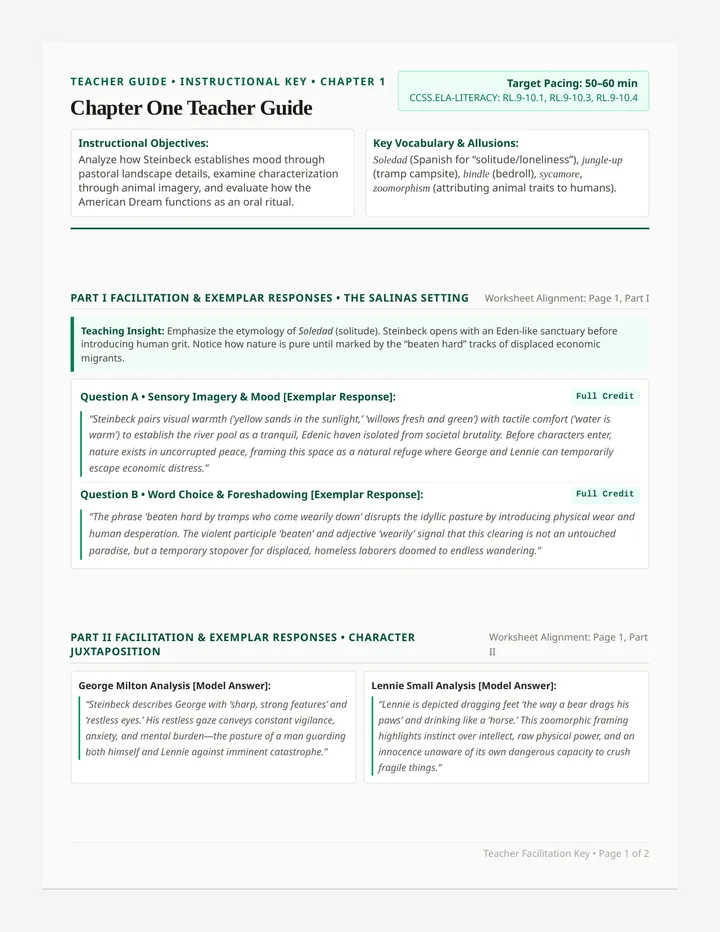
Chapter One Teacher Guide Teacher Guide • Instructional Key • Chapter 1
Chapter One Teacher Guide
Target Pacing: 50–60 min
CCSS.ELA-LITERACY: RL.9-10.1, RL.9-10.3, RL.9-10.4
Instructional Objectives: Analyze how Steinbeck establishes mood through pastoral landscape details, examine characterization through animal imagery, and evaluate how the American Dream functions as an oral ritual.
Key Vocabulary & Allusions: Soledad (Spanish for “solitude/loneliness”), jungle-up (tramp campsite), bindle (bedroll), sycamore, zoomorphism (attributing animal traits to humans).
Part I Facilitation & Exemplar Responses • The Salinas Setting
Worksheet Alignment: Page 1, Part I
Teaching Insight: Emphasize the etymology of Soledad (solitude). Steinbeck opens with an Eden-like sanctuary before introducing human grit. Notice how nature is pure until marked by the “beaten hard” tracks of displaced economic migrants.
Question A • Sensory Imagery & Mood [Exemplar Response]: Full Credit
“Steinbeck pairs visual warmth (‘yellow sands in the sunlight,’ ‘willows fresh and green’) with tactile comfort (‘water is warm’) to establish the river pool as a tranquil, Edenic haven isolated from societal brutality. Before characters enter, nature exists in uncorrupted peace, framing this space as a natural refuge where George and Lennie can temporarily escape economic distress.”
Question B • Word Choice & Foreshadowing [Exemplar Response]: Full Credit
“The phrase ‘beaten hard by tramps who come wearily down’ disrupts the idyllic pasture by introducing physical wear and human desperation. The violent participle ‘beaten’ and adjective ‘wearily’ signal that this clearing is not an untouched paradise, but a temporary stopover for displaced, homeless laborers doomed to endless wandering.”
Part II Facilitation & Exemplar Responses • Character Juxtaposition
Worksheet Alignment: Page 1, Part II
George Milton Analysis [Model Answer]:
“Steinbeck describes George with ‘sharp, strong features’ and ‘restless eyes.’ His restless gaze conveys constant vigilance, anxiety, and mental burden—the posture of a man guarding both himself and Lennie against imminent catastrophe.”
Lennie Small Analysis [Model Answer]:
“Lennie is depicted dragging feet ‘the way a bear drags his paws’ and drinking like a ‘horse.’ This zoomorphic framing highlights instinct over intellect, raw physical power, and an innocence unaware of its own dangerous capacity to crush fragile things.”
Teacher Facilitation Key • Page 1 of 2
Key & Rubric
Dream Motif, Multiple Choice, & Analytical Rubric
Teacher Resource Manual
Part III Exemplars & Multiple-Choice Key
Worksheet Alignment: Page 2, Part III
Question A: Rhythmic Repetition of Dream [Exemplar]: Full Credit
“The dream speech operates like a secular psalm or bedtime story. Migrant workers endure radical isolation and rootlessness (‘no family... don’t belong no place’). Reciting their shared future anchors both men against despair, reaffirming their mutual brotherhood in a society that discards solitary workers.”
Question B Key: B
Rationale: Lennie carries a dead mouse because he loves petting soft fur, yet he accidentally kills what he cherishes through uncontrollable strength. This directly foreshadows his future handling of soft things (puppies, Curley's wife).Distractor Analysis: (A) incorrect characterization; (C) George forbids dead mice; (D) Lennie possesses zero malice or sadism.
Part IV Model Exemplar Student Response (Score: 15/15)
High Anchor Response
“In Chapter 1, Steinbeck establishes a sharp tension between pastoral sanctuary and inescapable vulnerability to foreshadow the doom of George and Lennie’s American Dream. While the Salinas River appears as a tranquil haven where ‘water is warm’ and sycamores flourish, it is already marked by a path ‘beaten hard by tramps,’ proving that economic destitution and homelessness cannot be escaped. Within this setting, Steinbeck introduces Lennie through animal imagery—he drinks ‘like a horse’ and lumbers ‘the way a bear drags his paws.’ While this zoomorphic portrayal emphasizes Lennie’s innocent loyalty and physical prowess, his obsession with the dead mouse exposes his fatal flaw: he cannot moderate his own crushing strength. When George recites their dream of how they will ‘live off the fatta the lan’’ and tend rabbits, the ritual brings warmth to the dark clearing, yet Lennie’s inability to keep even a small mouse alive warns the reader that their fragile Eden is destined to be shattered by the very nature Lennie cannot control.”
Analytical Rubric (15 Pts)
• 5 pts - Evidence: Embeds at least 1 accurate quote smoothly into analysis.
• 5 pts - Analysis: Analyzes animal motif and setting connection to the dream.
• 5 pts - Style: Clear thesis sentence, formal diction, and precise syntax.
Discussion / Extension Prompts
• Why does George tell Lennie to return to this specific pool if trouble arises?
• How does Robert Burns’ poem “To a Mouse” illuminate George and Lennie’s dilemma?
• Is George’s frustration with Lennie cruel, protective, or both?
Teacher Facilitation Key • Page 2 of 2
River Oasis Analysis Slides Of Mice and Men • Chapter 1 Close Reading
The Salinas Sanctuary & The Fragile Dream
Analyzing pastoral imagery, character juxtaposition, and tragic foreshadowing in Steinbeck’s opening chapter.
Guided Close Reading & Discussion Deck Literature & Text Analysis • Grade 9–10
Setting Analysis • Paragraphs 1–2
The Edenic Pool vs. The Beaten Path
“The water is warm too, for it has slipped twinkling over the yellow sands in the sunlight... On one side the golden foothill slopes curve up... but on the valley side the water is lined with trees.”
Nature as Untouched Sanctuary
“A path beaten hard by boys coming down... and beaten hard by tramps who come wearily down from the highway to jungle-up.”
Critical Tension: Human weariness and economic destitution penetrate natural peace before a single word is spoken.
Close Reading Question: Why does Steinbeck describe nature as pure before showing human scars on the land? Worksheet Part I
Characterization • Paragraphs 3–5
George & Lennie: Mind vs. Might
George Milton
• Sharp & Defined: Small hands, restless eyes, quick mind.
• Hypervigilance: Carries the mental and logistical weight of survival.
• Role: Guardian, strategist, and disciplinarian.
Lennie Small
• Huge & Shapeless: Walks like a bear dragging its paws.
• Zoomorphism: Drinks like a horse, driven by immediate instinct.
• Role: Raw physical labor paired with child-like innocence.
Key Concept: Zoomorphism —Steinbeck portrays Lennie with animal traits to signal instinct over intellect. Worksheet Part II
Motif & Foreshadowing • The Pocket
The Dead Mouse as Tragic Omen
“‘I didn’t kill it. Honest! I found it. I found it dead.’ ... ‘Uh-uh. Jus’ a dead mouse, George. I didn’t kill it. Honest! I just wanted to pet it with my thumb.’”
1. Craving Softness Lennie seeks tactile comfort in a brutal, coarse world.
2. Zero Malice He loves living things, but lacks awareness of his physical power.
3. Fatal Foreshadowing Lennie unintentionally destroys what he cherishes most.
Discussion Check: How does Lennie’s handling of the mouse threaten their dream of tending rabbits? Analytical Insight
The Ritual • Campfire Scene
“Guys like us... We got a future!”
The Migrant Condition
“Guys like us, that work on ranches, are the loneliest guys in the world. They got no family. They don’t belong no place.”
Isolation, rootlessness, and disposable labor define Great Depression itinerants.
The Shared Antidote
“With us it ain’t like that. We got a future. We got somebody to talk to that gives a damn about us... live off the fatta the lan’.”
The recitation functions as a bedtime ritual and mutual vow against loneliness.
Oral Tradition: Notice how George recites this like a ritualistic prayer he has repeated dozens of times. Worksheet Part III
Independent Synthesis • Assessment
Drafting the Analytical Paragraph
Synthesis Writing Prompt (Part IV):
How does Steinbeck use animal imagery and natural setting details in Chapter 1 to highlight George and Lennie’s bond while foreshadowing the fragility of their dream?
1 Clear topic sentence / claim
2 1+ embedded textual quotes
3 Insightful thematic analysis
Complete Part IV on Page 2 of your worksheet now. Refer to the model criteria above! 15 Points • 10 Minutes