Lenny.com
Explore
Create
ActivitiesNewMathEnglish Language ArtsScience & EngineeringSocial StudiesGlobal LanguagesHealth & Physical EducationSpecial EducationCounseling & Life SkillsArts & CreativityESL
Lenny.com
Lenny.com
Explore
Create
ActivitiesNewMathEnglish Language ArtsScience & EngineeringSocial StudiesGlobal LanguagesHealth & Physical EducationSpecial EducationCounseling & Life SkillsArts & CreativityESL
Lenny.com
English Language ArtsPhonics & Reading FoundationsLetter IdentificationLearn Letters A-ZLowercase and Uppercase LettersConsonants and VowelsLetter-Sound AssociationsLetter-Sound Associations: LowercaseLetter-Sound Associations: UppercaseBeginning and Ending SoundsRhymingBlending And SegmentingShort VowelsShort Vowel SoundsConsonant BlendsConsonant DigraphsBlends, Digraphs, and TrigraphsDigraphs, Blends, and Silent LettersLong Vowel SoundsLong Vowel PatternsShort and Long VowelsShort and Long Vowel PatternsSilent EVowel SoundsVowel TeamsR-Controlled VowelsDiphthongs: Oi, Oy, Ou, OwVariant VowelsVariant, Diphthong, And R Vowel PatternsSoft G And CSight WordsIrregular WordsWord RecognitionSyllablesSyllable TypesTwo-Syllable WordsMultisyllabic WordsPhoneme ManipulationDecodable TextsVocabularyAction WordsQuestion WordsNouns and AdjectivesClassify WordsCompound WordsSynonyms and AntonymsHomophonesHomophones and HomonymsShades of MeaningContext CluesPrefixes and SuffixesGreek and Latin RootsAnalogiesIdioms and AdagesForeign Words and ExpressionsWord Choice and UsageReference SkillsReading ComprehensionRead-Along Literary TextsRead-Along Informational TextsReality vs. FictionStory ElementsCharacterSequenceMain IdeaCause And EffectCompare And ContrastReading StrategiesText StructureAuthor's PurposeAuthor's Purpose And ToneAuthor's PerspectivePoint Of ViewThemeInference And ThemeInference And AnalysisPoetry ElementsLiterary DevicesAnalyzing LiteratureAnalyzing Informational TextsComparing TextsAudience, Purpose, And ToneBusiness DocumentsNovel StudyNonfiction Book StudyGrammar & MechanicsSentencesNounsVerbsAdjectivesPronounsCapitalizationPunctuationContractionsConjunctionsPrepositionsArticlesAdjectives And AdverbsVerb TypesVerb TensePronouns And AntecedentsPronoun TypesSubject-Verb AgreementDirect And Indirect ObjectsSentences, Fragments, And Run-OnsPhrases And ClausesCommasSemicolons, Colons, And CommasDashes, Hyphens, And EllipsesSpellingAbbreviationsFormattingVerb Tense And MoodMisplaced ModifiersWritingDescriptive DetailsCreative WritingOpinion WritingTopic SentencesOrganizing WritingLinking WordsSentence VarietyIntroductions And ConclusionsPersuasive And Opinion WritingExpository WritingPersuasive StrategiesDeveloping And Supporting ArgumentsTopic Sentences And Thesis StatementsSummarizingResearch SkillsEditing And RevisingActive And Passive Voice=Writing Clearly And ConciselyDebate & Public SpeakingPublic Speaking BasicsPersuasive TechniquesClaims and EvidenceTypes of ArgumentsReasoning TypesLogical FallaciesTopic ResearchOrganizing EvidenceDebate Speech OrganizationAttacking and Defending ArgumentsClash and EngagementImpact CalculusQuestioning and Cross-ExaminationCritical ThinkingInformal LogicFormal LogicInductive Reasoning

Summarizing

Condenses complex texts into primary arguments and supporting details through paraphrasing and selective extraction. Strengthens the ability to differentiate between essential and non-essential information.

Lenny.com

Solutions

Lenny for EducatorsLenny for SchoolsLenny for Districts

Product

ExploreSign inCreateSupportAbout

Resources

Getting startedMTSS Acceleration Program

© 2026 Lenny Learning Inc.

TermsPrivacyAccessibility
LinkedInInstagramX
Lenny

Videos

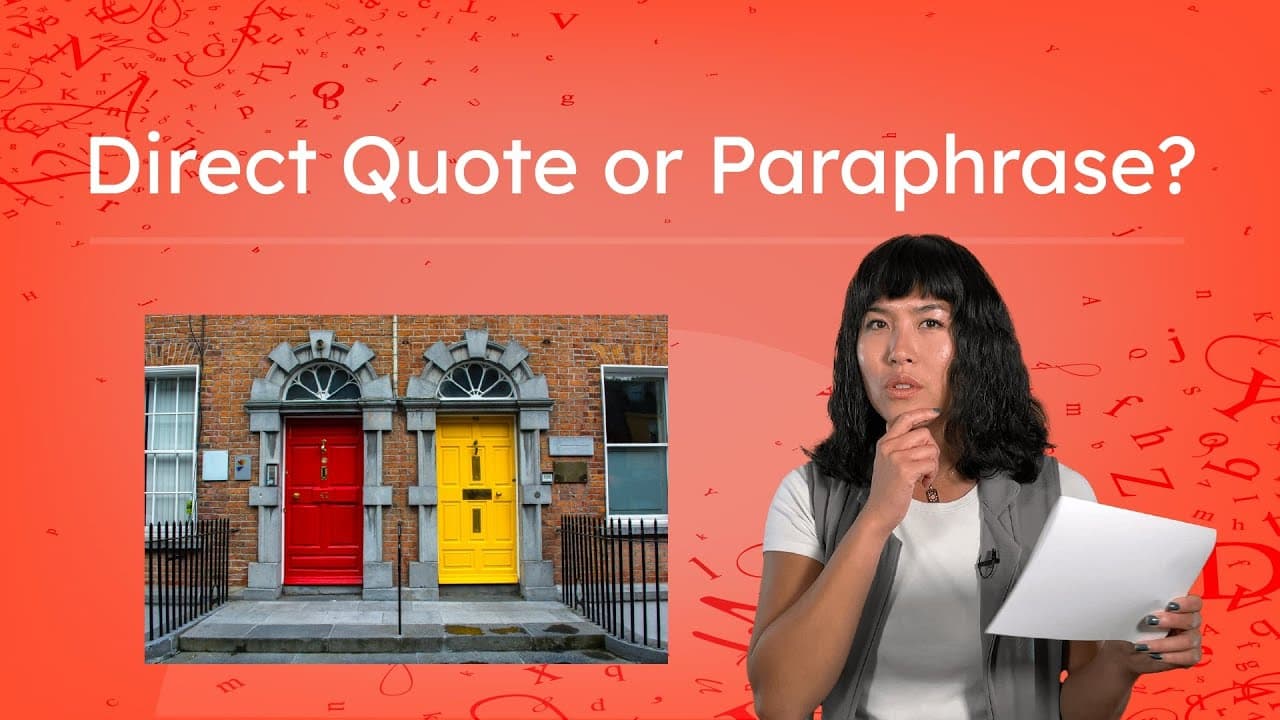
When to Quote vs. When to Paraphrase in Essays

When to Quote vs. When to Paraphrase in Essays

This instructional video guides high school students through the critical writing decision of when to use a direct quote versus a paraphrase in analytical essays. Using Toni Morrison's novel 'Beloved' as a case study, the presenter demonstrates how to integrate evidence effectively to support a thesis statement about literary motifs and character memory. The video distinguishes between analyzing specific language (which requires quotes) and summarizing events (which uses paraphrasing). The content covers key writing concepts including thesis statements, full direct quotes, partial quotes, paraphrasing, explanation sentences, and analysis sentences. It provides visual examples of how to structure a body paragraph, showing text on screen that integrates evidence with the student's own voice. The lesson emphasizes that the choice of evidence format depends entirely on the writer's purpose and what they intend to analyze. For educators, this video serves as an excellent model for teaching evidence integration and literary analysis. It moves beyond simple definitions to show the *why* and *how* of writing. Teachers can use this to help students move away from "quote bombing" (dropping quotes without context) and towards sophisticated embedding of partial quotes and meaningful analysis of diction and syntax.

Miacademy & MiaPrep Learning ChannelMiacademy & MiaPrep Learning Channel

10mins 30s

Synthesizing Sources: The Costume Dilemma

Synthesizing Sources: The Costume Dilemma

This educational video uses a relatable narrative about finding a theater costume to teach students the importance of researching and synthesizing information from multiple sources. The host, Justin, shares his initial failure to find a Mozart costume at a thrift store because he lacked specific knowledge about the era. He then observes a text message conversation between two friends, Liz and Rachel, who are successfully researching 1960s fashion for a different play.

Miacademy & MiaPrep Learning ChannelMiacademy & MiaPrep Learning Channel

6mins 54s

How Ancient Philosophies Shape Modern Asian Literature

How Ancient Philosophies Shape Modern Asian Literature

This educational video introduces students to four major Asian philosophies—Confucianism, Taoism, Buddhism, and Hinduism—and explores how these ancient belief systems influence contemporary Asian literature. Using a narrative framing device involving a writer named Liu Hao who has lost his memory, the host guides viewers through the definitions, key texts, and core tenets of each philosophy. The video emphasizes that philosophy is the study of life's important questions and encourages students to reflect on their own guiding principles. The lesson provides a structured comparison of the four philosophies, highlighting their unique focuses—from Confucianism's emphasis on social order and respect to Taoism's connection with nature. It explains the concept of "philosophical literature" and demonstrates how to identify philosophical themes in modern texts. A specific analysis of an excerpt from Cao Wenxuan's novel *Bronze and Sunflower* serves as a model for how students can spot Taoist influences like appreciating nature and "going with the flow" in character actions. Ideally suited for middle school Language Arts or World History classes, this video bridges the gap between abstract historical concepts and concrete literary analysis. It provides clear definitions, opportunities for student interaction through pause-and-think moments, and real-world examples of authors like Linda Sue Park and Grace Lin who incorporate these traditions. Teachers can use this resource to introduce a unit on world mythology, Asian literature, or to teach the skill of analyzing theme and cultural context in fiction.

Miacademy & MiaPrep Learning ChannelMiacademy & MiaPrep Learning Channel

8mins 57s

Just the Facts: Writing Objective Summaries

Just the Facts: Writing Objective Summaries

This educational video uses a clever pop culture reference to teach the fundamental skill of writing objective summaries. Using the character Joe Friday from the 1950s show "Dragnet" and his catchphrase "Just the facts, ma'am," the narrator explains the difference between objective reporting and subjective opinion. The video breaks down the specific rules of objectivity: avoiding feelings, first-person pronouns, and judgmental language, while clarifying that opinions aren't "bad," they just don't belong in summaries. The content transitions into a practical demonstration using a text about polar bears and climate change. The narrator reads the original text, then models how to strip away emotion to create a purely objective summary, contrasting this with a subjective reaction. This side-by-side comparison helps students visualize exactly what should be removed during the editing process. Ideal for English Language Arts classrooms, this resource supports standards related to reading comprehension, non-fiction analysis, and informational writing. It concludes with a sophisticated lesson on media literacy, challenging students to recognize subtle bias in how stories are framed—a critical skill for navigating modern news and information.

Khan AcademyKhan Academy

3mins 38s

How to Summarize a Story Using the SWBST Method

How to Summarize a Story Using the SWBST Method

This video introduces students to the "SWBST" (Someone, Wanted, But, So, Then) strategy, a mnemonic device designed to help learners effectively summarize fiction stories. The narrator acknowledges the difficulty of summarizing without rambling and presents this acronym as a "thought technology" to identify the most critical elements of a narrative: the main character, their goal, the conflict, the action taken to resolve it, and the resolution.

Khan AcademyKhan Academy

2mins 51s

Exploring Science Fiction and Worldbuilding

Exploring Science Fiction and Worldbuilding

This engaging educational video introduces students to the literary genre of Science Fiction (Sci-Fi) through a fun, narrative-driven lesson. Hosted by a narrator named Caroline and her robot companion Mia, the video uses a framing story of a crashed spaceship to explore key concepts. It defines Science Fiction as a sub-genre of speculative fiction that grounds its imaginative elements in scientific concepts, distinguishing it from pure fantasy. The lesson breaks down complex literary terms into accessible segments, covering the definition of speculative fiction, the role of science (both hard sciences like physics and soft sciences like sociology), and the crucial concept of "worldbuilding." The video delves deep into the mechanics of storytelling within the genre, emphasizing "internal consistency"—the idea that a fictional world must follow its own established laws, even if they differ from reality. It explores common tropes such as space travel, time manipulation, and futuristic technology, explaining how these elements serve the narrative. Furthermore, the video encourages critical thinking by discussing how Science Fiction acts as a mirror to the real world, exploring themes like the ethical implications of technology, social justice issues, and the human drive for exploration. It highlights historical examples, such as how H.G. Wells inspired rocket pioneer Robert Goddard. For educators, this resource is an excellent tool for Language Arts units on genre study, narrative structure, or creative writing. It provides clear definitions and structured pause points for reflection or guided note-taking. The video not only teaches literary analysis but also bridges the gap between STEM and the humanities by showing how scientific innovation and creative imagination feed into one another. It can be used to spark discussions about the future, inspire creative writing projects where students build their own worlds, or serve as a foundational text before reading a class novel in the genre.
Miacademy & MiaPrep Learning ChannelMiacademy & MiaPrep Learning Channel

12mins 11s

Materials

Wild Adventure Log Guest Form Plus Plus Plus Plus Plus

Wild Adventure Log Guest Form Plus Plus Plus Plus Plus

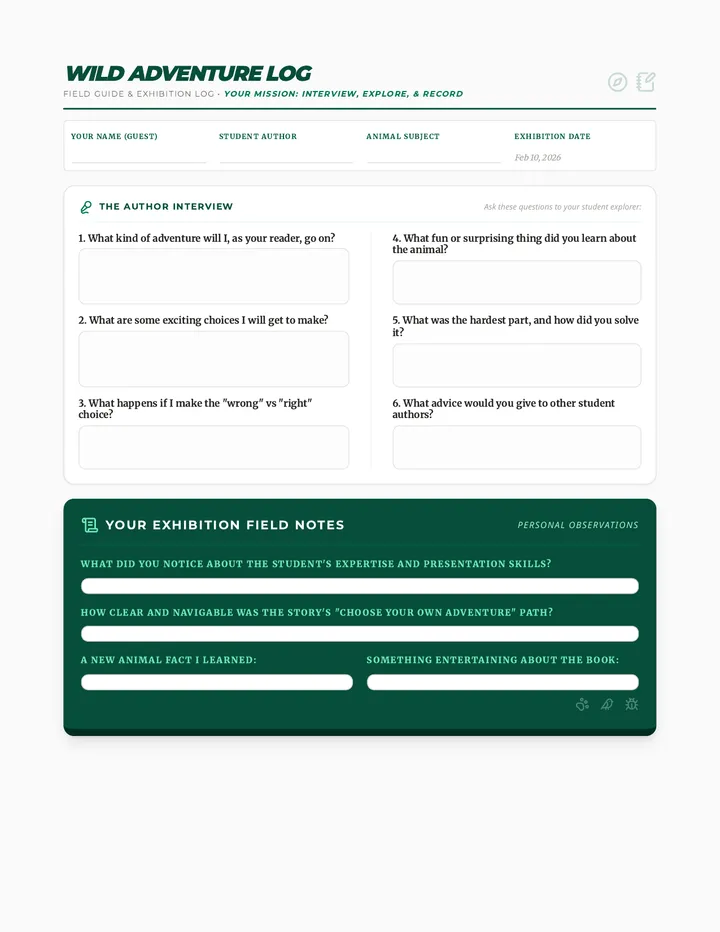
A 2nd-person 'Wild Adventure Log' guest form with maximized writing space. It features a side-by-side author interview/process section and a large Guest Observation area, all designed for comfortable handwriting on a single page.

E

epate

Rainforest Adventure Titles Worksheet Project

Rainforest Adventure Titles Worksheet Project

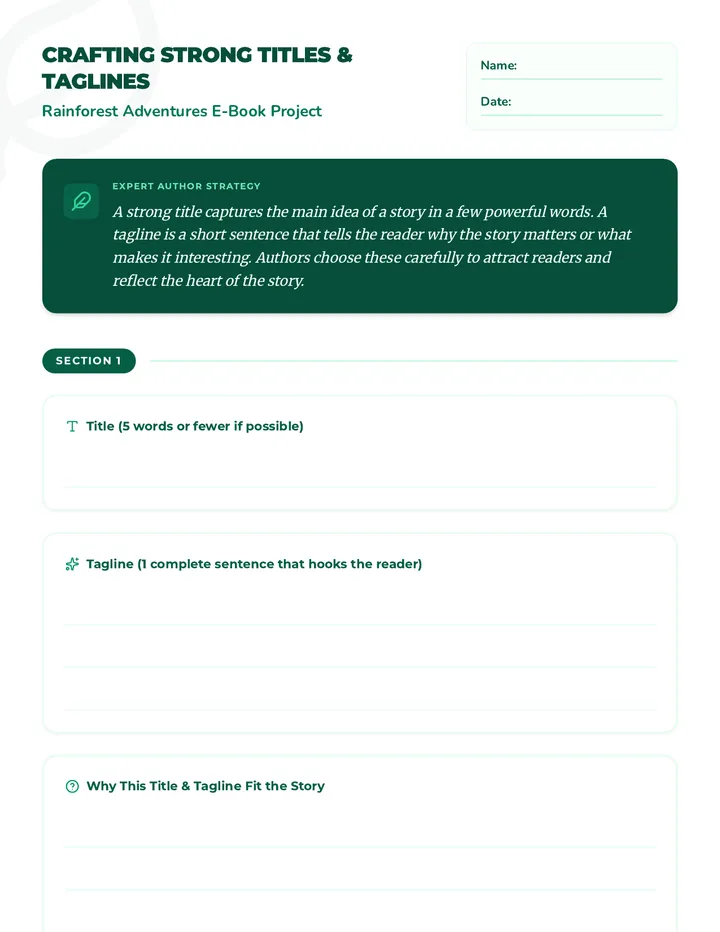
A professional 2-page printable worksheet for student authors to brainstorm and refine titles and taglines for their rainforest-themed e-books. It features a cohesive rainforest aesthetic across two structured pages, providing space for two distinct draft sections and a final synthesis reflection.

BJ

Brandon Jackson

E-Book Title Tagline Worksheet Revision

E-Book Title Tagline Worksheet Revision

A print-optimized brainstorming worksheet for Grade 5 students to draft e-book titles and taglines. It maximizes writing space with 3 full-width sections and a final reflection, featuring generous handwriting lines and a clean professional layout for sharp printing.

BJ

Brandon Jackson

Community Log Worksheet One-Pager

Community Log Worksheet One-Pager

A condensed, single-page version of the Community Log worksheet for 'The Giver' chapters 2 and 3, maintaining the clean aesthetic and selective icon colors while ensuring all content fits efficiently.

BC

Brenda Coombs

Fact Finder Log Worksheet

Fact Finder Log Worksheet

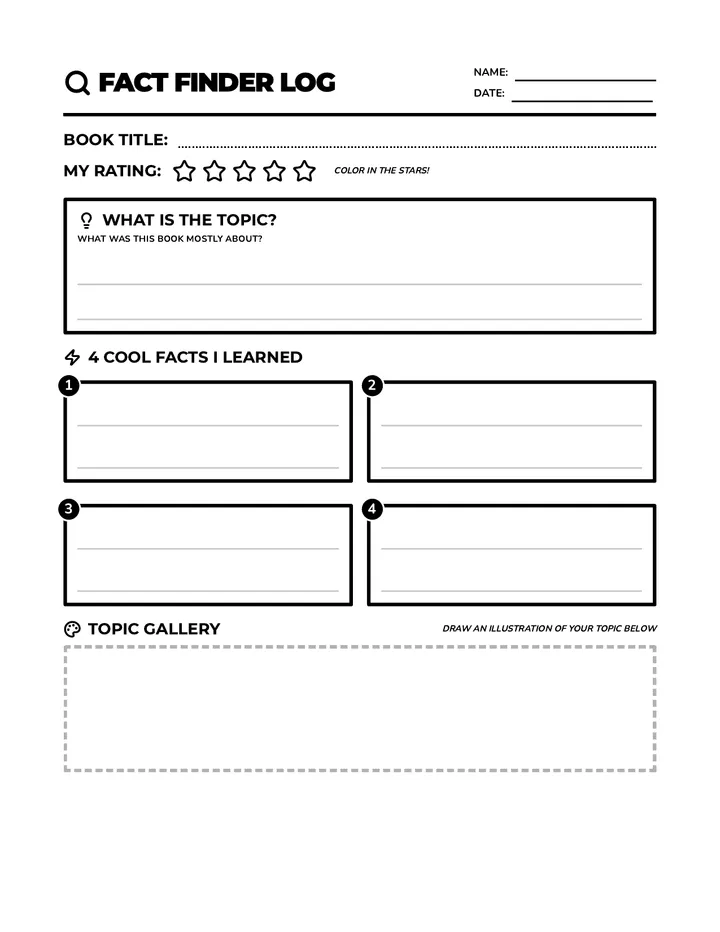
A high-contrast, black-and-white graphic organizer for students to log facts from a book, featuring sections for topic description, four key facts, and a drawing gallery, strictly formatted for a single-sided 8.5x11 page.

J

Jennifer.Bauman

Heartbeat Analysis Worksheet

Heartbeat Analysis Worksheet

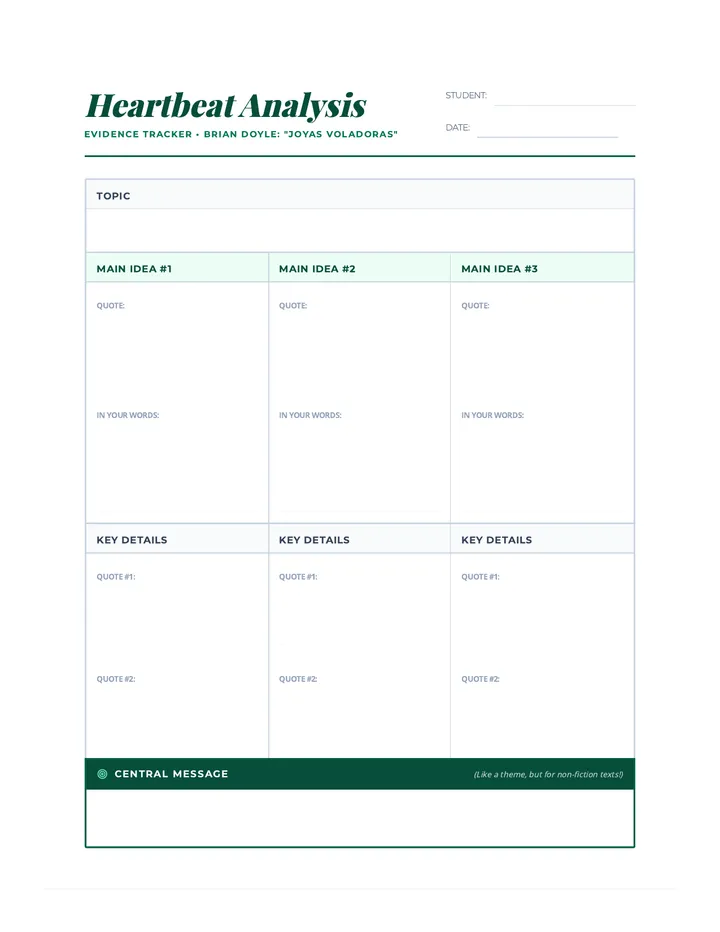
A 2-page literary analysis worksheet for Brian Doyle's 'Joyas Voladoras', optimized for 8.5x11 inch printing. Page 1 features an evidence tracker graphic organizer, and Page 2 focuses on syntax, tone, and mood analysis with structured response areas.

DC

Dylan Clark

Sequences

Invention Quest Slides

Frindle Frenzy Novel Study

A 9-day novel study for 'Frindle' by Andrew Clements, aligned to 3rd Grade ELAR TEKS, focusing on character development, vocabulary, and plot analysis.

LH

Lucy Hellerman

56
Lesson Plan 1 Introduction

Literary Device Detectives

A comprehensive multi-unit sequence for 3rd and 4th grade students covering key literary devices: Introduction to Figurative Language, Onomatopoeia, Similes, Metaphors, Personification, and Idioms. Each unit provides 5 lesson plans, interactive notebook resources, and a wide variety of activities and stories designed to improve descriptive writing and reading comprehension.

JS

Janette Sullivan

105
Value Vault Teacher Guide

Metamorphosis Mastery

An 8-week deep dive into Kafka's Metamorphosis for special education students, focusing on abstract thinking, social value, and the human condition through high-engagement activities and visual organizers.

C

Ceeasia.walker

58
Prophecy and Power Slides

Shadows and Crowns

A series of lessons exploring Shakespeare's Macbeth, specifically designed for 10th-grade emergent bilingual students to master complex characterization and thematic elements.

DC

Dylan Clark

30
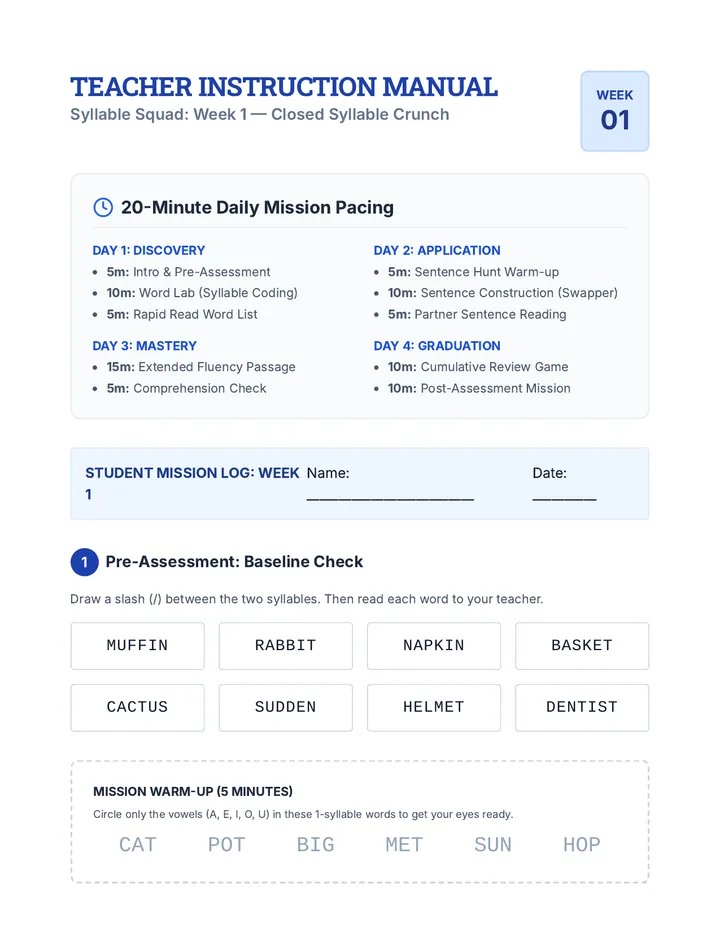
Week 1 Closed Syllable Manual

Syllable Squad Decoding Mission

A comprehensive 5-week phonics intervention focused on decoding two-syllable words across five major syllable types. Each week includes a pre-assessment, daily lessons with specific targets, student practice sheets, and a post-assessment.

KJ

Kelsey Jacobs

29
Question Anatomy Slides

Insight Investigators

A 6-week reading intervention unit for 5th graders focused on making inferences, analyzing questions, and using text evidence. Themes include mysteries, sports (baseball and basketball), and dragons to engage high-interest readers.

MK

Meg Keene

48