Lenny.com
Explore
Create
ActivitiesNewMathEnglish Language ArtsScience & EngineeringSocial StudiesGlobal LanguagesHealth & Physical EducationSpecial EducationCounseling & Life SkillsArts & CreativityESL
Lenny.com
Lenny.com
Explore
Create
ActivitiesNewMathEnglish Language ArtsScience & EngineeringSocial StudiesGlobal LanguagesHealth & Physical EducationSpecial EducationCounseling & Life SkillsArts & CreativityESL
Lenny.com
Lenny.com

Solutions

Lenny for EducatorsLenny for SchoolsLenny for Districts

Product

ExploreSign inCreateSupportAbout

Resources

Getting startedMTSS Acceleration Program

© 2026 Lenny Learning Inc.

TermsPrivacyAccessibility
LinkedInInstagramX
Lenny

Developing And Supporting Arguments

Evidence-based reasoning and logical structuring to build persuasive claims. Addresses source evaluation, rhetorical strategies, and the integration of supporting data.

English Language ArtsPhonics & Reading FoundationsLetter IdentificationLearn Letters A-ZLowercase and Uppercase LettersConsonants and VowelsLetter-Sound AssociationsLetter-Sound Associations: LowercaseLetter-Sound Associations: UppercaseBeginning and Ending SoundsRhymingBlending And SegmentingShort VowelsShort Vowel SoundsConsonant BlendsConsonant DigraphsBlends, Digraphs, and TrigraphsDigraphs, Blends, and Silent LettersLong Vowel SoundsLong Vowel PatternsShort and Long VowelsShort and Long Vowel PatternsSilent EVowel SoundsVowel TeamsR-Controlled VowelsDiphthongs: Oi, Oy, Ou, OwVariant VowelsVariant, Diphthong, And R Vowel PatternsSoft G And CSight WordsIrregular WordsWord RecognitionSyllablesSyllable TypesTwo-Syllable WordsMultisyllabic WordsPhoneme ManipulationDecodable TextsVocabularyAction WordsQuestion WordsNouns and AdjectivesClassify WordsCompound WordsSynonyms and AntonymsHomophonesHomophones and HomonymsShades of MeaningContext CluesPrefixes and SuffixesGreek and Latin RootsAnalogiesIdioms and AdagesForeign Words and ExpressionsWord Choice and UsageReference SkillsReading ComprehensionRead-Along Literary TextsRead-Along Informational TextsReality vs. FictionStory ElementsCharacterSequenceMain IdeaCause And EffectCompare And ContrastReading StrategiesText StructureAuthor's PurposeAuthor's Purpose And ToneAuthor's PerspectivePoint Of ViewThemeInference And ThemeInference And AnalysisPoetry ElementsLiterary DevicesAnalyzing LiteratureAnalyzing Informational TextsComparing TextsAudience, Purpose, And ToneBusiness DocumentsNovel StudyNonfiction Book StudyGrammar & MechanicsSentencesNounsVerbsAdjectivesPronounsCapitalizationPunctuationContractionsConjunctionsPrepositionsArticlesAdjectives And AdverbsVerb TypesVerb TensePronouns And AntecedentsPronoun TypesSubject-Verb AgreementDirect And Indirect ObjectsSentences, Fragments, And Run-OnsPhrases And ClausesCommasSemicolons, Colons, And CommasDashes, Hyphens, And EllipsesSpellingAbbreviationsFormattingVerb Tense And MoodMisplaced ModifiersWritingDescriptive DetailsCreative WritingOpinion WritingTopic SentencesOrganizing WritingLinking WordsSentence VarietyIntroductions And ConclusionsPersuasive And Opinion WritingExpository WritingPersuasive StrategiesDeveloping And Supporting ArgumentsTopic Sentences And Thesis StatementsSummarizingResearch SkillsEditing And RevisingActive And Passive Voice=Writing Clearly And ConciselyDebate & Public SpeakingPublic Speaking BasicsPersuasive TechniquesClaims and EvidenceTypes of ArgumentsReasoning TypesLogical FallaciesTopic ResearchOrganizing EvidenceDebate Speech OrganizationAttacking and Defending ArgumentsClash and EngagementImpact CalculusQuestioning and Cross-ExaminationCritical ThinkingInformal LogicFormal LogicInductive Reasoning

Videos

Strengthening Arguments by Addressing Opposing Viewpoints

Strengthening Arguments by Addressing Opposing Viewpoints

This video explores the rhetorical strategy of acknowledging and incorporating opposing viewpoints to strengthen argumentative writing. Using a martial arts analogy, the narrator explains that effective arguments do not simply "steamroll" opposition but rather engage with it constructively. The video outlines two primary applications for this technique: maintaining neutrality in journalistic reporting and fortifying persuasive arguments by anticipating and dismantling counter-claims. The video uses two distinct examples to illustrate these concepts. First, a humorous dispute over stolen cookies between fictional characters (Ms. Adeyemi and Mr. Dupont) demonstrates how to describe a conflict neutrally without injecting personal bias. Second, the historical mystery of the Lost Colony of Roanoke is used to show how addressing alternative theories (like disease or violence) and refuting them with evidence actually supports the author's main thesis that the colony's fate remains unknown. This resource is highly valuable for English Language Arts classrooms focusing on persuasive writing, debate, and media literacy. It provides a concrete framework (the "Block and Strike" method) for students to understand the function of counter-arguments and rebuttals. It also encourages critical reading by teaching students to be suspicious of authors who ignore opposing viewpoints entirely.

Khan AcademyKhan Academy

5mins 35s

How to Cite Explicit and Implicit Evidence in Literature

How to Cite Explicit and Implicit Evidence in Literature

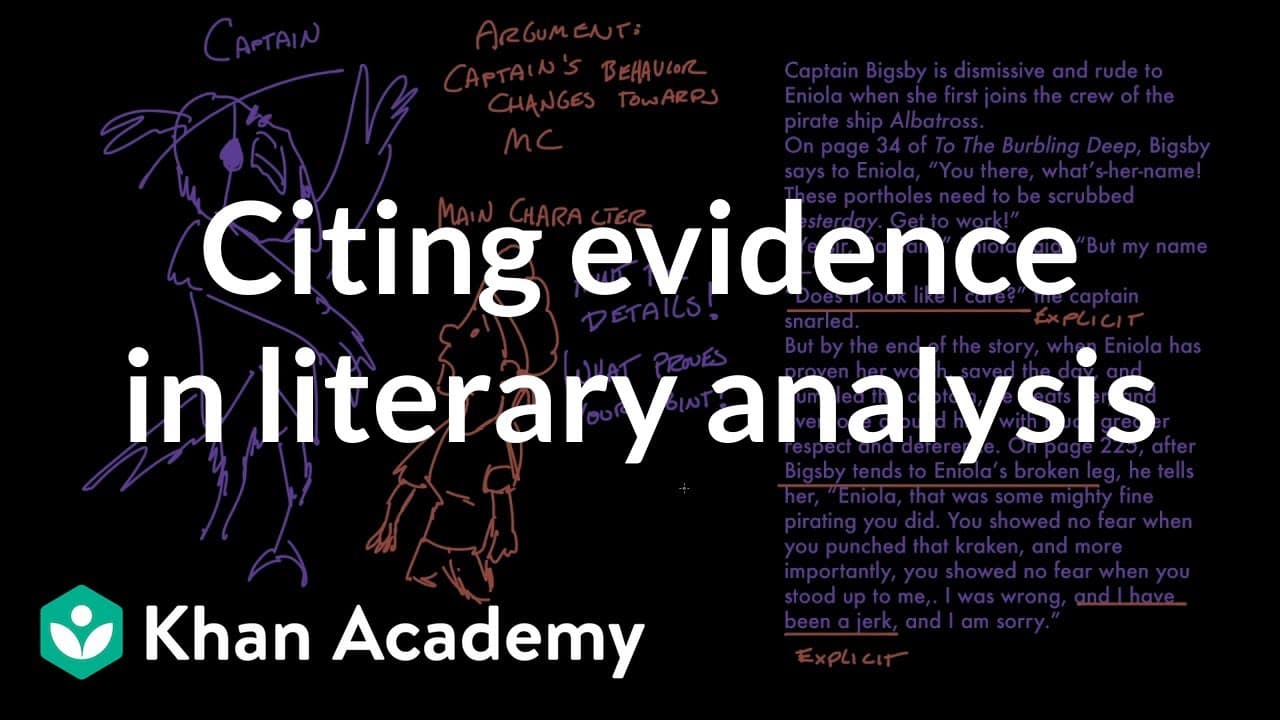
This video provides a clear and engaging guide to citing evidence in literary analysis, a fundamental skill for English Language Arts students. It distinguishes between "explicit" evidence (stated directly in the text) and "implicit" evidence (based on clues and inference). The narrator uses a humorous, originally illustrated example of a pirate captain to demonstrate how to support an argument about character development with specific textual details.

Khan AcademyKhan Academy

5mins 20s

When to Quote vs. When to Paraphrase in Essays

When to Quote vs. When to Paraphrase in Essays

This instructional video guides high school students through the critical writing decision of when to use a direct quote versus a paraphrase in analytical essays. Using Toni Morrison's novel 'Beloved' as a case study, the presenter demonstrates how to integrate evidence effectively to support a thesis statement about literary motifs and character memory. The video distinguishes between analyzing specific language (which requires quotes) and summarizing events (which uses paraphrasing). The content covers key writing concepts including thesis statements, full direct quotes, partial quotes, paraphrasing, explanation sentences, and analysis sentences. It provides visual examples of how to structure a body paragraph, showing text on screen that integrates evidence with the student's own voice. The lesson emphasizes that the choice of evidence format depends entirely on the writer's purpose and what they intend to analyze. For educators, this video serves as an excellent model for teaching evidence integration and literary analysis. It moves beyond simple definitions to show the *why* and *how* of writing. Teachers can use this to help students move away from "quote bombing" (dropping quotes without context) and towards sophisticated embedding of partial quotes and meaningful analysis of diction and syntax.

Miacademy & MiaPrep Learning ChannelMiacademy & MiaPrep Learning Channel

10mins 30s

Choosing the Best Text Evidence: The Supreme Court Tomato Case

Choosing the Best Text Evidence: The Supreme Court Tomato Case

This engaging educational video uses a real Supreme Court case from 1893 to teach students how to evaluate and select the best textual evidence to support a claim. The narrator presents the case of Nix v. Hedden, which legally decided whether a tomato should be classified as a fruit or a vegetable for tax purposes. By using a concrete, slightly humorous historical example, the video makes the abstract concept of argumentation and evidence selection accessible and memorable.

Khan AcademyKhan Academy

4mins 36s

How to Win Arguments Using Claims and Evidence

How to Win Arguments Using Claims and Evidence

This engaging video lesson breaks down the components of a persuasive argument using a relatable scenario: a teenager negotiating with her mother via text message for a new phone. The narrator analyzes the conversation in real-time, highlighting how the character, Liz, effectively uses rhetorical strategies to make her case. The video transforms a common daily interaction into a clear model for argumentative thinking. The content focuses on three core concepts of argumentation: Claims (stating a position), Evidence (providing specific facts to support the position), and Counterclaims (anticipating and addressing opposing arguments before they are fully raised). It specifically highlights how to evaluate the strength of different types of evidence, demonstrating why connecting the problem to schoolwork is more persuasive to a parent than connecting it to gaming. For educators, this video serves as an excellent hook or modeling tool for units on argumentative writing or speech. It takes abstract terms like 'counterclaim' and 'preemptive argument' and grounds them in a context every student understands. It is particularly useful for visual learners who benefit from seeing the argument structure unfold as a text message thread.

Miacademy & MiaPrep Learning ChannelMiacademy & MiaPrep Learning Channel

4mins 50s

How Politics Shaped Latin American Literature

How Politics Shaped Latin American Literature

This educational video explores the deep connection between the political history of Latin America and its literature. It guides students through two major historical periods: the colonial era and the post-independence rise of totalitarian regimes. Through the lens of specific literary movements, the video explains how writers like Simón Bolívar, José Martí, and Gabriel García Márquez used the written word to define national identities, fight for independence, and critique oppressive governments. The content breaks down complex political concepts such as colonialism, independence movements, and totalitarianism, contrasting the Latin American experience with that of Africa to highlight unique historical contexts. It introduces the genre of "political literature," splitting it into "Independence Movement Literature" (primarily persuasive nonfiction) and "Anti-Totalitarian Literature" (fiction and nonfiction). Specific works and authors are highlighted to illustrate themes of corruption, power, and resistance. Teachers can use this video to bridge Social Studies and English Language Arts curriculums. It provides a rich context for understanding World Literature, offering concrete definitions and historical examples that help students analyze how societal changes influence artistic expression. The built-in pause points and reflective questions make it an interactive tool for classroom discussion about government systems, freedom of expression, and the power of writing.
Miacademy & MiaPrep Learning ChannelMiacademy & MiaPrep Learning Channel

10mins 56s

Materials

September 11 Heroes RACES Worksheet

September 11 Heroes RACES Worksheet

A middle school English Language Arts 20-minute writing assignment featuring an informational passage on September 11 first responders and everyday heroes. Includes a structured RACES graphic organizer, analytical prompt, and printable response area.

AC

Aimee Crosby

Gatsby Loathsome Character Blueprint

Gatsby Loathsome Character Blueprint

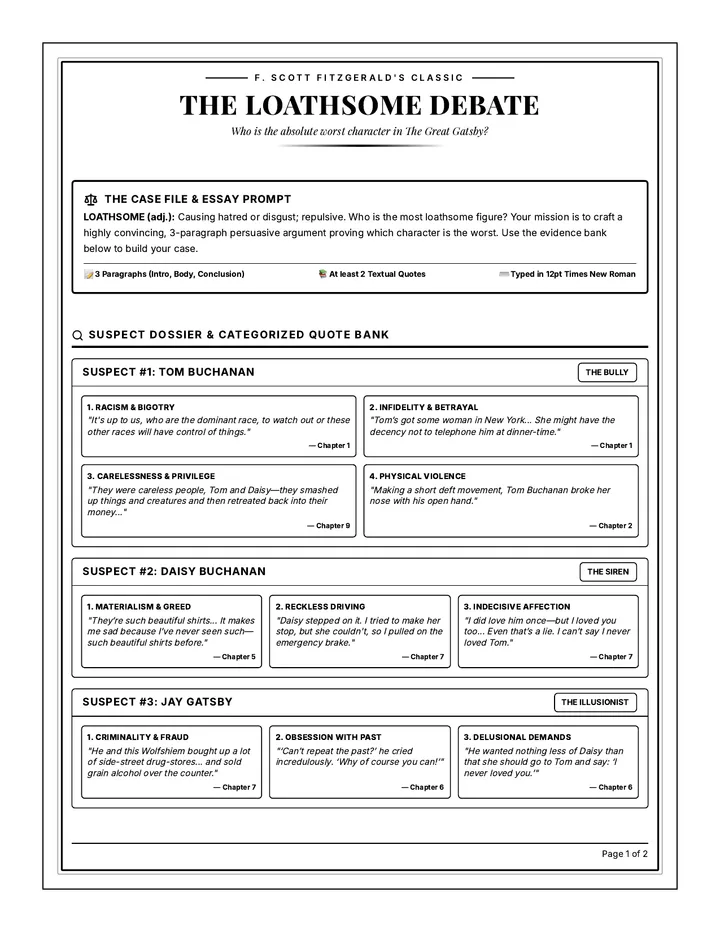
A two-page printable graphic organizer and quote bank in a high-contrast black-and-white theme with zero color or gray fills. Page 1 presents the 'Suspect Dossier' with clear borders, white backgrounds, and pure black text, while Page 2 features the highly structured essay outline and sentence starters with solid black-and-white print-friendly writing guides and page numbers.

KR

Kirstin Reed

Giver Chapters 14-15 One Pager-REVISED-v2-FINAL

Giver Chapters 14-15 One Pager-REVISED-v2-FINAL

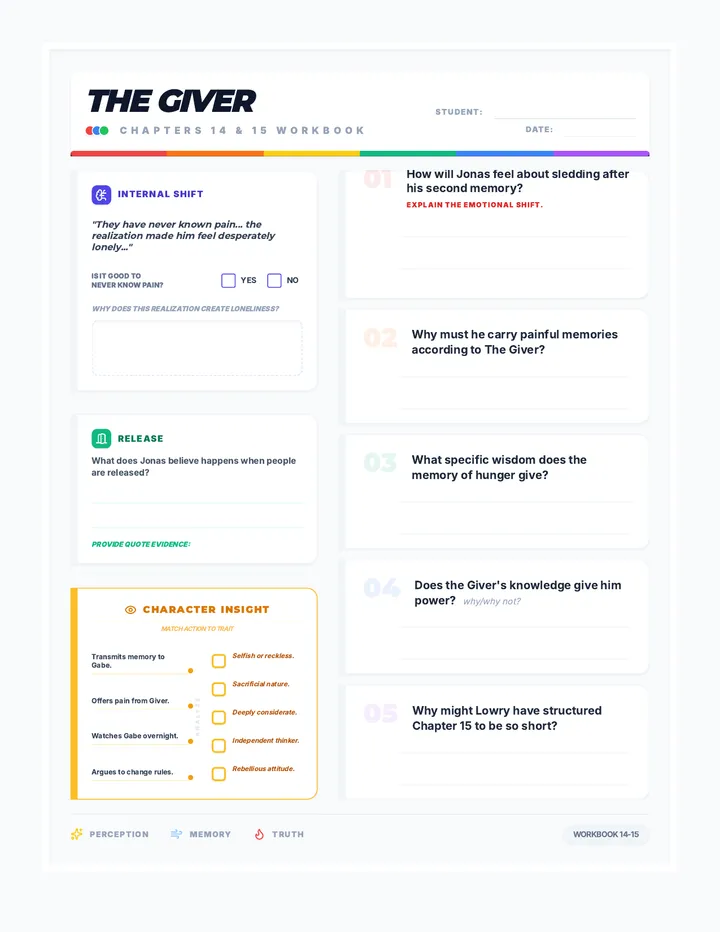
A final, refined one-page workbook for Chapters 14-15 of The Giver. This version has been strictly optimized for height by reducing margins and padding to ensure everything fits perfectly on a single page, while featuring a vibrant full-spectrum rainbow theme to represent Jonas's awakening to color and deep memory.

BC

Brenda Coombs

Argument Pro Rubric

Argument Pro Rubric

A comprehensive 100-point rubric for 10th-grade argumentative essays, featuring detailed criteria for claims, evidence, analysis, and counter-claims. Designed with a clean, professional aesthetic for easy grading and clear student feedback.

D

dmclaurin

Peter Pan Paradox Exit Ticket

Peter Pan Paradox Exit Ticket

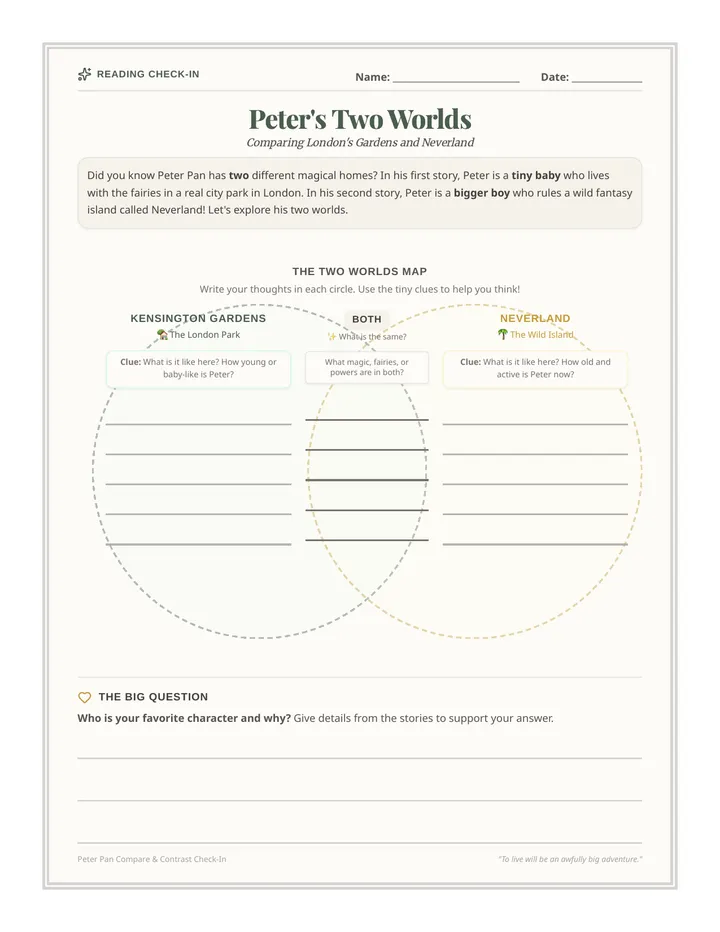
An updated 3rd-grade friendly exit ticket with a large, beautifully aligned Venn diagram where the text and writing lines are positioned in non-overlapping columns. Writing lines are now darker, wider, and increased to 5 lines per column.

SW

Shelley Waller

Dual Text Theme Writing Guide

Dual Text Theme Writing Guide

A student-friendly, STAAR-aligned Extended Constructed Response (ECR) guide comparing themes across 'Thank You, M'am' and 'A Police Stop Changed This Teenager's Life'. Features an accessible, clear prompt, simplified sentence starters, an annotated 5/5 exemplar essay, and a clear scoring rubric with checklist.

TJ

Tasha Jaramillo

Sequences

Prophecy and Power Slides

Shadows and Crowns

A series of lessons exploring Shakespeare's Macbeth, specifically designed for 10th-grade emergent bilingual students to master complex characterization and thematic elements.

DC

Dylan Clark

30
Question Anatomy Slides

Insight Investigators

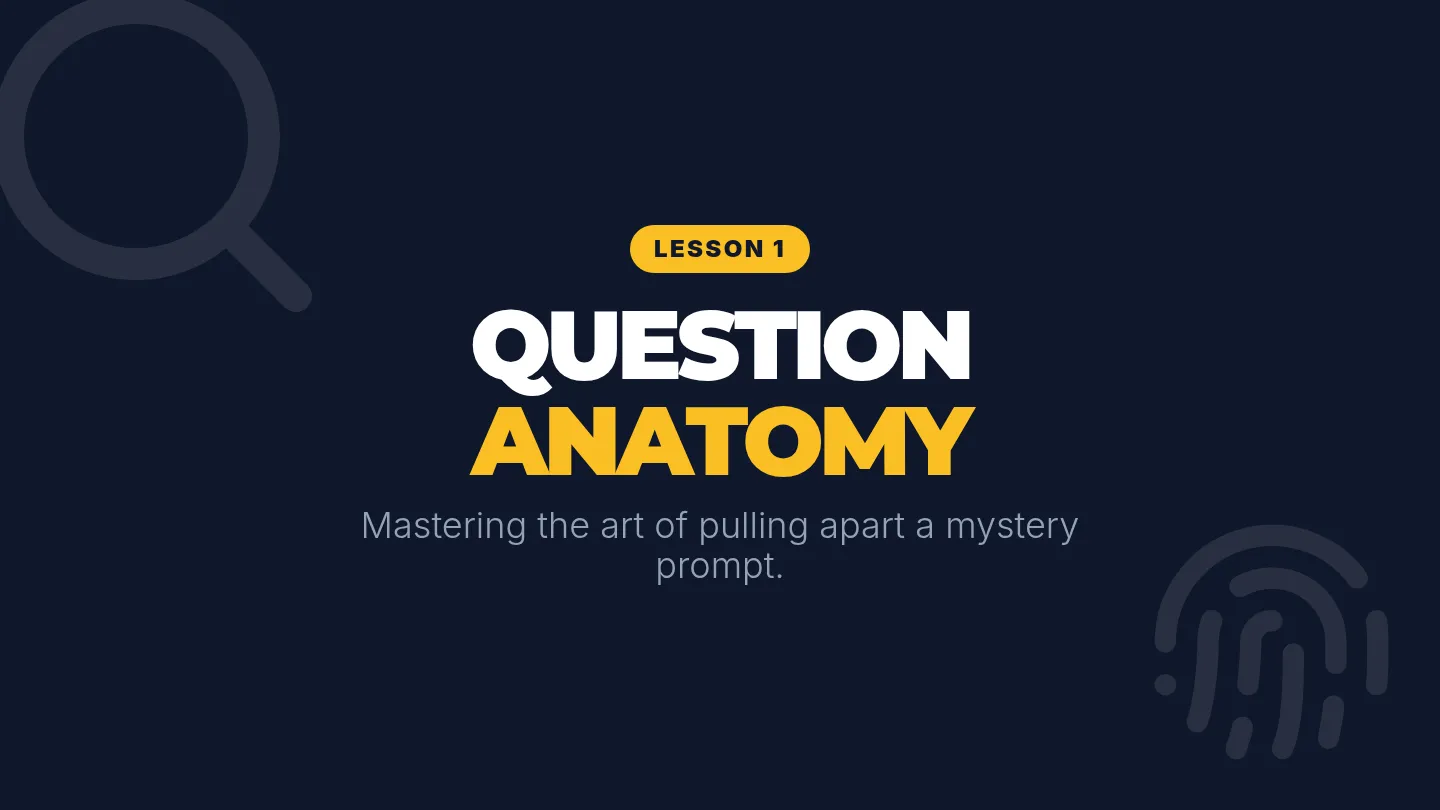
A 6-week reading intervention unit for 5th graders focused on making inferences, analyzing questions, and using text evidence. Themes include mysteries, sports (baseball and basketball), and dragons to engage high-interest readers.

MK

Meg Keene

48
Copenhagen Clues Slides

Resistance Chronicles

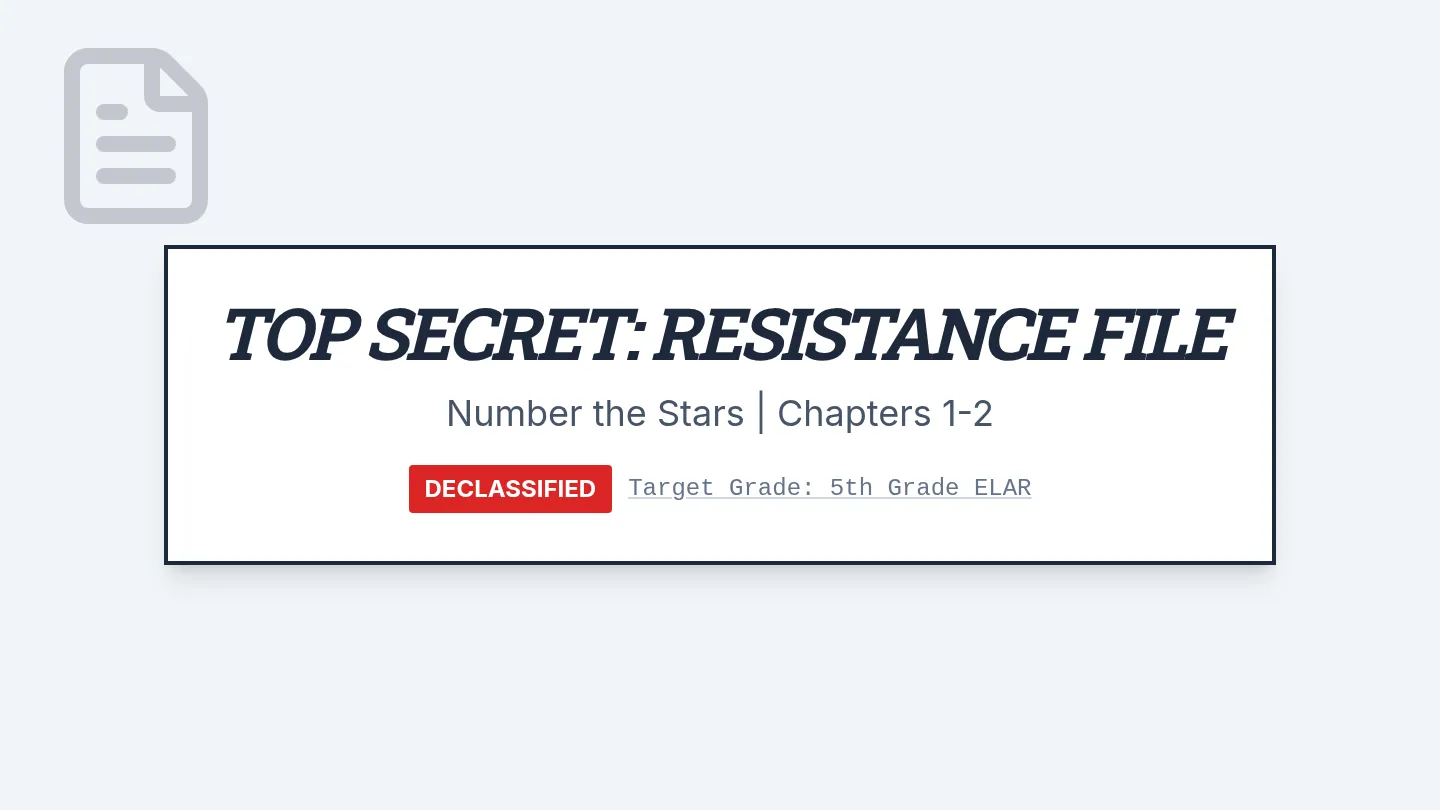
A 9-day novel study for Number the Stars centered on 5th Grade ELAR TEKS, focusing on character development, plot analysis, and historical context through the lens of a Resistance Secret File.

LH

Lucy Hellerman

79
Mission Briefing Worksheet

Mastery Mission

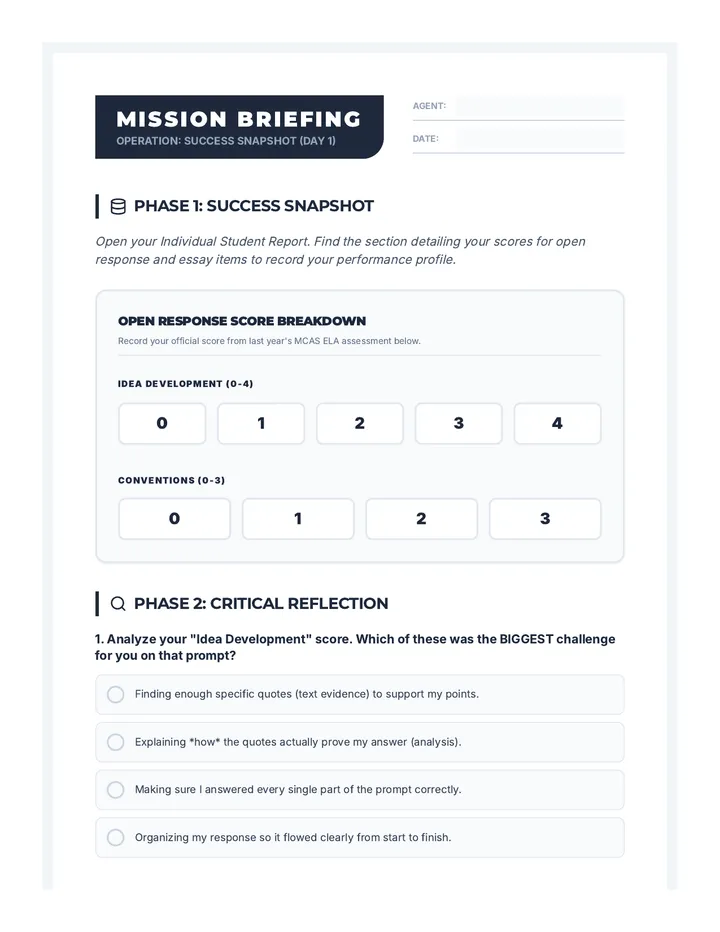
A project-based learning unit designed to help middle school students analyze their past MCAS ELA performance, deconstruct scoring rubrics, and create a personalized strategy playbook for upcoming assessments. Students move from 'investigating' their scores to 'rebooting' their responses and 'finalizing' their test-taking toolkit.

M

mhbutterworth

18
Master Pacing Guide Teacher Resource

Literacy Mastery Lab

A comprehensive year-long intervention sequence for 8th-grade literacy, focusing on STAR 360 and OSAS benchmark skills. The sequence follows a 3-day weekly instructional cycle (Instruction, Practice, Application) to supplement 2 days of choice reading.

SA

Senta Agnello-Shelton

60
Burger Builder Slides

Paragraph Foundations

A foundational paragraph writing unit designed for early writers and SpEd students to master core paragraph structures through narrative, opinion, and informational writing with heavy visual scaffolding.

E

ecreamer

23

Lessons

Astronaut Kitchens Passage

Evidence Explorers

An explicit instruction lesson for 3rd graders on locating text evidence to answer text-dependent questions using an 'I Do, We Do, You Do' model. Students learn to identify keywords in questions and find matching evidence in the text using a five-step checklist.

KB

Krista Bodkin

5
Master the Message Teacher Guide v2

Media Message Mastery

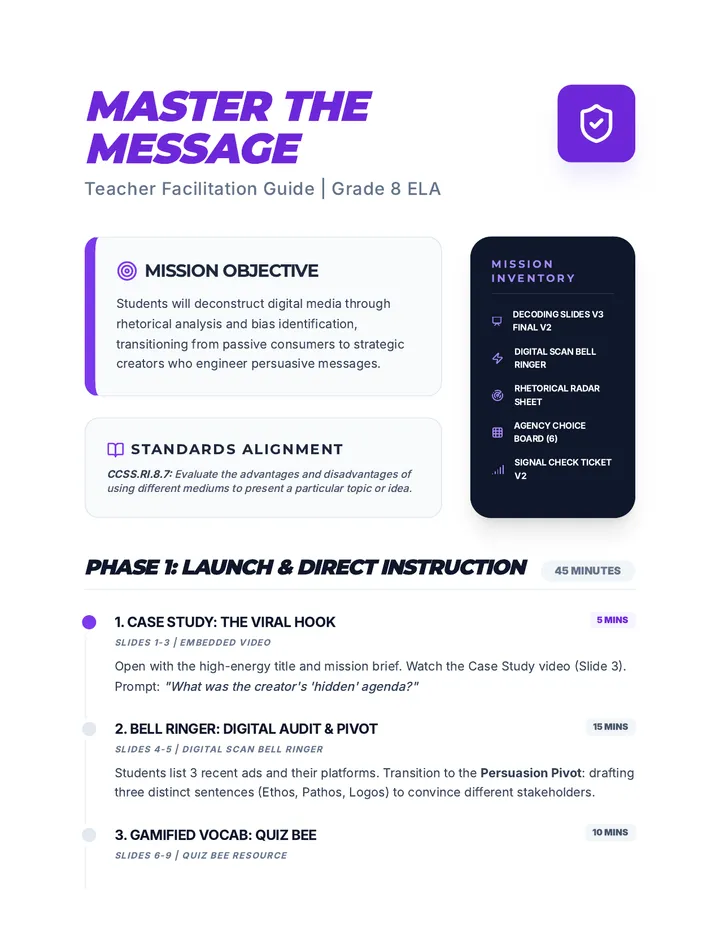
An 8th-grade ELA lesson focused on deconstructing digital media messages through the lens of rhetorical appeals (ethos, pathos, logos) and identifying bias in various online formats. Students transition from passive consumers to critical analysts of news clips, social media, and advertisements.

V

vivianbelarmino

36
Dahl Dreamers Choice Board

Dahl Dreamers

A collection of print-ready, high-interest ELA choice board activities and accompanying worksheets designed for 6th-grade early finishers. Rooted in Amplify 6A, students explore Roald Dahl's novels, connect them to his autobiography 'Boy', practice R.A.C.E. writing responses, engage in gobbledegook word play, and draft narrative responses.

A

Amy.Cannon

5
Awakening Words Bell Ringer

Stolen Seconds

A comprehensive lesson exploring Tanith Lee's 'Awake,' a subversion of Sleeping Beauty, focusing on structural choices and source material transformation (RL.5 and RL.9). Students will analyze character conflict and the concept of 'the gift of time.'

V

vivianbelarmino

25
Cosmic Frontier Assessment

Starbound Bridge Assessment

A summative assessment package focused on middle school ELA standards (RL.6/RI.6) through the lens of a persuasive text regarding NASA funding and its historical impact.

J

jtiburcio

7
Tomorrow Speech Worksheet

The Illusion of Tomorrow

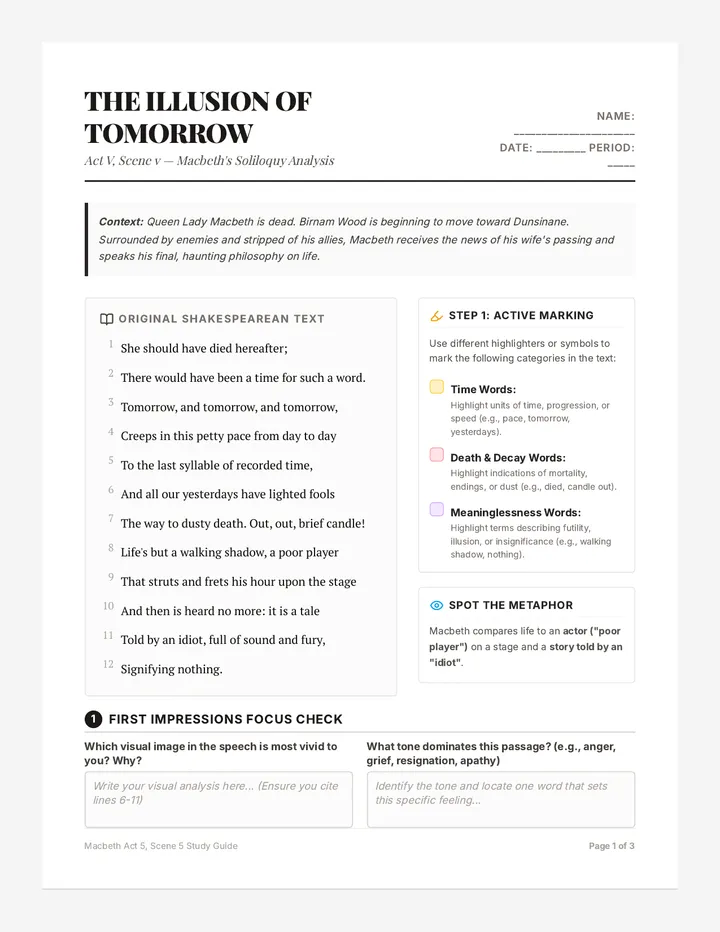
A comprehensive 10th-grade ELA lesson analyzing Macbeth's famous 'Tomorrow, and tomorrow, and tomorrow' speech from Act 5, Scene 5. Students explore Macbeth's psychological state—whether he is depressed, defeated, or finally realizing the truth of his ambitions—using textual annotation, group evidence organizers with scaffolded sentence stems, a Philosophical Four Corners debate, and a reflective exit ticket.

EC

Erin Cloutier

5