Rationale: Leo’s physical state transitions from feeling "butterflies" and a "tight throat" to laughing and feeling the "tight knot in his chest began to loosen." This directly demonstrates a clear shift toward calm and relief.
Question 7 (Correct Answer: B) — TEKS 3.8(B)
Rationale: By talking to each other after the funny stomach noise, Leo and Maya share their vulnerability. This mutual interaction relieves their shared tension, changing the trajectory of their first day.
Question 8 (Correct Answer: J) — TEKS 3.8(C)
Rationale: The resolution occurs in paragraph 9 when Leo and Maya connect, introduce themselves, and laugh, causing Leo's butterflies to "finally fly away" before class officially begins.
Question 9 (Correct Answer: C) — TEKS 3.10(A)
Rationale: The author chose to tell this story to show young readers that feeling anxious is natural and that connecting with others over shared vulnerabilities makes challenges easier to face.
Question 10 (Correct Answer: H) — TEKS 3.8(A)
Rationale: The central theme is that sharing our vulnerabilities/fears makes them lose their power. Maya’s confession that her stomach was doing the same thing allowed both kids to laugh and overcome their nervousness.
1. Literal vs. Figurative Confusions (Q1 & Q6): 3rd-grade students often struggle with figurative language (e.g., "pinched garden hose," "butterflies playing tag"). Guide students to visualize the object (a hose being pinched blocks water flow) and map that same feeling to the character's body (blocked throat/nervousness).
2. Over-Focusing on Minor Incidents (Q5): Students may mistake the funny "stomach squeak" or the "mom's toast" incident as the main conflict. Teach them that a main conflict must span the majority of the story and motivate the characters' primary growth.
3. Active Annotations: Encourage third graders to write labels next to paragraphs (e.g., "Nervous" next to Para 2-4, "Meets Maya" next to Para 5, "Funny" next to Para 6-7). This practice prevents them from guessing and builds solid evidence-hunting habits.
Instructional Support Material • Keep For Lesson Review
2. Under which subheading should the reader look to find out how to calm down the fluttery feeling in their stomach?
F The Brain's Tiny Alarm
G The Action Signal
H Taming Your Butterflies
J The Action Mode
3. According to paragraph 2, what causes the amygdala to sound its "alarm bell"?
A Feeling a bug land on your arm
B Encountering a completely new or unfamiliar situation
C Eating a cold breakfast in the morning
D Running or jumping during recess on the playground
4. Based on paragraph 3, why does the brain tell the heart to pump blood faster?
F To clear insects away from your stomach
G To deliver extra energy to your arms and legs for action
H To make you feel sleepy and relaxed
J To help your stomach digest food more quickly
5. According to the text, why does a person's stomach feel "butterflies" when they are nervous?
A The stomach becomes too full of healthy food
B The body borrows energy away from the stomach, slowing digestion
C The stomach receives extra blood from the lungs
D The brain is signaling that the body needs immediate exercise
Go to Page 3 for Questions 6-10
Those First Day Butterflies • Informational Reading Part II (Questions 6-10)
6. Why does the author compare the amygdala to "your brain’s personal alarm bell" in paragraph 2?
F To explain that it makes a loud, ringing sound inside the head
G To show how it alerts the body to react to new situations
H To argue that it is a dangerous part of the human brain
J To describe how it helps students remember their class schedule
7. The author wrote this passage mainly to —
A persuade readers to avoid starting new schools
B explain the biological reasons for nervousness and how to manage it
C entertain readers with a story about a kid who caught butterflies
D prove that butterflies are the most interesting insects in Texas
8. What is the central or main idea of the section titled "Taming Your Butterflies"?
F First-day nerves are permanent and cannot be managed
G Your heart and lungs are the most important organs in your body
H Simple actions like deep breaths and smiling can help calm nervous feelings
J Most kids do not feel any nervousness on the first day of school
9. The author includes the pronunciation (uh-MIG-duh-luh) in paragraph 2 to help the reader —
A spell the scientific name of the brain part correctly
B understand how the brain part was originally discovered
C say the scientific term aloud correctly while reading
D translate the word into another language
10. If the author added a diagram to this passage, which diagram would be most helpful to the reader?
F A drawing of different butterfly species found in North America
G A diagram of a school classroom showing where the desks are placed
H A map of Texas showing where major schools are located
J A diagram of the human brain labeling where the amygdala is located
★ End of Test — Double Check Your Work! ★
Question 7 (Correct Answer: B) — TEKS 3.10(A)
Rationale: The passage is expository/informational. It explains the biological process behind first-day nerves (amygdala, adrenaline, slowed digestion) and offers student-friendly ways to manage them, making B the only correct choice.
Question 8 (Correct Answer: H) — TEKS 3.9(D)(i)
Rationale: The section "Taming Your Butterflies" focuses completely on how to ease anxiety. It explicitly recommends taking deep breaths, smiling, and talking to classmates, which are all summarized perfectly by option H.
Question 9 (Correct Answer: C) — TEKS 3.3(B)
Rationale: Parenthetical phonetic spellings like "(uh-MIG-duh-luh)" are used as a pronunciation aid to support students in sounding out complex scientific words so they can read fluently.
Question 10 (Correct Answer: J) — TEKS 3.9(D)(ii)
Rationale: Because the text introduces a complex biological part of the body (the amygdala, located deep inside the brain), a diagram of the brain with this specific region labeled would directly support and clarify the text.
1. Connecting Fiction and Nonfiction: Have students pair this scientific passage with the story "Leo's Loud Stomach." Point out that the "butterflies" and "tight throat" Leo felt in paragraph 2 and 3 are the exact same physical changes explained scientifically in paragraphs 2 and 3 of this passage!
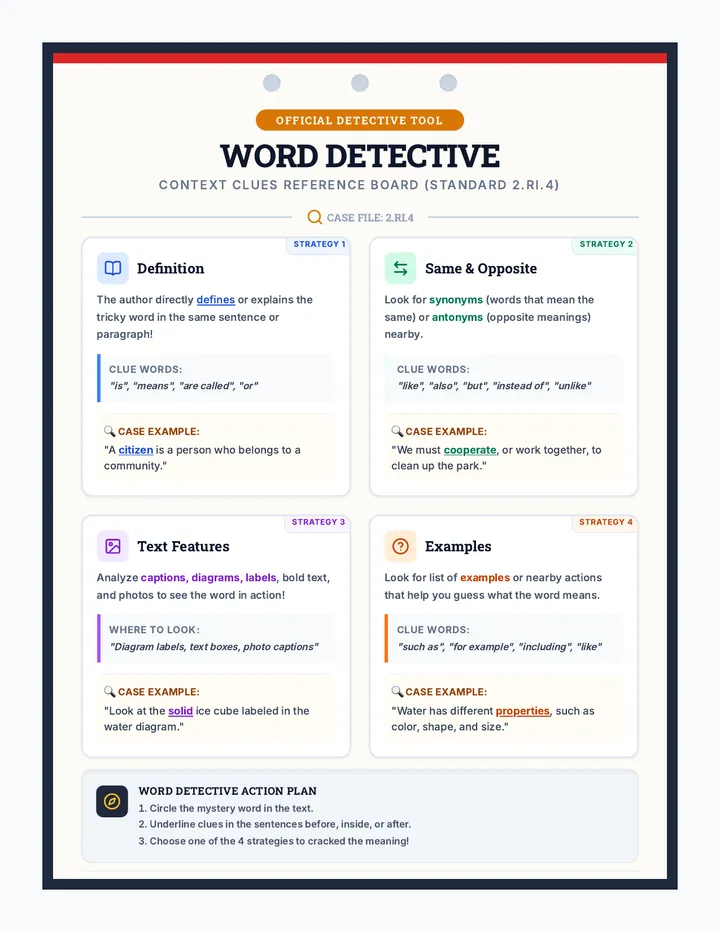
2. Text Feature Spotting (Q2 & Q9): STAAR heavily tests informational text features like subheadings, bold print, and parentheticals. Practice "scanning and skimming" by asking students to cover the text and point only to the subheadings to guess what each section will teach them.
3. Synthesizing Information: Have students practice the breathing technique described in paragraph 6. It serves as an excellent social-emotional learning (SEL) warm-up before beginning their reading assessment!
Instructional Support Material • Keep For Lesson Review