Descriptive Drafts Worksheet Mental Movie Magic
Lesson 1: Visualizing Text
Name: __________________________
Date: ___________________________
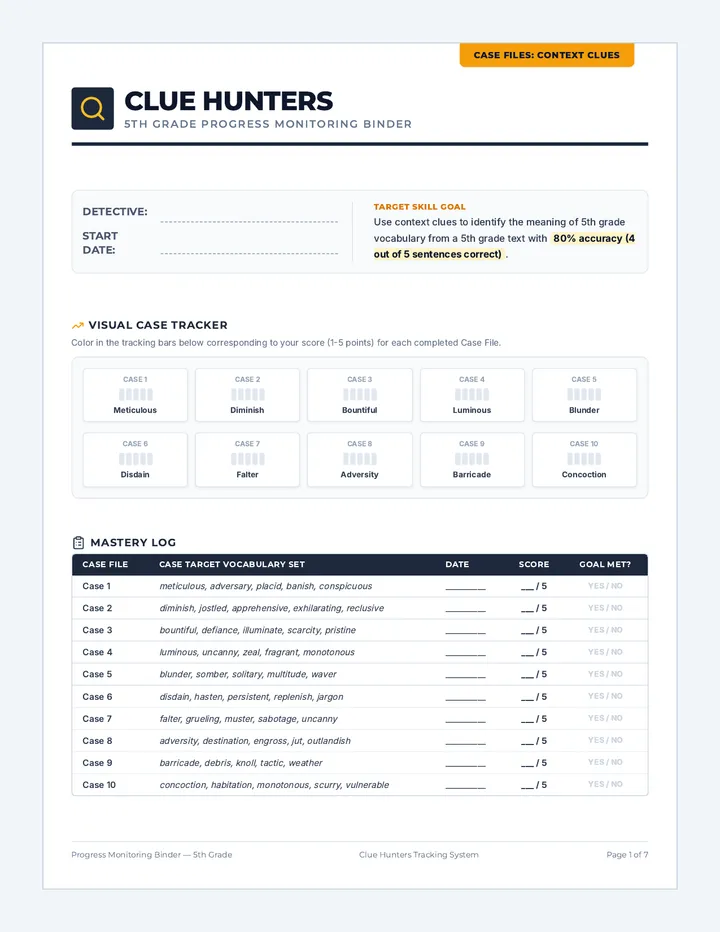
The Scene: The Clockwork Garden
"The heavy oak door groaned open to reveal a garden unlike any other. Instead of flowers of silk and scent, the ground was a tangled web of rusted copper vines and brass gears that ticked like a thousand tiny heartbeats. A single silver willow tree stood in the center, its leaves made of thin hammered tin that chimed in the wind. Above, the sky wasn't blue, but a bruised shade of violet, streaked with clouds that looked like wisps of gray smoke. Everything smelled of old pennies and rain."
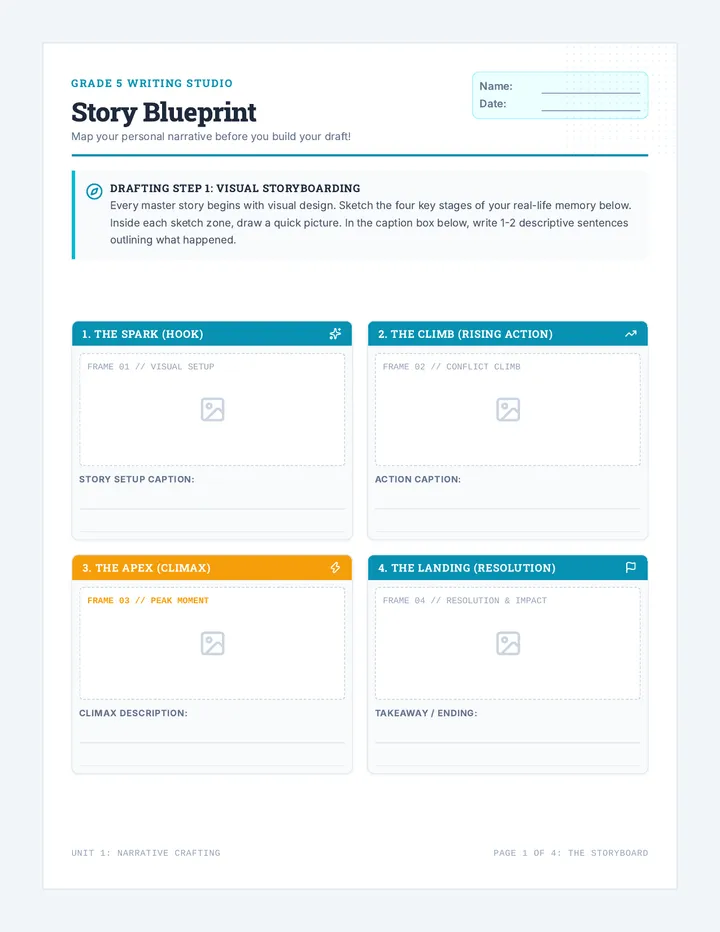
Part 1: Sketch Your Visualization
Based only on the text above, draw what you see in your mind. Focus on the details mentioned: the ground, the tree, and the sky.
Use this space for your drawing...
Part 2: Text Evidence
List three specific words or phrases that helped you decide how to draw your scene.
Reflect
Compare your drawing with a partner. Even though you read the same words, how are your drawings different? Why do you think that is?
Mental Movie Slides Mental Movie Magic
The Power of Visualization
The Hook
"I'm going to read a page to you, and I want you to draw exactly what you see in your mind."
Think about:
What colors do you see?
What sounds do you hear?
What does the air feel like?
What is Visualization?
The Definition
Creating a "Mental Movie" while you read.
The Fuel
Authors use sensory details and adjectives to help us see.
"Your brain is the world's most powerful movie projector."
Spotting the Details
Which phrase creates a stronger image?
"The garden was old."
Option A
"Rusted copper vines and brass gears ticked like heartbeats."
Option B
Why? Option B uses precise nouns and vivid verbs.
Mission: Sketch It
ACTION TIME
Read
"The Clockwork Garden" on your worksheet.
Sketch
Draw exactly what the text describes. Use the sensory clues.
Cite
Underline 3 words that inspired your artistic choices.
Visualization Guide Teacher Notes Teacher Resource
Mental Movie Magic
Lesson 1: Instructional Guide & Facilitation Notes
Learning Objective
Students will be able to interpret descriptive language in a literary text to create a detailed visual representation, citing specific text evidence to justify their artistic decisions.
Key Vocabulary
Visualization Sensory Details Text Evidence Adjectives Interpretation
Materials Needed
Mental Movie Slides
Descriptive Drafts Worksheet
Colored pencils/sketching tools
Lesson Procedure
1
The Hook: Auditory Visualization (10 min)
Ask students to close their eyes. Read the "Clockwork Garden" passage aloud with dramatic pauses. Encourage students to "see" the scene in their minds. Prompt: "Who saw something shiny? Who heard a ticking sound? Keep those images in your head—we are going to put them on paper."
2
Skill Modeling: Mental Movie Magic (15 min)
Use the Mental Movie Slides to define visualization. Model how to identify "power words" in a sentence. Show the difference between a weak sentence ("The room was messy") and a descriptive one ("Mountains of crusty socks and crumpled candy wrappers buried the floor").
3
Guided Activity: Sketch & Cite (25 min)
Distribute the Descriptive Drafts Worksheet . Students work independently to sketch the garden based on the text. Circulate and ask students to point to the specific word in the text that inspired a certain color or shape in their drawing.
4
Debrief: Perspective Shift (10 min)
Have students share their sketches in pairs. Discuss why the drawings are different despite having the same text. Key Point: Our personal experiences and imaginations fill in the gaps that the author leaves. This is why directors and book fans often disagree on how a movie should look!
Differentiation Strategies
Support
Provide a "Menu of Details" where students can check off sensory words (e.g., "silver," "rusted," "ticking") as they include them in their drawing.
Extension
Ask students to write one additional sentence for the passage that includes a smell or sound not already mentioned, then update their drawing.
Visual Toolkit Slides The Director's Eye
Translating Words into Images
The Translation Problem
"The dark, spooky forest was silent."
Text Format
How do we show this on screen without a narrator?
Visual Format
Directors don't use adjectives.
They use Visual Literacy.
Tool #1: Color Palette
Cool Blues
Creates a mood of sadness, mystery, or coldness.
Warm Oranges
Creates a mood of comfort, joy, or nostalgia.
Dark Greens
Creates a mood of nature, sickness, or envy.
Tool #2: Lighting
High-Key
Bright, even light. Used for comedies, musicals, or "happy" scenes. Very few shadows.
Low-Key
High contrast with deep shadows. Used for horror, thrillers, or "sad/serious" scenes.
Tool #3: Composition (Camera Angles)
The "Low" Angle
The camera looks UP at the character.
Makes them look powerful, scary, or heroic.
The "High" Angle
The camera looks DOWN at the character.
Makes them look weak, small, or scared.
The Director's Challenge
If you were filming a scene where a small child enters a giant, scary castle, what lighting and camera angle would you use? Why?
Directors Eye Worksheet The Director's Eye
Lesson 2: Analyzing Visual Choices
Name: __________________________
Date: ___________________________
Mission Briefing
You are a visual detective. Watch the assigned film clip or look at the graphic novel panel. Your job is to identify the visual techniques the creator used to tell the story without using words.
Visual Technique Evidence (What did you see?) Effect (How does it feel?) Color Palette
| | |
|
Lighting
| | |
|
Composition
| | |
|
Sound/Music
| | |
Word vs. Image
Choose one adjective from the original text (e.g., "spooky," "happy," "old"). How was that adjective replaced visually?
Written Adjective:
Visual Replacement:
The Big Question
Did the visual version change the mood of the story, or did it feel the same as when you read it? Explain why.
The Fidelity File Worksheet The Fidelity File
Lesson 3: Text vs. Media Audit
AUDIT STATUS
IN PROGRESS
Lead Auditor: __________________________
Target Adaptation: _____________________
The Changes Chart
Type of Change Describe the Change Why did they do it? Addition (New scene/character) Deletion (Cut scene/dialogue) Alteration (Changed detail)
Audit Reasoning Guide
When looking for the "Why," consider these common reasons:
Time Constraints
Too long for a movie.
Visual Impact
Looks better on screen.
Audience Appeal
Makes it more exciting.
Auditor's Conclusion
Overall, was the adaptation "Faithful" to the original text? Explain your final verdict.
Adaptation Audit Slides The Adaptation Audit
Investigating the "Why" behind the Change
The Big Word: Fidelity
fi·del·i·ty (noun)
The degree to which an adaptation is faithful or accurate to the original source.
High Fidelity = Very Accurate
Why would a director change the story?
Reason 1: Time
Most books take 8-10 hours to read. Movies are only 2 hours.
Stuff HAS to be cut!
Reason 2: Visual Impact
Some things that are cool in a book are boring to watch . Directors add action or visuals to keep us interested.
Types of Audit Changes
Additions
Adding a character to give someone to talk to, or adding a scene for more excitement.
Deletions
Cutting secondary characters or sub-plots that don't help the main story move fast enough.
Alterations
Changing a character's age, a setting's location, or a character's personality to fit the movie's vibe.
Start the Audit!
Use your "Fidelity File" worksheet.
Most importantly: Explain the Reason!
Book on Trial Cards Book on Trial: Debate Cards
Lesson 4: Evaluating Effectiveness
Team Prosecution
The "Fidelity" Fan
"The movie is guilty of ruining the book because it changed too much!"
Your Argument Strategy:
Point out a specific missing scene that was important for character growth.
Explain how a visual choice (like a bright color) ruined a "scary" mood from the text.
Argue that the ending was changed to be "too happy" and lost the book's theme .
Team Defense
The "Visual" Visionary
"The movie is innocent! It captured the spirit of the book perfectly."
Your Argument Strategy:
Defend a change by explaining how it made the story more exciting for an audience.
Describe how the music or lighting captured the "vibe" of the book better than words could.
Argue that even though details changed, the main message is still there.
The Witness
The "Expert" Reader
"I have the text evidence to prove what really happened."
Your Argument Strategy:
Find the exact page number or quote that describes the setting.
Describe the character's original feelings from the book's internal monologue.
Verify if the movie's climax matches the book's major plot points.
The Judge
The "Critic" Judge
"I decide based on effectiveness, not just if I liked it."
Your Role:
Listen for specific evidence (text vs. visual techniques).
Ask: "How did that specific change help or hurt the mood ?"
Deliver a final Verdict : Guilty (Ruined the book) or Innocent (Successful adaptation).
Instructions
Cut these cards out and distribute them to small groups. Each group should have a mix of roles to conduct their "Mini-Trial."
Adaptation Quality Rubric The Critic's Compass
Evaluation Rubric: Text vs. Media
Criteria Master Critic (3) Developing Critic (2) Novice Critic (1) Mood & Atmosphere Identifies the mood of the book and explains how specific visual techniques recreated it. Identifies the mood, but has trouble explaining exactly how the visual version created it. Struggles to identify the mood or only talks about whether they "liked" the movie. Fidelity & Logic Identifies a major change and provides a logical reason (Time, Visual Impact, etc.) for why it was made. Identifies a change but the reason for the change is unclear or missing. Mentions that things were different but doesn't explain why it matters. Evidence Usage Uses specific text quotes and describes specific camera angles or color choices. Uses general examples from the book and movie, but lacks specific details. Does not refer back to the book or movie details to support the argument. The "Verdict" Makes a clear claim about which version is more effective and supports it with a balanced argument. Makes a claim but the argument is mostly based on personal preference. No clear claim is made about the effectiveness of the adaptation.
Pre-Writing Reflection
Before you start your final review, pick one criteria above where you feel you are a "Master Critic." Why is that your strongest area?
Critics Corner Template Critic's Corner
The Final Comparative Review
Assignment
Final Project
Headline (Make it catchy!):
e.g., "Page vs. Pixels: Which Garden Wins?"
Byline (Your Name):
Section 1: The Intro
Introduce the book and the adaptation. State your main claim (the Verdict).
Section 2: Mood & Visuals
Compare how the author used words vs. how the director used visual tools (lighting, color, camera angles).
Section 3: The Audit
Discuss one major change (addition, deletion, or alteration) and whether it helped or hurt the story.
Section 4: The Final Recommendation
Give your final recommendation. Who should read the book first? Who should watch the movie?
Final Star Rating
Rate the adaptation based on its overall effectiveness.
Final Review Slides The Final Review
You are the Critic
The Critic's Mission
Your goal is to write a Comparative Review that tells your audience which version of the story is more effective.
"It’s not just about what you liked. It’s about how well the director used the tools of film to tell the author’s story."
Three Big Parts:
The Mood & Visuals
The Adaptation Audit
The Verdict
Step 1: The Catchy Headline
Professional reviews always start with a "hooky" headline.
Avoid:
"My Review of The Secret Garden Movie"
Try:
"Page vs. Pixels: Why the Movie Lost the Magic"
Step 2: Compare & Contrast
From the Book:
"The author describes the garden as 'ticking like heartbeats' to create a mystery..."
From the Movie:
"The director used ticking sound effects and cool blue lighting to match that mystery."
Connect the two versions with words like similarly, however, or instead.
Step 3: The Verdict
End your review by telling the audience exactly what to do.
"If you love a deep mystery, read the book. If you want a fast-paced adventure, the movie is for you!"
Deadline: Today!
Use your Critic's Corner Template and your Fidelity File notes to draft your review.