Factory Secrets Workbook
Factory Secrets • Article 1
Name: ______________________ Date: _________
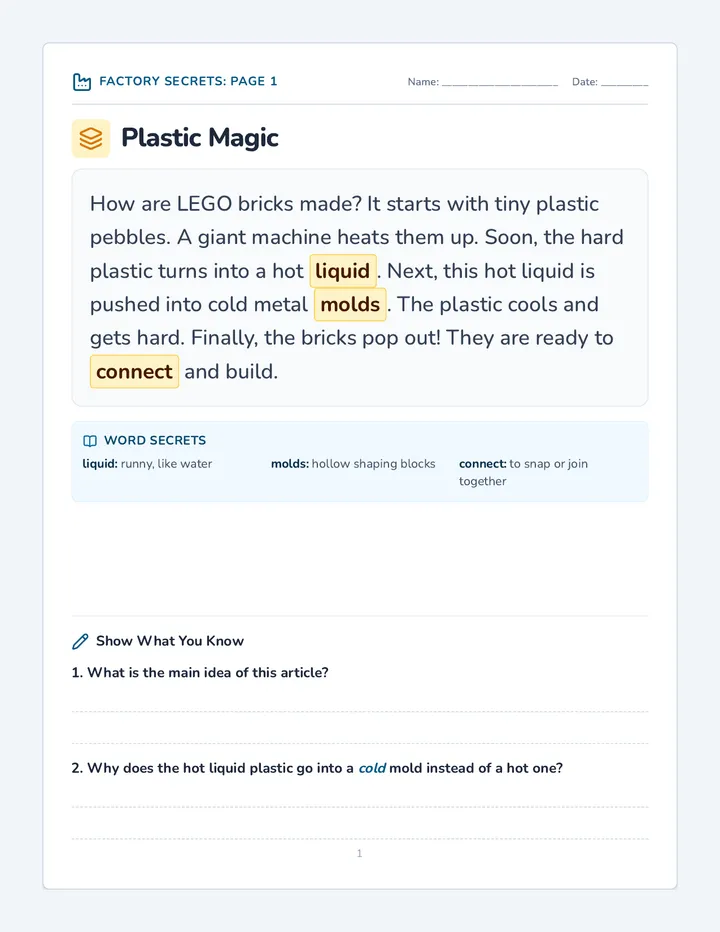
Plastic Magic
How LEGO Bricks Are Born
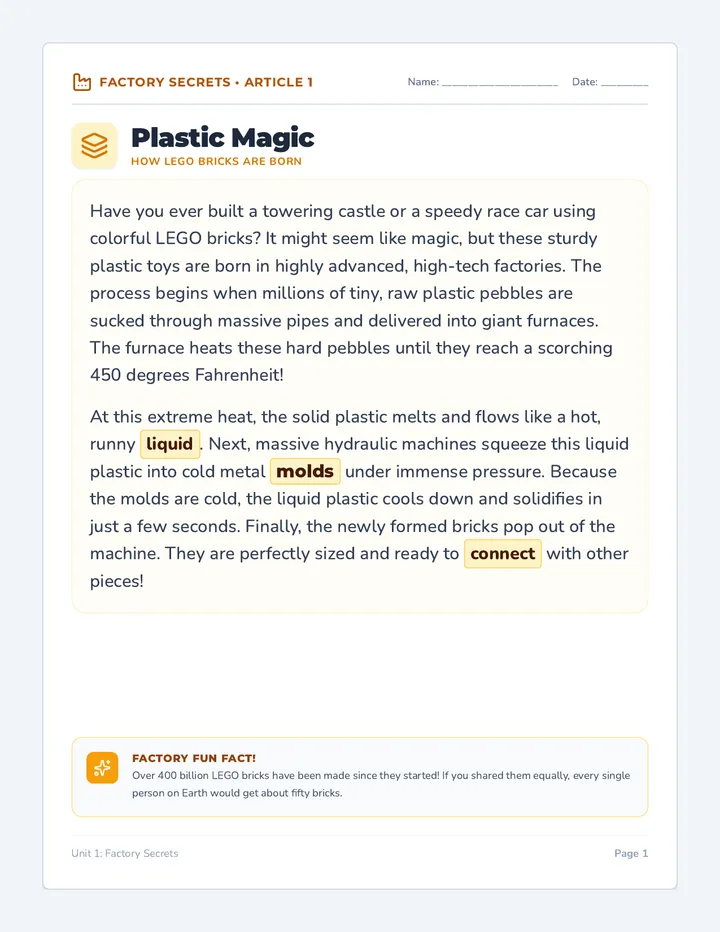
Have you ever built a towering castle or a speedy race car using colorful LEGO bricks? It might seem like magic, but these sturdy plastic toys are born in highly advanced, high-tech factories. The process begins when millions of tiny, raw plastic pebbles are sucked through massive pipes and delivered into giant furnaces. The furnace heats these hard pebbles until they reach a scorching 450 degrees Fahrenheit!
At this extreme heat, the solid plastic melts and flows like a hot, runny liquid. Next, massive hydraulic machines squeeze this liquid plastic into cold metal molds under immense pressure. Because the molds are cold, the liquid plastic cools down and solidifies in just a few seconds. Finally, the newly formed bricks pop out of the machine. They are perfectly sized and ready to connect with other pieces!
Factory Fun Fact!
Over 400 billion LEGO bricks have been made since they started! If you shared them equally, every single person on Earth would get about fifty bricks.
Unit 1: Factory Secrets Page 1
Factory Secrets • Questions 1
Name: ______________________ Date: _________
Plastic Magic Study
Show What You Know (24pt Print)
1. Why does the raw plastic need to be heated to 450 degrees in the furnace?
2. How do cold metal molds help turn the hot liquid back into hard blocks?
Unit 1: Factory Secrets Page 2
Factory Secrets • Article 2
Name: ______________________ Date: _________
Wax Wonders
The Colorful Life of Crayons
Crayons are some of the most colorful and beloved art tools in the entire world, but how are they made? It all starts when factory workers melt huge blocks of clear, solid wax inside giant heated vats. The wax is heated until it completely liquefies and becomes a warm liquid.
Next, workers stir in a special, finely ground color powder called pigment. This powder is carefully mixed to give each crayon its bold, bright shade, such as sky blue or sunset orange. The warm, colored wax is then poured into hundreds of tiny metal tubes to shape them into pointed cylinders. Cold water is pumped around the tubes to cool the wax quickly. Once they cool and harden, the crayons become extremely sturdy.
Factory Fun Fact!
The distinct smell of crayons is one of the most recognized scents in the entire world! It comes from a beef ingredient used to make the wax mix smooth and soft.
Unit 1: Factory Secrets Page 3
Factory Secrets • Questions 2
Name: ______________________ Date: _________
Wax Wonders Study
Show What You Know (24pt Print)
1. What is the job of the color powder called pigment in the factory?
2. Why do you think crayons need double-layered paper labels?
Unit 1: Factory Secrets Page 4
Factory Secrets • Article 3
Name: ______________________ Date: _________
Laser Discs
Storing Digital Worlds
How does a flat, shiny plastic disc hold an entire video game universe with hundreds of characters, levels, and songs? The journey begins with plain, clear plastic pellets that are melted and pressed into a flat circle. Then, a massive stamping machine presses billions of tiny, microscopic bumps into the surface. These bumps are actually a secret computer code!
To make this microscopic code readable, the factory coats the plastic disc with a super-thin, shiny layer of aluminum. This shiny metal layer reflects light like a mirror. When you insert the disc into your console, a narrow computer laser beam shines on it. The laser reads the code. Finally, a tough plastic coat is used to protect it from scratches.
Factory Fun Fact!
The microscopic bumps on a single disc are so tiny that if you laid them out in a straight line, it would stretch for over five miles!
Unit 1: Factory Secrets Page 5
Factory Secrets • Questions 3
Name: ______________________ Date: _________
Laser Discs Study
Show What You Know (24pt Print)
1. How does the shiny metal layer help the laser read the game code?
2. Why is a tough plastic coat added at the very end of the process?
Unit 1: Factory Secrets Page 6
Factory Secrets • Article 4
Name: ______________________ Date: _________
Stitched Spheres
The Physics of Soccer Balls
Soccer is played all over the world, but have you ever wondered how a soccer ball stays so incredibly round and bouncy after being kicked? The secret lies in its complex inner construction. Every professional soccer ball starts with a stretchy rubber balloon called a bladder, which is inflated with air to test for any leaks.
To keep the bladder perfectly round, workers wrap it in multiple strong layers of cloth. Next, machines cut out thirty-two flat outer pieces called panels. Some panels are six-sided hexagons, while others are five-sided pentagons. Skilled craftspeople or high-tech automated sewing machines stitch these panels together. This tight stitching makes the outer shell extremely durable!
Factory Fun Fact!
The classic black-and-white soccer ball pattern was designed so that the ball would be easy to see on old black-and-white television screens in the year 1970!
Unit 1: Factory Secrets Page 7
Factory Secrets • Questions 4
Name: ______________________ Date: _________
Stitched Spheres Study
Show What You Know (24pt Print)
1. What is the main purpose of the inner rubber bladder?
2. Why do workers wrap the bladder in layers of strong cloth?
Unit 1: Factory Secrets Page 8
Factory Secrets • Article 5
Name: ______________________ Date: _________
Chewy Ropes
Squeezing Out Sweet Treats
Bubble gum is a sweet and stretchy treat, but did you know that it starts its life as a tough, rubbery raw ingredient? This base is called a gum base. It is a unique synthetic rubber because it does not dissolve in your mouth, no matter how long or hard you chew it.
Inside the factory, workers melt the gum base in massive industrial mixers. They add sweet corn syrup, fine sugar, and bright liquid flavorings. The mixture is stirred until it looks like giant, warm loaves of pink bread. Next, machines squeeze the stretchy dough through small shaped holes, creating long, chewy ropes. Finally, another high-speed machine cuts the ropes and ensures each piece is tightly wrapped!
Factory Fun Fact!
The largest bubble ever recorded in the world was 23 inches wide! It was blown by a woman in 1994 using three big pieces of bubble gum.
Unit 1: Factory Secrets Page 9
Factory Secrets • Questions 5
Name: ______________________ Date: _________
Chewy Ropes Study
Show What You Know (24pt Print)
1. Why must the gum base be made of material that does not dissolve?
2. Explain how the sweet mixture is shaped into small pieces.
Unit 1: Factory Secrets Page 10
Factory Secrets • Practice 1
Name: ______________________ Date: _________
Vocabulary Matcher
Part 1: Match the meanings (24pt Print)
Write the correct letter in the brackets to match each vocabulary word with its meaning.
1. liquid
2. pigment
3. sturdy
4. reflects
5. durable
6. dissolve
[ ] A. strong and tough
[ ] B. runny, like water
[ ] C. melts in liquid
[ ] D. color powder
[ ] E. bounces light back
[ ] F. solid and sturdy
Unit 1: Factory Secrets Page 11
Factory Secrets • Practice 2
Name: ______________________ Date: _________
Complete the Sentences
Part 2: Use the Word Bank (24pt Print)
Word Bank
connect molds wax laser bladder
-
A warm candle is made of cold which melts easily when heated.
-
Liquid plastic is squeezed into metal to give toys their shape.
-
LEGO bricks are built to together tightly to create structures.
-
A game console uses a narrow light beam to read coded discs.
-
The stretchy rubber balloon, or , holds air in a soccer ball.
Unit 1: Factory Secrets Page 12