Lenny.com
Explore
Create
ActivitiesNewMathEnglish Language ArtsScience & EngineeringSocial StudiesGlobal LanguagesHealth & Physical EducationSpecial EducationCounseling & Life SkillsArts & CreativityESL
Lenny.com
Lenny.com
Explore
Create
ActivitiesNewMathEnglish Language ArtsScience & EngineeringSocial StudiesGlobal LanguagesHealth & Physical EducationSpecial EducationCounseling & Life SkillsArts & CreativityESL
Lenny.com
Lenny.com

Solutions

Lenny for EducatorsLenny for SchoolsLenny for Districts

Product

ExploreSign inCreateSupportAbout

Resources

Getting startedMTSS Acceleration Program

Newsletters

School Funding Newsletter

© 2026 Lenny Learning Inc.

TermsPrivacyAccessibility
LinkedInInstagramX
Lenny
English Language ArtsPhonics & Reading FoundationsLetter IdentificationLearn Letters A-ZLowercase and Uppercase LettersConsonants and VowelsLetter-Sound AssociationsLetter-Sound Associations: LowercaseLetter-Sound Associations: UppercaseBeginning and Ending SoundsRhymingBlending And SegmentingShort VowelsShort Vowel SoundsConsonant BlendsConsonant DigraphsBlends, Digraphs, and TrigraphsDigraphs, Blends, and Silent LettersLong Vowel SoundsLong Vowel PatternsShort and Long VowelsShort and Long Vowel PatternsSilent EVowel SoundsVowel TeamsR-Controlled VowelsDiphthongs: Oi, Oy, Ou, OwVariant VowelsVariant, Diphthong, And R Vowel PatternsSoft G And CSight WordsIrregular WordsWord RecognitionSyllablesSyllable TypesTwo-Syllable WordsMultisyllabic WordsPhoneme ManipulationDecodable TextsVocabularyAction WordsQuestion WordsNouns and AdjectivesClassify WordsCompound WordsSynonyms and AntonymsHomophonesHomophones and HomonymsShades of MeaningContext CluesPrefixes and SuffixesGreek and Latin RootsAnalogiesIdioms and AdagesForeign Words and ExpressionsWord Choice and UsageReference SkillsReading ComprehensionRead-Along Literary TextsRead-Along Informational TextsReality vs. FictionStory ElementsCharacterSequenceMain IdeaCause And EffectCompare And ContrastReading StrategiesText StructureAuthor's PurposeAuthor's Purpose And ToneAuthor's PerspectivePoint Of ViewThemeInference And ThemeInference And AnalysisPoetry ElementsLiterary DevicesAnalyzing LiteratureAnalyzing Informational TextsComparing TextsAudience, Purpose, And ToneBusiness DocumentsNovel StudyNonfiction Book StudyGrammar & MechanicsSentencesNounsVerbsAdjectivesPronounsCapitalizationPunctuationContractionsConjunctionsPrepositionsArticlesAdjectives And AdverbsVerb TypesVerb TensePronouns And AntecedentsPronoun TypesSubject-Verb AgreementDirect And Indirect ObjectsSentences, Fragments, And Run-OnsPhrases And ClausesCommasSemicolons, Colons, And CommasDashes, Hyphens, And EllipsesSpellingAbbreviationsFormattingVerb Tense And MoodMisplaced ModifiersWritingDescriptive DetailsCreative WritingOpinion WritingTopic SentencesOrganizing WritingLinking WordsSentence VarietyIntroductions And ConclusionsPersuasive And Opinion WritingExpository WritingPersuasive StrategiesDeveloping And Supporting ArgumentsTopic Sentences And Thesis StatementsSummarizingResearch SkillsEditing And RevisingActive And Passive Voice=Writing Clearly And ConciselyDebate & Public SpeakingPublic Speaking BasicsPersuasive TechniquesClaims and EvidenceTypes of ArgumentsReasoning TypesLogical FallaciesTopic ResearchOrganizing EvidenceDebate Speech OrganizationAttacking and Defending ArgumentsClash and EngagementImpact CalculusQuestioning and Cross-ExaminationCritical ThinkingInformal LogicFormal LogicInductive Reasoning

New Concept English Book 1

A rigorous, WIDA-aligned ESL curriculum sequence based on New Concept English Book 1 (First Things First), focusing on absolute beginner grammatical structures, possessive pronouns, polite requests, and daily vocabulary.

Ccolin.cumberbatch
Excuse Me

A WIDA-aligned ESL lesson based on New Concept English Book 1, Lesson 1 "Excuse me!", focusing on polite greetings, yes/no questions with "to be", and possessive adjectives (your, my, its) bilingually in Spanish.

Sorry Sir

A WIDA-aligned ESL lesson based on New Concept English Book 1, Lesson 3 "Sorry, sir!" and Lesson 4, focusing on polite requests, possessive adjectives (my, your), negative contractions (it isn't), and daily objects bilingually in Spanish.

Nice To Meet You

A WIDA-aligned ESL lesson based on New Concept English Book 1, Lesson 5 "Nice to meet you." and Lesson 6 "What make is it?", focusing on introductions, nationalities, pronouns (he, she, it), articles (a/an), and car brands bilingually in Spanish.

New Concept English Book 1

A rigorous, WIDA-aligned ESL curriculum sequence based on New Concept English Book 1 (First Things First), focusing on absolute beginner grammatical structures, possessive pronouns, polite requests, and daily vocabulary.

Ccolin.cumberbatch

1. pen A. reloj de pulsera

2. pencil B. abrigo

3. book C. bolígrafo / pluma

4. watch D. lápiz

5. coat E. falda

6. dress F. libro

7. skirt G. vestido

8. shirt H. camisa

2. INTERACTIVE DRILL PATTERN / PATRÓN DE INTERACCIÓN

Practice asking and answering with a partner about various objects using possessives.

Positive Answer / Afirmación:

A: Is this your book?

B: Yes, it is. Thank you.

(¿Es este tu libro? Sí, lo es. Gracias.)

Negative Answer / Negación:

A: Is this your book?

B: No, it isn't. It's your book.

(¿Es este tu libro? No, no lo es. Es tu libro.)

Camden Prep High School • Student Packet Page 2 of 4

UNCOMMON SCHOOLS | CAMDEN PREP HIGH SCHOOL

NEW CONCEPT ENGLISH • BOOK 1 / LIBRO 1

Binder Section: CW

Lesson 1-2 • Student Worksheets

Page 3

3. KEY STRUCTURES: SUBJECT PRONOUNS VS. POSSESSIVE ADJECTIVES

A possessive adjective must always be followed by a noun. Un adjetivo posesivo siempre debe ir seguido de un sustantivo.

• I → my (This is my handbag. / Esta es mi cartera.)

• you → your (Is this your handbag? / ¿Es esta su cartera?)

4. EXERCISE A: STATEMENT TO YES/NO QUESTION CONVERSION

Directions: Transform each standard statement into a polite Yes/No question starting with "Is this your...?"
/ Instrucciones: Transforma cada afirmación estándar en una pregunta de sí o no que comience con "¿Es este tu/su...?".

1. This is my pen. → / Este es mi bolígrafo. →

2. This is my watch. → / Este es mi reloj. →

3. This is my coat. → / Este es mi abrigo. →

5. EXERCISE B: COMPLETE THE CLASSIC DIALOGUE

Fill in the blanks with the correct missing words from Lesson 1.

Man: _______________ me! (1)

/ Hombre: ¡_______________ me! (1) (Disculpe...)

Woman: Yes?

/ Mujer: ¿Sí?

Man: Is _______________ your handbag? (2)

/ Hombre: ¿Es _______________ su cartera? (2)

Woman: _______________? (3)

/ Mujer: ¿_______________? (3) (¿Perdone...?)

Man: Is this your _______________? (4)

/ Hombre: ¿Es esta su _______________? (4)

Woman: _______________, it is. (5) Thank you very much.

/ Mujer: _______________, lo es. (5) Muchísimas gracias.

Camden Prep High School • Student Packet Page 3 of 4

UNCOMMON SCHOOLS | CAMDEN PREP HIGH SCHOOL

NEW CONCEPT ENGLISH • BOOK 1 / LIBRO 1

Binder Section: CW

8. EXIT TICKET - MULTIPLE CHOICE QUESTIONS

/ 8. boleto de salida - preguntas de selección múltiple

INDEPENDENT WORK - Silent exit ticket execution. / TRABAJO INDEPENDIENTE - Realización silenciosa del boleto de salida.

1. What does "Excuse me" mean bilingually?

/ ¿Qué significa "Excuse me"?

  • (a) Muchas gracias
  • (b) Disculpe / Con permiso
  • (c) Hola señor
  • (d) Lo siento mucho

2. Is this _____ handbag?

/ ¿Es esta _____ cartera?

  • (a) you
  • (b) yours
  • (c) your
  • (d) me

3. Is this your handbag? Yes, it _____ .

/ Sí, lo es.

  • (a) am
  • (b) is
  • (c) are
  • (d) isn't

4. "Pardon?" is used when you _____ .

/ "Pardon?" se usa cuando _____ .

  • (a) didn't hear clearly
  • (b) want to say goodbye
  • (c) are happy
  • (d) are very angry

5. Is this your pen? No, it _____ .

/ No, no lo es.

  • (a) am not
  • (b) aren't
  • (c) isn't
  • (d) is

6. This is my car. It's _____ car.

/ Es _____ carro.

  • (a) my
  • (b) I
  • (c) you
  • (d) mine

7. "Thank you very much" means _____ .

/ Significa _____ .

  • (a) De nada señor
  • (b) Muchísimas gracias
  • (c) Hola amigo
  • (d) Por favor, pase

8. Handbag belongs to the category of _____ .

/ Pertenece a _____ .

  • (a) personal objects
  • (b) vehicles
  • (c) clothing
  • (d) locations

9. "Is this your book?" "Yes, _____ ."

/ "Sí, lo es."

  • (a) it are
  • (b) this are
  • (c) this is
  • (d) it is

10. "Book" translates to Spanish as _____ .

/ Se traduce como _____ .

  • (a) bolígrafo
  • (b) cartera
  • (c) libro
  • (d) vestido

11. What is a "foreigner"?

/ ¿Qué es un "foreigner"?

  • (a) Un mozo
  • (b) Un extranjero
  • (c) Un policía
  • (d) Un maestro

12. "Is this _____ pencil?" "No, it's my pencil."

/ ¿Es este _____ lápiz?

  • (a) your
  • (b) you
  • (c) its
  • (d) me

EXTRA CREDIT (5 EXPERT POINTS) / CRÉDITO EXTRA (5 PUNTOS EXPERTOS)

1. Why does the woman say "Pardon?" in the dialogue?

/ ¿Por qué la mujer dice "Pardon?" en el diálogo?

2. How does the man show politeness when interrupting?

/ ¿Cómo demuestra educación el hombre al interrumpir?

8. SENTENCE STRUCTURE & REWRITE / ESTRUCTURA DE ORACIONES

Original: This is my pen.

/ Original: Este es mi bolígrafo.

Directions: Transform the statement into a polite Yes/No question starting with "Is this...?"

/ Instrucciones: Transforma la afirmación en una pregunta de sí o no que comience con "Is this...?"

Camden Prep High School • Student Packet Page 4 of 4

  • Partner B turns around and says: "Yes?"
  • A holds the object up and asks: "Is this your [object]?"
  • B acts confused: "Pardon?"
  • A repeats the question, and B replies with a happy smile!
  • Polite Final Remarks:

    "Yes, it is! Thank you very much!"
    (¡Sí, lo es! ¡Muchísimas gracias!)

    ✓ Focus on polite tone, rising intonation, and eye-contact!

    Now open your Student Packets to Page 3 to complete Exercise B! NCE Lesson 1

    • Real-world image matching (suit, car, school, teacher).

    Write 3 original "No, it isn't my..." answers.

    4. Closure / Exit Ticket

    10 min

    Exit Ticket: Complete 12 multiple choice grammar and reading questions silently on Page 4.
    Extra Credit: Challenge scholars to write down why the man received the wrong umbrella first.

    • Scan Q4 (Is this your...) and Q12 (cloakroom meaning).

    Preview next lesson's vocabulary lists.

    Teacher Reflection

    Beginners often struggle with the pronunciation of "umbrella" (/ʌm'brelə/) and placing "please" at the end of the sentence. Ensure they don't say *No, is not my umbrella* (skipping 'it').

    Reteach & Support

    Target students struggling with contraction spelling *isn't*. Run a quick whiteboard spelling sprint with *is not* vs *isn't*.

    School Events

    Enforce professional uniform standards and silent corridor transitions. Collect and grade previous evening's homework packets at the start of Period 1.
    TEACHER OBSERVATIONS & LESSON ADJUSTMENTS / ANOTACIONES

    Note: This is a 1 on 1 session. / Nota: Esta es una sesión individual.

    Camden Prep High School • Teacher Guide & Key Page 1 of 4

    UNCOMMON SCHOOLS | CAMDEN PREP HIGH SCHOOL

    TEACHER EXEMPLAR MASTERY KEY

    MASTER KEY

    TW (10 MIN) Enforce silent entry & uniform check. Introduce objectives. SW (5 MIN) Scholars complete Do Now. LAP #1

    DO NOW / ACTIVIDAD INICIAL ANSWER:

    How do you ask for your belongings politely at a coat check? / ¿Cómo pides tus pertenencias de forma educada...?

    In Spanish, we say "Mi abrigo y mi paraguas, por favor. Aquí está mi tiquete." In English, we use "please" at the end of the request: "My coat and my umbrella please. Here is my ticket."

    CC (2 MIN) Cold Call 2 scholars to read full answers. Stamp spelling.

    Vocabulary & Text Key:

    • cloakroom (guardarropa): Noun. A room in a public building where outdoor coats and luggage may be left.
    • ticket (boleto / tiquete): Noun. A piece of paper showing that you have paid or left an item.
    • sorry (lo siento): Adjective. Used to express apology or regret.
    • sir (señor): Noun. Term of respect for addressing a man.

    TT (2 MIN) Turn & Talk: "What is the function of the word 'sorry' in the dialogue? Talk!"

    Comprobación de Lectura / Comprehension Check Answers:

    1. What items is the man asking for?

    Answer: His coat and his umbrella.

    2. What number is on his ticket?

    Answer: Number five.

    3. Is the first umbrella given to him correct?

    Answer: No, he says "This is not my umbrella."

    4. Does he get his umbrella back at last?

    Answer: Yes, he says "Yes, it is."

    Camden Prep High School • Teacher Guide & Key Page 2 of 4

    UNCOMMON SCHOOLS | CAMDEN PREP HIGH SCHOOL

    TEACHER EXEMPLAR SOLUTIONS

    Page 3

    1. DIALOGUE COMPLETION SOLUTIONS

    LAP #2 SW (10 MIN) Independent dialogue practice RR Conduct Round Robin

    Man: My coat and my umbrella please. (umbrella)

    Man: Here is my ticket. (ticket)

    Attendant: Thank you, sir. Number five. (sir)

    Attendant: Here's your umbrella and your coat. (coat)

    Man: This is not my umbrella. Sorry, sir. (Sorry)

    2. NEGATIVE CONTRACTIVE STRUCTURES KEY

    Singular Negation:

    This is my coat. → This is not my coat.

    It is my umbrella. → It isn't my umbrella.

    Possessive Contrast:

    This is my coat.

    Is this your coat?

    No, it isn't. It's your coat.

    EXERCISE B: NEGATIVE RESPONSES SOLUTIONS

    TW (10 MIN) Practice with tenses CC scholars read questions

    1. Is this your pen? → No, it isn't my pen. It's your pen.

    2. Is this your pencil? → No, it isn't my pencil. It's your pencil.

    3. Is this your book? → No, it isn't my book. It's your book.

    4. Is this your watch? → No, it isn't my watch. It's your watch.

    5. Is this your coat? → No, it isn't my coat. It's your coat.

    Camden Prep High School • Teacher Guide & Key Page 3 of 4

    UNCOMMON SCHOOLS | CAMDEN PREP HIGH SCHOOL

    EXIT TICKET ANSWER REFERENCE KEY

    Page 4

    LAP #4 SW (8 MIN) Silent exit ticket execution. TW Aggressive Monitoring: Scan Q4 and Q12.

    8. EXIT TICKET MULTIPLE CHOICE ANSWERS

    Q1 Key: ✓ (b)

    Q2 Key: ✓ (c)

    Q3 Key: ✓ (a)

    Q4 Key: ✓ (b)

    Q5 Key: ✓ (c)

    Q6 Key: ✓ (a)

    Q7 Key: ✓ (b)

    Q8 Key: ✓ (a)

    Q9 Key: ✓ (d)

    Q10 Key: ✓ (c)

    Q11 Key: ✓ (b)

    ✓ (a)

    EXTRA CREDIT ANSWER SOLUTIONS

    1. Why does the man get the wrong umbrella first?

    The cloakroom attendant gave him a different umbrella by mistake because there were many similar black umbrellas in the room.

    2. How does the man show gratitude when he finally gets it?

    He says "Yes, it is. Thank you very much" with a happy, polite expression.

    8. SENTENCE STRUCTURE & REWRITE MASTER ANSWER:

    Original: This is my umbrella.

    Answer: Is this your umbrella? / No, it isn't my umbrella. It's your umbrella.

    Camden Prep High School • Teacher Guide & Key Page 4 of 4

    it

    STUDENT NOTES / NOTAS DEL ESTUDIANTE

    Camden Prep High School • Student Packet Page 1 of 4

    UNCOMMON SCHOOLS | CAMDEN PREP HIGH SCHOOL

    NEW CONCEPT ENGLISH • BOOK 1 / LIBRO 1

    Binder Section: CW

    Lesson 3-4 • Student Worksheets

    Page 2

    1. EVERYDAY OBJECTS / VOCABULARIO DE OBJETOS

    Directions: Match each English object noun with its correct Spanish translation.
    / Instrucciones: Une cada sustantivo de objeto en inglés con su traducción correcta en español.

    1. suit A. escuela

    2. school B. hija

    3. teacher C. terno / traje

    4. son D. hijo

    5. daughter E. profesor / maestro

    6. car F. carro / auto

    7. house G. casa

    8. coat H. abrigo

    2. INTERACTIVE DRILL PATTERN / PATRÓN DE NEGACIÓN

    Practice asking and answering with a partner about various objects using negative contractions.

    Ask and Deny / Pregunta y niega:

    A: Is this your coat?

    B: No, it isn't. It's your coat.

    (¿Es este tu abrigo? No, no lo es. Es tu abrigo.)

    Identify Owner / Identificar dueño:

    A: Is this it?

    B: Yes, it is. Thank you!

    (¿Es este? Sí, lo es. ¡Gracias!)

    Camden Prep High School • Student Packet Page 2 of 4

    UNCOMMON SCHOOLS | CAMDEN PREP HIGH SCHOOL

    NEW CONCEPT ENGLISH • BOOK 1 / LIBRO 1

    Binder Section: CW

    Lesson 3-4 • Student Worksheets

    Page 3

    3. KEY STRUCTURES: SINGULAR NEGATIVE CONTRACTION "IT ISN'T" / CONTRACCIÓN NEGATIVA (IT ISN'T)

    In English, we shorten "it is not" to "it isn't". Always include the pronoun "it". / En inglés, abreviamos "it is not" a "it isn't". Siempre incluye el pronombre "it".

    • Declarative / Afirmativo: This is my umbrella. / Este es mi paraguas.

    • Negative / Negativo: No, it isn't my umbrella. It's your umbrella. / No, no es mi paraguas. Es tu paraguas.

    4. EXERCISE A: NEGATIVE RESPONSE TRANSFORMATIONS

    Directions: Answer each question negatively in the form: "No, it isn't my [object]. It's your [object]."
    / Instrucciones: Responde a cada pregunta negativamente siguiendo el formato del ejemplo.

    1. Is this your pen? → / ¿Es este tu bolígrafo? →

    2. Is this your book? → / ¿Es este tu libro? →

    3. Is this your watch? → / ¿Es este tu reloj? →

    5. EXERCISE B: COMPLETE THE CLOAKROOM DIALOGUE

    Fill in the blanks bilingually with the correct missing words from Lesson 3.

    Man: My coat and my _______________ please. (1)

    / Hombre: Mi abrigo y mi _______________, por favor. (1)

    Man: Here is my _______________. (2)

    / Hombre: Aquí está mi _______________. (2)

    Attendant: Thank you, _______________. Number five. (3)

    / Encargado: Gracias, _______________. Número cinco. (3)

    Attendant: Here's your umbrella and your _______________. (4)

    / Encargado: Aquí tiene su paraguas y su _______________. (4)

    Man: This is not my umbrella. _______________, sir. (5)

    / Hombre: Este no es mi paraguas. _______________, señor. (5)

    Camden Prep High School • Student Packet Page 3 of 4

    UNCOMMON SCHOOLS | CAMDEN PREP HIGH SCHOOL

    NEW CONCEPT ENGLISH • BOOK 1 / LIBRO 1

    Binder Section: CW

    8. EXIT TICKET - MULTIPLE CHOICE QUESTIONS

    / 8. boleto de salida - preguntas de selección múltiple

    INDEPENDENT WORK - Silent exit ticket execution. / TRABAJO INDEPENDIENTE - Realización silenciosa del boleto de salida.

    1. "My coat and umbrella please" is a polite _____ .

    / Es una forma educada de _____ .

    • (a) greeting
    • (b) request / petición
    • (c) goodbye
    • (d) introduction

    2. Here is _____ ticket.

    / Aquí está _____ boleto.

    • (a) I
    • (b) you
    • (c) my
    • (d) me

    3. This is _____ my umbrella.

    / Este _____ es mi paraguas.

    • (a) not
    • (b) no
    • (c) isn't
    • (d) aren't

    4. Is this your umbrella? No, _____ .

    / No, no lo es.

    • (a) is not
    • (b) it isn't
    • (c) its not
    • (d) it are not

    5. "Sorry, sir" translates to Spanish as _____ .

    / Se traduce como _____ .

    • (a) Hola señor
    • (b) Con permiso señor
    • (c) Lo siento, señor
    • (d) Muchas gracias

    6. Here _____ your umbrella.

    / Aquí _____ su paraguas.

    • (a) is / 's
    • (b) are / 're
    • (c) am
    • (d) aren't

    7. "Sir" is a term used to show _____ to a man.

    / Se usa para mostrar _____ .

    • (a) anger
    • (b) respect / respeto
    • (c) surprise
    • (d) humor

    8. Ticket number _____ was his ticket.

    / Su tiquete era el número _____ .

    • (a) five
    • (b) four
    • (c) three
    • (d) several

    9. "Cloakroom" translates as _____ .

    / Se traduce como _____ .

    • (a) aula de clases
    • (b) estación de tren
    • (c) hotel de paso
    • (d) guardarropa

    10. "Suit" translates to Spanish as _____ .

    / Se traduce como _____ .

    • (a) cartera
    • (b) camisa
    • (c) terno / traje
    • (d) vestido

    11. What is an "attendant"?

    / ¿Qué es un "attendant"?

    • (a) Un viajero
    • (b) Un encargado
    • (c) Un cartero
    • (d) Un policía

    12. Is this _____ coat?

    / ¿Es este _____ abrigo?

    • (a) your
    • (b) you
    • (c) its
    • (d) me

    EXTRA CREDIT (5 EXPERT POINTS) / CRÉDITO EXTRA (5 PUNTOS EXPERTOS)

    1. Why does the man get the wrong umbrella first?

    / ¿Por qué recibe el paraguas equivocado al principio?

    2. How does the man show gratitude when he finally gets it?

    / ¿Cómo demuestra agradecimiento al final?

    8. SENTENCE STRUCTURE & REWRITE / ESTRUCTURA DE ORACIONES

    Original: This is my umbrella.

    / Original: Este es mi paraguas.

    Directions: Transform the statement into a polite Yes/No question and a negative response.

    / Instrucciones: Transforma la afirmación en una pregunta y una respuesta negativa.

    Camden Prep High School • Student Packet Page 4 of 4

  • Partner B (Attendant) takes it: "Thank you, sir. Number five."
  • B hands back an umbrella: "Here's your umbrella."
  • A looks at the umbrella: "This is not my umbrella."
  • B acts apologetic, saying "Sorry, sir.", and finds the correct one!
  • Polite Final Remarks:

    "Yes, it is! Thank you very much!"
    (¡Sí, lo es! ¡Muchísimas gracias!)

    ✓ Focus on polite tone, correct negation, and eye-contact!

    Now open your Student Packets to Page 3 to complete Exercise B! NCE Lesson 3

    • Car logo realia (Toyota, Volvo, Fiat, Ford).

    Write 3 sentences describing classroom items and origins.

    4. Closure / Exit Ticket

    10 min

    Exit Ticket: Complete 12 multiple choice grammar and nationality questions silently on Page 4.
    Extra Credit: Write down why we say *an American car* instead of *a American car*.

    • Scan Q4 (article a/an) and Q10 (Italian nationality).

    Preview next lesson vocabulary.

    Teacher Reflection

    Spanish speakers often forget to capitalize nationality adjectives in English (e.g. writing *french* instead of *French*). Emphasize that all nationalities in English MUST begin with a capital letter!

    Reteach & Support

    Target students struggling with *he* (él) vs *she* (ella) distinction. Run a quick photo sorting exercise with masculine and feminine character cards.

    School Events

    Enforce professional uniform standards and silent corridor transitions. Collect and grade previous evening's homework packets at the start of Period 1.
    TEACHER OBSERVATIONS & LESSON ADJUSTMENTS / ANOTACIONES

    Note: This is a 1 on 1 session. / Nota: Esta es una sesión individual.

    Camden Prep High School • Teacher Guide & Key Page 1 of 4

    UNCOMMON SCHOOLS | CAMDEN PREP HIGH SCHOOL

    TEACHER EXEMPLAR MASTERY KEY

    MASTER KEY

    TW (10 MIN) Enforce silent entry & uniform check. Introduce objectives. SW (5 MIN) Scholars complete Do Now. LAP #1

    DO NOW / ACTIVIDAD INICIAL ANSWER:

    How do you introduce a new classmate politely? / ¿Cómo presentas a un nuevo compañero...?

    In Spanish, we say "Te presento a Sophie. Es francesa. Mucho gusto." In English, we use "This is Miss Sophie Dupont. She is French. Nice to meet you."

    CC (2 MIN) Cold Call 2 scholars to read full answers. Stamp spelling.

    Vocabulary & Text Key:

    • Good morning (Buenos días): Standard formal morning greeting.
    • This is... (Este/Esta es...): Standard formula used to introduce someone.
    • Nice to meet you (Mucho gusto): Polite social formula used upon meeting someone for the first time.
    • too (también): Adverb. Placed at the end of the sentence to show similarity.

    TT (2 MIN) Turn & Talk: "Practice greeting each other with 'Nice to meet you!'"

    Comprobación de Lectura / Comprehension Check Answers:

    1. Who is the new student?

    Answer: Miss Sophie Dupont.

    2. What nationality is Sophie?

    Answer: She is French.

    3. What nationality is Hans?

    Answer: He is German.

    4. Is Chang-woo Chinese?

    Answer: No, he is Korean.

    Camden Prep High School • Teacher Guide & Key Page 2 of 4

    UNCOMMON SCHOOLS | CAMDEN PREP HIGH SCHOOL

    TEACHER EXEMPLAR SOLUTIONS

    Page 3

    1. PRONOUN FILL-IN SOLUTIONS (HE / SHE / IT)

    LAP #2 SW (10 MIN) Independent drill RR Conduct Round Robin

    1. Alice is a student. She isn't German. She is French. This is her car. It is a French car.

    2. Hans is a student. He isn't French. He is German. This is his car. It is a German car.

    2. ARTICLES & CAR NATIONALITIES KEY

    Article Rules (a vs. an):

    a French car / a German car

    an American car / an Italian car

    an English car

    Car Makes & Nationalities:

    Volvo → Swedish

    Peugeot → French

    Toyota → Japanese

    Fiat → Italian

    EXERCISE B: QUESTION & ANSWER PAIR SOLUTIONS

    TW (10 MIN) Practice nationality pairs CC scholars read pairs

    1. Naoko. Japanese/(German) → Is she a German student? No, she isn't. She's a Japanese student.

    2. This is a Peugeot. French/(German) → Is it a German car? No, it isn't. It's a French car.

    3. Hans. German/(Italian) → Is he an Italian student? No, he isn't. He's a German student.

    4. This is a Ford. American/(English) → Is it an English car? No, it isn't. It's an American car.

    Camden Prep High School • Teacher Guide & Key Page 3 of 4

    UNCOMMON SCHOOLS | CAMDEN PREP HIGH SCHOOL

    EXIT TICKET ANSWER REFERENCE KEY

    Page 4

    LAP #4 SW (8 MIN) Silent exit ticket execution. TW Aggressive Monitoring: Scan Q4 and Q10.

    8. EXIT TICKET MULTIPLE CHOICE ANSWERS

    Q1 Key: ✓ (b)

    Q2 Key: ✓ (a)

    Q3 Key: ✓ (c)

    Q4 Key: ✓ (b)

    Q5 Key: ✓ (a)

    Q6 Key: ✓ (c)

    Q7 Key: ✓ (b)

    Q8 Key: ✓ (d)

    Q9 Key: ✓ (a)

    Q10 Key: ✓ (c)

    Q11 Key: ✓ (b)

    Q12 Key: ✓ (a)

    EXTRA CREDIT ANSWER SOLUTIONS

    1. Why do we say "an American car" instead of "a American car"?

    We use "an" before words that start with a vowel sound (A, E, I, O, U) to make pronunciation smoother.

    2. What make is a Fiat and what country does it come from?

    A Fiat is an Italian car make and it comes from Italy.

    8. SENTENCE STRUCTURE & REWRITE MASTER ANSWER:

    Original: Sophie is French.

    Answer: Is Sophie French? / She is a French student.

    Camden Prep High School • Teacher Guide & Key Page 4 of 4

    Lesson 5-6 • Student Worksheets

    Page 2

    1. CAR MAKES & NATIONALITIES / MARCAS Y NACIONALIDADES

    Directions: Match each car brand with its nationality of origin.
    / Instrucciones: Une cada marca de auto con su nacionalidad de origen.

    1. Volvo A. German (alemán)

    2. Peugeot B. Swedish (sueco)

    3. Mercedes C. Japanese (japonés)

    4. Toyota D. French (francés)

    5. Daewoo E. American (estadounidense)

    6. Mini F. Italian (italiano)

    7. Ford G. Korean (coreano)

    8. Fiat H. English (inglés)

    2. INTERACTIVE DRILL PATTERN / PATRÓN DE IDENTIFICACIÓN

    Practice asking and answering with a partner about national origins and car makes.

    Introduce Person / Presentar persona:

    A: This is Sophie.

    B: She is French. Nice to meet you!

    (Esta es Sophie. Ella es francesa. ¡Mucho gusto!)

    Identify Car Origin / Identificar auto:

    A: What make is it?

    B: It is a Volvo. It is a Swedish car.

    (¿Qué marca es? Es un Volvo. Es un auto sueco.)

    Camden Prep High School • Student Packet Page 2 of 4

    UNCOMMON SCHOOLS | CAMDEN PREP HIGH SCHOOL

    NEW CONCEPT ENGLISH • BOOK 1 / LIBRO 1

    Binder Section: CW

    Lesson 5-6 • Student Worksheets

    Page 3

    3. KEY STRUCTURES: HE / SHE / IT & INDEFINITE ARTICLES (A / AN)

    Use a before consonant sounds (*a French car*) and an before vowel sounds (*an American car*).

    • Masculine: He is German. / Él es alemán.

    • Inanimate object: It is an Italian car. / Es un auto italiano.

    4. EXERCISE A: COMPLETE WITH HE, SHE, OR IT

    Directions: Complete the sentences using He, She, or It.
    / Instrucciones: Completa las oraciones usando He (él), She (ella), o It (ello/objeto).

    1. Alice is a student. _____ isn't German. _____ is French. / Alice es estudiante. _____ no es alemana. _____ es francesa.

    2. Hans is a student. _____ isn't French. _____ is German. / Hans es estudiante. _____ no es francés. _____ es alemán.

    3. This is his car. _____ is a German car. / Este es su auto. _____ es un auto alemán.

    5. EXERCISE B: WRITE QUESTIONS AND ANSWERS

    Write question and answer pairs following the model.

    1. This is Naoko. Japanese/(German)

    Is she a German student? No, she isn't. She is a Japanese student.

    2. This is a Peugeot. French/(German)

    Is it a German car? No, it isn't. It is a French car.

    Camden Prep High School • Student Packet Page 3 of 4

    UNCOMMON SCHOOLS | CAMDEN PREP HIGH SCHOOL

    NEW CONCEPT ENGLISH • BOOK 1 / LIBRO 1

    Binder Section: CW

    8. EXIT TICKET - MULTIPLE CHOICE QUESTIONS

    / 8. boleto de salida - preguntas de selección múltiple

    INDEPENDENT WORK - Silent exit ticket execution. / TRABAJO INDEPENDIENTE - Realización silenciosa del boleto de salida.

    1. Sophie is from France. She is _____ .

    / Ella es _____ .

    • (a) Germany
    • (b) French / francesa
    • (c) France
    • (d) Japan

    2. Hans is German. _____ is a student.

    / _____ es estudiante.

    • (a) He
    • (b) She
    • (c) It
    • (d) They

    3. This is a Volvo. It is _____ Swedish car.

    / Es _____ auto sueco.

    • (a) an
    • (b) the
    • (c) a
    • (d) some

    4. This is a Ford. It is _____ American car.

    / Es _____ auto estadounidense.

    • (a) a
    • (b) an
    • (c) one
    • (d) any

    5. "Nice to meet you" translates as _____ .

    / Se traduce como _____ .

    • (a) Mucho gusto / Encantado
    • (b) Buenos días
    • (c) Hasta luego
    • (d) Lo siento

    6. Naoko is from Japan. She is _____ .

    / Ella es _____ .

    • (a) Chinese
    • (b) Korean
    • (c) Japanese
    • (d) French

    7. "What make is it?" asks about the _____ .

    / Pregunta sobre _____ .

    • (a) color
    • (b) brand / marca
    • (c) price / precio
    • (d) speed

    8. Chang-woo is Korean. _____ is from Korea.

    / _____ es de Corea.

    • (a) She
    • (b) It
    • (c) You
    • (d) He

    9. A Toyota is a _____ make.

    / Un Toyota es una marca _____ .

    • (a) Japanese
    • (b) French
    • (c) German
    • (d) Swedish

    10. Fiat is an _____ car make.

    / Fiat es una marca _____ .

    • (a) English
    • (b) American
    • (c) Italian
    • (d) Korean

    11. "This is Miss Sophie Dupont" is an _____ .

    / Es una _____ .

    • (a) apology
    • (b) introduction / presentación
    • (c) question
    • (d) request

    12. Xiaohui is Chinese, _____ .

    / Xiaohui _____ es china.

    • (a) too / también
    • (b) to
    • (c) two
    • (d) neither

    EXTRA CREDIT (5 EXPERT POINTS) / CRÉDITO EXTRA (5 PUNTOS EXPERTOS)

    1. Why do we say "an American car" instead of "a American car"?

    / ¿Por qué usamos "an" antes de palabras con vocal?

    2. What make is a Fiat and what country is it from?

    / ¿De qué país y qué nacionalidad es la marca Fiat?

    8. SENTENCE STRUCTURE & REWRITE / ESTRUCTURA DE ORACIONES

    Original: Sophie is French.

    / Original: Sophie es francesa.

    Directions: Expand into a full sentence with pronoun, article, and nationality: "She is a..."

    / Instrucciones: Expande a una oración completa con pronombre, artículo y sustantivo.

    Camden Prep High School • Student Packet Page 4 of 4

  • Partner B smiles and extends a hand: "Nice to meet you!"
  • The introduced peer replies: "Nice to meet you, too!"
  • Switch roles and practice with different nationalities!
  • Sample Introduction:

    "This is Hans. He is German."
    "Nice to meet you!"
    (¡Mucho gusto en conocerte!)

    ✓ Focus on correct pronoun (he/she) and clear pronunciation!

    Now open your Student Packets to Page 3 to complete Exercise B! NCE Lesson 5

    You might also like

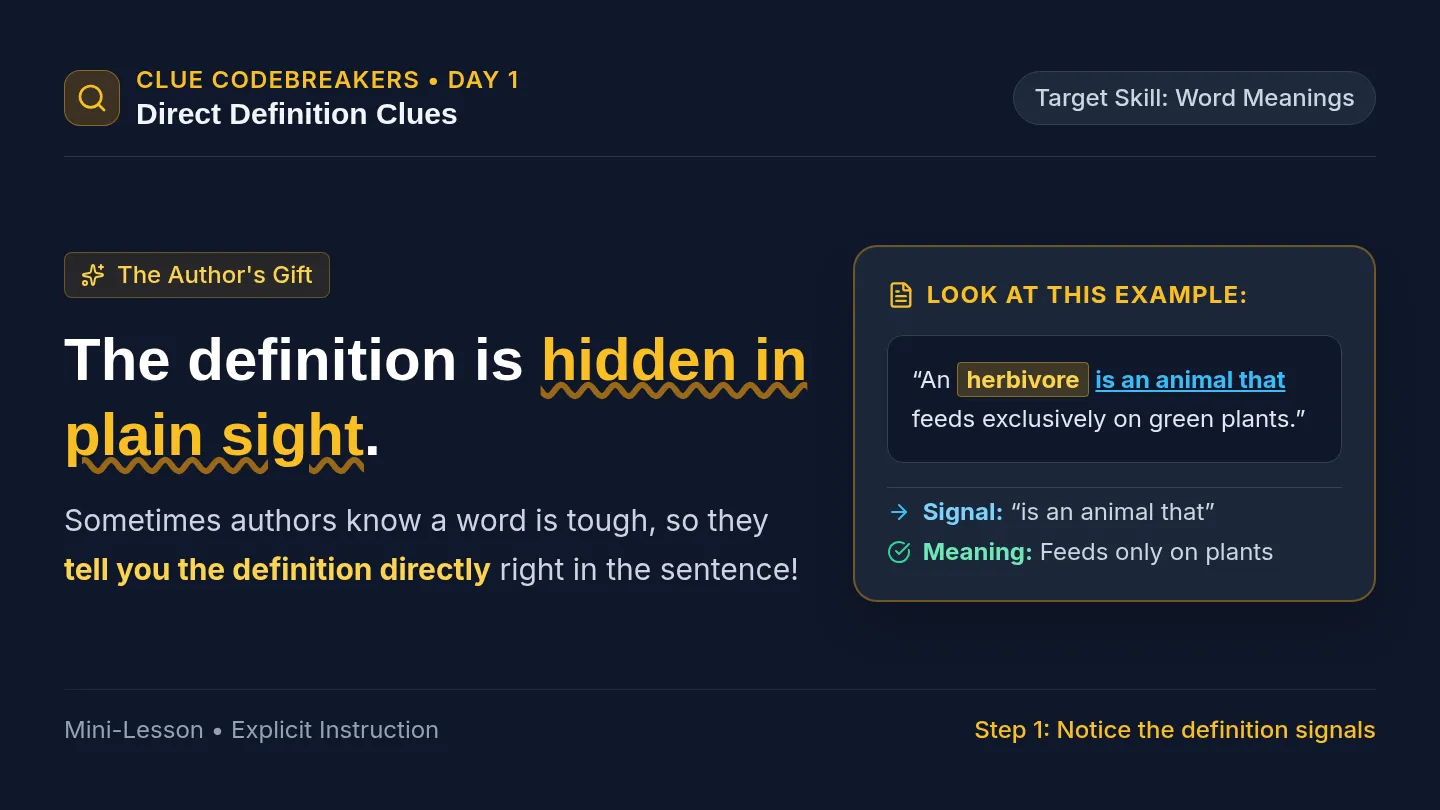
    Signal Seekers Slides

    Clue Codebreakers

    A 3-session targeted remediation sequence designed to help struggling readers master definition context clues, progressing from explicit signal words to punctuation appositives and independent reading transfer.

    E

    ewestbrook

    6
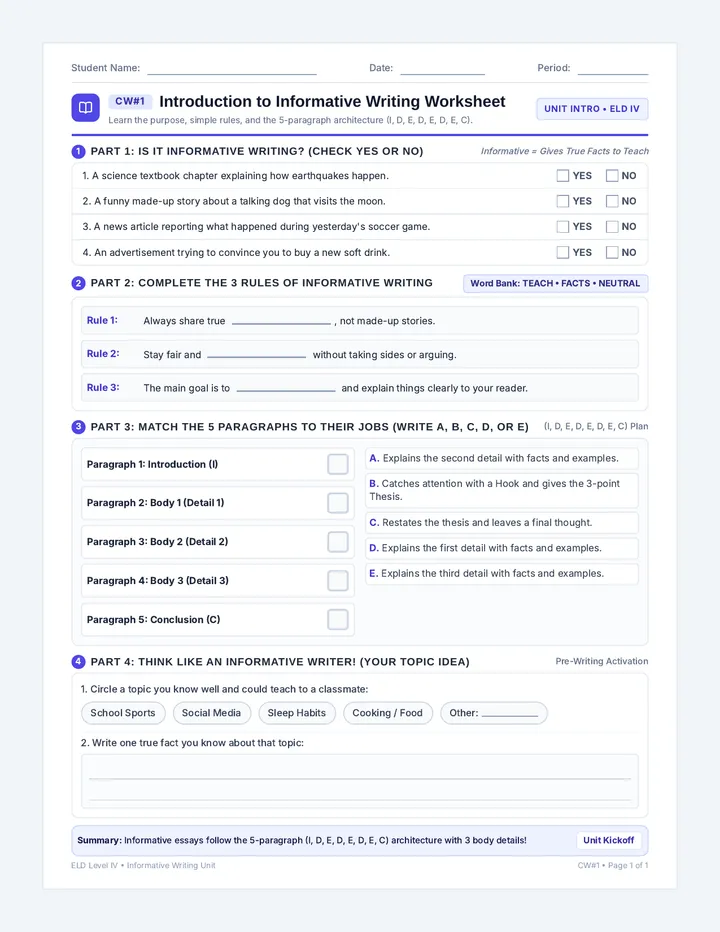
    Intro Architect Worksheet

    Informative Thesis Mastery

    A high school ELD IV instructional unit focused on constructing clear, scaffolded 3-detail thesis statements for informative essays.

    SF

    Shirley Fung

    3
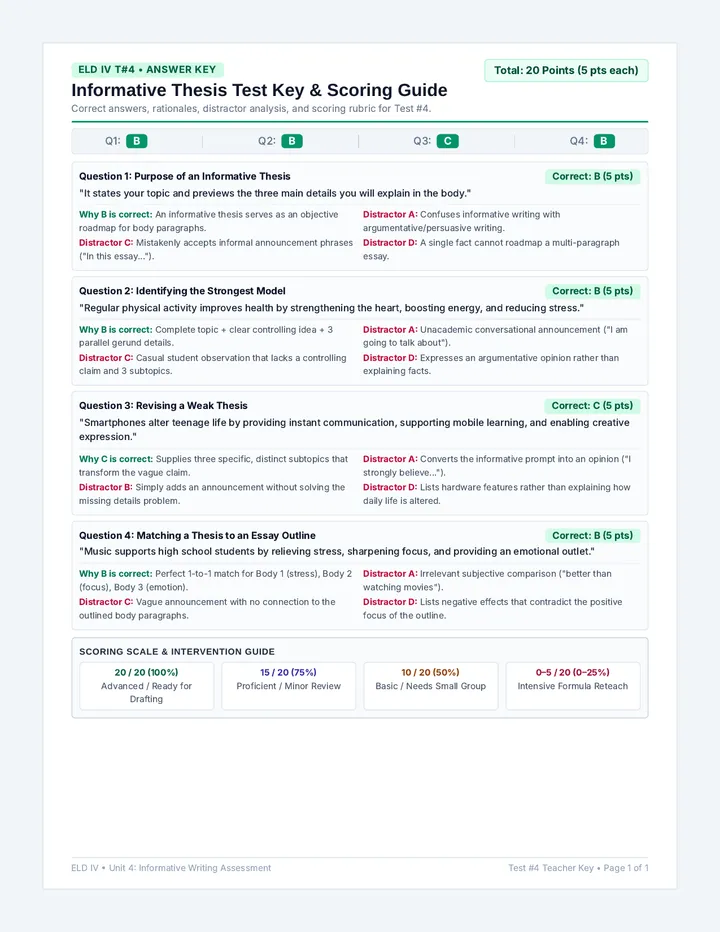
    Informative Thesis Answer Key

    Informative Thesis Answer Key

    A dedicated single-page teacher answer key and distractor analysis specifically for ELD IV T#4 (Informative Thesis Statements Test).

    SF

    Shirley Fung

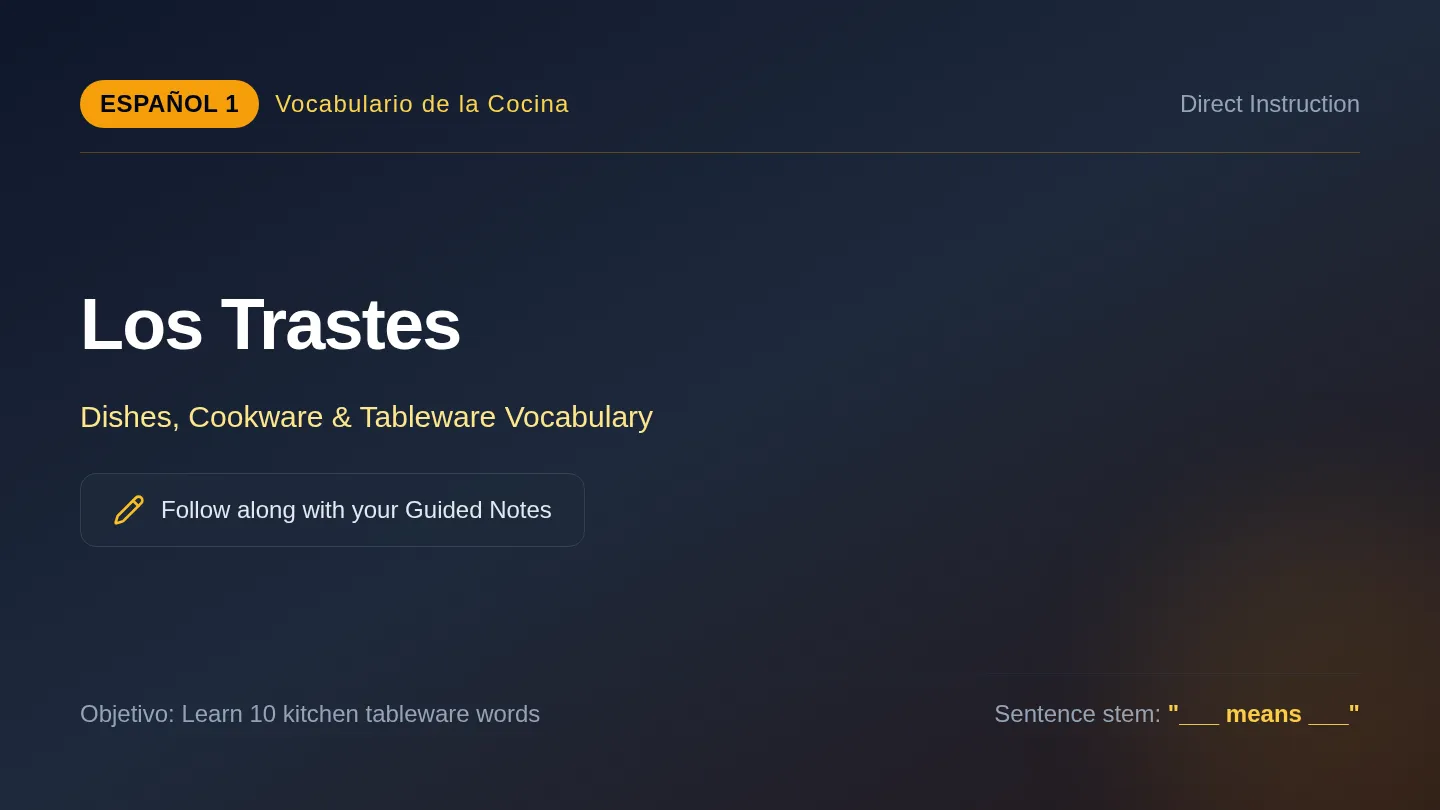
    Dishes Showcase Slides

    Spanish Vocabulary Adventures

    Foundational thematic Spanish units covering everyday vocabulary through direct instruction slides, structured guided notes, and illustrated assessments.

    GJ

    Gerardo Jimenez Ramirez

    8
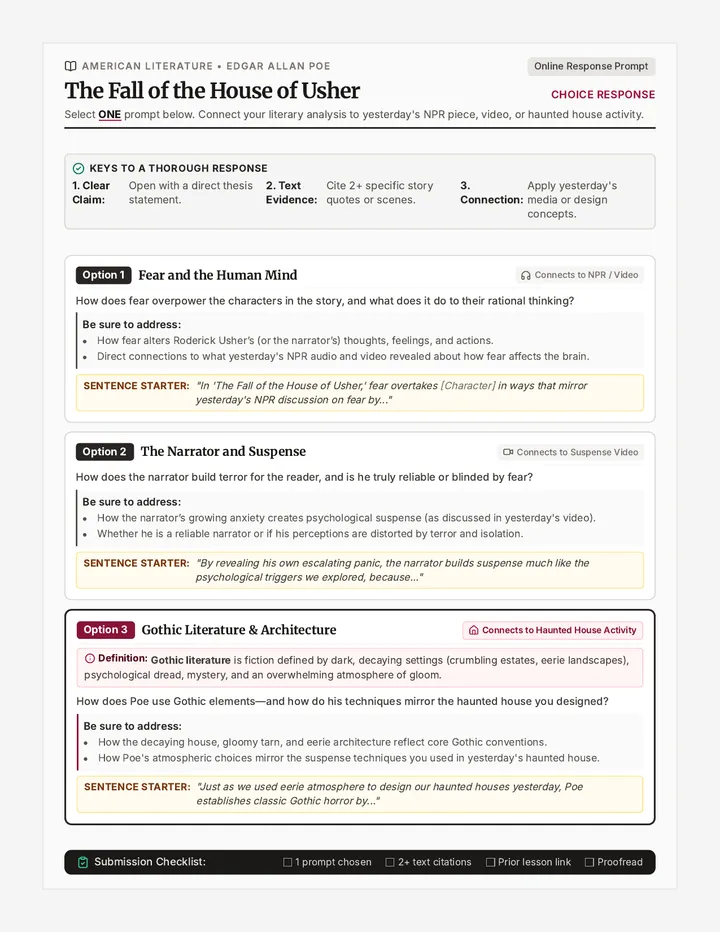
    Usher Response Prompts Handout

    House of Usher Analysis

    A high school English Language Arts lesson examining fear, unreliable narration, and Gothic conventions in Edgar Allan Poe's classic short story 'The Fall of the House of Usher'. Students synthesize psychological concepts, media analysis, and creative architecture into a text-based analytical response.

    AC

    Alison Crabtree

    2
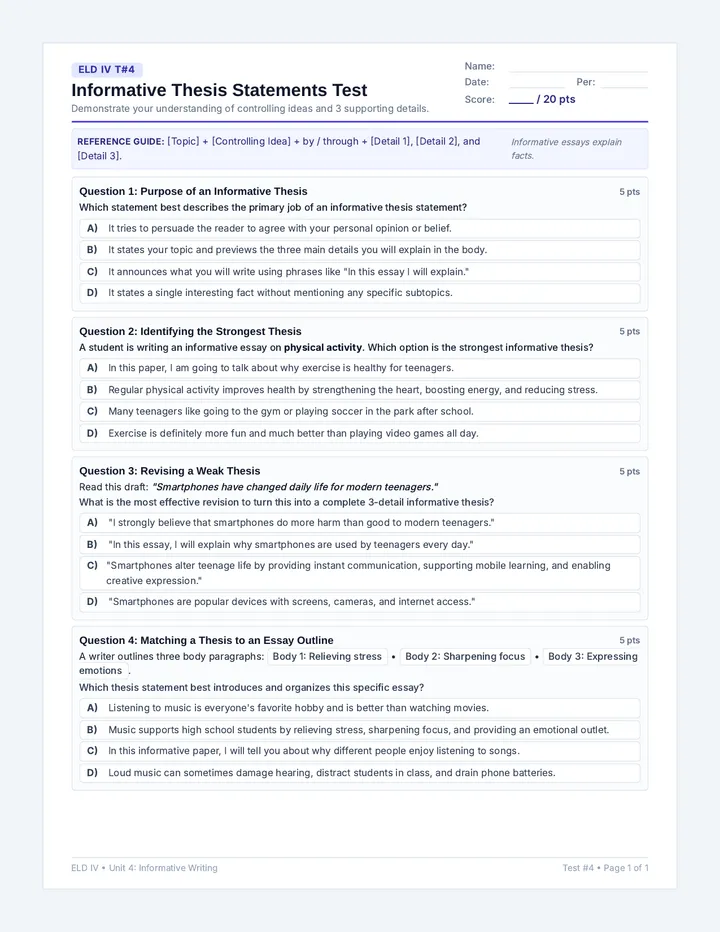
    Informative Thesis Test

    Informative Thesis Test

    A single-page, 4-question all-multiple-choice assessment labeled ELD IV T#4 evaluating high school ELD IV students on the purpose, structure, diagnosis, and outline alignment of 3-detail informative thesis statements.

    SF

    Shirley Fung

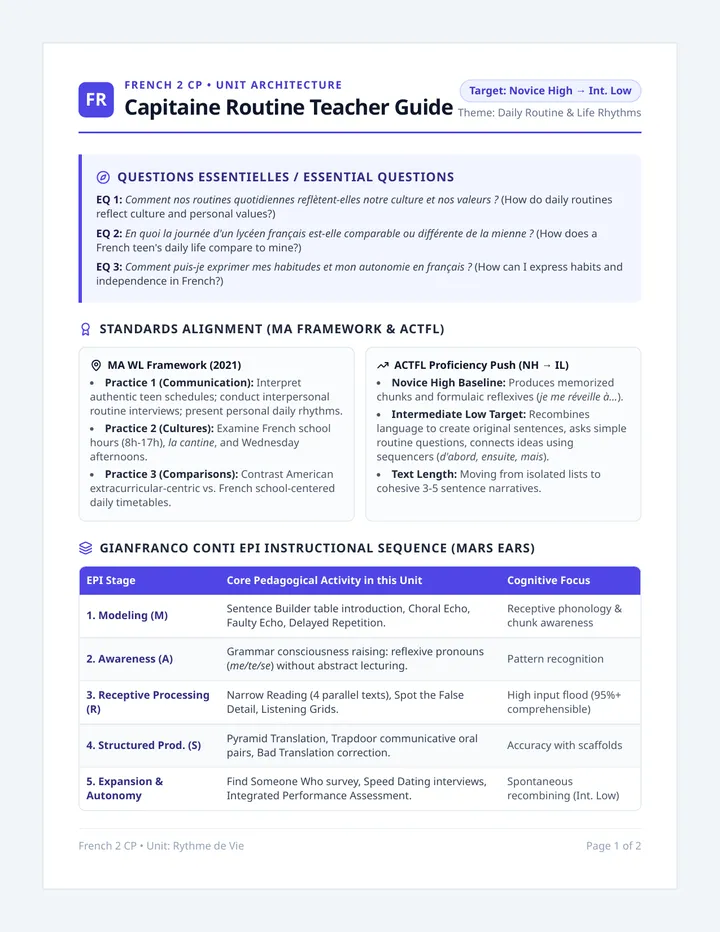
    Capitaine Routine Teacher Guide

    Rythme de Vie

    A comprehensive modular French 2 CP unit on daily routines designed for Novice High learners transitioning to Intermediate Low. Aligned with Massachusetts World Language Frameworks and ACTFL proficiency standards, powered by Gianfranco Conti's Extensive Processing Instruction (EPI) methodology.

    BM

    Bailey Mahoney

    8
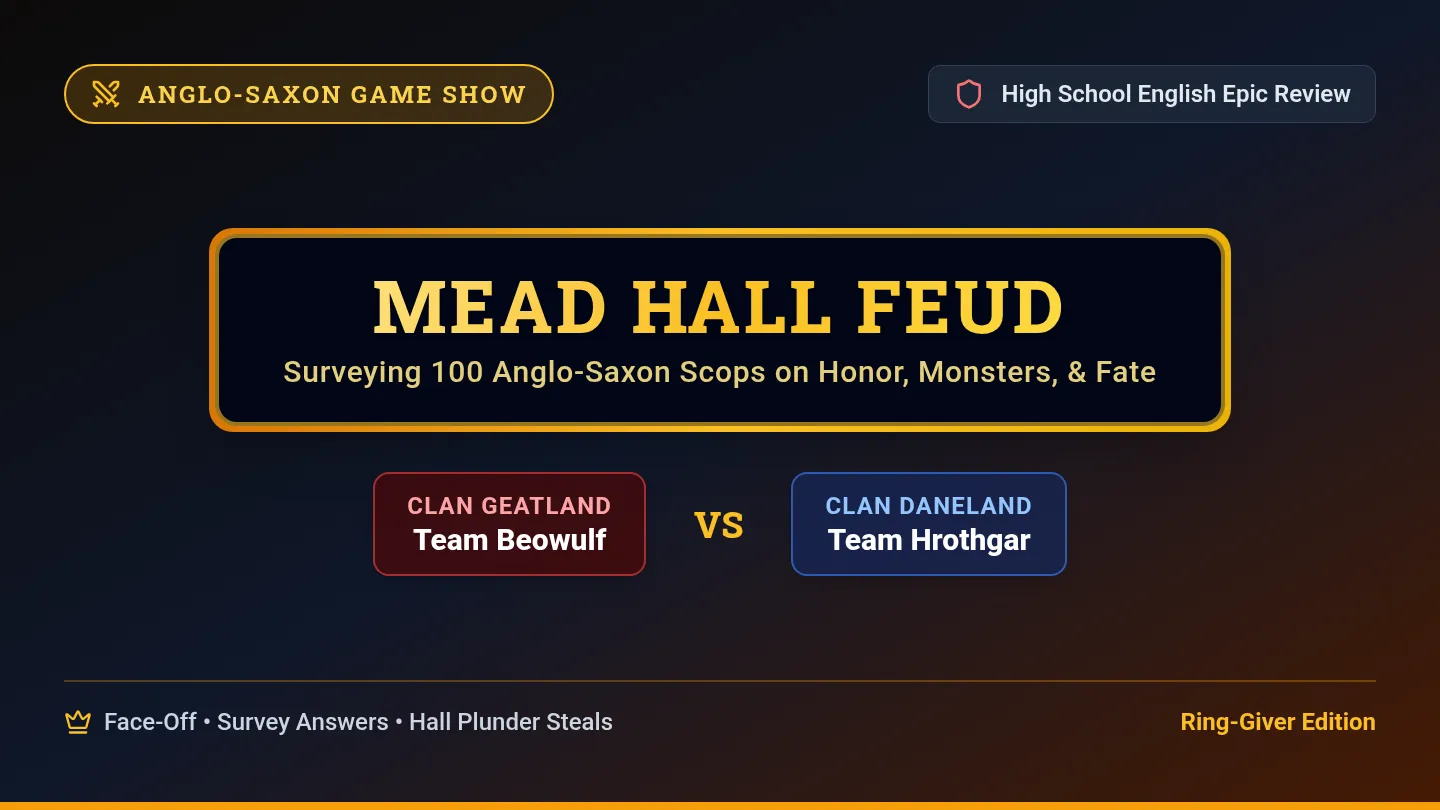
    Mead Hall Feud Slides

    Mead Hall Feud

    An energetic, high-school-aligned Beowulf review game styled after Family Feud, testing students on Anglo-Saxon cultural values, character motives, epic conventions, and major themes. Teams face off to uncover top survey answers while analyzing literary context and textual evidence.

    Lenny Avatar
    Lenny
    2
    Intro Architect Worksheet

    Intro Architect Worksheet

    A two-page ELD Level IV graphic organizer worksheet labeled CW#9 teaching 5-paragraph informative essay introductory architecture, sentence variety, and 3-point thesis roadmapping.

    SF

    Shirley Fung

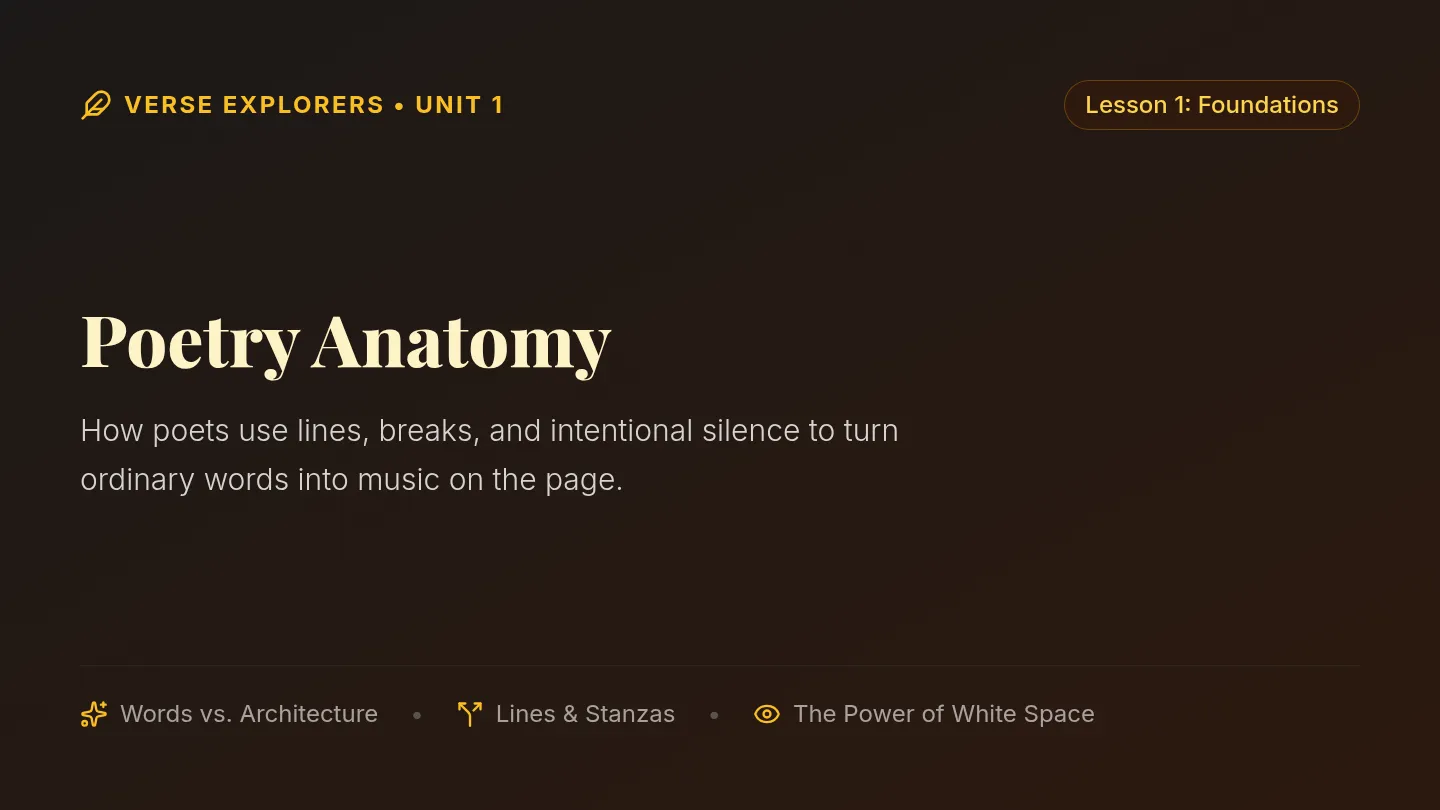
    Poetry Anatomy Slides

    Verse Explorers

    A three-part introductory poetry sequence that guides students through the structural, rhythmic, and musical building blocks of verse. Students contrast poetry with prose, master line breaks and stanzas, tap out meter and poetic beats, and craft original structured stanzas.

    NJ

    Natalie Johnson

    6
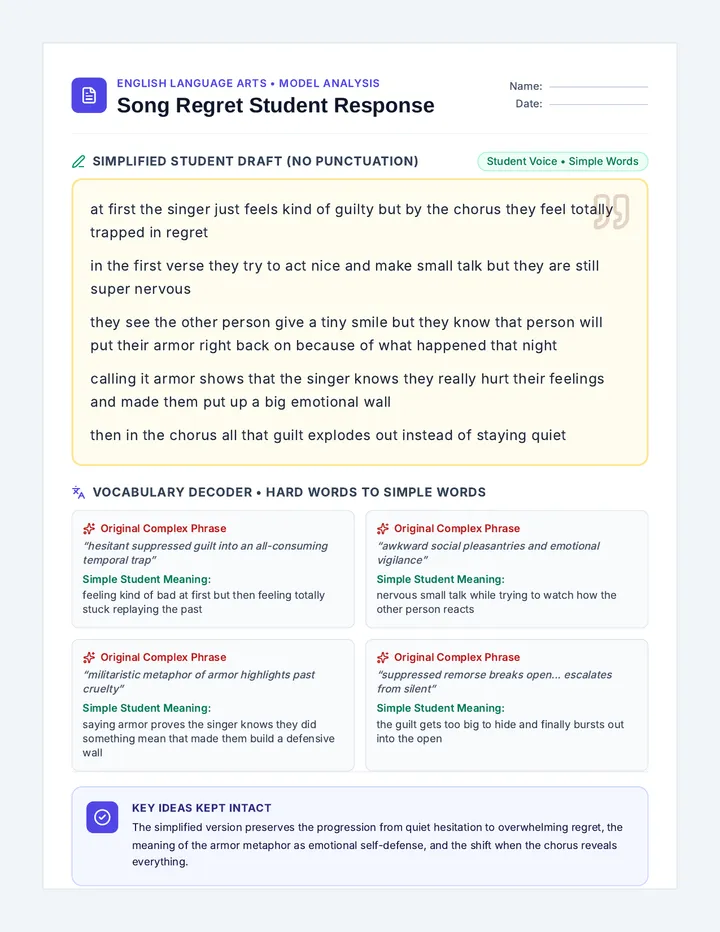
    Song Regret Student Response

    Lyric Regret Study

    A close-reading lesson examining emotional evolution and figurative language in song lyrics through accessible student-written models.

    Lenny Avatar
    Lenny
    2
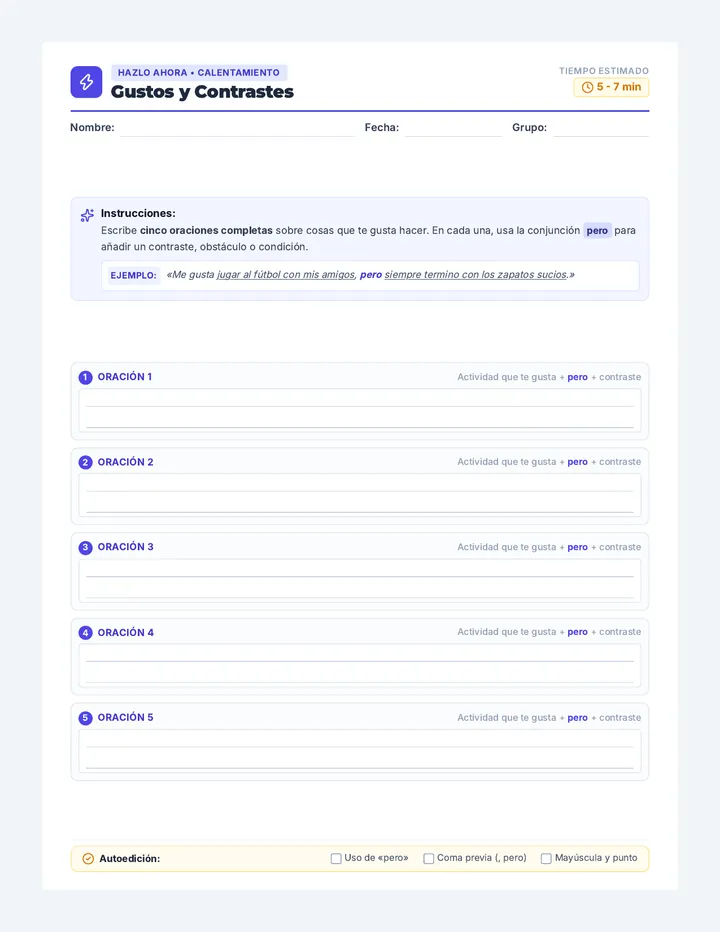
    Gustos Contrastes Hazlo Ahora

    Gustos Contrastes Hazlo Ahora

    Una hoja de trabajo imprimible para la actividad de inicio 'Hazlo Ahora' donde los estudiantes redactan cinco oraciones completas expresando actividades que disfrutan y contrastándolas mediante la conjunción adversativa 'pero'. Incluye un ejemplo modelo guiado, espacio pautado para la escritura de cada oración y una lista de verificación de autoedición.

    BR

    Berkys Ramirez Diaz