Reading Navigator Cheat Sheet Reading Navigator
NC ELA Strategy Cheat Sheet (Grades 3-5)
Standards
RI & RL (No RI.7)
Step 1: Get Ready
1
Look Ahead
Read the title and look at the pictures. Guess the topic!
2
Read Questions First
Check the questions before you read. Circle key names.
3
Think While You Read
Stop every few paragraphs. Ask: "What just happened?"
PROVE IT!
Always find the sentence in the text that proves your answer is right.
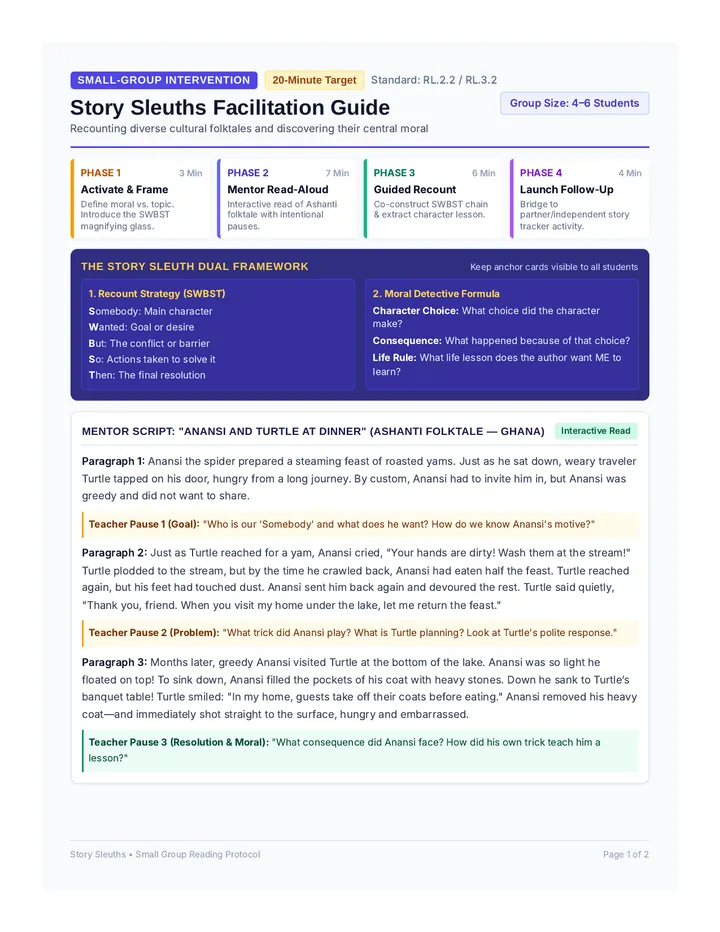
Fiction: Story Solvers
People & Problems
What is the problem? How does the character act? Actions show personality traits.
The Lesson Learned
What did the character learn at the end? This lesson is the Theme.
Who is Talking?
Is it the character saying "I"? Or is a narrator saying "She"?
Non-Fiction: Fact Finders
The Main Idea
What is the one big thing the author wants to teach you? Check the first sentence!
How it's Ordered
Does it tell steps in order? Does it compare two things? Does it show a cause and an effect?
Author's Goal
Is the author trying to give you facts or trying to change your mind?
Word Power
Solve Tricky Words:
Look at the sentences around the word.
Swap the word with a different one.
Break the word into parts (Re- or -less).
Test-Day Check
Cross out answers that are "no way" wrong.
Read the whole question twice.
Don't leave any blanks!
"Read carefully. Be a detective!"
Simplified NC EOG Strategy Guide Grades 3-5 Standards Reference: RL/RI .1-.6 & .8-.9
Navigator Bookmark Guides STORY SOLVER
Fiction Strategy
Who is in it?
Think about the characters. How do they feel? Why do they act that way?
What's the Fix?
What is the problem? How do the characters solve it in the end?
The Lesson
What did the story try to teach you? (This is the Theme).
Who's Talking?
Is a character telling the story? Look for words like I or me.
"Be a character expert!"
FACT FINDER
Non-Fiction Strategy
The Big Idea
What is the one thing this whole text is about? Check the first sentence!
Word Clues
Look for words like "because" (why) or "first, next, last" (order).
Why Write It?
Does the author want to teach you facts or try to change your mind?
Find Proof
If the question asks a fact, find the exact sentence in the text.
"Facts are everywhere!"
Word Clues
Vocabulary Strategy
Sentence Clues
Read the sentences before and after the hard word. Use clues!
The Swap Fix
Put another word in its place. Does the sentence still make sense?
Break It Up
Look for small words inside big words. Like Pre-view or Help-ful.
Pick the Best
The question might ask for the best meaning. Read all choices!
"Solve the mystery!"
Strategic Blueprint Cheat Sheet Strategic Blueprint
NC ELA EOG Strategy Guide (Grades 6-8)
Status: Operational
Standards RL/RI .1 through .9
01: Pre-Assessment Protocol
SCAN
Environmental Sweep
Evaluate text features, formatting, and source citations to determine genre and potential bias.
SYNC
Standard Alignment
Preview stems to identify standard requirements (e.g., Tone, Inference, Structure).
MAP
Annotation Strategy
Mark shifts in tone, transition words, and claim/evidence pairs during reading.
Verification Required
Every answer choice must have explicit textual support. If you cannot cite a specific line, the choice is an invalid inference.
02: Literary Analysis (RL)
Perspective & POV (RL.6)
Analyze how the author's perspective creates effects like suspense or irony. Compare differing points of view.
Nuanced Themes (RL.2)
Trace how theme develops through recurring motifs and character evolution (RL.3) over the whole text.
Transformation (RL.9)
Analyze how a modern work of fiction draws on themes, patterns of events, or character types from myths or traditional stories.
03: Rhetorical Evaluation (RI)
Evaluating Argument (RI.8)
Differentiate between Claims, Reasons, and Evidence. Evaluate if support is sufficient and relevant.
Cross-Text Synthesis (RI.9)
Analyze cases where two texts provide conflicting information. Identify where they disagree on matters of fact vs. interpretation.
Author's Craft (RI.6)
Determine how authors writing about the same topic shape their presentations by emphasizing different evidence.
04: Diction & Precision (L)
Standard: RL.4 / RI.4 / L.4-5
Connotation: The emotional weight of word choices.
Denotation: The literal, dictionary definition.
Precision: Distinguishing similar words (e.g. L.5c).
Post-Execution Review
Eliminate distractors that are factually true but irrelevant to the specific question.
Re-read cited paragraphs; context is vital for higher-level standards.
Precision Analysis
Standardized Assessment Blueprint Middle School ELA (6-8) NC EOG Reference Guide
Strategist Bookmark Guides Literary Analyst
Standard: RL 6-8
PERSPECTIVE
Analyze how the author's point of view impacts meaning. Look for suspense or irony.
STRUCTURE
How do chapters or stanzas contribute to the whole? Look for pacing and sub-plots.
RL.9 ANALYSIS
How does a story "re-imagine" an older text? Look for allusions and shared character types.
TEXTUAL EVIDENCE
Analyze stage directions and line breaks for deeper evidence in drama and verse.
Synthesize Analysis
Rhetoric Expert
Standard: RI 6-8
ARGUMENT TRACE
Identify the Claim. Evaluate if the Evidence is sufficient and relevant.
RI.9 SYNTHESIS
When two texts give conflicting info, do they disagree on facts or interpretations?
AUTHOR'S CRAFT
How does the author handle opposing views? (RI.6 Perspectives).
TECHNICAL TEXT
Determine the meaning of symbols and domain-specific academic vocabulary.
Evaluate Validity
Diction Mastery
Standard: L 6-8
CONNOTATION
Identify the "emotional weight" of a word. Is it positive, negative, or neutral?
ANALOGY
Analyze relationships between words (e.g., Part-to-Whole or Cause/Effect).
WORD CHOICE
Distinguish between words with similar meanings (e.g., surprised vs. astounded).
MORPHOLOGY
Use Greek and Latin affixes and roots as clues to meaning.
Command Language