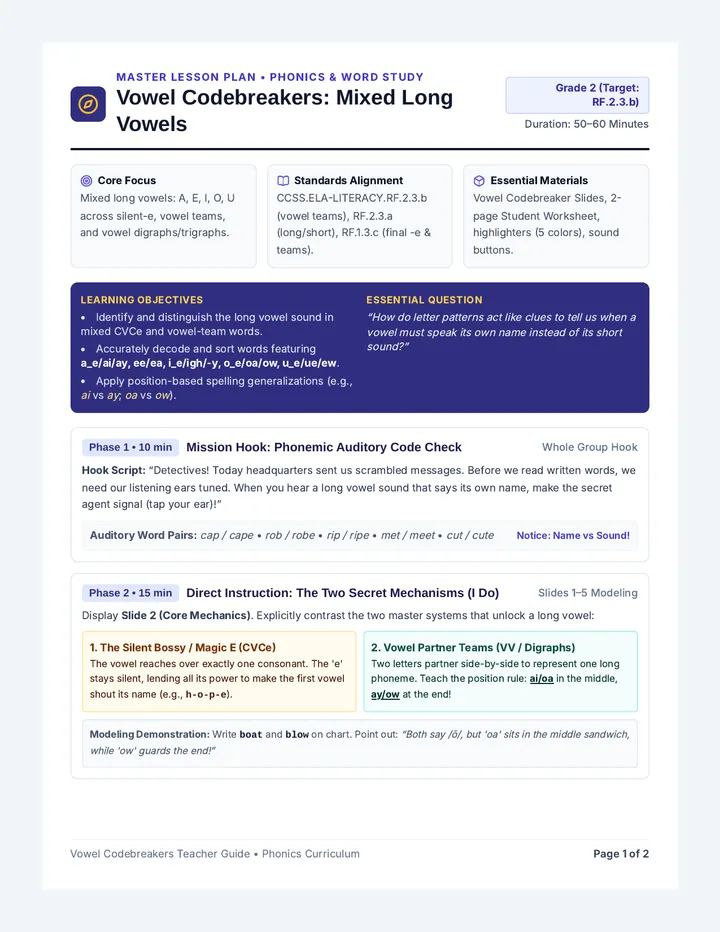
| Animal | 1. SAY (Text Quote) | 2. MEAN (Inference) | 3. MATTER (Significance) |
|---|---|---|---|
| Baboons | "got used to me much more quickly... grabbing any food... left lying." | Opportunistic feeders motivated by food scraps. | Shows quick habituation without evaluating safety. |
| Chimps | "almost a year before I could approach to within one hundred yards." | Inference about their caution: | Why this proved high intelligence: |
FIELD LANGUAGE: Setting Off Nonrestrictive Details (6.L.2.a)
Goodall adds rich background using parentheticals. Rewrite this field note inserting paired commas or paired dashes around the bold nonrestrictive clause:
"Jane Goodall [ who was only twenty-six years old with no university degree ] set off alone into the Kakombe valley."
• EXIT TICKET: AASA Evidence-Based Selected Response (6.RI.1) 5 Minutes
Part A: Based on Chunk 1, what inference can best be drawn about why Goodall's methods succeeded?
(A) She forced the animals to interact by trapping them with scouts.
(B) She recognized that wild chimps required solitary, nonthreatening patience over months.
Part B: Which quotation from the text best supports your answer to Part A?
[1] "I ate a couple of slices of bread and had a cup of coffee from the Thermos flask." (Para 12)
[2] "At first I watched from afar, through my binoculars, and never tried to get close." (Para 13)
Grade 6 ELA • Unit 2: Animal Allies Page 2 of 2
Grade 6 ELA • Standards Writing Portfolio Page 2 of 3
Gombe Stream Expedition Academy • 3-Day Standards Writing Portfolio Target: All Components of 6.RI.1 • 6.RI.3
Day 3: Social Hierarchies, Tactical Minds & Relationships Among Ideas (Chunk 3)
Name:
Date:
Task 7: Developing Character & Social Order (Component: 6.RI.3 Anecdotes) Para 58
Prompt: In paragraph 58, how does Goodall illustrate Mike's rise to dominance over Goliath? Analyze how this anecdote develops the idea that chimpanzee leadership relies on psychological strategy and intellect rather than sheer physical violence.
Task 8: Analyzing Relationships Among Individuals, Events & Ideas (6.RI.3 Advanced) Paras 36, 39, 61
Prompt (Synthesis): Analyze the relationship among these three elements across the memoir:
(1) David Greybeard's courage to approach camp → (2) The termite toolmaking observation → (3) The growth of Gombe into a world-famous research center.
Explain how one chimpanzee's individual trust sparked a chain of events that transformed a fragile two-tent camp into an enduring scientific institution. Cite specific evidence from the text.
Grade 6 ELA • Standards Writing Portfolio Page 3 of 3
Verdict: TRAP! 100% true in paragraph 12, but eating bread does NOT prove scientific patience!
✗
Quote B: "At first I watched from afar, through my binoculars, and never tried to get close."
Verdict: WINNER! Directly proves she resisted the urge to rush in and waited patiently from a distance.
✓
PART 3: PROMPT TRANSLATOR & SHORT RESPONSE
Actual Test Prompt: "Analyze what the text says explicitly and what can be inferred about the physical challenges Goodall confronted upon arriving at Gombe."
Translating this into student language:
The test is asking two simple things: (1) What exact facts made the mountains hard to climb? and (2) What can you tell about how exhausted or determined Jane felt?
Your Written Response (Include ONE explicit quote and ONE logical inference):
Grade 6 ELA • 6.RI.1 Evidence Detective Page 2 of 2
Teacher Modeling Script ("I Do" → "We Do")
Teacher: "Notice paragraph 38 carefully. When David picks a blade of grass and pokes it into the mound, he is using an object. But look at what happens when it bends: 'he dropped it, picked up a little twig, stripped the leaves off it, and used that.'"
"Why is stripping leaves off the twig so vital? Stripping leaves modifies the object—it transforms raw vegetation into an intentional tool. On the AASA test, questions under 6.RI.3 will ask: How does the author illustrate the revolutionary nature of this event? It is illustrated through this precise physical modification."
Conventions Mini-Lesson: Parentheses for Definitions (6.L.2.a)
Parentheses Rule: Show students paragraph 18: "nocturnal (nighttime) creatures" and "civets (creatures looking rather like raccoons)."
Explain: "When an author includes a technical or unfamiliar scientific word, parentheses allow them to provide a quick, unobtrusive definition right inside the sentence. The sentence flows naturally even if the parenthetical words are omitted."
Differentiation & Scaffolding Strategies
Support for Struggling Readers: Provide a physical graphic illustration of paragraph 38: (1) Grass bent → (2) Leafy twig selected → (3) Leaves stripped → (4) Termites harvested.
Extension for Advanced Learners: Have students analyze why Louis Leakey famously responded to this finding by stating: "Now we must redefine tool, redefine Man, or accept chimpanzees as humans."
Gombe 3-Day Unit • Teacher Instructional Guide Page 2 of 2
| 2. MEAN (Inference) |
|---|
| 3. MATTER (Impact) |
|---|
| Grass | "picked a blade of grass, poked it into a tunnel... withdrew it." | Tool USING: Uses raw, unaltered natural object. | Impressive, but grass bends easily and breaks. |
| Twig | "picked up a little twig, stripped the leaves off it, and used that." | Inference: Deliberately modified... | Redefined the boundary of Man... |
FIELD LANGUAGE: Parentheses for Definitions (6.L.2.a)
In paragraph 18, Goodall defines terms using parentheses: "nocturnal (nighttime) creatures." Add parentheses around the definitions below:
1. Goodall examined msulula [ a tree bearing tiny round red fruits ] where chimps fed daily.
2. Goodall conducted daily vigils [ periods of quiet, watchful observation ] from the Peak.
• EXIT TICKET: AASA Evidence-Based Selected Response (6.RI.3) 5 Minutes
Part A: In paragraph 39, how does Goodall develop the significance of David Greybeard's toolmaking?
(A) By showing he copied this trick from African scouts.
(B) By showing that modifying a twig disproved the belief that only humans make tools.
Part B: Which quotation from paragraph 39 best supports the answer to Part A?
[1] "I was really thrilled." (Para 39)
[2] "He had actually made a tool. Before this observation, scientists had thought that only humans could make tools." (Para 39)
Grade 6 ELA • Unit 2: Animal Allies Page 2 of 2
See how Jane Goodall uses all three moves to build David Greybeard into a historical figure:
Step 1 (INTRODUCES): How does Jane first present David in Para 34? Fill in below
Step 2 (ILLUSTRATES): What specific anecdote shows his calm courage in Para 36? Fill in below
Step 3 (DEVELOPS): How does his relationship with Jane change the OTHER chimps in Para 37? Fill in below
CASE STUDY 2: Mike and the Kerosene Cans (Paragraph 58)
Prompt: "How does Goodall develop the idea that Mike gained leadership through intellect rather than physical combat?"
Translating this prompt into student language:
The test is asking: "What mini-story (illustration) does Jane tell that shows (develops) Mike using his brain instead of punching and biting?"
Your Written Answer (Use the words 'illustrates' and 'develops' in your response):
Grade 6 ELA • 6.RI.3 Author's Craft Practice Page 2 of 2
"When writing your extended response on the benchmark, remember our 6.L.2.a rule: include at least two parenthetical elements set off with paired commas, parentheses, or dashes!"
Conventions Check: Paired Dashes & Commas (6.L.2.a)
Reminder on Paired Punctuation: "If your nonrestrictive information sits inside the middle of a sentence, it requires two marks: two commas, two parentheses, or two dashes. Never mix marks, like opening with a dash and closing with a comma!"
Assessment Accommodations & Supports
Accommodations for Struggling Writers: Provide an essay graphic organizer with pre-printed sentence frames for 6.L.2.a: "Jane Goodall, [insert description], observed that chimps..."
Advanced Writer Extension: Encourage students to incorporate both a parenthetical definition (parentheses) and an emphatic aside (paired dashes) in their response to reach Level 4 Highly Proficient.
Gombe 3-Day Unit • Teacher Instructional Guide Page 2 of 2
| Leader | 1. SAY (Text Quote) | 2. MEAN (Inference) | 3. MATTER (Impact) |
|---|
| Goliath | "The first top-ranking male... excitable, impetuous temperament." | Relied on natural size and physical energy to intimidate. | Traditional dominance based on physical strength. |
| Mike | "did this by using his brain... hit and kick [cans]... didn't need to fight." | Inference: Substituted psychological fear... | Ruled top male 6 years without fighting... |
FIELD LANGUAGE: Paired Dashes for Dramatic Asides (6.L.2.a)
Rewrite the sentence below inserting paired dashes around the bold nonrestrictive clause:
"Mike [ a small chimp who used his brain instead of fighting ] ruled as top male for six years."
• EXIT TICKET: AASA Evidence-Based Selected Response (6.RI.3) 5 Minutes
Part A: In paragraph 58, how does Goodall illustrate that chimp dominance relies on clever tactics rather than sheer muscle?
(A) By showing Mike physically overpowered all rival males.
(B) By showing a small chimp used noisy kerosene cans to terrorize rivals without fighting.
Part B: Which quotation from paragraph 58 best supports the answer to Part A?
[1] "The first top-ranking male I knew was Goliath." (Para 58)
[2] "So Mike didn't need to fight to get to the top—which was just as well, as he was a very small chimp." (Para 58)
Grade 6 ELA • Unit 2: Animal Allies Page 2 of 2
AASA Grade 6 ELA Benchmark • Day 3 of 3 Page 1 of 3
Section 2: Character Analysis & Language Conventions Standards: 6.RI.3 • 6.L.2.a
Question 3 (Part A & Part B) Standard: 6.RI.3
Part A: In paragraphs 38–39, how does Goodall develop the significance of David Greybeard's actions at the termite mound?
(A) By illustrating that David Greybeard had been trained to use tools by visiting African game scouts.
(B) By demonstrating that modifying a twig into a fishing tool shattered the long-standing scientific assumption that only humans make tools.
(C) By proving that chimpanzees survive entirely on insects rather than plant seeds and fruit.
(D) By showing that David Greybeard shared his tool openly with all other chimps in the troop.
Part B: Which quotation from paragraph 39 best supports the answer to Part A?
(A) "When his piece of grass got bent, he dropped it, picked up a little twig..." (Paragraph 38)
(B) "He had actually made a tool. Before this observation, scientists had thought that only humans could make tools." (Paragraph 39)
(C) "Later I would learn that chimpanzees use more objects as tools than any creature except for us." (Paragraph 39)
(D) "This finding excited Louis Leakey more than any other." (Paragraph 39)
Question 4 (Language Conventions) Standard: 6.L.2.a
Read the sentence: "David Greybeard a calm male chimp with a white beard was the first to take bananas from Goodall's camp." Which correction properly uses punctuation to set off the nonrestrictive element?
(A) David Greybeard, a calm male chimp with a white beard, was the first
(B) David Greybeard (a calm male chimp with a white beard was the first
(C) David Greybeard a calm male chimp with a white beard—was the first
(D) David Greybeard, a calm male chimp with a white beard was the first
Question 5 (Language Conventions) Standard: 6.L.2.a
Which sentence demonstrates the correct use of dashes to set off a parenthetical element for dramatic emphasis?
(A) Male chimpanzees though only four feet tall—are three times stronger than a human man.
(B) Male chimpanzees—though only four feet tall, are three times stronger than a human man.
(C) Male chimpanzees—though only four feet tall—are at least three times stronger than a grown man.
(D) Male chimpanzees—though only four feet tall are at least three times stronger than a grown man.
AASA Grade 6 ELA Benchmark • Day 3 of 3 Page 2 of 3
Session 3: Extended Constructed Response AASA Writing Blueprint
Item 6: Comprehensive Constructed Response (Standards: 6.RI.1, 6.RI.3, 6.L.2.a)
In My Life with the Chimpanzees, Jane Goodall documents a dramatic evolution in her relationship with the animals—progressing from early frustration and fear to unprecedented scientific breakthrough and institutional legacy.
Writing Prompt:
Write a multi-paragraph response analyzing how Goodall develops this transformation over time. In your essay:
Student Response:
AASA Grade 6 ELA Benchmark • Day 3 of 3 Page 3 of 3
Grade 6 ELA • Unit 2 Assessment Key Page 1 of 2
Constructed Response Rubric & Exemplars • Day 3 AASA Grade 6 Writing Standards
AASA 4-Point Analytical Writing Rubric
| Score | Reading Comprehension (6.RI.3) | Evidence Citation (6.RI.1) | Conventions & Punctuation (6.L.2.a) |
|---|---|---|---|
| 4 | Insightful analysis of how Goodall's relationship and discoveries develop over time. | Integrates ≥2 strong, well-chosen textual citations with thorough elaboration. | ≥2 nonrestrictive elements punctuated perfectly with commas, dashes, or parentheses. |
| 3 | Clear explanation of relationship evolution and chimp anecdotes. | Includes 2 relevant text details or quotes with appropriate explanation. | Uses parenthetical punctuation correctly with minor or no errors. |
| 2 | Partial or superficial description of events without analyzing development. | Includes 1 text detail or general references without specific citations. | Inconsistent or incorrect use of commas/dashes/parentheses. |
Annotated Student Response (Score 4 • Highly Proficient)
In My Life with the Chimpanzees, Jane Goodall documents a monumental transformation from solitary struggle to revolutionary scientific breakthrough. At first, the chimps viewed Goodall as a terrifying outsider; in paragraph 8, Goodall records that "as soon as they saw us they leapt down and vanished." It required nearly a full year of patient climbing before she could approach within one hundred yards.
The crucial turning point arrived through David Greybeard, a calm and handsome male with a dense white beard, who became the first chimp to visit her camp and accept bananas directly from her hand. This personal breakthrough culminated in the termite mound observation—an event that shattered established biological theories—where David stripped leaves from a twig to fish for insects. By establishing trust with individual chimpanzees like David and Flo, Goodall demonstrated that chimps make tools and express affection like humans, ultimately transforming her humble camp into a world-famous university research center.
✓ 6.RI.1: Quotes exact evidence (Para 8). ✓ 6.RI.3: Analyzes David's role in changing biology. ✓ 6.L.2.a: Correctly uses comma appositive and paired dashes!
Grade 6 ELA • Unit 2 Assessment Key Page 2 of 2
2. The Watershed Event
Jane witnesses David modifying a twig for termites (Para 38).
3. The Enduring Legacy
Gombe expands into an international research center (Para 61).
The Connection: Without David's individual courage, Jane would never have been close enough to see toolmaking; without toolmaking, the world would never have funded the permanent research station!
CASE STUDY 2: PROMPT TRANSLATOR & WRITTEN RESPONSE
Actual Test Prompt: "Analyze in detail the relationship between Mike's kerosene can tactic and the broader social hierarchy of chimpanzee communities."
Translating this into student language:
The test is asking: "How does Mike's funny noisy-can trick prove that chimp leadership isn't just about who has the biggest muscles?"
Your Written Response (Explain how Mike's mind changed the hierarchy):
Grade 6 ELA • 6.RI.3 Idea Connections Practice Page 2 of 2