An intensive 8th grade ELA review sequence mastering textual evidence and analytical inferences across diverse fiction and nonfiction case files. Students progress from decoding subtle textual clues to evaluating evidence strength and constructing airtight cited arguments.
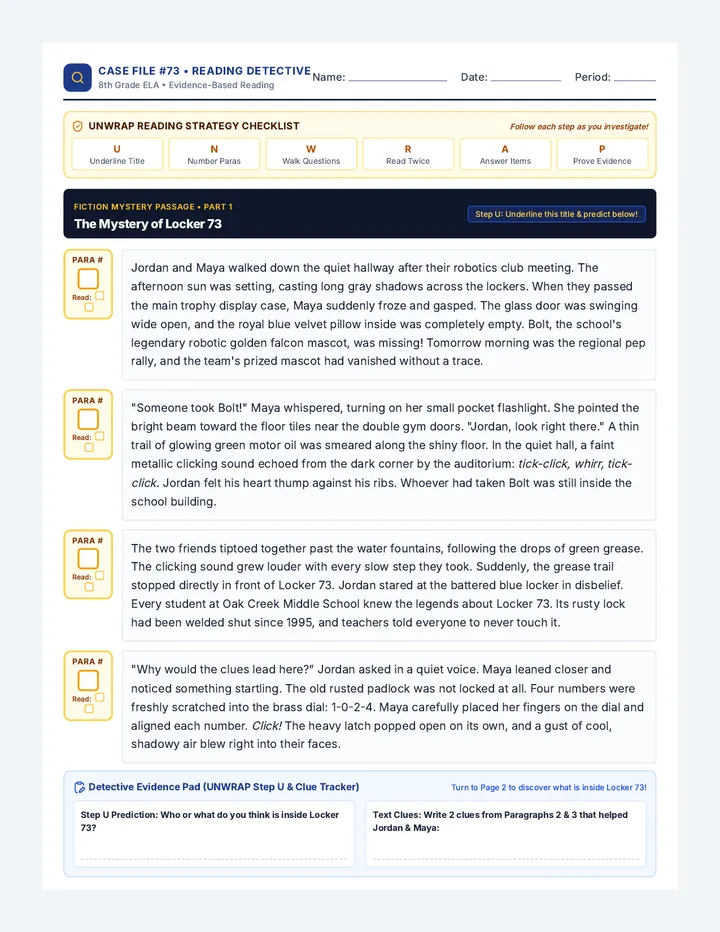
[12]Without looking back at the village gates, he turned his boots toward the southern trail leading far away.
3. What can readers infer about Leo's ultimate decision from his actions in lines 11–12?
A. He plans to carry out the governor's orders after taking a rest on the ridge.
B. He has decided to abandon his mission and leave his post rather than harm the village families.
C. He lost the letter by accident under a rock and is searching for it.
D. He is traveling south to find more guards to help him shut off the water canal.
Constructed Response: Forensic Case Analysis
RACES PROTOCOL • RL.8.1
Question: Based on lines 07–12, what can you infer about why Leo decides not to carry out his orders?
Use the RACES strategy: R & A: Restate the question and state your inference. • C: Cite at least one direct quote from Case File B. • E: Explain how your quote proves your inference. • S: Sum up your main point.
R/A: Inference / Claim
C: Cited Direct Quote
E: Clear Explanation
S: Summary Sentence
EVIDENCE DOSSIER SERIES • RL.8.1 REVIEW PAGE 2 OF 2
[E: Explain Reasoning] Rather than harming the people, Leo hides the governor's letter under a heavy rock and hikes down the southern trail away from the town. This proves his conscience matters more to him than obeying an unjust order.
[S: Sum It Up] In summary, Leo chooses to walk away from his duties rather than bring disaster to the villagers.
R/A (1 pt): Restates question and states clear inference why Leo disobeys.
C (1 pt): Cites at least one accurate direct quote with quotation marks.
E (1 pt): Explains how the evidence logically supports the inferred motive.
S (1 pt): Provides a concluding sentence summing up the main claim.
Teacher Coaching Tips for RACES in Lesson 1:
Step-by-step Chunking: Have struggling students write the letters R, A, C, E, S in the margin to verify every element before submission.
Distinguish Summary from Evidence: Ensure students copy exact words inside quotation marks rather than writing a vague summary of what happened.
EVIDENCE DOSSIER SERIES • TEACHER ANSWER KEY PAGE 2 OF 2
WEAK (Subjective opinion)
Why is B strongest? It provides the exact biological mechanism (chemosynthesis) proving survival without sunlight. ANALYSIS
Investigation Mission: Fact Finders
MISSION PROTOCOL
01
Annotate the Article
Read "Echoes in the Deep." Star [★] facts that directly establish the scientific claim and bracket [ ] background info.
02
Filter Strong vs Weak
Examine the evidence bank. Reject quotes that describe feelings or generalities and select only data-driven citations.
03
Write the Case Report
Use the 3-layer quote sandwich to construct an airtight written response citing two distinct evidentiary facts.
Open Dossier File 02: Fact Finders Worksheet and begin Section 1.
COMMENCE
[09]British captain Robert Scott relied on new motor-sleds and small horses. However, the motor engines
[10]quickly broke down in the freezing cold, and the horses could not survive the deep snowdrifts.
[11]Scott’s men were forced to pull heavy supply sleds by hand, leaving them weak and exhausted.
[12]In contrast, Norwegian explorer Roald Amundsen used 52 trained sled dogs and lightweight wooden skis.
[13]His team traveled quickly, reached the South Pole 34 days ahead of Scott, and returned home safely.
Quote Framing Practice: Eliminate Dropped Quotes
Use the frame below to embed textual evidence showing why Scott's transport plan failed:
The author shows equipment failure when stating that , which forced Scott's crew to pull heavy sleds by hand.
Question: Based on lines 08–13, why did Roald Amundsen succeed in reaching the South Pole while Robert Scott failed?
Use the RACES strategy: R & A: State your claim explaining why Amundsen succeeded. • C: Cite at least one direct quote showing Amundsen's gear and one for Scott's team. • E: Explain how your evidence proves why Amundsen won. • S: Sum up your main point.
R/A: Accurate Claim
C: 2 Cited Quotes
E: Clear Explanation
S: Summary Sentence
EVIDENCE DOSSIER SERIES • RI.8.1 REVIEW PAGE 2 OF 2
[C & E: Evidence 2 & Explanation - Amundsen] In contrast, Amundsen prepared properly by using "52 trained sled dogs and lightweight wooden skis" (line 12). Because dogs and skis were built for polar conditions, Amundsen’s team traveled smoothly and arrived 34 days ahead of Scott, while Scott's men wore themselves out pulling heavy sleds by hand.
[S: Sum It Up] In conclusion, Amundsen's practical preparation and reliable equipment were the key reasons he won the race and survived.
R/A (1 pt): Clearly states why Amundsen won and Scott failed.
C (1 pt): Quotes text evidence for BOTH Amundsen and Scott.
E (1 pt): Explains how dogs/skis contrasted with broken motors.
S (1 pt): Concludes with a strong summary sentence.
Teacher Coaching Strategy:
Remind students that a strong informational response must contrast both sides. If they only mention Amundsen or only mention Scott, prompt them to add the missing comparison to earn full evidence points.
EVIDENCE DOSSIER SERIES • TEACHER ANSWER KEY PAGE 2 OF 2
"Thomas felt the plaster dust choking his breath, but his thumb remained glued to the brass key: DOT-DOT-DASH. He ignored the creaking ceiling, knowing ferry relief depended on his wire."
Key Subtext: Physical sensory fear suppressed by moral resolve.
Synthesis Prompt: How do both authors emphasize the heroism of early telecommunicators? CROSS-ANALYSIS
Final Review Challenge
MISSION READY
TASK 01
Close Analysis
Read paired Case Files C and D on Dossier 03.
Annotation phase
TASK 02
Evidence Curation
Select the strongest quote from each source.
Evidence matrix
TASK 03
Final Verdict
Draft your complete multi-evidence synthesis response.
Constructed report
Execute Dossier File 03: Verdict Defense Worksheet to complete the review sequence.
COMMENCE REVIEW
Your Revision Task: Rewrite the sentence below by embedding the quote with an appropriate author signal phrase and analytical reasoning:
Prompt: Synthesize evidence from both Source A and Source B to explain how dedication to public service is portrayed during the disaster. In a structured paragraph, state your analytical claim, integrate at least one direct quote from Source A AND one direct quote from Source B using proper lead-in phrases, and thoroughly explain how both texts corroborate each other.
Standard Mastery Scorecard
4: Precise Claim
4: Paired Citations
4: Deep Reasoning
4: Quote Framing
EVIDENCE DOSSIER SERIES • CAPSTONE REVIEW PAGE 2 OF 2
[Synthesized Claim] Both accounts portray early telegraph operators as unsung civic heroes whose moral determination to preserve community life compelled them to face catastrophic peril during the 1906 San Francisco earthquake.
[Source A Integration] Documenting the historical facts, Source A emphasizes their institutional courage by noting that operators "refused evacuation orders, remaining in their cracking Market Street headquarters to transmit emergency dispatches requesting medical convoys and tugboats" until fire consumed the facility (lines 03–06).
[Source B Integration & Dual Reasoning] Corroborating this historical account, Source B brings the emotional reality to life through Thomas, who endured falling debris while repeating, "'just ten more wires for the hospital'" (lines 11–12). By pairing Source A’s logistical proof of dispatching convoys with Source B’s intimate glimpse of a trembling operator enduring injury for wounded citizens, both texts demonstrate that these operators viewed communication as a vital lifeline worth defending with their lives.
Claim (1 pt): Synthesizes both texts into a unified argument.
Citations (1 pt): Directly quotes Source A AND Source B.
Framing (1 pt): Zero floating quotes; uses strong lead-ins.
Synthesis (1 pt): Explains how both texts corroborate heroism.
Sequence Debrief & Student Growth Indicators:
Successful students demonstrate progression from identifying basic character clues (Lesson 1) to evaluating empirical evidence quality (Lesson 2), culminating in cross-genre textual synthesis with seamless citation frames (Lesson 3).
EVIDENCE DOSSIER SERIES • TEACHER ANSWER KEY PAGE 2 OF 2