Syllable Sleuth Anchor Charts
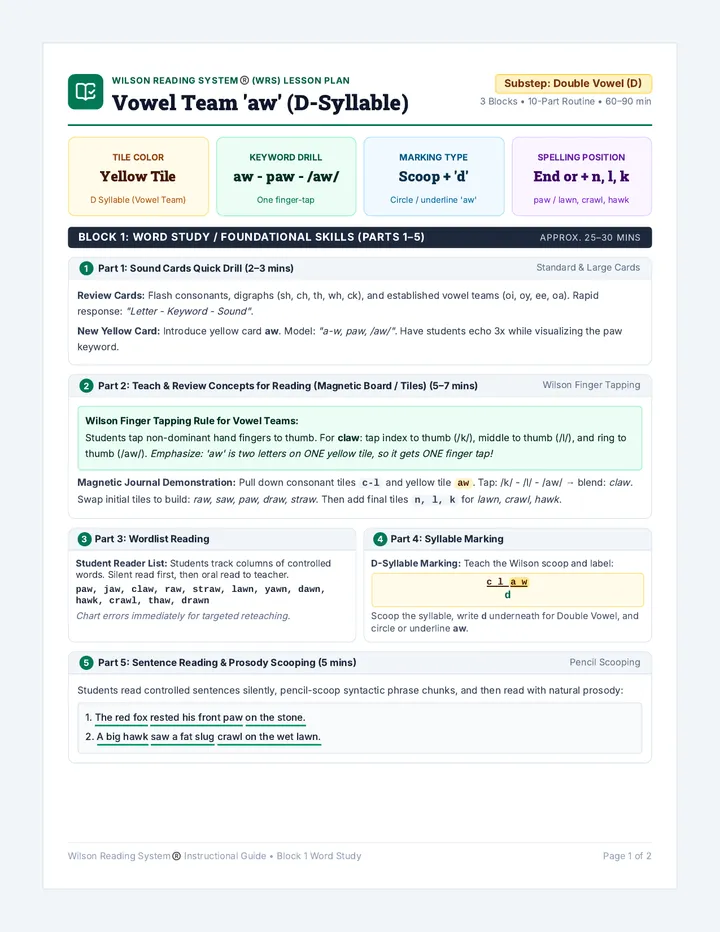
Wilson Reading System • Step 2.1
Closed Syllables & Short Vowels
Master Anchor Chart 1
1
The Closed Syllable Rule
Mark: ˘ over vowel + c under scoop
1. Only ONE Vowel
Contains exactly one vowel letter (a, e, i, o, u).
2. Closed by Consonant
One or more consonants lock the vowel in from behind.
3. Short Vowel Sound
The vowel is forced to say its short sound (marked with breve ˘).
Short Vowel Soundboard & Keywords
Listen for the short vowel sound
Vowel A
ă
apple /ă/
c-a-t • m-a-p
Vowel E
ĕ
Ed /ĕ/
b-e-d • s-e-t
Vowel I
ĭ
itch /ĭ/
f-i-sh • s-i-t
Vowel O
ŏ
octopus /ŏ/
h-o-p • c-o-t
Vowel U
ŭ
up /ŭ/
d-u-ck • r-u-g
The 4-Sound Finger Tapping Routine (Elbows Up!)
Model Word: "CLAP"
1
Index Finger
/k/
1st Consonant
2
Middle Finger
/l/
2nd Consonant
3
Ring Finger
/ă/
Short Vowel
4
Pinky & Sweep
/p/
Sweep: "CLAP!"
1. Digraph (Review) 1 Tap = 1 Line
Two letters team up to make ONE sound (sh, ch, th, wh, ck). Underline together!
˘
s h ĭ p
c
3 letters = 3 sounds (1 tap for sh)
2. Two-Letter Blend (Step 2.1) 2 Taps = 2 Lines
Each consonant keeps its OWN sound (st, fl, cr, nd, mp). Underline separately!
˘
fl ă g
c
4 letters = 4 sounds (2 taps at front)
Golden Rule: One vowel followed by consonants = Closed Syllable = Short Vowel!
Step 2.1 Complete
Wilson Reading System • Step 2 Special Rules
Bonus Letters, Welded Sounds & Suffix -s
Master Anchor Chart 2
Rule
The Bonus Letter Rule (ff, ll, ss, zz)
Mark with a star (*)
In a 1-syllable word, right after 1 short vowel, double the letters f, l, s, and sometimes z!
Bonus F
p ŭ f f*
puff, cliff, sniff
Bonus L
b ĕ l l*
bell, hill, doll
Bonus S
m ĭ s s*
miss, kiss, glass
Bonus Z
b ŭ z z*
buzz, fizz, jazz
Welded
Welded (Glued) Sounds
Box letters together!
Letters stuck tightly together to make one distinct sound. Draw a box around them!
The Special Trio
all ball, fall
am ham, slam
an fan, plan
The -NG Family (Ring)
ang fang /ăng/
ing ring /ĭng/
ong song /ŏng/
ung lung /ŭng/
The -NK Family (Junk)
ank bank /ăngk/
ink pink /ĭngk/
onk honk /ŏngk/
unk junk /ŭngk/
Step 2.5
The Suffix -s Rule: NEVER Tap the Suffix!
Circle the Suffix!
1. Cover the Suffix
Cover suffix -s with your finger to reveal the baseword.
plant | s
2. Tap the Baseword
Tap only baseword sounds: /p/ /l/ /ă/ /n/ /t/.
5 taps = "plant"
3. Add Suffix Sound
Uncover -s. Add /s/ or /z/ sound at the end!
"plant" + s = "plants"
Step 2 Marking Practice Scoop baseword, underline blends, star bonus letters, box welded sounds, circle suffix!
˘
sp l ĭ t s
c
˘
c l ĭ f f* s
c
Remember: Never tap the suffix! Only tap baseword phonemes. Bonus Letters & Welded Sounds Complete
Wilson Reading System • Steps 2.2, 2.4, 2.5
3-Letter Blends, Digraph Blends & 5–6 Sounds
Master Anchor Chart 3
Step 2.2
3-Letter Blends (3 Consonants = 3 Taps = 3 Underlines)
Tap thumb to index, middle, then ring!
str-
strap, strip
/s/ /t/ /r/
spr-
spring, sprint
/s/ /p/ /r/
scr-
scrap, scrub
/s/ /k/ /r/
spl-
splash, split
/s/ /p/ /l/
squ-
squid, squint
/s/ /k/ /w/
Digraph Blends: Digraph + Consonant Side-by-Side
Watch Your Taps!
The digraph gets 1 underline & 1 tap. The consonant gets its own separate underline & tap!
Initial Digraph Blends
sh r e d → shred
th r ĭ f t → thrift
th r ŏ b → throb
Digraph has 1 line; r has 1 line!
Final Digraph Blends (-nch)
l ŭ n ch → lunch
b ĕ n ch → bench
p ĭ n ch → pinch
n has 1 line; ch has 1 line!
Blend + Digraph Endings
fl ă sh → flash
cr ă sh → crash
cl ŏ th → cloth
Blend at front; digraph at end!
Step 2.4
Five Sounds in a Closed Syllable (CCVCC)
The Wilson Return Tap
C C (Initial Blend) + V (Short Vowel) + C C (Final Blend) = 5 SOUNDS
1. Index /f/
2. Middle /r/
3. Ring /ŏ/
4. Pinky /s/
5. Index Again! /t/
Sweep across thumb after 5th tap to blend: "FROST!"
6-Sound Heavy Hitters (Step 2.5) 3 front consonants + 1 short vowel + 2 final consonants (CCCVCC)
splint strict scrimp strand
Golden Question: "Does this sound have 1 letter or 2 letters?" Digraph = 1 tap; Blend = separate taps! Steps 2.2, 2.4, 2.5 Complete
Wilson Reading System • Syllable Exceptions
The 5 Closed Syllable Exceptions
Master Anchor Chart 4
The Famous Wilson Memory Phrase
"A Wild Child will Find Cold Gold with a Bolt on a Post!"
The Exception Rule
Why are these words exceptions?
Looks closed, but vowel is LONG!
These words are closed in by two consonants, but instead of making a short sound, the vowel breaks the rule and says its LONG name!
-ild long /ī/
w ild
wild
child
mild
-ind long /ī/
f ind
find, kind
mind, blind
grind
-old long /ō/
c old
cold, gold
hold, sold
scold, fold
-olt long /ō/
b olt
bolt
colt
jolt, volt
-ost long /ō/
p ost
post
most
host
How to Code a Closed Syllable Exception
3 Simple Steps
Step 1: Macron ( ¯ )
Place a macron over the vowel to show it's long.
¯
k i n d
Step 2: Scoop Syllable
Scoop underneath the entire syllable.
¯
k i n d
Step 3: Slash the 'c'
Write 'c' with a slash through it (c/ or c-exc).
¯
k i n d
c
Watch Out for Regular Closed Impostors!
Not all words ending in -ost are exceptions! Words like cŏst, lŏst, and frŏst have a regular short /ŏ/ sound. Always test both sounds if unsure!
Exception Rule: -ild, -ind, -old, -olt, -ost = Long Vowels! Closed Exceptions Complete
Wilson Reading System • Step 3.1 – 3.5
Syllable Division & The Sneaky Schwa
Master Anchor Chart 5
The 5-Step Bridge Syllable Division Routine
Model: "napkin"
1 Spot & Dot Talking Vowels: Put a dot under each vowel letter.
n a p k i n
2 Build Consonant Bridge: Count consonants between vowels.
V — C C — V
3 Divide (The Cut!): Split right between the two consonants!
nap / kin
4 Scoop & Code Syllables: Add breve (˘) and label each scoop 'c'.
năp • kĭn (c | c)
5 Read & Blend Chunks: Read part 1, part 2, then blend together!
"NAP-KIN!"
1. Rabbit Rule (VC/CV)
Split between twin or different consonants.
rab / bit • traf / fic
2. Blend Monster
Keep the 2-letter blend or digraph intact!
in / spect • mon / ster
3. Compound Words
Split between the two real base words.
sun / fish • cat / nip
ə
Beware the Sneaky Schwa (/ə/)! (Step 3.5)
The Lazy Vowel Sound
What is the Schwa?
When a closed syllable is unaccented (not stressed), the vowel relaxes and sounds like a muffled "uh" /ə/ or /ĭ/ instead of its true sound.
How We Mark It
Put an accent mark (´) over the stressed syllable. Put an upside-down /ə/ above the lazy unaccented vowel.
wag • on "wag-un"
sal • ad "sal-ud"
cac • tus "cac-tus"
pan • ic "pan-ik"
Student "Flex the Vowel" Strategy: If a word sounds strange with its regular short vowel, flex the unaccented vowel to /ə/ ("uh"). Does it make a word you know?
Master Marking Model: d ĭ s (c) + r ŭ pt (c) = disrupt
Steps 2 & 3 Complete