Lenny.com
Explore
Create
ActivitiesNewCurriculumNewMathEnglish Language ArtsScience & EngineeringSocial StudiesGlobal LanguagesHealth & Physical EducationSpecial EducationCounseling & Life SkillsArts & CreativityESL
Lenny.com
Lenny.com
Explore
Create
ActivitiesNewCurriculumNewMathEnglish Language ArtsScience & EngineeringSocial StudiesGlobal LanguagesHealth & Physical EducationSpecial EducationCounseling & Life SkillsArts & CreativityESL
Lenny.com
Lenny.com

Solutions

Lenny for EducatorsLenny for SchoolsLenny for Districts

Product

ExploreSign inCreateSupportAbout

Resources

Getting startedMTSS Acceleration Program

Newsletters

School Funding Newsletter

© 2026 Lenny Learning Inc.

TermsPrivacyAccessibility
LinkedInInstagramX
Lenny
English Language ArtsPhonics & Reading FoundationsLetter IdentificationLearn Letters A-ZLowercase and Uppercase LettersConsonants and VowelsLetter-Sound AssociationsLetter-Sound Associations: LowercaseLetter-Sound Associations: UppercaseBeginning and Ending SoundsRhymingBlending And SegmentingShort VowelsShort Vowel SoundsConsonant BlendsConsonant DigraphsBlends, Digraphs, and TrigraphsDigraphs, Blends, and Silent LettersLong Vowel SoundsLong Vowel PatternsShort and Long VowelsShort and Long Vowel PatternsSilent EVowel SoundsVowel TeamsR-Controlled VowelsDiphthongs: Oi, Oy, Ou, OwVariant VowelsVariant, Diphthong, And R Vowel PatternsSoft G And CSight WordsIrregular WordsWord RecognitionSyllablesSyllable TypesTwo-Syllable WordsMultisyllabic WordsPhoneme ManipulationDecodable TextsVocabularyAction WordsQuestion WordsNouns and AdjectivesClassify WordsCompound WordsSynonyms and AntonymsHomophonesHomophones and HomonymsShades of MeaningContext CluesPrefixes and SuffixesGreek and Latin RootsAnalogiesIdioms and AdagesForeign Words and ExpressionsWord Choice and UsageReference SkillsReading ComprehensionRead-Along Literary TextsRead-Along Informational TextsReality vs. FictionStory ElementsCharacterSequenceMain IdeaCause And EffectCompare And ContrastReading StrategiesText StructureAuthor's PurposeAuthor's Purpose And ToneAuthor's PerspectivePoint Of ViewThemeInference And ThemeInference And AnalysisPoetry ElementsLiterary DevicesAnalyzing LiteratureAnalyzing Informational TextsComparing TextsAudience, Purpose, And ToneBusiness DocumentsNovel StudyNonfiction Book StudyGrammar & MechanicsSentencesNounsVerbsAdjectivesPronounsCapitalizationPunctuationContractionsConjunctionsPrepositionsArticlesAdjectives And AdverbsVerb TypesVerb TensePronouns And AntecedentsPronoun TypesSubject-Verb AgreementDirect And Indirect ObjectsSentences, Fragments, And Run-OnsPhrases And ClausesCommasSemicolons, Colons, And CommasDashes, Hyphens, And EllipsesSpellingAbbreviationsFormattingVerb Tense And MoodMisplaced ModifiersWritingDescriptive DetailsCreative WritingOpinion WritingTopic SentencesOrganizing WritingLinking WordsSentence VarietyIntroductions And ConclusionsPersuasive And Opinion WritingExpository WritingPersuasive StrategiesDeveloping And Supporting ArgumentsTopic Sentences And Thesis StatementsSummarizingResearch SkillsEditing And RevisingActive And Passive Voice=Writing Clearly And ConciselyDebate & Public SpeakingPublic Speaking BasicsPersuasive TechniquesClaims and EvidenceTypes of ArgumentsReasoning TypesLogical FallaciesTopic ResearchOrganizing EvidenceDebate Speech OrganizationAttacking and Defending ArgumentsClash and EngagementImpact CalculusQuestioning and Cross-ExaminationCritical ThinkingInformal LogicFormal LogicInductive Reasoning

Sound Cue Reference Sheet

Alphabet and sound cue reference sheet updated with N (No), R (Rat), S (Snake), Y (Yes), and Z (Zip) while preserving the single-page layout and clean high-contrast styling.

SCSarah Clark

Sound Cue Reference Sheet

Alphabet and sound cue reference sheet updated with N (No), R (Rat), S (Snake), Y (Yes), and Z (Zip) while preserving the single-page layout and clean high-contrast styling.

SCSarah Clark

You might also like

Stated Signals Slides

Signal Hunters

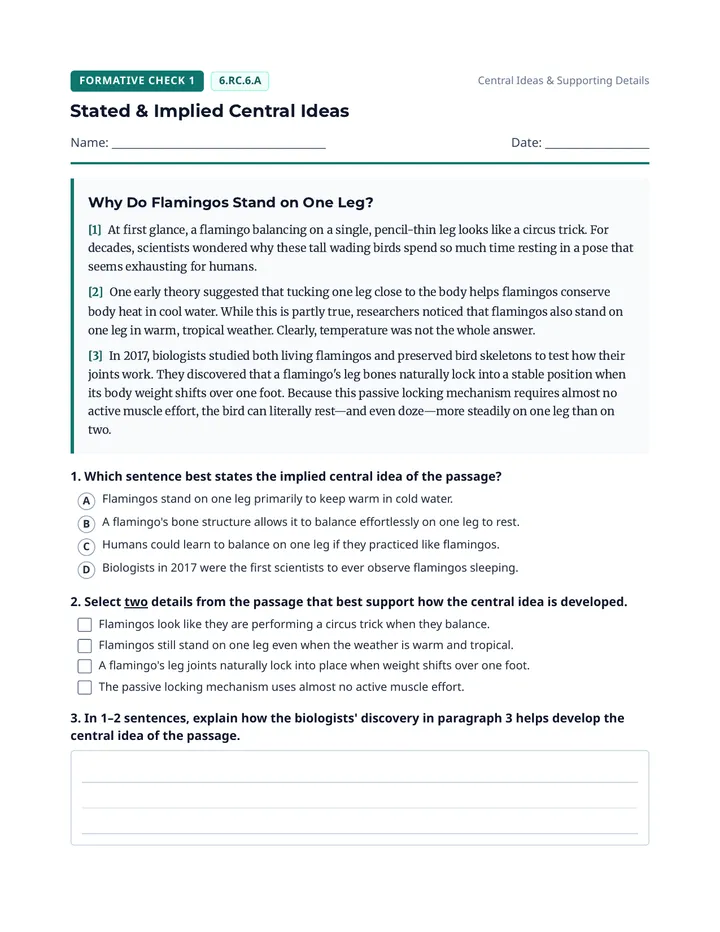
A 3-day scaffolded Tier 2/3 reading intervention sequence targeting standard 6.RC.6.A. Students progress from stated central ideas to implied central ideas and independent mastery, integrating central idea identification, detail-development analysis, and objective summarizing free of personal opinion.

U

9
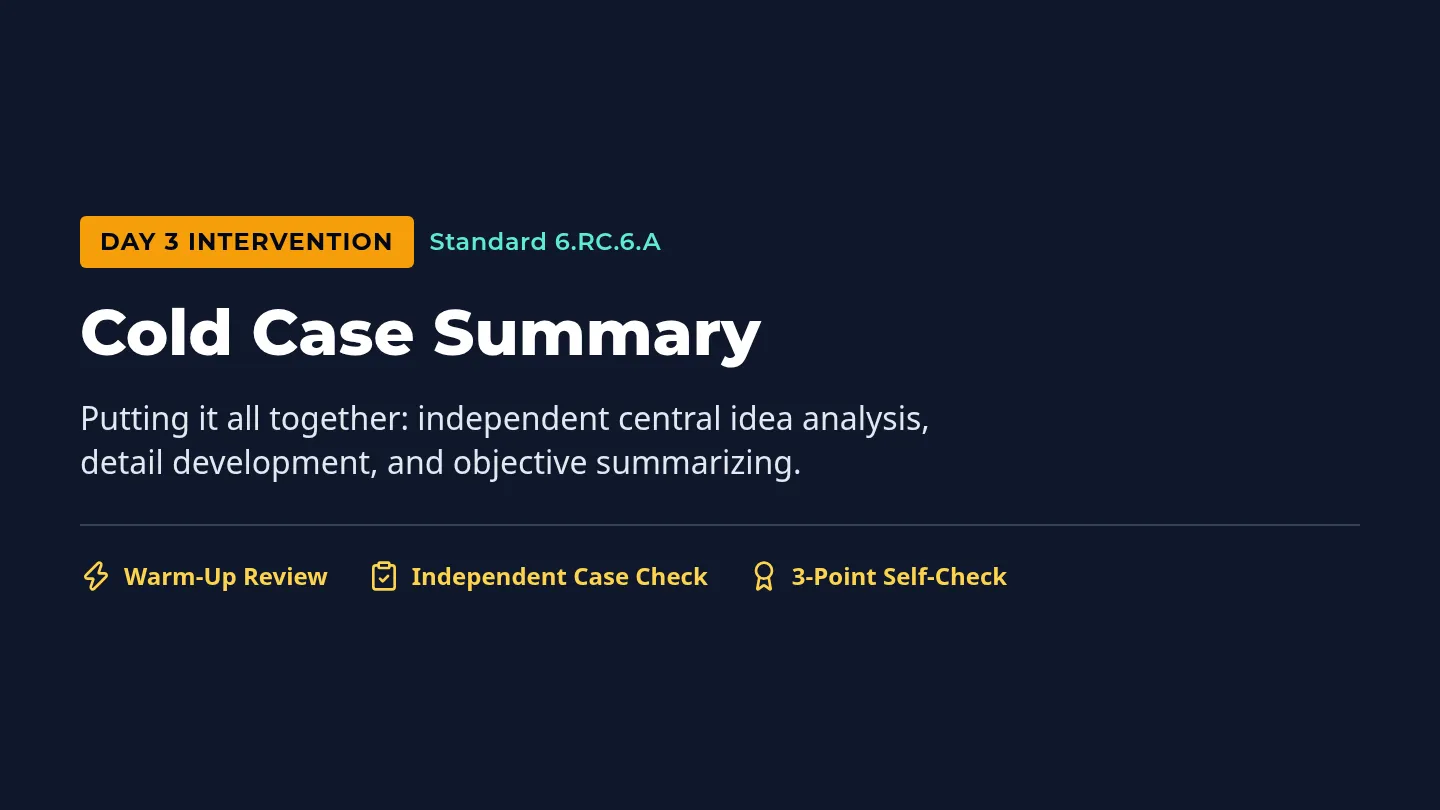
Cold Case Summary Slides

Cold Case Summary

Day 3 provides independent, integrated practice and a formative mastery check using a text on whale echolocation and ocean noise. Students independently identify the central idea, explain detail development, filter out opinion-based summaries, and craft a concise objective summary.

U

3
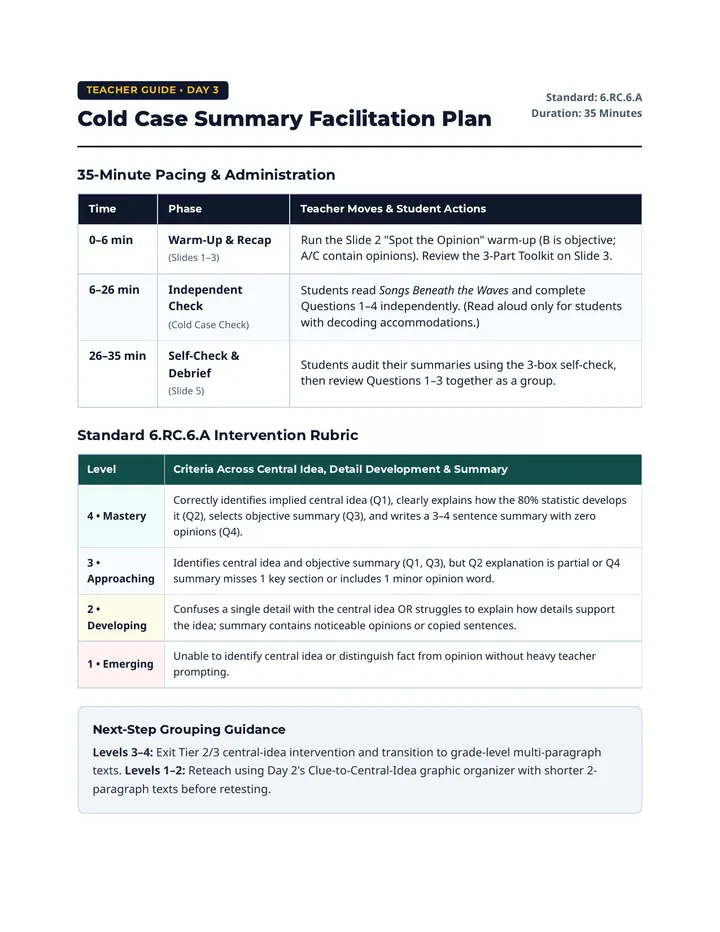
Cold Case Summary Teacher Guide

Cold Case Summary Teacher Guide

A 2-page teacher guide and answer key for Day 3 (Cold Case Summary). Includes a 35-minute pacing plan, a 4-point intervention mastery rubric aligned to 6.RC.6.A, next-step grouping recommendations, and complete answer keys for the mastery check.

U

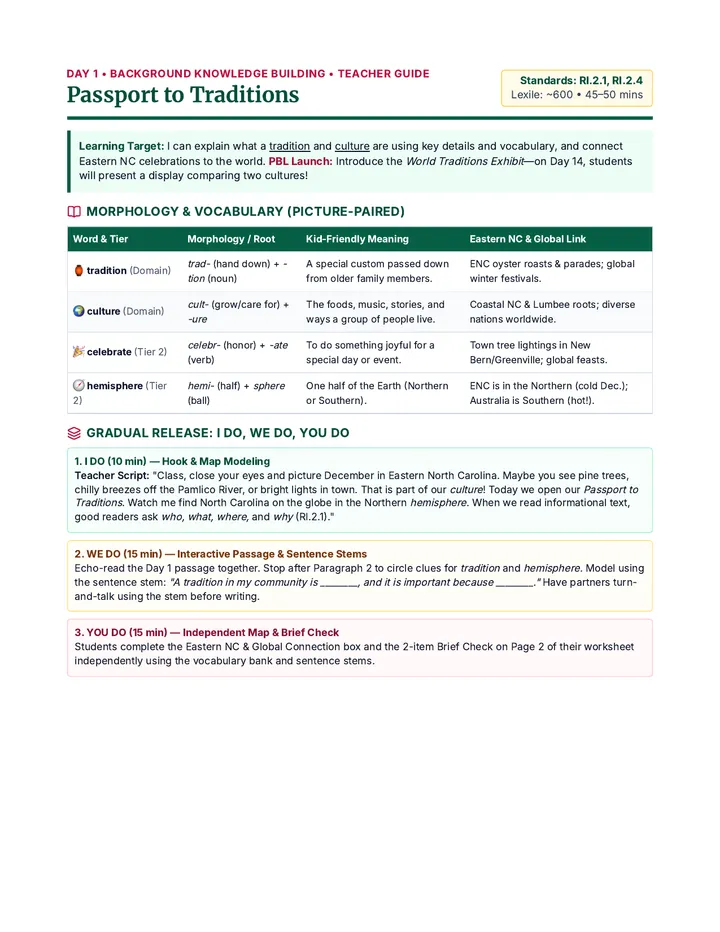
Passport Kickoff Teacher Guide

World Traditions Exhibit

A 14-day second-grade project-based learning unit at Lexile 600 exploring Christmas and winter holiday traditions around the world, aligned to RI.2.1, RI.2.2, RI.2.4, and RI.2.9. Students build background knowledge, analyze informational passages with Eastern NC and global connections, and design a World Traditions Exhibit comparing cultures.

BR

Brittany Realegeno

47
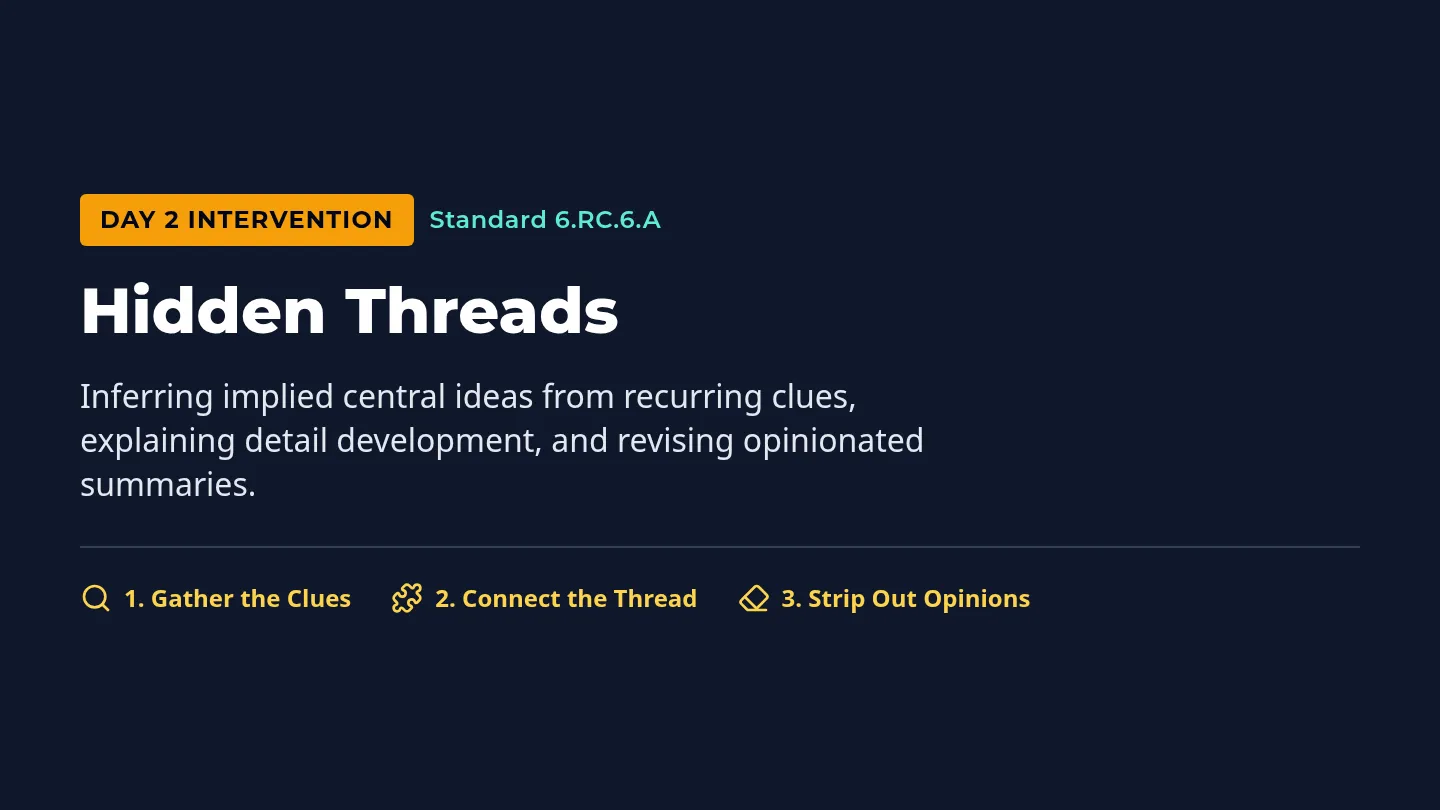
Hidden Threads Slides

Hidden Threads

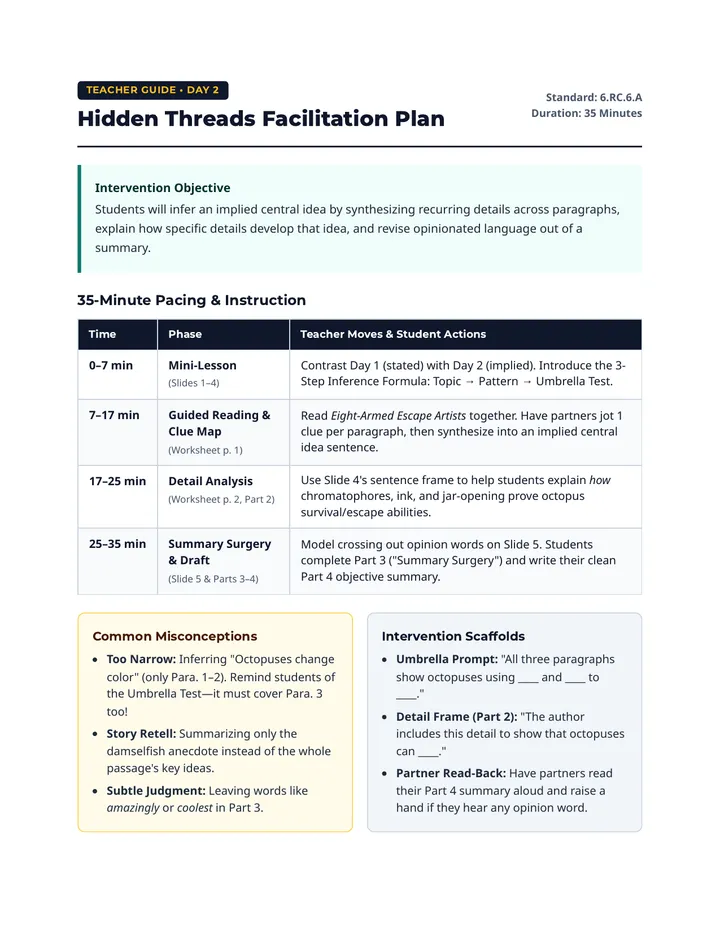
Day 2 shifts from explicit statements to implied central ideas using an informational text on octopus intelligence and camouflage. Students synthesize recurring clues to infer the unstated central idea, explain how specific details build that idea, and revise opinionated summaries into objective ones.

U

3
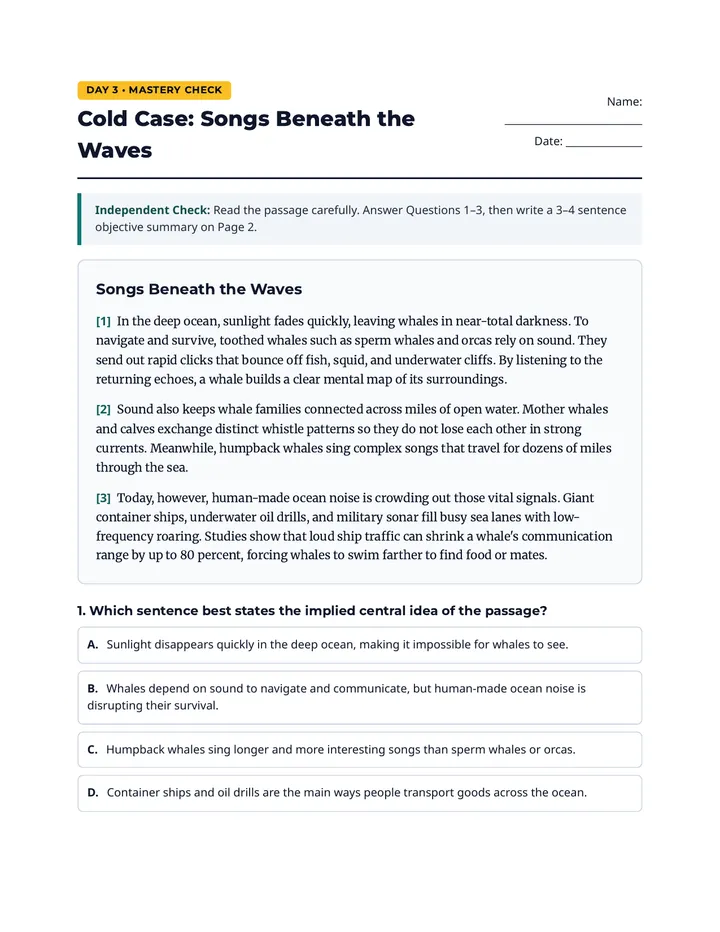
Cold Case Summary Check

Cold Case Summary Check

A 2-page printable student mastery check for Day 3 (Cold Case Summary). Features an informational passage on whale echolocation and ocean noise, 3 targeted 6.RC.6.A questions (central idea, detail development, objective summary selection), an independent summary writing box, and a student self-check.

U

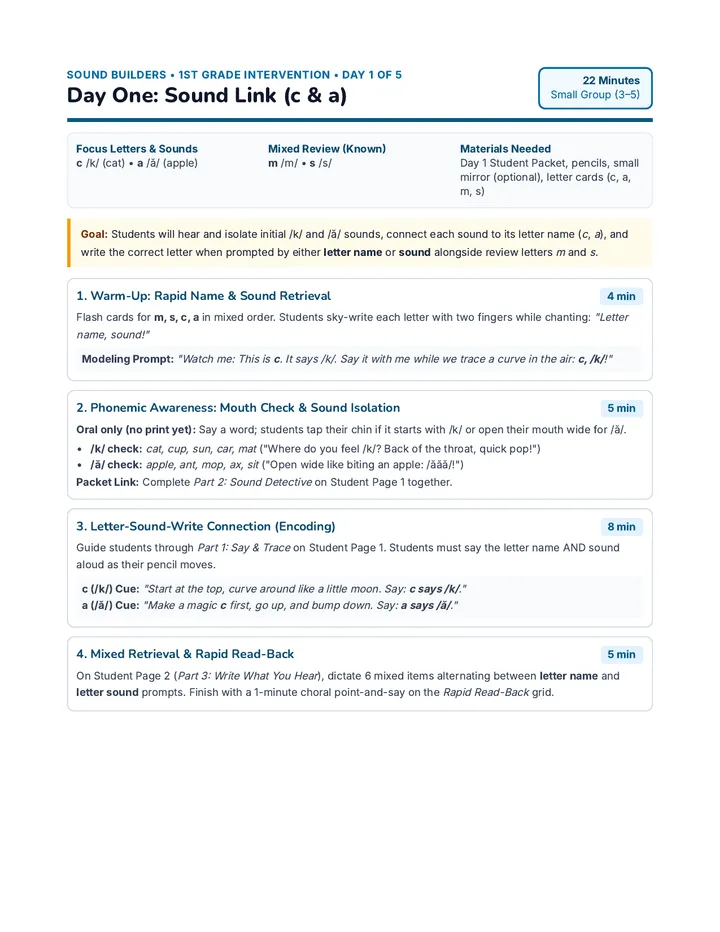
Day One Teacher Guide

Sound Builders

A 5-day 1st grade reading intervention sequence targeting letter-name correspondence, letter-sound mastery, phonemic awareness, and mixed retrieval encoding across high-utility letters. Each day pairs a scripted teacher guide with matching printable student practice pages and built-in data tracking.

BP

Brooke Powers

10
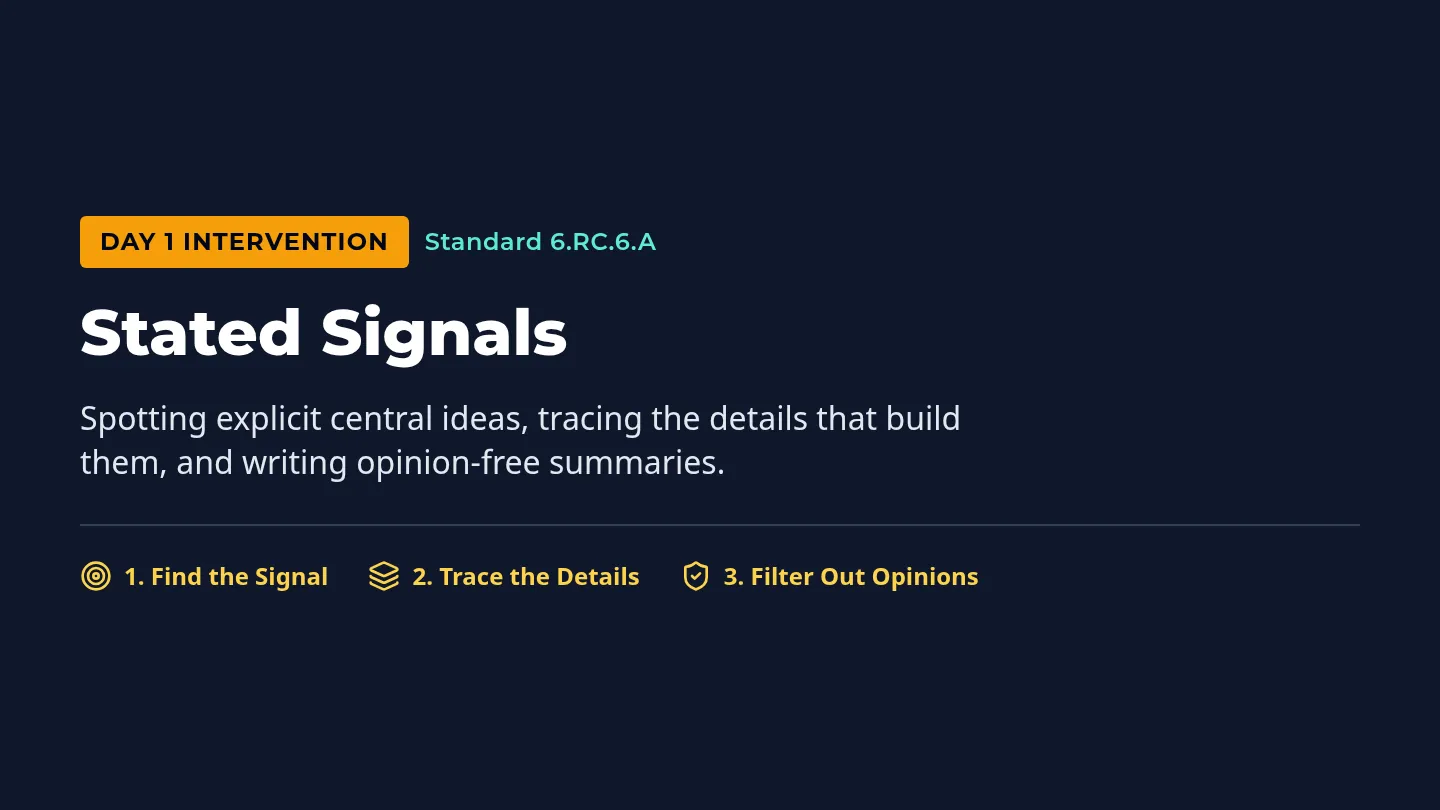
Stated Signals Slides

Stated Signals

Day 1 of the intervention sequence introduces stated central ideas using an informational text on urban rooftop farms. Students distinguish topic from central idea, trace how three key details develop the stated claim, and write an objective summary free of personal opinions.

U

3
Cold Case Summary Slides

Cold Case Summary Slides

A 5-slide instructional deck for Day 3 (Cold Case Summary) of the Signal Hunters intervention sequence. Reviews stated vs. implied central ideas, runs a quick Spot the Opinion warm-up, sets expectations for the independent mastery check, and provides a 3-point self-check debrief.

U

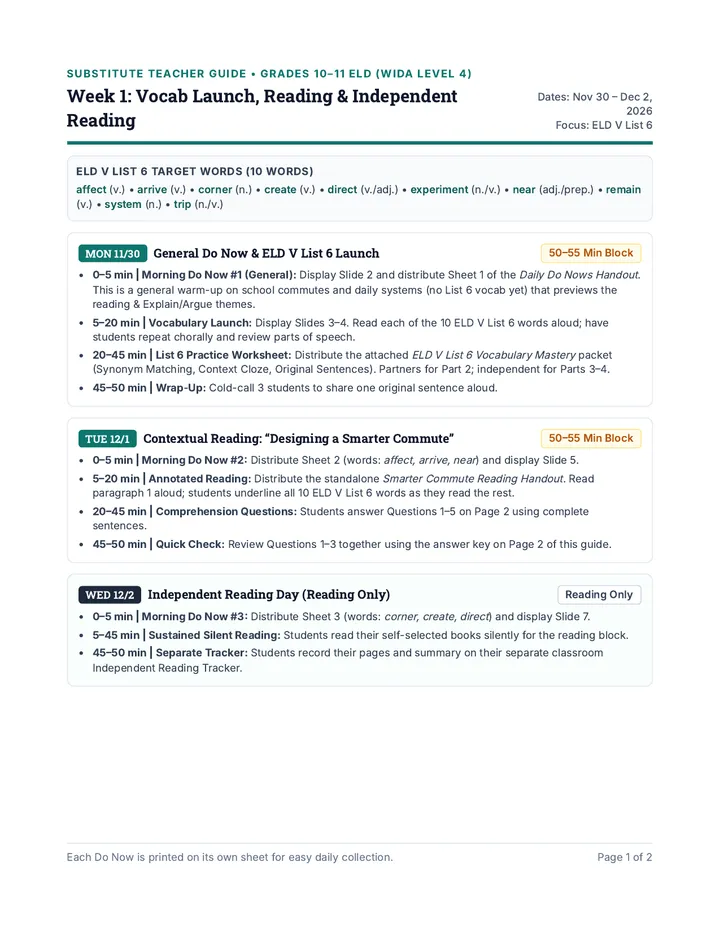
Vocab Launch Teacher Guide

December ELD Sub Hub

A complete substitute-ready instructional sequence for Grades 10–11 ELD (WIDA Level 4) covering November 30 through December 23, 2026 (excluding Friday, December 11). Includes vocabulary launch, contextual reading, Explain vs. Argue writing, benchmark and quiz days, Independent Reading Wednesdays, and 4-domain ACCESS test practice with Off2Class link spots.

CS

Christine Staugler

22
Central Idea Formative Checks

Central Idea Detectives

A 6th-grade ELA assessment bundle aligned to standard 6.RC.6.A, featuring ISAT-style formative checks, a comprehensive summative test with informational passages, and teacher guidance with answer keys and rubrics.

JM

Justin Miller

3
Hidden Threads Teacher Guide

Hidden Threads Teacher Guide

A 2-page teacher guide and answer key for Day 2 (Hidden Threads). Includes a 35-minute intervention pacing plan, questioning prompts for inferring unstated central ideas, misconception alerts, scaffolds, and complete answer keys.

U