Central Idea Formative Checks
Formative Check 1 6.RC.6.A
Central Ideas & Supporting Details
Stated & Implied Central Ideas
Name: _______________________________________
Date: ___________________
Why Do Flamingos Stand on One Leg?
[1] At first glance, a flamingo balancing on a single, pencil-thin leg looks like a circus trick. For decades, scientists wondered why these tall wading birds spend so much time resting in a pose that seems exhausting for humans.
[2] One early theory suggested that tucking one leg close to the body helps flamingos conserve body heat in cool water. While this is partly true, researchers noticed that flamingos also stand on one leg in warm, tropical weather. Clearly, temperature was not the whole answer.
[3] In 2017, biologists studied both living flamingos and preserved bird skeletons to test how their joints work. They discovered that a flamingo's leg bones naturally lock into a stable position when its body weight shifts over one foot. Because this passive locking mechanism requires almost no active muscle effort, the bird can literally rest—and even doze—more steadily on one leg than on two.
1. Which sentence best states the implied central idea of the passage?
A Flamingos stand on one leg primarily to keep warm in cold water.
B A flamingo's bone structure allows it to balance effortlessly on one leg to rest.
C Humans could learn to balance on one leg if they practiced like flamingos.
D Biologists in 2017 were the first scientists to ever observe flamingos sleeping.
2. Select two details from the passage that best support how the central idea is developed.
Flamingos look like they are performing a circus trick when they balance.
Flamingos still stand on one leg even when the weather is warm and tropical.
A flamingo's leg joints naturally lock into place when weight shifts over one foot.
The passive locking mechanism uses almost no active muscle effort.
3. In 1–2 sentences, explain how the biologists' discovery in paragraph 3 helps develop the central idea of the passage.
Formative Check 2 6.RC.6.A
Objective Summaries vs. Opinions
Summarizing Without Personal Opinion
Name: _______________________________________
Date: ___________________
The Rise of Vertical Farms
[1] Traditional farming requires vast stretches of open land, predictable weather, and large amounts of water. As cities grow larger, some agricultural engineers are turning upward instead of outward by building vertical farms inside warehouses and skyscrapers.
[2] Inside a vertical farm, crops such as lettuce, herbs, and strawberries grow in stacked trays under LED lights. Computers monitor temperature, humidity, and nutrients around the clock. Because the water is recycled in a closed loop, vertical farms use up to 95 percent less water than outdoor fields.
[3] However, vertical farming is not a complete replacement for traditional agriculture. Running artificial lights and climate systems requires a great deal of electricity, and staple crops like wheat and corn are too large and slow-growing to be raised profitably indoors. Still, vertical farms offer cities a reliable way to produce fresh greens year-round.
4. Which sentence should not be included in an objective summary of the passage because it contains a personal opinion?
A Vertical farms grow crops in stacked indoor trays using LED lights and recycled water.
B Vertical farming is an exciting and much better way to grow food than boring outdoor farms.
C High electricity costs and crop size limit which plants can be grown profitably indoors.
D Urban vertical farms can supply fresh produce to cities throughout the entire year.
5. Which statement provides the best objective summary of the passage?
A Strawberries taste fresher when they are grown inside skyscrapers with LED lights.
B Traditional farms waste too much water and should be replaced by city warehouses.
C Vertical farms use stacked indoor trays and recycled water to grow fresh produce in cities, though high energy needs and crop limits keep them from replacing traditional farms.
D Computers inside vertical farms control temperature, humidity, and nutrients every hour.
6. Write a 2–3 sentence objective summary of "The Rise of Vertical Farms." Be sure to keep your summary free of personal opinions.
Central Idea Summative Test
Summative Assessment 6.RC.6.A
Page 1 of 5
Central Ideas & Objective Summaries
Name: ____________________________________
Date: _________________
Score: _____ / 15
Directions: Read each passage carefully. Then answer the questions that follow. For multiple-choice items, circle or mark the best answer. For multi-select items, mark the exact number of choices requested. Write your constructed response in complete sentences inside the box provided.
Passage 1
The Secret Architecture of Termite Mounds
[1] Rising up to thirty feet above the dry grasslands of southern Africa, termite mounds look like giant earthen sculptures. Built grain by grain from soil and saliva by insects no larger than a fingernail, these towering structures are actually living climate-control systems. Far from being simple dirt piles, termite mounds are engineered to keep their underground colonies at a steady temperature despite scorching desert days and chilly nights.
[2] Inside the mound, millions of termites do not actually live in the tall spire. Instead, the colony resides in a subterranean nest beneath the tower, where the insects tend subterranean gardens of fungus. This fungus breaks down tough plant fibers into food the termites can digest. However, the fungus can only survive if the nest stays close to 87 degrees Fahrenheit and remains moist.
[3] To protect their food supply, termites construct an intricate network of vertical chimneys and horizontal tunnels throughout the mound. As the colony and its fungus gardens generate heat, warm, stale air rises up through the central chimney. At the same time, cooler, oxygen-rich air is drawn in through tiny pores near the base of the mound, creating a continuous, natural airflow.
[4] The mound's outer walls also respond to changing weather. During the heat of midday, sun-warmed air near the outer surface rises, pulling fresh air up from the cool underground nest. At night, when desert temperatures drop, the airflow reverses direction, preventing the colony from losing too much warmth. Termites constantly open and seal small vents to fine-tune this system.
[5] Modern architects have studied these insect-built towers for inspiration. In Zimbabwe, the Eastgate Centre—a large office and shopping complex—was designed using ventilation principles borrowed from termite mounds. By relying on natural airflow rather than conventional air conditioning, the building uses roughly 35 percent less energy than similar structures nearby.
Part 1: Questions 1–3 (Passage 1) Page 2 of 5
1. Which sentence best states the central idea of Passage 1?
A Termites in southern Africa build the tallest insect structures on Earth using soil and saliva.
B Termite mounds use clever natural ventilation to regulate colony temperatures and have even inspired energy-saving human architecture.
C Because fungus cannot survive in cold weather, termites must move their underground gardens every night.
D Architects in Zimbabwe invented a new type of air conditioning after visiting the African grasslands.
2. Select two details from the passage that best support how the termites' ventilation system works.
Termite mounds can reach heights of up to thirty feet above the dry grasslands.
Warm, stale air rises through a central chimney while cooler air enters through tiny pores near the base.
Termites grow underground gardens of fungus to break down tough plant fibers into food.
Termites open and seal small vents in the outer walls to adjust airflow as outside temperatures change.
3. This question has two parts. First, answer Part A. Then, answer Part B.
Part A: How does paragraph 5 help develop the central idea of the passage?
A It proves that human architects can build taller towers than insects can.
B It shows that termite mound engineering is effective enough to be copied in human buildings.
C It explains why shopping complexes in Zimbabwe need more air conditioning than offices.
D It argues that termites should be protected because they help reduce city electricity bills.
Part B: Which sentence from paragraph 5 best supports your answer in Part A?
A "Modern architects have studied these insect-built towers for inspiration."
B "In Zimbabwe, the Eastgate Centre—a large office and shopping complex—was designed using ventilation principles borrowed from termite mounds."
C "By relying on natural airflow rather than conventional air conditioning, the building uses roughly 35 percent less energy than similar structures nearby."
D Both B and C together best support Part A.
Part 1 Continued & Passage 2 Page 3 of 5
4. Which statement provides the best objective summary of Passage 1 without personal opinions?
A Termites are the smartest insects in Africa because their amazing dirt towers keep their fungus gardens comfortable.
B Every office building in the world should copy the Eastgate Centre in Zimbabwe to stop wasting electricity.
C African termites build mounds with chimneys, tunnels, and vents that regulate nest temperatures for their fungus gardens, a design that architects have adapted for energy-efficient buildings.
D Millions of termites live underground beneath thirty-foot mounds where they eat tough plant fibers all day.
Passage 2
Mapping the Deepest Trench
[1] Nearly seven miles beneath the surface of the western Pacific Ocean lies the Challenger Deep, the lowest known point on Earth's seabed. Located at the southern end of the Mariana Trench, this underwater canyon is deeper than Mount Everest is tall. At that depth, the weight of the water creates crushing pressure more than one thousand times greater than atmospheric pressure at sea level.
[2] For centuries, scientists had no reliable way to measure or explore this pitch-black environment. In 1960, Swiss engineer Jacques Piccard and U.S. Navy Lieutenant Don Walsh became the first humans to reach the Challenger Deep inside a thick-walled submersible called the Trieste. After a five-hour descent, they spent only twenty minutes on the ocean floor before returning to the surface.
[3] Because sending human crews to such extreme depths is dangerous and expensive, modern oceanographers rely heavily on robotic vehicles and multibeam sonar. Ships on the surface send out fan-shaped pulses of sound waves that bounce off the seafloor. By timing how long the echoes take to return, researchers can create detailed three-dimensional maps of underwater cliffs and ridges.
[4] Uncrewed submersibles equipped with high-definition cameras and mechanical arms have also revealed surprising life forms in the trench. Despite freezing temperatures and total darkness, scientists have observed pale snailfish, giant single-celled organisms, and shrimp-like amphipods thriving near chemical vents.
[5] Still, vast stretches of Earth's deepest waters remain unmapped. Advances in autonomous underwater robots continue to expand what researchers know about the Mariana Trench, turning one of the planet's most inaccessible places into an active frontier of scientific discovery.
Part 2: Questions 5–7 (Passage 2) Page 4 of 5
5. Which sentence best states the implied central idea of Passage 2?
A The Challenger Deep is deeper than Mount Everest is tall, making it too dangerous for any research.
B Although the Mariana Trench's extreme conditions once prevented exploration, advancing technology now allows scientists to map its floor and study its life.
C Jacques Piccard and Don Walsh stayed on the ocean floor for only twenty minutes in 1960.
D Pale snailfish and shrimp-like amphipods are the only creatures capable of surviving in the Pacific Ocean.
6. Select two sentences that should be included in an objective summary of Passage 2.
The 1960 Trieste expedition was the bravest and most exciting ocean adventure in history.
Today, researchers use multibeam sonar and robotic submersibles to map the trench and observe deep-sea organisms.
Extreme water pressure and darkness make the Challenger Deep difficult to explore directly with human crews.
Scientists should stop spending money on space exploration and focus only on the Mariana Trench.
7. This question has two parts. First, answer Part A. Then, answer Part B.
Part A: How do paragraphs 3 and 4 develop the central idea of Passage 2?
A They show how new tools like sonar and robotic vehicles overcome the limits of human exploration.
B They explain why Jacques Piccard refused to return to the Challenger Deep after 1960.
C They prove that sound waves travel faster in cold water than in warm water.
D They argue that high-definition cameras scare away deep-sea fish near chemical vents.
Part B: Which detail from paragraphs 3–4 best supports your answer in Part A?
A "Ships on the surface send out fan-shaped pulses of sound waves..."
B "...researchers can create detailed three-dimensional maps of underwater cliffs and ridges."
C "Uncrewed submersibles equipped with high-definition cameras and mechanical arms have also revealed surprising life forms in the trench."
D Both B and C together best support Part A.
Part 2 Continued: Constructed Response (Passage 2) Page 5 of 5
8. Constructed Response (4 Points)
Objective Summary & Central Idea
Write an objective summary of "Mapping the Deepest Trench" in 4–6 sentences. In your summary, state the central idea of the passage and explain how the author develops it using specific details from the text. Be sure to keep your response completely free of personal opinions.
Before You Finish — Check Your Summary:
Stated the central idea clearly
Used specific details from the text
No personal opinions included
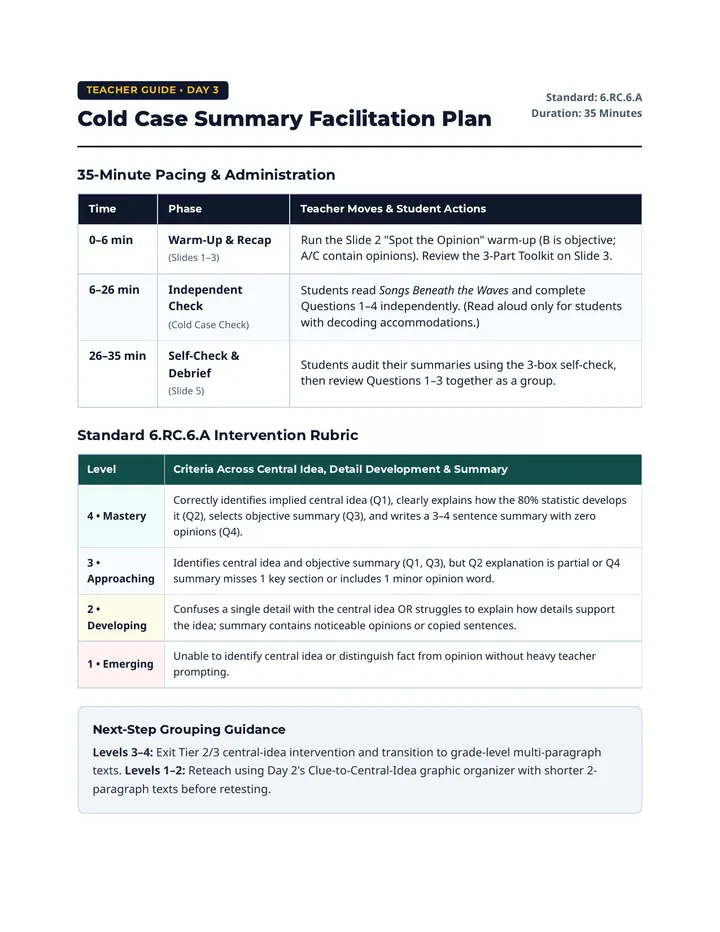
Central Idea Teacher Guide
Teacher Guide Grade 6 ELA • 6.RC.6.A
Page 1 of 3
Central Idea Detectives: Assessment Guide
Standard 6.RC.6.A Unpacked
"Explain stated or implied central ideas from texts, including how they are developed using specific details from the text; provide a summary of texts distinct from personal opinions."
1. Central Idea
Distinguish the overarching point (stated or implied) from a broad topic or a single minor detail.
2. Development
Trace how specific facts, examples, or paragraphs build and support that central idea.
3. Objective Summary
Synthesize key points in a neutral tone, excluding personal judgments or evaluative adjectives.
Recommended Pacing & Administration
| Assessment |
Est. Time |
Instructional Use |
| Formative Check 1 |
10–12 min |
Use mid-unit after teaching stated vs. implied central ideas. Review Item 2 (multi-select) together to model eliminating "interesting but minor" details. |
| Formative Check 2 |
10–12 min |
Use after modeling objective summaries. Have students highlight opinion words (e.g., exciting, boring, better) before writing Item 6. |
| Summative Test |
35–45 min |
Independent end-of-unit assessment. Mirrors ISAT item types: selected response, multi-select, two-part evidence items, and a 4-point brief write. |
Common Misconceptions
- Topic vs. Central Idea: Students write a 1–2 word topic ("termite mounds") instead of a complete claim about what the text conveys.
- Sneaky Opinions: Students include evaluative words (amazing, smartest, should) inside summaries without realizing they are opinions.
- Detail Trap: Students pick vivid facts (e.g., "30 feet tall") rather than details that actually develop the central idea.
Differentiation Supports
- Scaffolding: Allow struggling readers to annotate the "who/what" and "so what?" in the margin of each numbered paragraph before answering.
- Sentence Frames (Item 8): Provide frames such as "The central idea of the passage is... The author develops this by explaining..."
- Extension: Ask early finishers to underline the exact phrase in each passage that proves why the incorrect choices are wrong.
Complete Answer Keys Page 2 of 3
Formative Checks 1 & 2 Answer Key
| Item |
Correct |
Rationale / Exemplar Response |
| FC1 #1 |
B |
Synthesizes paragraphs 2–3: warm weather disproved heat-only theory; bone structure explains effortless resting. |
| FC1 #2 |
Choices 3 & 4 |
Joints locking over one foot + passive mechanism requiring almost no muscle effort directly develop the central idea. |
| FC1 #3 |
Short Answer |
Exemplar: The 2017 study proves that flamingos' leg joints lock passively, which explains how they rest steadily on one leg without tiring their muscles. |
| FC2 #4 |
B |
Contains evaluative opinion language ("exciting," "much better," "boring"). |
| FC2 #5 |
C |
Covers benefits (stacked trays, recycled water) and limitations (energy, crop size) neutrally. |
| FC2 #6 |
Short Summary |
Exemplar: Vertical farms grow crops indoors in stacked trays using LED lights and recycled water. Although high electricity use and crop limits keep them from replacing outdoor farms, they provide cities with fresh greens year-round. |
Summative Test Answer Key (Items 1–7 • 11 Points)
| Item |
Points |
Correct |
Scoring & Rationale |
| Item 1 |
1 pt |
B |
Captures both the natural climate-control function (P1–4) and architectural inspiration (P5). |
| Item 2 |
2 pts (1 ea) |
Choices 2 & 4 |
Chimney/pore airflow (P3) and opening/sealing outer vents (P4) explain how ventilation works. |
| Item 3 |
2 pts (1 ea) |
Part A: B |
|
| Part B: D |
P5 shows effectiveness via human imitation; B (Eastgate design) + C (35% energy savings) together prove it. |
|
|
| Item 4 |
1 pt |
C |
Neutral, complete summary; A/B contain opinions ("smartest," "amazing," "should"). |
| Item 5 |
1 pt |
B |
Implied central idea across P1–5: extreme environment vs. advancing tech enabling mapping & discovery. |
| Item 6 |
2 pts (1 ea) |
Choices 2 & 3 |
Both are factual key points; Choices 1 & 4 contain personal opinions ("bravest," "should stop"). |
| Item 7 |
2 pts (1 ea) |
Part A: A |
|
| Part B: D |
P3–4 show sonar mapping + robotic cameras overcoming human limits; B and C together support both tools. |
|
|
Total Score Note: Summative Items 1–7 total 11 points; Item 8 (Constructed Response) is worth 4 points, for a 15-point total.
Item 8: Constructed Response Rubric & Exemplar Page 3 of 3
ISAT-Style 4-Point Scoring Rubric (6.RC.6.A)
| Score |
Criteria |
| 4 |
Clearly states the central idea, explains how it is developed using specific, accurate details from multiple paragraphs (e.g., 1960 Trieste, multibeam sonar, robotic submersibles), and provides a completely objective summary free of personal opinions. |
| 3 |
States the central idea and includes at least two relevant supporting details from the text; summary is mostly objective with no major personal opinions, though explanation of development may be brief. |
| 2 |
Partially identifies the central idea or retells isolated facts without explaining how they develop the idea; or includes a noticeable personal opinion (e.g., "I think this is cool"). |
| 1 |
Minimal, vague, or inaccurate summary; relies heavily on personal opinion or misunderstands the central idea. |
| 0 |
Blank, illegible, or completely off-topic response. |
Annotated 4-Point Exemplar Response
"In 'Mapping the Deepest Trench,' the central idea is that advancing technology has allowed scientists to explore and study the Mariana Trench despite its extreme conditions. The author develops this idea by first explaining that crushing water pressure and darkness at the Challenger Deep limited early human visits, such as the brief 1960 Trieste descent. Next, the passage describes how modern researchers overcome these dangers by using multibeam sonar to create 3D maps of the seafloor. Finally, the author explains that uncrewed robotic submersibles with cameras have discovered deep-sea organisms like snailfish and amphipods living near chemical vents. Together, these details show how new tools continue to turn the deep ocean into an active area of research."
Summative Assessment Scoring Summary (15 Points Total)
• Selected Response (1, 4, 5): 3 pts
• Multi-Select (2, 6): 4 pts (2 pts each)
• Two-Part Evidence (3, 7): 4 pts (2 pts each)
• Constructed Response (8): 4 pts | Proficiency Target: 11–15 pts (Meets/Exceeds 6.RC.6.A)