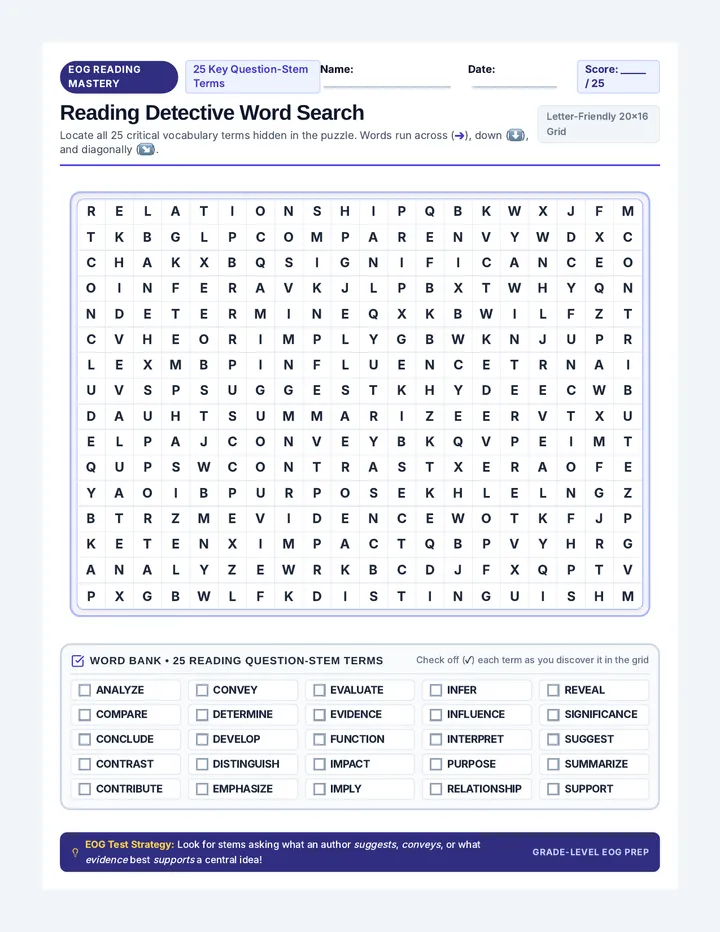
Reading Detectives Workbook
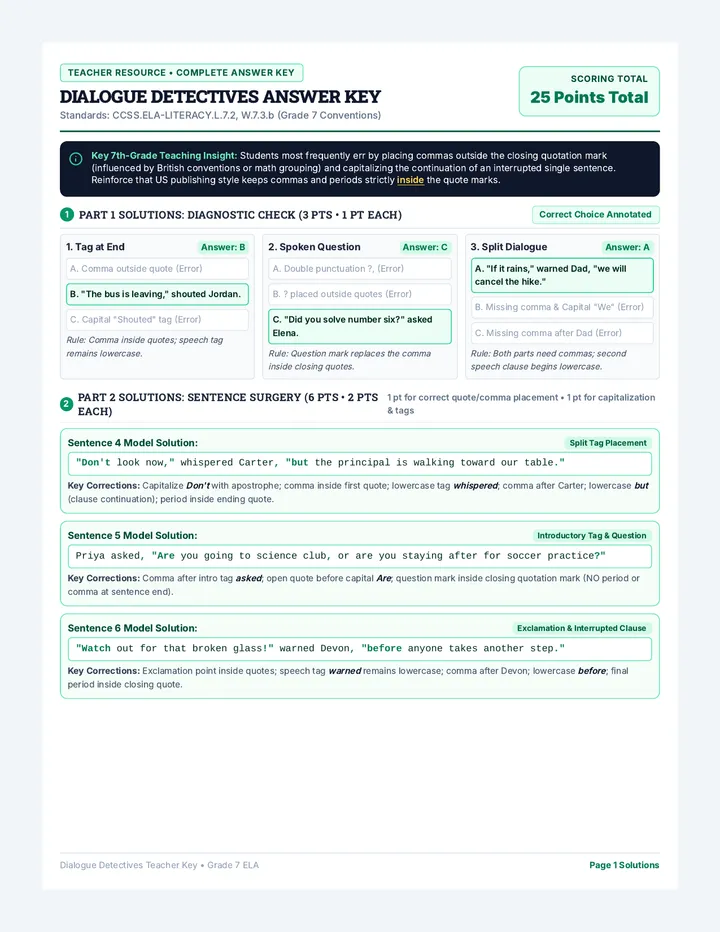
7th Grade Resource ELA
Mission 1: Uncover the Big Idea
Name:
Date:
Detective Formula: Topic (Who/What it's about) + Author's Point (What the author wants you to know) = Central Idea
Field Report: Deep Ocean Word Count: 115
Creatures of the Midnight Zone
[¶1]Nearly three miles beneath the ocean surface lies the Midnight Zone, a world of freezing temperatures and total blackness. Yet this pitch-black abyss is packed with life. Deep-sea animals have developed a superpower called bioluminescence—the ability to make their own glowing light through internal chemical reactions.
[¶2]These glow-in-the-dark adaptations are vital for survival. The female anglerfish dangles a glowing bulb from her head to lure hungry prey right into her jaws. Other animals, like the lanternfish, shine blue lights from their bellies to blend with faint surface light, hiding from predators below. Without bioluminescence, deep ocean creatures could not eat, hide, or find mates in the eternal dark.
1 What is the central idea of the passage?
A The ocean's Midnight Zone is very cold and completely dark three miles down.
B Deep-sea animals depend on bioluminescence in various ways to survive extreme darkness.
C The female anglerfish uses a glowing lure to catch smaller fish for dinner.
2 Supporting Detail Pillars: Write two specific details from the text that prove the central idea.
Central Idea: Deep-sea animals use glowing light (bioluminescence) to survive.
Detail 1 (Hunting / Feeding):
How does glowing light help an animal eat?
Detail 2 (Protection / Hiding):
How does glowing light help an animal hide?
Focus: Identifying Main Idea & Key Supporting Details Page 1 of 4
7th Grade Resource ELA
Mission 2: Read Between the Lines
Name:
Date:
Inference Formula: Text Clues (What the words say) + Background Knowledge (What you already know) = Inference
Field Report: Animal Behavior Word Count: 125
The Feathered Masterminds
[¶1]At a bustling downtown street corner in Sendai, Japan, a crow sits on a traffic light holding a tough walnut. It drops the nut into the roadway, right in front of oncoming vehicles. Heavy tires crunch over the shell, cracking it wide open.
[¶2]The bird does not dive in right away. Instead, it patiently waits until the pedestrian signal switches from red to green and traffic stops. Only then does the crow hop into the crosswalk, collect the cracked nut meat, and fly off safely. Research also reveals that crows remember human faces for over five years. If a researcher wears a specific mask while trapping a crow, that crow—and its entire flock—will scream alarm calls whenever that mask appears again.
1 Complete the Inference Equation for the crosswalk crow.
1. Text Clue
The crow waits for the green pedestrian signal before walking into the street to get its food.
FACT IN PASSAGE
2. My Brain (Prior Knowledge)
What do green walking signals tell human drivers and walkers?
3. Smart Inference
What can you infer about how crows understand human traffic?
2 Inference Check: Why do crows sound alarms when a person wearing a specific mask walks by?
Use this sentence starter to write your answer:
"I can infer that the crows warn each other because..."
Focus: Combining Text Clues + Background Knowledge to Infer Page 2 of 4
7th Grade Resource ELA
Mission 3: Prove It with Evidence
Name:
Date:
Detective Sentence Starter Toolkit:
• "According to paragraph [#]..." • "The author explicitly states that..." • "For example, the text says, '...'" • "This is supported by the fact that..."
Historical Investigation Word Count: 120
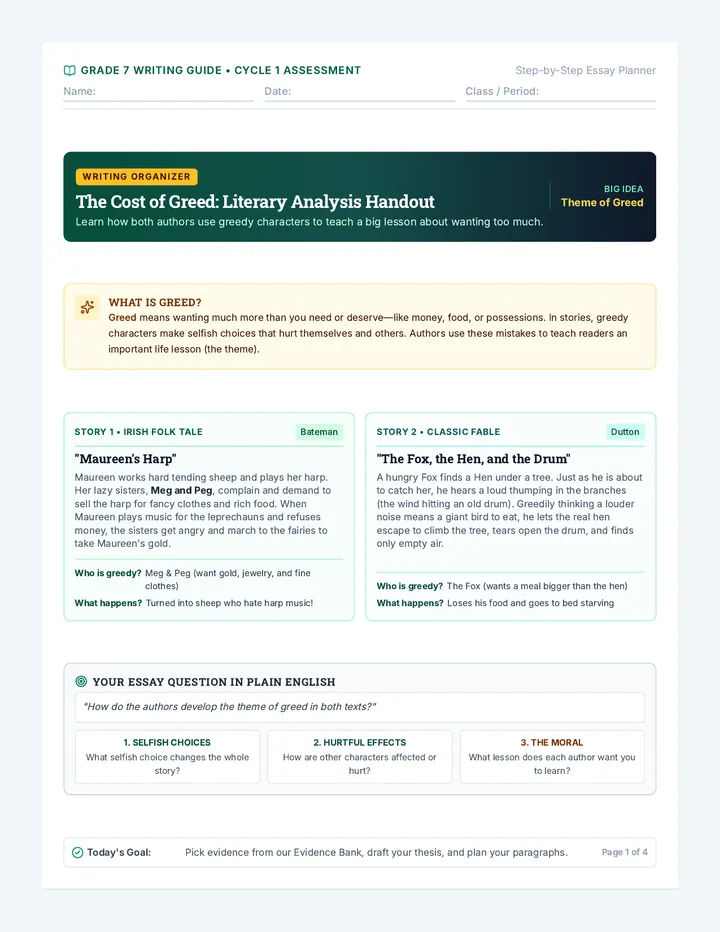
The Ghost Fleet of Mallows Bay
[¶1]During World War I, the United States rushed to build hundreds of wooden steamships to carry supplies across the Atlantic. When the war ended abruptly in 1918, the ships became unnecessary. Over one hundred giant wooden hulls were towed into Mallows Bay on the Potomac River and burned to the waterline, leaving charred skeletons stranded in shallow water.
[¶2]For decades, people called it an environmental eyesore. But over time, something astonishing took place. Trees and marsh grasses rooted directly into the decomposing wooden decks. Today, these "ghost ships" serve as artificial reefs. They shelter rare river otters, provide nesting perches for bald eagles, and protect nurseries of striped bass. What began as discarded wartime trash transformed into a thriving wildlife sanctuary.
1 Which piece of text evidence best proves that the ghost ships help wildlife?
A "Over one hundred giant wooden hulls were towed into Mallows Bay..."
B "They shelter rare river otters, provide nesting perches for bald eagles, and protect nurseries of striped bass."
C "When the war ended abruptly in 1918, the ships became unnecessary."
2 Constructed Response: Explain how the ships changed over time. Cite one direct quote using a starter from the toolkit.
Your Written Response:
Focus: Quoting Directly & Using Evidence Sentence Stems Page 3 of 4
Mastery Challenge
Final Case: The Falcon Comeback
Target Skills: Main Idea Inference Evidence
Comprehensive Case Study Word Count: 135
Sky Hunters in the Concrete Jungle
[¶1]The peregrine falcon is celebrated as the fastest creature on Earth, capable of plunging at speeds over 200 miles per hour. Yet by 1970, this fierce raptor had completely vanished from the eastern United States. Toxic agricultural pesticides had caused falcon eggshells to become brittle and break before chicks could hatch.
[¶2]After the harmful chemicals were banned, conservation scientists began a daring rescue mission. They released captive-bred falcon chicks onto high balconies and bridge towers in major metropolitan centers like New York and Chicago.
[¶3]Surprisingly, the birds flourished in urban environments. Tall concrete skyscrapers closely resembled their natural rocky cliff edges, safely keeping eggs away from ground predators. City skies also provided an endless supply of pigeons and starlings. Today, peregrine falcons have made a triumphant recovery, showing that human cities can sometimes offer an unexpected refuge for endangered wildlife.
1 Main Idea: What is the central message of the entire passage?
A Falcons fly over 200 miles per hour when hunting.
B Peregrine falcons successfully rebounded by adapting to city life.
2 Supporting Detail: According to paragraph 1, what caused falcon eggshells to break?
3 Inference: Why are skyscraper ledges safer for falcon chicks than city parks or ground bushes?
4 Citing Evidence: Quote one exact sentence from paragraph 3 that proves cities provided plenty of food for falcons.
Start with: The author writes, "..."
Detective Self-Check:
Still Need Practice Getting Clues Down Case Mastered!
Focus: Integrated Reading Comprehension Review & Self-Assessment Page 4 of 4