Lenny.com
Explore
Create
ActivitiesNewMathEnglish Language ArtsScience & EngineeringSocial StudiesGlobal LanguagesHealth & Physical EducationSpecial EducationCounseling & Life SkillsArts & CreativityESL
Lenny.com
Lenny.com
Explore
Create
ActivitiesNewMathEnglish Language ArtsScience & EngineeringSocial StudiesGlobal LanguagesHealth & Physical EducationSpecial EducationCounseling & Life SkillsArts & CreativityESL
Lenny.com
Lenny.com

Solutions

Lenny for EducatorsLenny for SchoolsLenny for Districts

Product

ExploreSign inCreateSupportAbout

Resources

Getting startedMTSS Acceleration Program

© 2026 Lenny Learning Inc.

TermsPrivacyAccessibility
LinkedInInstagramX
Lenny
English Language ArtsPhonics & Reading FoundationsLetter IdentificationLearn Letters A-ZLowercase and Uppercase LettersConsonants and VowelsLetter-Sound AssociationsLetter-Sound Associations: LowercaseLetter-Sound Associations: UppercaseBeginning and Ending SoundsRhymingBlending And SegmentingShort VowelsShort Vowel SoundsConsonant BlendsConsonant DigraphsBlends, Digraphs, and TrigraphsDigraphs, Blends, and Silent LettersLong Vowel SoundsLong Vowel PatternsShort and Long VowelsShort and Long Vowel PatternsSilent EVowel SoundsVowel TeamsR-Controlled VowelsDiphthongs: Oi, Oy, Ou, OwVariant VowelsVariant, Diphthong, And R Vowel PatternsSoft G And CSight WordsIrregular WordsWord RecognitionSyllablesSyllable TypesTwo-Syllable WordsMultisyllabic WordsPhoneme ManipulationDecodable TextsVocabularyAction WordsQuestion WordsNouns and AdjectivesClassify WordsCompound WordsSynonyms and AntonymsHomophonesHomophones and HomonymsShades of MeaningContext CluesPrefixes and SuffixesGreek and Latin RootsAnalogiesIdioms and AdagesForeign Words and ExpressionsWord Choice and UsageReference SkillsReading ComprehensionRead-Along Literary TextsRead-Along Informational TextsReality vs. FictionStory ElementsCharacterSequenceMain IdeaCause And EffectCompare And ContrastReading StrategiesText StructureAuthor's PurposeAuthor's Purpose And ToneAuthor's PerspectivePoint Of ViewThemeInference And ThemeInference And AnalysisPoetry ElementsLiterary DevicesAnalyzing LiteratureAnalyzing Informational TextsComparing TextsAudience, Purpose, And ToneBusiness DocumentsNovel StudyNonfiction Book StudyGrammar & MechanicsSentencesNounsVerbsAdjectivesPronounsCapitalizationPunctuationContractionsConjunctionsPrepositionsArticlesAdjectives And AdverbsVerb TypesVerb TensePronouns And AntecedentsPronoun TypesSubject-Verb AgreementDirect And Indirect ObjectsSentences, Fragments, And Run-OnsPhrases And ClausesCommasSemicolons, Colons, And CommasDashes, Hyphens, And EllipsesSpellingAbbreviationsFormattingVerb Tense And MoodMisplaced ModifiersWritingDescriptive DetailsCreative WritingOpinion WritingTopic SentencesOrganizing WritingLinking WordsSentence VarietyIntroductions And ConclusionsPersuasive And Opinion WritingExpository WritingPersuasive StrategiesDeveloping And Supporting ArgumentsTopic Sentences And Thesis StatementsSummarizingResearch SkillsEditing And RevisingActive And Passive Voice=Writing Clearly And ConciselyDebate & Public SpeakingPublic Speaking BasicsPersuasive TechniquesClaims and EvidenceTypes of ArgumentsReasoning TypesLogical FallaciesTopic ResearchOrganizing EvidenceDebate Speech OrganizationAttacking and Defending ArgumentsClash and EngagementImpact CalculusQuestioning and Cross-ExaminationCritical ThinkingInformal LogicFormal LogicInductive Reasoning

Cost of Greed

A 7th-grade literary analysis lesson focused on comparing how authors develop the theme of greed in 'Maureen's Harp' and 'The Fox, the Hen, and the Drum.' Students examine character choices, consequences, and moral lessons using guided organizers and teacher-supported exemplars.

AMAshley McGregor
"...we can't wear melodies or eat music. If we sold the harp we could all have fine clothes..."

Analysis Key: Demonstrates the sisters' fixation on physical vanity and shallow luxuries over Maureen's art and spiritual joy.

Option B (par. 23): "‘Think of the dresses and jewelry we could have bought!’ Peg said. ‘You always think only of yourself.’"

Analysis Key: Dramatic irony. The sisters project their own extreme selfishness onto Maureen, proving greed warps empathy.

Option C (par. 34): "‘Of course we want Maureen’s reward,’ Meg said. ‘Did you think you could get away without paying her?’"

Analysis Key: Direct climax of their greed. Demanding payment for art they did not create seals their transformation into beasts.

"The Fox, the Hen, and the Drum" (Dutton)

Option A (par. 3): "‘A noise as loud as that must be made by a fowl much larger than this Hen. I will, therefore, let her go...’"

Analysis Key: Shows how greed distorts logical reasoning. The Fox abandons real, present food for an exaggerated assumption.

Option B (par. 4): "He soon had it open, only to see that it was filled with nothing more or less than empty air. The Fox hung his tail."

Analysis Key: Powerful symbolism. The empty drum represents the emptiness of greedy desires, ending in humiliation.

Option C (par. 5): "‘What a stupid wretch I am!’ he groaned. ‘Because of my own greediness, I must now go supper-less to bed.’"

Analysis Key: Direct thematic statement. The character explicitly acknowledges that greed, not bad luck, caused his starvation.

Exemplar Thesis Statements Across 3 Proficiency Levels

Use these models to evaluate student thesis statements in Step 2 of their handout:

Scaffolded / Approaching Grade Level: Score: 2.5 - 3.0

"In 'Maureen's Harp' by Teresa Bateman and 'The Fox, the Hen, and the Drum' by Maude Barrows Dutton, both authors develop the theme of greed by showing that characters make selfish choices to get more, which leads to punishments like turning into sheep or going hungry, teaching readers that greed causes loss."

Proficient / Target Grade Level (Meets Standard): Score: 3.5 - 4.0

"In 'Maureen's Harp' and 'The Fox, the Hen, and the Drum,' Teresa Bateman and Maude Barrows Dutton develop the theme of greed by showing how characters' uncontrolled desires drive them to abandon gratitude and pursue unearned rewards, ultimately causing them to lose the very blessings they sought to multiply."

Advanced / Exemplary (Exceeds Standard): Score: 4.0+

"Through the selfish scheming of Meg and Peg in 'Maureen's Harp' and the impulsive folly of the Fox in 'The Fox, the Hen, and the Drum,' both authors illustrate that greed blinds individuals to the value of contentment, revealing that those who exploit others or recklessly pursue illusions inevitably bring about their own ruin."

Grade 7 Writing Assessment • Teacher Answer Key Page 2 of 4

2

Step 3 Key: Fully Articulated Model Paragraphs (Intro, Body 1, Body 2)

Model Writing

Model Paragraph 1: Introduction Exemplar

Exemplar Text

In storytelling and in life, greed is a dangerous flaw that convinces individuals that what they have will never be enough. Rather than appreciating everyday gifts, greedy characters often take reckless risks or mistreat those around them. This moral lesson is central to both the Irish folk tale "Maureen's Harp" by Teresa Bateman and the classic fable "The Fox, the Hen, and the Drum" by Maude Barrows Dutton. In both passages, central characters are undone by their own selfish appetites. Ultimately, both authors develop the theme of greed by demonstrating that when characters prioritize selfish desires over honesty and gratitude, their actions lead to severe consequences that leave them with less than what they started with.

Model Paragraph 2: Body 1 Exemplar • "Maureen's Harp"

Meg & Peg Analysis

In "Maureen's Harp," Teresa Bateman develops the theme of greed through the sisters Meg and Peg, whose selfish actions directly drive the story's conflict. From the beginning, the sisters lay idle while Maureen works, constantly demanding to sell their only heirloom because they "can’t wear melodies or eat music" (par. 4). When Maureen performs for the leprechauns and accepts only the joy of playing, Meg and Peg react with furious outrage: "‘Think of the dresses and jewelry we could have bought!’ Peg said. ‘You always think only of yourself’" (par. 23). This reaction reveals the blinding nature of their greed; they hypocritically accuse the selfless Maureen of selfishness simply because she did not exploit her talent for material gold. Motivated by avarice, they march to the fairies and demand payment for work they never did. Consequently, the leprechaun king rewards them according to their character by transforming them into sheep with golden fleeces. By stripping Meg and Peg of their humanity and leaving them to shiver and cover their ears whenever Maureen plays, Bateman illustrates that unearned greed dehumanizes people and turns life's sweetest joys into unbearable misery.

Model Paragraph 3: Body 2 Exemplar • "The Fox, Hen, & Drum"

The Fox Analysis

Similarly, in "The Fox, the Hen, and the Drum," Maude Barrows Dutton develops the theme of greed by showing how a single selfish decision causes an animal to lose what was already within reach. When a hungry Fox spots a plump Hen, he is about to secure a meal until he hears branches beating against a drum. Driven by greed, he reasons: "‘A noise as loud as that must be made by a fowl much larger than this Hen. I will, therefore, let her go, and will bring down that larger bird for my supper’" (par. 3). Rather than being grateful for the meal before him, the Fox's greed leads him to make a foolish gamble. His noisy, aggressive scramble startles the Hen, allowing her to fly to safety. After tearing open the drum with tooth and claw, he discovers that it contains "nothing more or less than empty air" (par. 4). Dutton uses the empty drum as a metaphor for greed itself: an alluring illusion that hollows out true satisfaction. In his own words, the Fox admits, "‘Because of my own greediness, I must now go supper-less to bed’" (par. 5). Through the Fox's hunger and shame, Dutton proves that greed blinds individuals with false promises, leaving those who refuse to be satisfied with nothing at all.

Grade 7 Writing Assessment • Teacher Answer Key Page 3 of 4

3

Step 4 Key: Model Synthesis, Conclusion & Scoring Rubric

Evaluation Guide

Model Paragraph 4: Synthesis & Moral Conclusion Exemplar

Conclusion Exemplar

Although "Maureen's Harp" is an Irish fairy tale about familial jealousy and "The Fox, the Hen, and the Drum" is an animal fable about predatory instinct, both authors convey identical warnings about the destructive nature of greed. In Bateman's story, Meg and Peg's greed harms their hard-working sister and results in a permanent physical transformation into beasts, punishing their refusal to appreciate Maureen's music. In Dutton's fable, the Fox's greed allows his prey to escape, punishing his impulsive impatience with acute hunger. Despite these differences in setting and character, both Bateman and Dutton show that greed creates a tragic blindness. When individuals allow greed to govern their choices, they do not gain the grandeur they imagined; instead, they destroy their present security and are left with lasting regret.

Assessment Rubric & Grading Breakdown (4-Point Scale)

LinkIt Grade 7 Writing Standards Alignment

1. Claim & Comparative Thesis Score 1-4

States a clear, nuanced comparative thesis identifying both texts, both authors, character selfish choices, and the universal theme of greed.

2. Text Evidence & Citations Score 1-4

Integrates accurate direct quotes or specific text evidence from both stories with accurate paragraph citations and smooth introductory frames.

3. Analysis of Theme & Plot Score 1-4

Deeply analyzes how selfish actions drive the plot, impact other characters (Maureen, Hen), and develop the author's moral lesson rather than merely summarizing.

4. Organization & Conventions Score 1-4

Uses comparative transition words (Similarly, However, In contrast); maintains formal academic tone; correct spelling, capitalization, and punctuation.

Common Student Misconceptions & Rapid Teacher Reteach:

• Misconception 1: Students write about Maureen's goodness rather than analyzing Meg & Peg's greed.
Reteach: Prompt students: "Maureen is the hero, but who makes the selfish choice that changes the plot?"

• Misconception 2: Students claim the Fox was just unlucky rather than greedy.
Reteach: Highlight paragraph 5: The Fox directly admits he is hungry because of his "own greediness."

Complete Teacher Guide & Scoring Key Page 4 of 4
You might also like

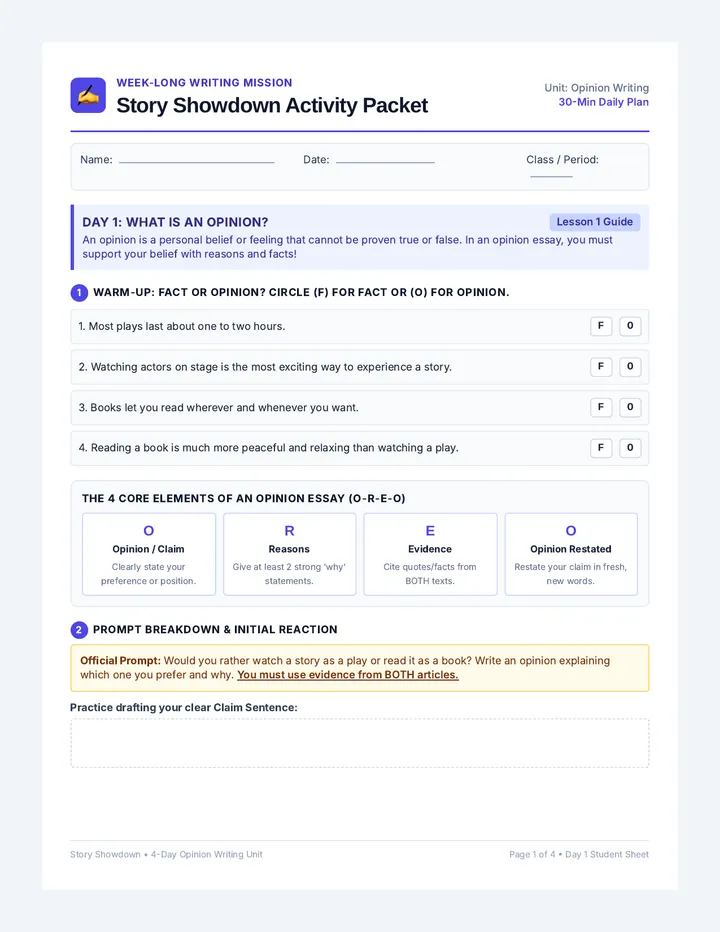
Story Showdown Activity Packet

Story Showdown

A four-day opinion writing unit guiding students through forming claims, analyzing paired texts, and crafting evidence-based essays comparing theatrical plays and books.

SM

Samantha McBath

6
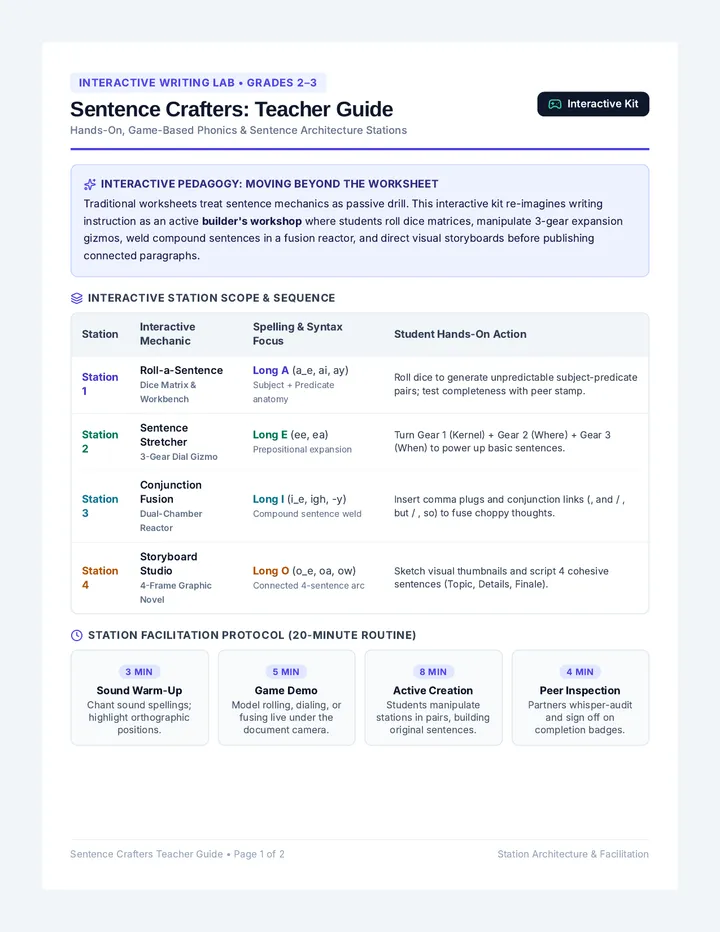
Sentence Crafters Teacher Guide

Sentence Crafters

A scaffolded writing curriculum connecting long vowel phonics mastery (a, e, i, o) directly to sentence architecture. Students progress through daily routines from identifying subjects and predicates to crafting expanded compound sentences and multi-sentence paragraphs.

KS

Kaila Strubhart

3
Reading Points Tracker Chart

Reading Points Tracker Chart

A clean, basic 10-step visual reading points tracker chart designed for elementary and middle school students. It features an ascending progress ladder where colored sections represent points earned and empty sections show points still needed, with customizable fields for individualized goals without hardcoded point values.

KS

Kaila Strubhart

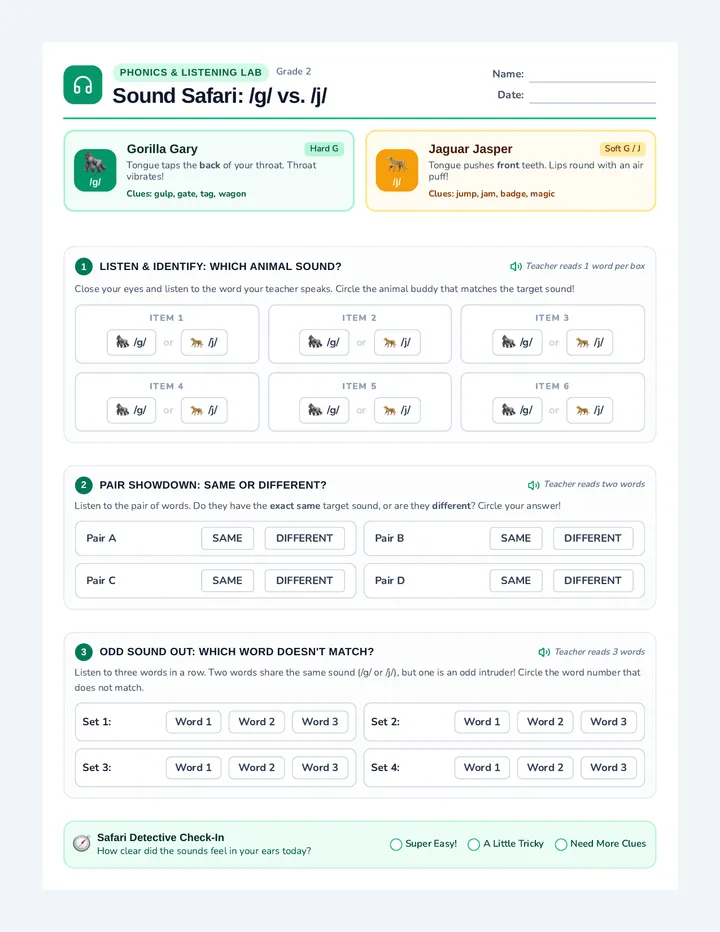
Sound Safari Activity

Sound Detectives Lab

A comprehensive second-grade phonemic and auditory discrimination curriculum targeting easily confused consonant pairs and digraphs through diagnostic listening sheets, teacher scripts, and tactile sorting manipulatives.

C

cnduffy

4
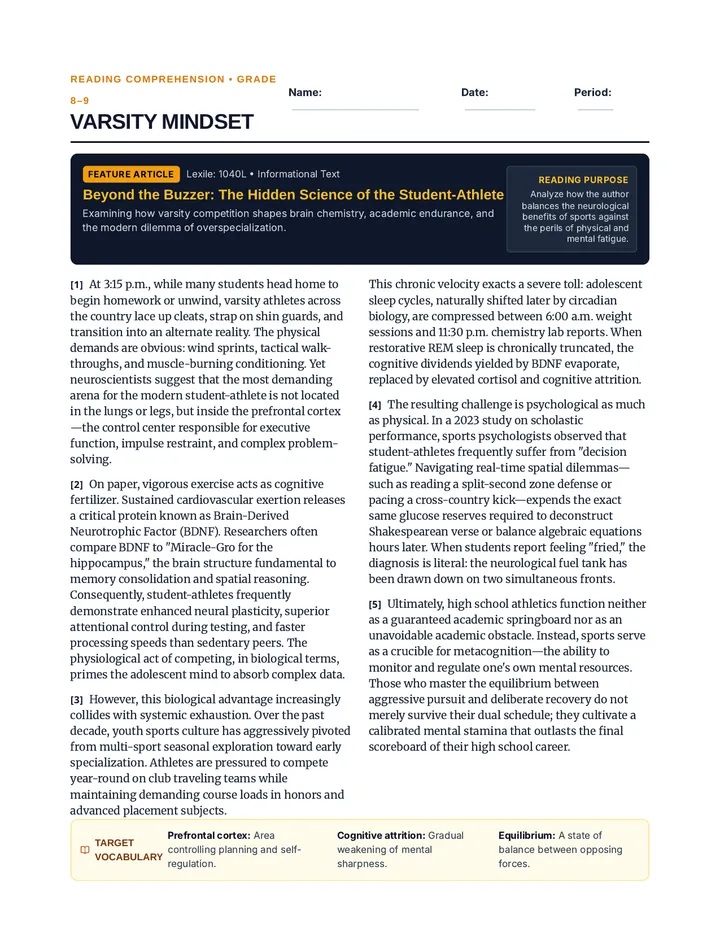
Varsity Mindset Worksheet

Varsity Mindset

An 8th-9th grade reading comprehension lesson exploring the physiological, academic, and psychological dynamics of the modern student-athlete.

AR

Alexander Rhea

2
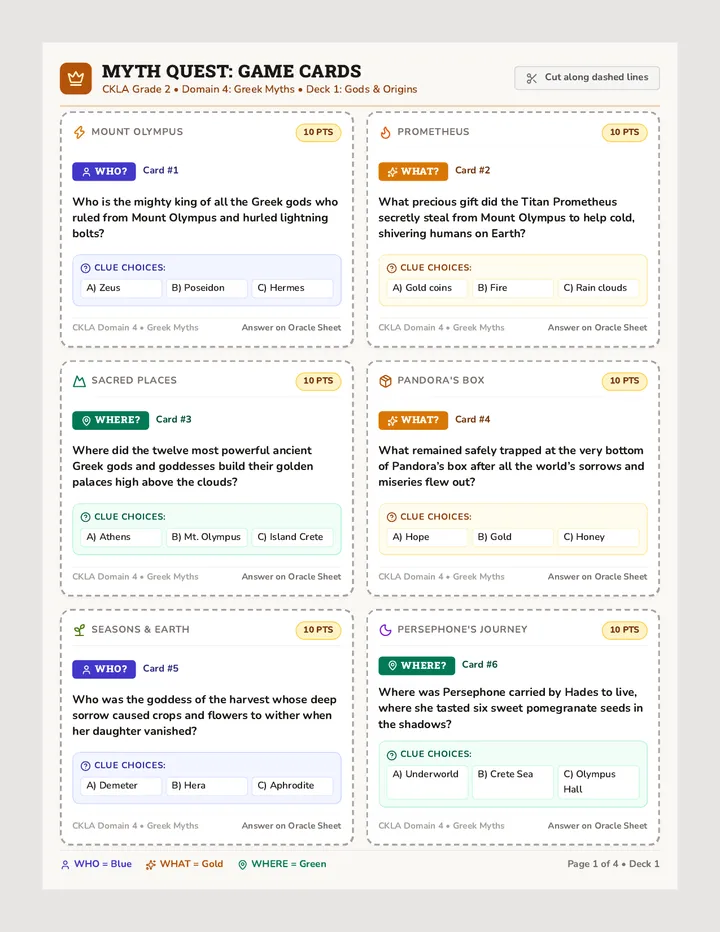
Myth Quest Game Cards

Myth Quest Game Cards

A 4-page classroom game card set featuring 18 Who, What, and Where trivia challenge cards based on CKLA Grade 2 Domain 4 Greek Myths. Includes cutting guides, point values, multiple-choice clues, and a master answer key with game rules and scorecards.

T

Toni.Godsey

Monday Sentences Worksheet

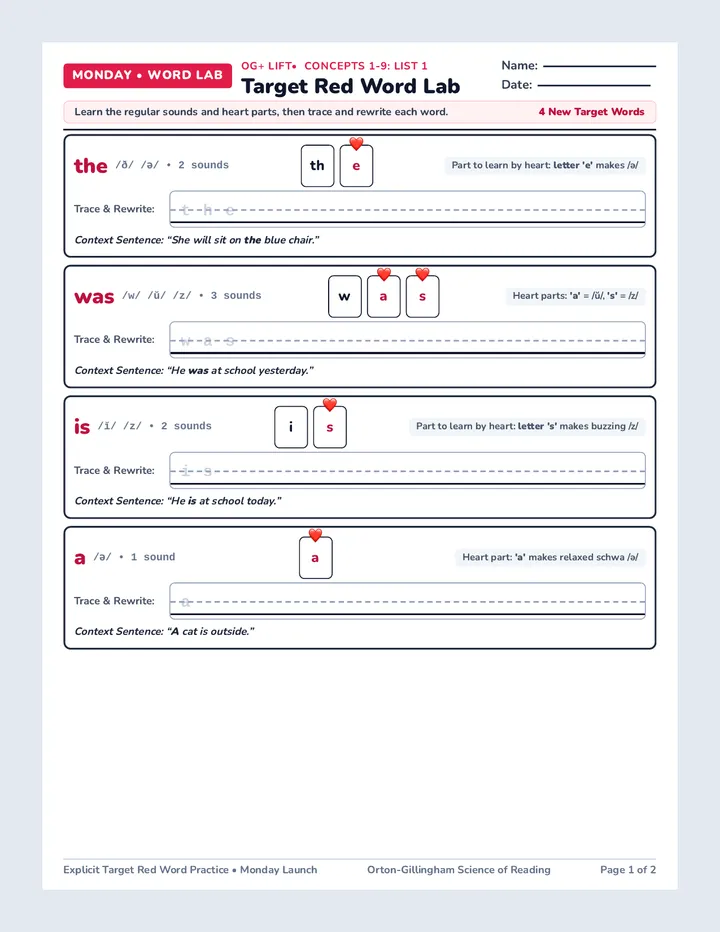
Red Words Weekly Routine Week 1

A five-day Orton-Gillingham instructional sequence targeting 11 high-frequency red and decodable words through consistent daily routines, progressive sentence pyramids, and decodable stories.

S

Sara

43
Recess Champions Reading Worksheet

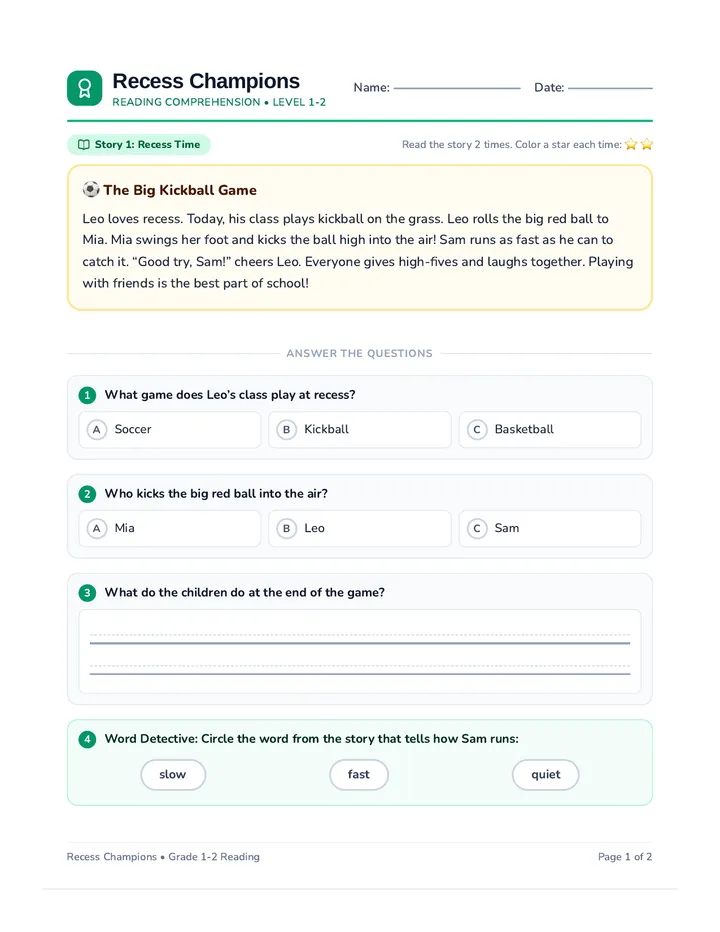
Recess Champions

An engaging early elementary reading comprehension lesson focusing on school sports and teamwork, designed for 1st and 2nd grade literacy development.

AR

Alexander Rhea

2
Maple Street Drama Worksheet

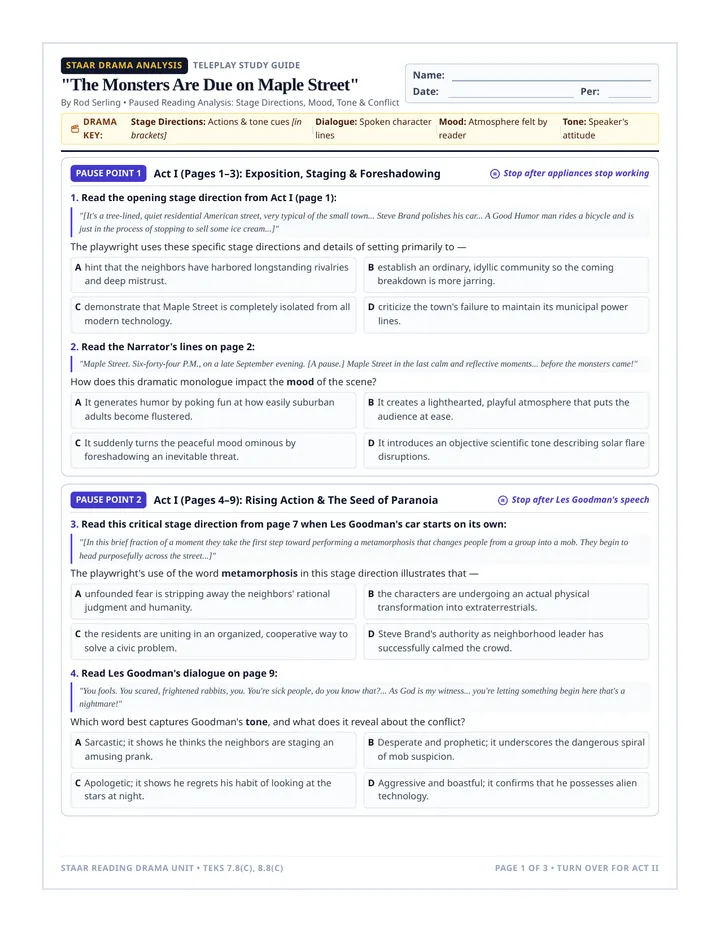
Maple Street Drama Worksheet

A STAAR-aligned 3-page reading, analysis, and multimedia comparison study guide for Rod Serling's "The Monsters Are Due on Maple Street." Page 3 replaces the observation matrix with targeted STAAR film analysis questions on cinematography, sound design, and actor performance, accompanied by a comparative synthesis writing prompt.

K

knessa

Echo Champ Tracker Phase 1

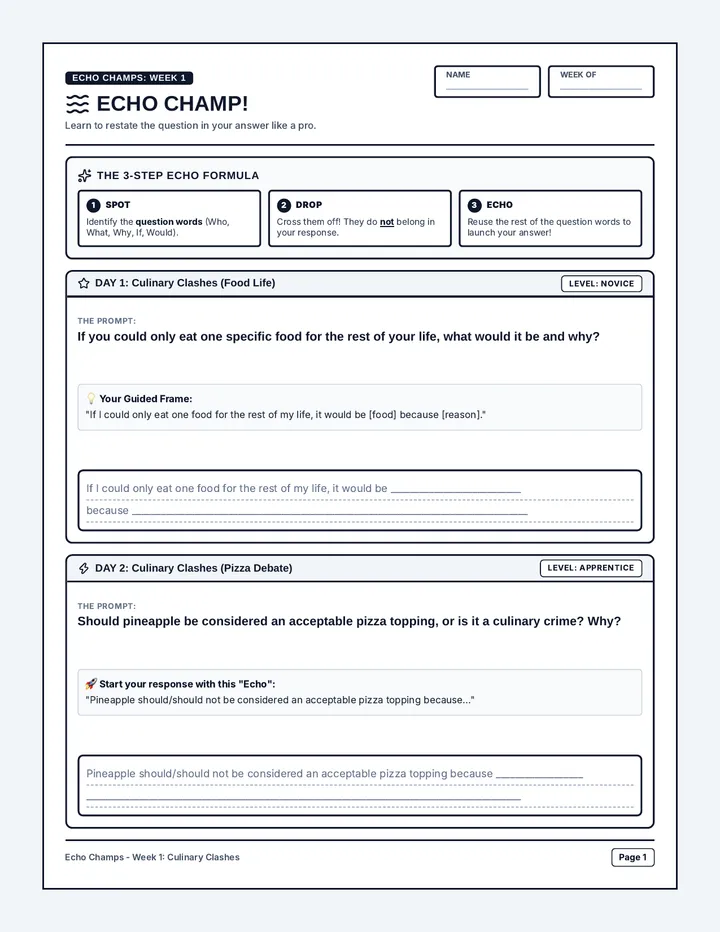
Echo Champs Unit

A comprehensive twelve-week scaffolded daily bell ringer sequence designed to help students master restating the question, featuring an initial six-week core sequence and a dedicated six-week Tier 2 intervention for students requiring additional practice.

CP

Camryn Pope

12
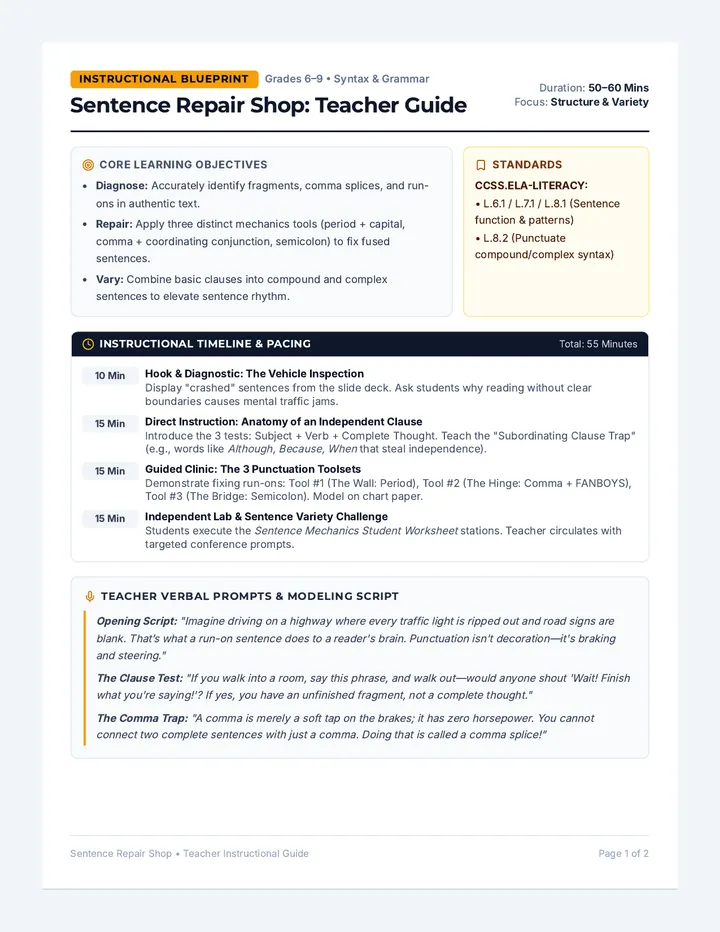
Sentence Repair Teacher Guide

Sentence Repair Shop

A comprehensive middle school grammar lesson focused on sentence anatomy, diagnosing and repairing fragments and run-on sentences, and crafting sentence variety. Students analyze clauses, apply punctuation formulas, and rebuild weak syntax into dynamic writing.

T

timothy.nixon

4
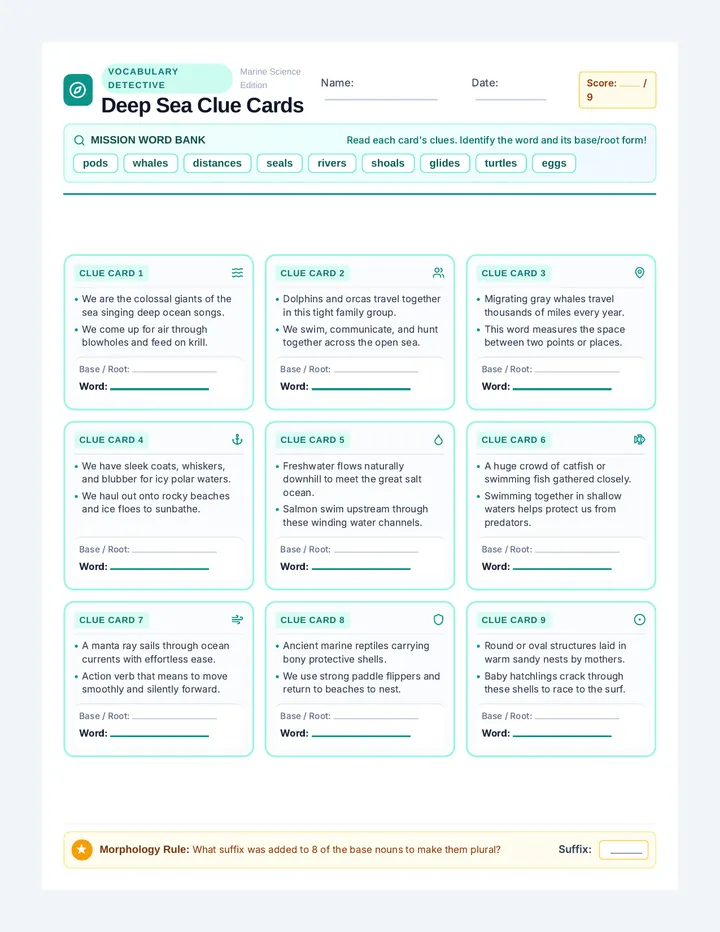
Ocean Clue Cards Game

Ocean Clue Cards Game

A two-page interactive vocabulary game featuring 9 ocean-themed clue cards, a student mystery recording sheet with word root analysis, and a printable cut-and-play card deck for partner or small-group gameplay.

DH

Danielle Healy