Praxis Reading Study Guide
Praxis 5205 Teaching Reading: Elementary
6-Week Master Study Roadmap
Test Date: Monday, Dec 7, 2026
Study Window: Oct 26 – Dec 6 (6 Weeks)
Candidate Name___________________________
Target Score / State CutScore: _____ / Cut: 159
Daily Study Target60–75 Min / 5 Days per Week
Praxis 5205 Structure & Weighted Domains
Test Length
150 Min
2.5 Hours Continuous
Selected Response
90 Items
~75% of Total Score
Constructed Response
3 Items
~25% of Total Score
Target Raw Score
70%+
Aim for 65+ SR correct
I. Phonological Awareness
~15% (~14 Qs)
II. Phonics & Words
~20% (~18 Qs)
III. Fluency & Vocab
~21% (~19 Qs)
IV. Comprehension
~22% (~20 Qs)
V. Writing & Assessment
~22% + 3 CR Qs
Master 6-Week Timeline: Oct 26 – Dec 7
Paced specifically for high-yield mastery
Week 1 Oct 26–Nov 1
Domain I: Phonological Awareness & Concepts About Print
Phonemic manipulation, rhyming, syllable blending/segmenting, print tracking, Elkonin boxes.
Foundation
Week 2 Nov 2–Nov 8
Domain II: Phonics, Morphology & Word Recognition
6 Syllable types, orthographic mapping, phoneme-grapheme mapping, affixes, etymology, Ehri's phases.
Core Phonics
Week 3 Nov 9–Nov 15
Domain III: Reading Fluency & Academic Vocabulary Acquisition
Accuracy, automaticity, prosody, WCPM norms, Beck's 3 Tiers of Vocabulary, Frayer models, morphology.
Bridge Skills
Week 4 Nov 16–Nov 22
Domain IV: Literary & Informational Text Comprehension
Scarborough's Rope, text structures, QAR, reciprocal teaching, metacognition, close reading routines.
Comprehension
Week 5 Nov 23–Nov 29
Domain V: Writing, Research & Diagnostic Assessment
Writing stages, miscue analysis, running records, diagnostic screener data, holiday-paced drills.
Data & Analysis
Week 6 Nov 30–Dec 6
Constructed-Response Mastery, Timed Mocks & Taper
Full 150-min timed practice exam, error debrief, writing 3 CR responses, test-day logistics lock-in.
Peak Readiness
Standard Weekly Study Protocol (60–75 Min/Session)
Day 1: Theory
Read core concepts, study Science of Reading research definitions.
Day 2: Application
Analyze teaching scenarios, student artifacts, and classroom models.
Day 3: Targeted Qs
Take 25–30 domain practice items under timed conditions.
Day 4: Error Log
Review misses in-depth; explain why the distractor was incorrect.
Day 5/Weekend
Flashcard active recall + draft 1 constructed-response prompt.
Praxis 5205 Study Guide • Target Test Date: December 7, 2026 Page 1 of 5
PHASE 1
Foundational Reading & Word Recognition
Weeks 1 & 2 • Oct 26 – Nov 8
W1
Week 1: Phonological Awareness & Concepts About Print
Oct 26 – Nov 1 • Approx. 15% of Exam (~14 Selected-Response Qs)
Goal: Master Auditory Hierarchy
Mon (Oct 26): Diagnostic & Print Concepts
Book handling, directionality, word boundaries, letter naming fluency, environmental print.
Tue (Oct 27): Phonological Continuum
Word level → Rhyme/Alliteration → Syllable segmenting/blending → Onset-Rime manipulation.
Wed (Oct 28): Phonemic Awareness Operations
Phoneme isolation, blending, segmenting, deletion, addition, substitution (purely auditory!).
Thu (Oct 29): Diagnostic Screener Protocols
Elkonin sound boxes, DIBELS/AIMSweb benchmarks, dialect vs phonological deficit.
Fri (Oct 30): Practice Test Drill (25 Qs)
Timed domain test. Score target: 80%+. Log any missed question reasons in error log.
Weekend (Oct 31–Nov 1): Active Review
Flashcard review (phoneme vs morpheme vs grapheme). Draft 1 mini phoneme error analysis.
Praxis Trap: Phonemic awareness is auditory/oral with NO print. Once letters are introduced, it becomes phonics!
Score Target: 20/25
W2
Week 2: Phonics, Morphology & Word Recognition
Nov 2 – Nov 8 • Approx. 20% of Exam (~18 Selected-Response Qs)
Goal: Master 6 Syllable Types
Mon (Nov 2): Letter-Sound & Spelling Rules
Consonant digraphs (sh, ch), blends (bl, str), diphthongs (oi, ou), vowel teams, hard/soft c & g.
Tue (Nov 3): The 6 Syllable Types
Closed (cat), Open (he), VCe (cake), Vowel Team (boat), R-Controlled (bird), Consonant-le (table).
Wed (Nov 4): Syllabication & Structural Analysis
Syllable division patterns (VC/CV, V/CV, VC/V). Morphemes: prefixes, Latin roots, Greek combining forms.
Thu (Nov 5): Sight Words & Orthographic Mapping
Ehri's Word Reading Phases (Pre, Early, Full, Consolidated). Heart word method vs rote memorization.
Fri (Nov 6): Domain II Practice Drill (30 Qs)
Timed practice set. Focus heavily on identifying syllable patterns and student spelling error types.
Weekend (Nov 7–8): Miscue Analysis Simulation
Analyze running record data for cueing systems: Visual/Graphophonic vs Meaning vs Syntax.
Memory Mnemonic: CLOVER = Closed, Consonant-Le, Open, Vowel Team, Magic E (VCe), R-Controlled.
Score Target: 24/30
Weekly Checkpoint Prompt: Orthographic Analysis Self-Grading Prompt
Scenario: A 1st-grader writes "FLOTE" for float and "SHOPIN" for shopping. What reading development phase are they in, and what targeted lesson is required?
Model Key: Full Alphabetic / Transitional spelling. The student understands long vowel sounds and inflections but requires instruction on vowel digraph conventions (oa vs o_e) and doubling rules for short vowel closed syllables before adding -ing.
Praxis 5205 Study Guide • Foundational Literacy Phase Page 2 of 5
PHASE 2
Fluency, Vocabulary & Text Comprehension
Weeks 3 & 4 • Nov 9 – Nov 22
W3
Week 3: Reading Fluency & Academic Vocabulary
Nov 9 – Nov 15 • Approx. 21% of Exam (~19 Selected-Response Qs)
Goal: Fluency Triad & Tier 2 Words
Mon (Nov 9): The Fluency Triad & Benchmarks
Accuracy (95%+), Rate (WCPM norms), Prosody (expression, phrasing, intonation). Cognitive load theory.
Tue (Nov 10): Evidence-Based Fluency Interventions
Repeated reading, assisted reading, choral/echo reading, reader's theatre. (Round-robin reading is ALWAYS wrong!).
Wed (Nov 11): Beck's Three Tiers of Vocabulary
Tier 1 (basic everyday), Tier 2 (high-utility academic: analyze, justify), Tier 3 (domain-specific: photosynthesis).
Thu (Nov 12): Vocabulary Instructional Strategies
Frayer Model (definition, facts, examples, non-examples), semantic feature analysis, morphology, word webs.
Fri (Nov 13): Domain III Practice Drill (25 Qs)
Timed practice set. Emphasize questions testing vocabulary selection and reader fluency diagnosis.
Weekend (Nov 14–15): CR Question Practice #1
Write a 15-minute response on diagnosing a student with fast rate but poor prosody and comprehension.
Praxis Rule: Direct vocabulary instruction should ALWAYS prioritize Tier 2 words because they unlock cross-curricular comprehension!
Score Target: 21/25
W4
Week 4: Literary & Informational Text Comprehension
Nov 16 – Nov 22 • Approx. 22% of Exam (~20 Selected-Response Qs)
Goal: Close Reading & Scaffolds
Mon (Nov 16): Theoretical Comprehension Models
Simple View of Reading (RC = Decoding × Language Comprehension). Scarborough's Reading Rope strands.
Tue (Nov 17): Informational Text Structures
Chronological, cause/effect, compare/contrast, problem/solution, description. Signal words & graphic organizers.
Wed (Nov 18): Literary Analysis & Elements
Theme, character traits vs feelings, setting impact, point of view (1st vs 3rd omniscient), poetic devices.
Thu (Nov 19): Active Metacognitive Scaffolds
Reciprocal Teaching (predict, question, clarify, summarize), QAR taxonomy (Right There, Think & Search, Author & You, On My Own).
Fri (Nov 20): Domain IV Practice Drill (30 Qs)
Timed practice set focusing on passage-based questions, inferencing items, and scaffold selection.
Weekend (Nov 21–22): CR Question Practice #2
Constructed Response prompt: identify comprehension deficit from student response and assign evidence-based intervention.
Key Distiction: Graphic organizers MUST match text structure: Venn diagram for compare/contrast; flow chart for chronological sequence!
Score Target: 25/30
Weekly Checkpoint Prompt: Comprehension Scaffolding Self-Grading Prompt
Scenario: 4th-grade students can answer literal "Right There" questions after reading a science article about ecosystems, but struggle to answer inferential questions requiring text synthesis. What is the most effective evidence-based strategy?
Model Key: Model explicit QAR (Question-Answer Relationship) and Think-Alouds showing how to combine explicit clues in the text with schema ("Author and You"). Utilize reciprocal teaching summarizing and questioning roles.
Praxis 5205 Study Guide • Intermediate Fluency & Meaning Phase Page 3 of 5
PHASE 3
Assessment, Writing & Peak Test-Day Countdown
Weeks 5 & 6 • Nov 23 – Dec 6
W5
Week 5: Writing, Assessment & Data (Thanksgiving Week)
Nov 23 – Nov 29 • Paced for Holiday Flexibility (~22% Total Weight)
Focus: Assessment Data & Writing Stages
Mon (Nov 23): Stages of Writing Development
Precommunicative → Semiphonetic → Phonetic → Transitional → Conventional writing.
Tue (Nov 24): The Writing Process & Genre Scaffolds
Prewriting, drafting, revising (content), editing (mechanics), publishing. Mentor texts & rubrics.
Wed (Nov 25): Diagnostic Assessment Landscape
Screening vs Diagnostic vs Progress Monitoring vs Summative. Norm-referenced vs Criterion-referenced.
Thu (Nov 26 - Thanksgiving): Micro-Drill (25 min)
Light flashcard session on test acronyms: IRI, QRI, WCPM, CBM, RTI/MTSS tiers while traveling/resting.
Fri (Nov 27): Running Records & Miscue Data
Calculate accuracy rate: (Total words - Errors) / Total words × 100. Self-correction ratio calculation.
Weekend (Nov 28–29): Comprehensive Mixed Drill
Complete 40 mixed domain practice questions. Identify your bottom 2 weakest test topics for Week 6.
Reading Levels Rule: Independent = 95–100% accuracy | Instructional = 90–94% | Frustration = <90%. Never test comprehension on frustration level text!
Score Target: 34/40
W6
Week 6: The Final Countdown & Full Practice Simulation
Nov 30 – Dec 6 • Taper & Final Exam Readiness
TEST: MON, DEC 7
Mon (Nov 30): FULL TIMED MOCK EXAM
Simulate exact conditions: 90 SR items + 3 CR prompts. Strictly enforce 150 minutes uninterrupted.
Tue (Dec 1): Exhaustive Mock Debrief
Review every missed question. Write out the exact misconception in your test log.
Wed (Dec 2): Weakest Domain Deep-Dive
Spend 90 minutes drilling exclusively your lowest-scoring domain from Tuesday's diagnostic.
Thu (Dec 3): 3-Prompt Constructed Speed Drill
Write 3 full responses in 45 minutes using the 4-step template on Page 5.
Fri (Dec 4): High-Yield Formula & Glossary Refresh
Review 6 syllable types, phonemic stages, and Beck's vocabulary tiers for 45 minutes.
Sat (Dec 5): Logistics Lock-In & Light Review
Confirm testing center route / test-at-home equipment check. 30 min flashcard review max.
Sun (Dec 6): Taper & Mindset Reset (NO CRAMMING)
Read Page 5 Test-Day Game Plan once. Prep ID and clothing. 8 hours of sleep!
Mon (Dec 7): EXAM DAY EXECUTION
Arrive 30 min early; execute time management strategy; earn your passing score!
Praxis 5205 Study Guide • Final Countdown Phase Page 4 of 5
Constructed-Response Playbook & Test-Day Blueprint
The 25% Scoring Anchor: 3 Written Prompts (Scored 0–3 each)
High-Impact Strategy
The 4-Sentence High-Score Template (Use on all 3 CRs)
Each constructed response provides student data (running record, writing sample, or comprehension answers). Scorers award 3/3 for identifying strengths, weaknesses, and evidence-based interventions.
1 Identify Specific Strength with Evidence
"Based on the provided assessment sample, the student demonstrates a clear strength in [skill], as evidenced by their correct use of [exact quotation or word from data]."
2 Identify Specific Deficit with Evidence
"However, the student exhibits a primary instructional need in [skill], as seen when they incorrectly [quote specific error pattern, e.g., substituted short /e/ for /i/ in 'sit']."
3 Name Named Research-Based Intervention
"To address this deficit, the teacher should implement [explicit evidence-based strategy, e.g., explicit Elkonin sound box segmentation with phoneme-grapheme mapping]."
4 Explain Mechanism (Why It Works)
"This strategy supports the student by [mechanistic reason, e.g., making abstract phonemes concrete and reinforcing orthographic mapping of the target vowel pattern]."
High-Yield Deficit-to-Intervention Matcher
| Observed Student Error | Underlying Reading Need | Targeted Intervention Strategy | Key Term |
|---|
| Reads "ship" for "slip" or "fog" for "frog" | Consonant blend omission / segmentation | Elkonin sound boxes with counters for each sound; explicit blend blending routines. | Phonemic Seg. |
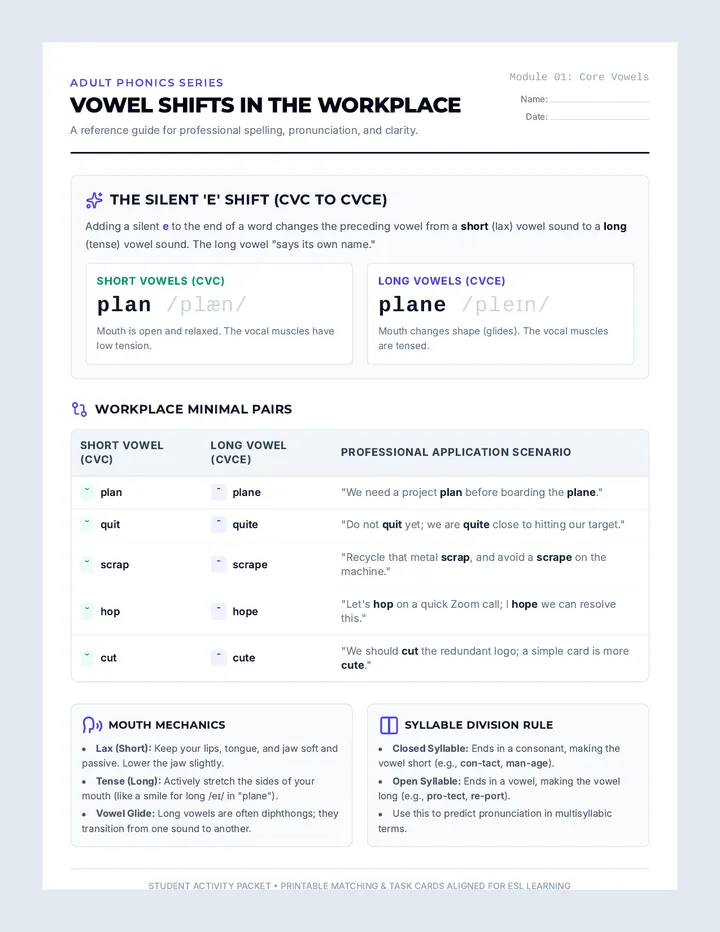
| Reads "pane" for "pan" or "mad" for "made" | Silent-e / VCe pattern confusion | Closed vs VCe minimal word pairs sort (tap/tape, hop/hope) with magnetic letters. | Orthography |
| Reads word-by-word with robotic, flat pitch | Lack of prosody and phrase boundaries | Choral reading with scoop phrases; reader's theater with teacher-modeled intonation. | Prosody |
| Reads fluently but cannot infer character motives | Inferential comprehension breakdown | QAR "Author and Me" questioning protocol; teacher think-aloud modeling textual clues. | Metacognition |
Test-Day Pacing Protocol (150 Minutes Total)
Strict Time Budget
Part 1: Selected Response
90 Minutes (90 Qs)
Average 1 minute per question. If stuck after 60 sec, pick best answer, flag, and immediately move on!
Part 2: Constructed Response
45 Minutes (3 CRs)
Allocate exactly 15 minutes per prompt. Stick rigidly to the 4-step template above. Be concise and specific.
Part 3: Final Buffer
15 Minutes
Review flagged selected-response items. Verify all 3 CR prompts have complete sentences with explicit text evidence.
December 7 Morning Routine:
Primary ID matched to admission ticket • High-protein breakfast • Arrive 30 minutes early • Trust your 6 weeks of prep!
You've Got This!
Praxis 5205 Study Guide • Constructed-Response & Exam-Day Strategy Page 5 of 5