Oral Delivery Critique Response Sheet
Workplace Case Analysis • ECE & Communication
Oral Delivery Critique Response Sheet
Target: Level 3+ Writing
Student:
Date:
Period:
Score:
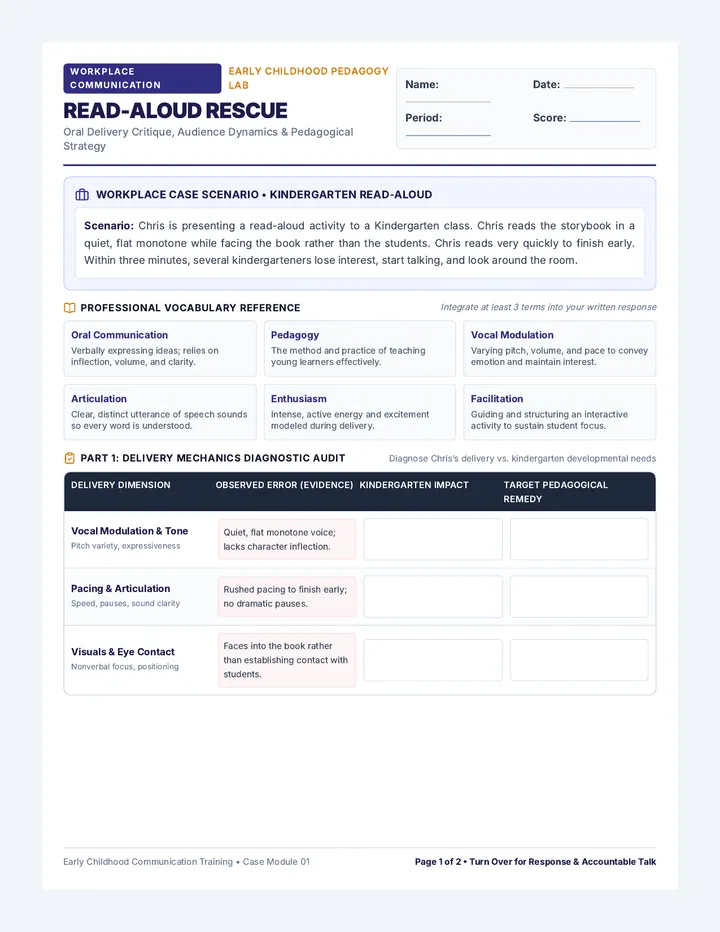
Workplace Scenario: Chris's Kindergarten Read-Aloud
Field Observation
Chris is presenting a read-aloud activity to a Kindergarten class. Chris reads the storybook in a quiet, flat monotone while facing the book rather than the students. Chris reads very quickly to finish early. Within three minutes, several kindergarteners lose interest, start talking, and look around the room.
Observed Errors: Flat Monotone Facing Book / No Eye Contact Rushed Pacing Loss of Engagement
Academic Vocabulary Toolkit (Embed in Analysis)
Target: Use 3+ terms
Oral Communication Verbal expression using clear inflection & delivery.
Vocal Modulation Varying pitch, tone, & volume to sustain interest.
Pedagogy Age-appropriate teaching methods & practices.
Articulation Distinct utterance of speech sounds for clarity.
Facilitation Guiding & structuring the activity smoothly.
Enthusiasm Dynamic, eager energy that sparks attention.
Class Comment Drop Prompt
Analyze Chris's oral delivery. What specific communication errors contributed to the loss of student engagement? What pedagogical delivery techniques should Chris use to regain control and keep kindergarteners focused?
Sentence Frame Assist: “Chris’s oral presentation struggled because [root communication barrier]. Specifically, Chris used [vocal trait] tone and [speed] pacing, which caused the students to [student reaction]. To improve facilitation, Chris should apply pedagogical techniques such as [specific instructional actions] because [developmental rationale].”
Independent Written Response (Level 3+ Analysis)
Write in complete sentences
Level 3+ Writing Self-Check:
Critiqued vocal mechanics Addressed nonverbal errors Proposed Kindergarten pedagogy Used 3+ vocabulary terms
Accountable Talk & Delivery Redesign
Collaborative Peer Defense • Exemplar Deconstruction • Interactive Scripting
Page 2 of 2
Model Level 3+ Exemplar Breakdown
Anchor Text
“Chris’s oral presentation struggled because of poor vocal modulation and lack of visual engagement. Specifically, Chris used a quiet, monotone voice and rushed pacing while looking at the book instead of the audience, causing students to lose interest. To improve facilitation, Chris should apply pedagogical techniques such as varying pitch for character voices, slowing down pacing, and holding up picture cards to maintain visual contact.”
• Root Barrier Identifies modulation & visual disconnection.
• Delivery Mechanics Details tone, rushed speed, and head posture.
• Pedagogical Remedy Gives actionable, age-appropriate solutions.
Accountable Talk Discussion Protocol
1. Justifying Claims “My critique is grounded in the fact that Chris...” “This delivery error directly caused...”
2. Probing / Extending “How would your suggested strategy help...” “What if Chris also incorporated...”
3. Respectful Counter “While I agree pacing was fast, I argue...” “Another priority for kindergarteners is...”
Peer Justification Exchange
Classmate Partner:
A. Summarize your partner's top pedagogical recommendation for Chris:
B. Justify your agreement or explain a refinement to your partner's reasoning using Accountable Talk stems:
Application: Scripting Chris's Opening 60 Seconds
Include [Cues]
Write the revised opening words Chris should say. Include bracketed delivery cues for [Vocal Modulation], [Pacing Pause], and [Eye Contact / Visual Prop].
“Good morning, friends! [Look up with warm smile & wide eyes] Today we have a mystery...”
Teacher Rubric: Level 1 (Emerging) • Level 2 (Developing) • Level 3 (Proficient) • Level 3+ (Mastery & Justified)
Teacher Signature: