Determine the Supporting Details Activity
Hallway Lab Grades 3–4 Reading Comprehension
DETERMINE THE SUPPORTING DETAILS
Teacher Blueprint & Setup 6 Stations • Complete Sentences
Poster Setup: Reading Passage + 7 Cards
[ 1 STATION READING PASSAGE ] Read First as a Squad!
[ 1 MAIN IDEA CARD ] Complete Sentence
Detail 1 Complete Proof
Detail 2 Complete Proof
Detail 3 Complete Proof
[ 3 IMPOSTER TRAPS ] Complete Sentences (Off-Topic)
Trap A: Wrong Topic Trap B: Different Detail Trap C: Habitat Trivia
Lab Equipment
- • 6 Large Chart Sheets: Taped 6–8 ft apart in hall.
- • 6 Station Passages: Mounted on chart paper top.
- • 42 Magnetic Cards: 7 per station (All full sentences).
Detective Roles
Passage Reader: Reads story Magnet Sorter: Moves cards Scribe: Logs team work Scrambler: Resets station
Facilitator Master Key: 18 Imposter Traps
St. 1: Cheetah Speed
X1 (Lions): Different big cat species and pack hunting.
X2 (Cub fur): Camouflage feature, not running speed.
X3 (Zebras): Savanna prey animals grazing.
St. 2: Firefly Squid
X1 (Reefs): Ocean habitat, not squid bioluminescence.
X2 (Eggs): Egg-laying lifecycle, not light survival.
X3 (Giant squid): Different squid species anatomy.
St. 3: Honeybee Dance
X1 (Honey spoil): Honey food chemistry trivia.
X2 (Queen eggs): Hive reproduction, not waggle dancing.
X3 (Wasps): Different insect and wood nest building.
St. 4: River Architects
X1 (Ducks): Pond bird feathers, not dam construction.
X2 (Tail slap): Danger alarm signal, not lodge building.
X3 (Otters): Different river animal sliding for fun.
St. 5: Tree Frogs
X1 (Dart frogs): Ground dart frogs are toxic; tree frogs are not.
X2 (Jelly eggs): Reproduction, not tree safety adaptation.
X3 (Toucans): Rainforest bird fruit eating.
St. 6: Astronaut Life
X1 (Moon orbit): Astronomy orbit time, not chores.
X2 (Space suits): Spacewalk equipment, not daily living.
X3 (Hubble): Telescope astronomy, not station chores.
Detective Rule for Imposters: An imposter can be 100% true in real life, but if it doesn't give direct evidence for the headline, it goes in the trap box!
Teacher Guide • Print Pages 4 & 5 double-sided for student squads. Page 1 of 5 • Teacher Blueprint & Key
STATION POSTER PASSAGES & CARD BANK (1–3)
Mount reading passages on posters; transcribe cards in complete sentences.
Stations 1 • 2 • 3
1 Station 1: Cheetah Speed Animal Adaptations
Station 1 Reading Passage (Mount on Poster): Cheetahs are famous across the African savanna for being the fastest land animals on Earth. When a cheetah spots an antelope, it explodes into a chase that can reach sixty miles per hour in just three seconds. Every part of a cheetah's body is built for explosive acceleration. Its slender frame, lightweight bones, and flexible muscles work together like a high-performance race car to catch swift prey before running out of breath.
Main Idea Card: Cheetahs have special body features that help them sprint at super fast speeds.
3 Supporting Details:
• A flexible spine bends and springs back like a coiled spring to lengthen each stride.
• Tough claws do not retract so they can dig into dirt like running cleats.
• Unusually wide nostrils take in huge gulps of oxygen during high-speed chases.
3 Imposter Traps:
• Lions live together in family groups called prides and hunt as a team.
• Young cheetah cubs grow a thick mantle of smoky gray fur along their backs.
• Herds of zebras graze peacefully across the open savanna plains.
2 Station 2: Firefly Squid Glow Ocean Life
Station 2 Reading Passage (Mount on Poster): Deep in the cold, sunless waters of the ocean, the firefly squid lights up the sea with a dazzling blue glow. This tiny creature measures only three inches long, but its entire body is covered in hundreds of specialized light-producing organs. Living in the deep twilight zone means danger lurks in every shadow. By controlling its brilliant chemical lights, the firefly squid stays hidden, scares away hungry hunters, and finds other squid in the pitch-black water.
Main Idea Card: Firefly squid use their glowing bodies to survive in deep dark ocean water.
3 Supporting Details:
• Hundreds of tiny light organs on the squid's body flash bright blue light into the sea.
• The flashing lights create sudden bright bursts that blind and confuse predator fish.
• Squid pulse their light organs in specific patterns to send signals to friends.
3 Imposter Traps:
• Coral reefs provide shelter for thousands of tropical fish in warm oceans.
• Female firefly squid lay thousands of tiny eggs along ocean rocks every spring.
• Giant squids have enormous eyes the size of basketballs to see in the deep sea.
3 Station 3: Honeybee Waggle Dance Insect Communication
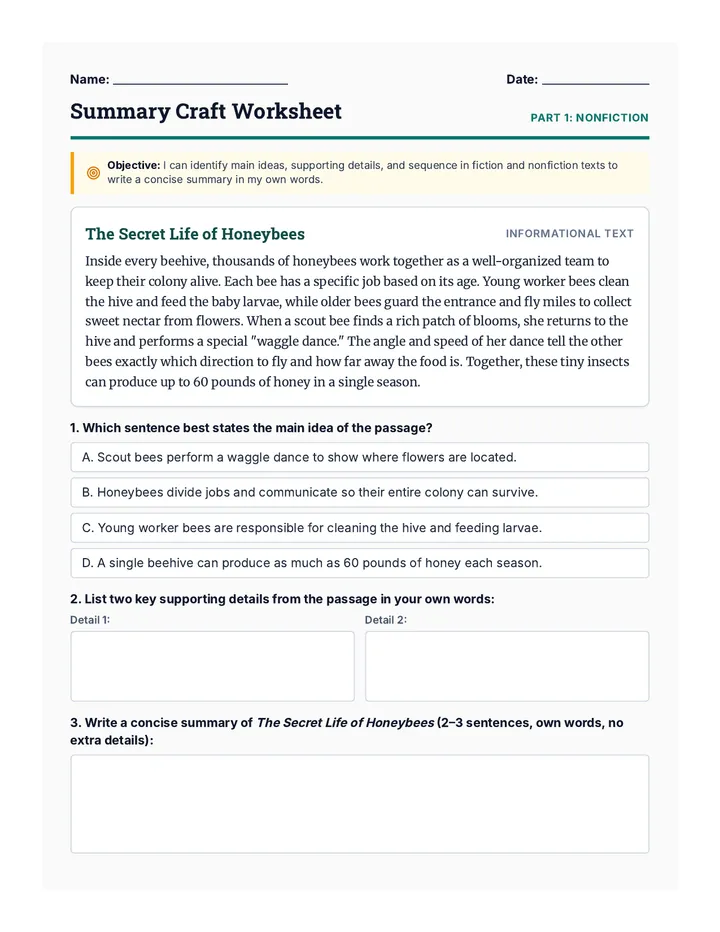
Station 3 Reading Passage (Mount on Poster): Inside a crowded, dark beehive, worker bees need an accurate way to share directions to the sweetest flower patches miles away. Instead of making sounds, scout bees perform a clever routine known as the waggle dance on the vertical honeycomb. Other worker bees gather close in the dark, touching the dancer with their antennae. By following the dancer's vibrating movements, the bees learn exactly which way to fly and how far to travel for food.
Main Idea Card: Honeybees dance inside their dark hive to tell worker bees where food is located.
3 Supporting Details:
• The angle of the bee's straight dance path points toward the position of the sun.
• A longer waggle run across the honeycomb shows that flowers are farther away.
• The dancing bee shares tiny flower nectar samples so workers recognize the scent.
3 Imposter Traps:
• Honey sealed inside jars never spoils because it contains very little moisture.
• A healthy queen bee can lay up to two thousand eggs each day to grow the colony.
• Paper wasps build gray umbrella nests out of chewed wood pulp under roof eaves.
Hallway Poster Passages & Cards • Complete Sentences Page 2 of 5 • Stations 1–3
STATION POSTER PASSAGES & CARD BANK (4–6)
Mount reading passages on posters; transcribe cards in complete sentences.
Stations 4 • 5 • 6
4 Station 4: River Architects River Habitat Builders
Station 4 Reading Passage (Mount on Poster): Along forest rivers and streams, beavers work tirelessly through the night as nature's greatest structural engineers. Without any human blueprints, a family of beavers can completely transform a fast-rushing stream into a quiet, deep pond. They fell sturdy birch and willow trees, pile heavy branches into the water, and seal the cracks with thick river mud. This engineered pond creates a safe, protected sanctuary where beavers can raise their young away from dangerous land predators.
Main Idea Card: Beavers are skilled builders that reshape waterways to create safe underwater homes.
3 Supporting Details:
• Strong orange chisel teeth can chew through a thick tree trunk in under an hour.
• Layers of interwoven branches and heavy mud create durable, watertight dams.
• Beaver lodges feature secret underwater doorways that keep hungry wolves outside.
3 Imposter Traps:
• Mallard ducks swim across calm beaver ponds and spread waterproof oil on feathers.
• Beavers slap their wide, scaly tails against water to warn family of danger.
• Playful river otters slide down slippery mud banks into the water on sunny days.
5 Station 5: Red-Eyed Tree Frogs Rainforest Wildlife
Station 5 Reading Passage (Mount on Poster): High up in the leafy canopy of the Central American rainforest, red-eyed tree frogs spend their lives surrounded by hungry birds, snakes, and bats. Because these little amphibians cannot fight off large predators, they rely on clever physical features to stay alive. During the day, they tuck their bright limbs away and sleep motionless on green leaves. If a predator comes too close, the frog uses a sudden shock tactic that buys it precious seconds to escape into the trees.
Main Idea Card: Red-eyed tree frogs have clever ways to stay safe high up in leafy trees.
3 Supporting Details:
• Sticky suction-cup pads on their toes allow them to climb and cling to wet leaves.
• Flashing their huge scarlet eyes startles predators and gives time to leap away.
• Vibrant lime-green back skin acts as natural camouflage among green foliage.
3 Imposter Traps:
• Poison dart frogs have toxic skin that warns predators they are poisonous to eat.
• Female tree frogs lay clutches of clear jelly eggs on leaves above forest pools.
• Colorful toucans fly through the rainforest canopy searching for ripe wild figs.
6 Station 6: Astronaut Daily Life Space Science
Station 6 Reading Passage (Mount on Poster): Orbiting two hundred and fifty miles above Earth, astronauts aboard the International Space Station live in continuous freefall. In this zero-gravity environment, everything from pencils to water drops floats through the air. Because simple Earth habits no longer work in space, astronauts must completely reinvent their daily routines. They follow carefully engineered procedures to eat their meals, get a restful night's sleep, and keep their bodies healthy while living in space.
Main Idea Card: Astronauts must adapt how they eat, sleep, and exercise in zero gravity.
3 Supporting Details:
• Astronauts eat from sealed pouches with velcro straps so liquids cannot float away.
• Crew members sleep inside padded sleeping bags that are securely tied to walls.
• Astronauts strap onto exercise treadmills for two hours daily to prevent muscle loss.
3 Imposter Traps:
• The Moon takes approximately twenty-seven days to complete one orbit around Earth.
• Pressurized space suits cost millions of dollars and protect astronauts on spacewalks.
• The Hubble Space Telescope captures sharp photographs of distant glowing galaxies.
Hallway Poster Passages & Cards • Complete Sentences Page 3 of 5 • Stations 4–6
DETERMINE THE SUPPORTING DETAILS
Stations 1 • 2 • 3
Squad Name:
Detectives:
Room / Period:
Detective Mission: Read each hallway paragraph first! Then match the 1 Main Idea, find the 3 Supporting Details, and catch all 3 Imposter Traps!
1 Station 1: Cheetah Speed
1. Read Poster Passage
Main Idea Headline (What is the big point?):
3 True Supporting Details (Complete Sentences):
3 Imposter Clues Caught (Off-Topic Traps):
2 Station 2: Firefly Squid Glow
1. Read Poster Passage
Main Idea Headline (What is the big point?):
3 True Supporting Details (Complete Sentences):
3 Imposter Clues Caught (Off-Topic Traps):
3 Station 3: Honeybee Waggle Dance
1. Read Poster Passage
Main Idea Headline (What is the big point?):
3 True Supporting Details (Complete Sentences):
3 Imposter Clues Caught (Off-Topic Traps):
Squad reminder: Mix cards thoroughly before moving to next station! Page 4 of 5 • Squad Log (Stations 1–3)
DETERMINE THE SUPPORTING DETAILS: SIDE 2
Stations 4 • 5 • 6
4 Station 4: River Architects
1. Read Poster Passage
Main Idea Headline (What is the big point?):
3 True Supporting Details (Complete Sentences):
3 Imposter Clues Caught (Off-Topic Traps):
5 Station 5: Red-Eyed Tree Frogs
1. Read Poster Passage
Main Idea Headline (What is the big point?):
3 True Supporting Details (Complete Sentences):
3 Imposter Clues Caught (Off-Topic Traps):
6 Station 6: Astronaut Daily Life
1. Read Poster Passage
Main Idea Headline (What is the big point?):
3 True Supporting Details (Complete Sentences):
3 Imposter Clues Caught (Off-Topic Traps):
Squad Mission Sign-Off Verify your team work:
6 stations solved
18 imposters caught
Posters scrambled
Hallway Lab Complete • Hand in to Facilitator Page 5 of 5 • Squad Log (Stations 4–6)