Dual Lens Writing Template
Mentor Text & Craft Analysis
Exemplar Essay • Grade 7 Analytical Compare & Contrast Model
Step 0: Analyze the Model
Study how the writer organizes claims & evidence
Model Topic: Graphic Novels vs. Traditional Prose Novels
Organizational Style: Point-by-Point
¶ 1 Introduction
When entering a library, readers often debate between grabbing a fast-moving graphic novel or settling into a traditional prose novel. Although graphic novels and traditional novels share the ability to build complex characters and rich emotional worlds, they differ in how they pace storytelling and engage reader imagination, proving that both mediums cultivate unique cognitive strengths.
¶ 2 Similarity: Character Depth
At their foundation, both formats succeed by making readers empathize with protagonists facing genuine conflict. In prose fiction like Jason Reynolds's Ghost, Castle's fear and trauma are revealed through internal monologue. Similarly, in Jerry Craft's graphic novel New Kid, Jordan's isolation is captured through nuanced facial expressions and posture. Both authors achieve equivalent emotional resonance.
¶ 3 Contrast: Pacing & Format
In contrast, the two mediums deliver plot momentum through distinct mechanics. Graphic novels rely on panel transitions and visual gutters, allowing readers to absorb setting and action instantaneously. On the other hand, prose novels require deliberate time, building atmosphere through layered sensory details that unfold gradually across paragraphs.
¶ 4 Contrast: Imagination Demand
Furthermore, each format activates the reader's imagination in contrasting ways. Whereas graphic novels provide explicit illustrations of character appearance and setting, prose forces readers to co-create every scene mentally. Consequently, while graphic novels sharpen visual literacy, prose texts strengthen imaginative visualization.
¶ 5 Conclusion: "So What?"
Ultimately, neither storytelling form is superior to the other; instead, they serve complementary purposes. While prose develops linguistic stamina, graphic novels offer urgent visual commentary. Celebrating both styles expands our definition of what it means to be a powerful, flexible reader.
Thesis Architecture
Notice the yellow highlight: states shared ground first (complex characters), then two specific differences (pacing & imagination), ending with a clear insight.
Similarity Bridge
Green underlined words (both, similarly) establish common ground early so the essay is not purely a list of differences.
Contrasting Pivots
Red underlined words (in contrast, on the other hand, whereas) guide the reader smoothly between the two subjects without jarring shifts.
Equal Analytical Weight
Both graphic novels and prose get concrete titles and equal sentence space in each body paragraph. Neither is treated as an afterthought.
The "So What?" Payoff
The conclusion does not just re-list traits; it explains why this comparison matters to real middle school readers in the broader world.
Deconstruct the Model: Notice & Note Complete these 3 checks with a partner before planning
1. Identify the Pivot:
Where does paragraph 3 shift from Subject A to Subject B? Which signal word triggered it?
2. Test the Thesis:
Does the thesis state a similarity before the differences? How does that strengthen the argument?
3. Find the Takeaway:
What larger lesson about reading does the author deliver in the final sentence of paragraph 5?
Dual Lens Writing System • Part 1: Mentor Text & Model Analysis Page 1 of 3
Dual Lens Writing Template
Grade 7 ELA • Analytical Compare & Contrast Blueprint
Name:
Date:
Topic / Core Question:
1 Define Your Two Subjects Select two characters, texts, historical eras, or concepts
Subject A:
Brief Description / Role:
Subject B:
Brief Description / Role:
2 Analytical Feature Matrix Focus on meaningful traits, motives, or impacts
| Evaluation Criteria |
Subject A Evidence |
Subject B Evidence |
|
|
|
| 1. Purpose or Goal |
|
|
What drives each subject?
|
|
|
|
2. Methods & Actions
How do they operate?
|
|
|
|
3. Impact / Outcome
What is the final result?
|
|
|
3 The 7th-Grade Thesis Formula Core Claim
Although [Subject A] and [Subject B] share (similarity), they differ significantly in (key difference 1) and (key difference 2), proving that (larger message / "so what?").
Your Working Thesis Statement:
4 Choose Essay Structure
A. Point-by-Point
Compare both subjects inside each criteria body paragraph.
B. Block Method
Analyze all of Subject A in Para 1, then Subject B in Para 2.
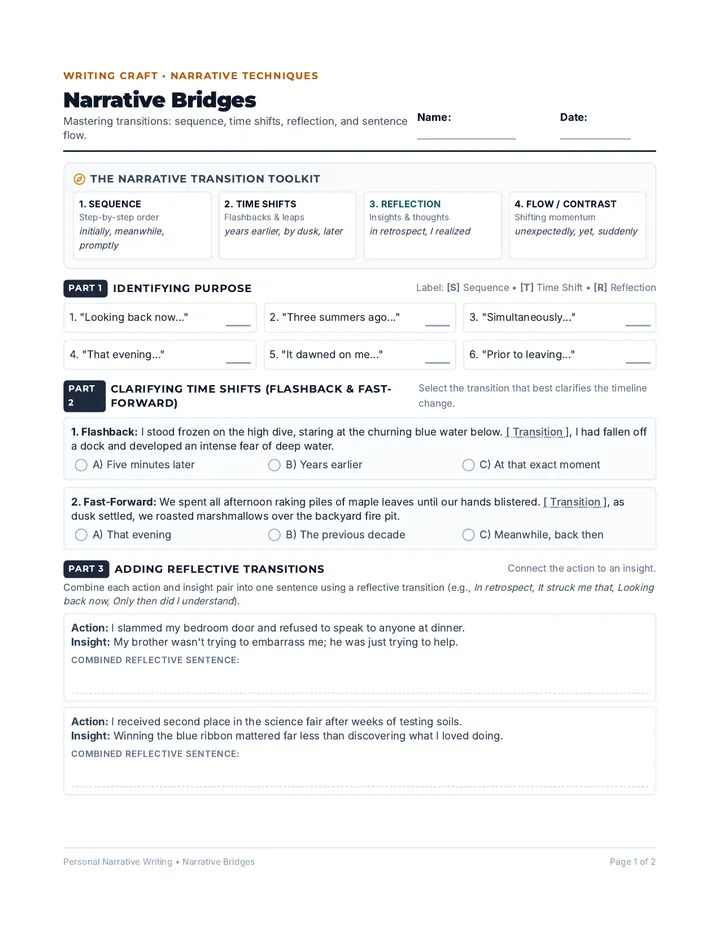
Signal Words Bank
Showing Similarity:
similarly, likewise, both, in comparison, just as, mirror
Showing Contrast:
in contrast, conversely, on the other hand, whereas, however
Dual Lens Writing System • Part 2: Brainstorming & Matrix Page 2 of 3
Guided Drafting Blueprint
Transform your matrix and thesis into a complete five-part comparative draft
Part 3: Drafting
¶ 1 Introduction (Hook, Context & Thesis)
Engage reader • Introduce both subjects
Hook & Context:
Thesis Statement (Refined from Page 2):
¶ 2 Body Paragraph 1: Primary Similarity or First Feature
Topic Sentence + Text Evidence
Topic Sentence (State the shared trait or criterion):
Subject A Evidence & Explanation:
Subject B Evidence & Explanation:
¶ 3 Body Paragraph 2: Major Contrast or Second Feature
Use transition: "In contrast," / "Conversely,"
Topic Sentence (Signal the shift in focus):
Subject A Evidence & Explanation:
Subject B Evidence & Explanation:
¶ 4 Body Paragraph 3: Deeper Contrast or Third Feature
Evaluate impact, outcome, or significance
Topic Sentence (Highlight the nuanced difference):
Subject A Evidence & Explanation:
Subject B Evidence & Explanation:
¶ 5 Conclusion: Synthesis & Broader Impact
Do not merely repeat • Answer "So What?"
Restated Thesis (Fresh phrasing):
Final Insight / Reader Takeaway (Why does this comparison matter?):
7th-Grade Writer's Self-Check
Balanced focus on both subjects Specific text evidence cited At least 3 transition words Clear "So What?" insight
Dual Lens Writing System • Part 3: Essay Drafting Frames Page 3 of 3