Whisker Rescue Passage Explorer Series • Level 4.5
The Kelp Forest Secret
By Lenny • An Animal Rescue Adventure
The chilly Pacific breeze whipped Maya’s dark curls across her face as she scrambled over the slippery tide pool rocks. Behind her, Chloe carried their bright yellow field journal, her eyes scanned the waterline. The girls were volunteer Beach Defenders, trained to spot wildlife in trouble, but today the cove seemed unusually quiet.
Suddenly, a high-pitched, metallic squeak pierced the sound of the crashing waves. Maya froze. "Did you hear that?" she whispered, gesturing toward the dense kelp forest swaying just offshore. The sound came again—a small, frantic whistle.
Hurrying toward the water's edge, Chloe pointed. "There! In the giant kelp!"
Tangled in a thick mass of amber seaweed and blue nylon fishing line was a tiny, furry face. Two round, dark eyes stared up at them with terror. It was a baby sea otter, no bigger than a loaf of bread. The plastic line was tightly wrapped around its small torso, trapping it against the heavy kelp. Without help, the rising tide would soon pull the pup underwater.
"We have to rescue him!" Chloe cried, reaching for her sneakers.
"Wait," Maya said gently, holding Chloe's arm. "Rule number one of marine rescue: never touch wild animals. They can bite when scared, and we might hurt them more. We need to call the experts."
Maya pulled out her walkie-talkie and dialed the Marine Mammal Center hotline. Within minutes, Dr. Ramos and her rescue team arrived, carrying thick protective gloves and a large, padded carrier. Together, under Dr. Ramos's careful direction, they safely snipped the fishing line and freed the shivering pup.
"You girls saved his life today," Dr. Ramos smiled as she wrapped the pup in a warm towel. "By staying calm and calling us, you proved you're real marine scientists."
Scientific Log: Sea Otters
Sea otters are keystone species in Pacific kelp forests. By eating sea urchins, they protect the kelp, which provides vital shelter and oxygen for thousands of other ocean creatures.
Target Words: entangled, conservation, rehabilitate, keystone Standard RL.4.1, RL.4.4
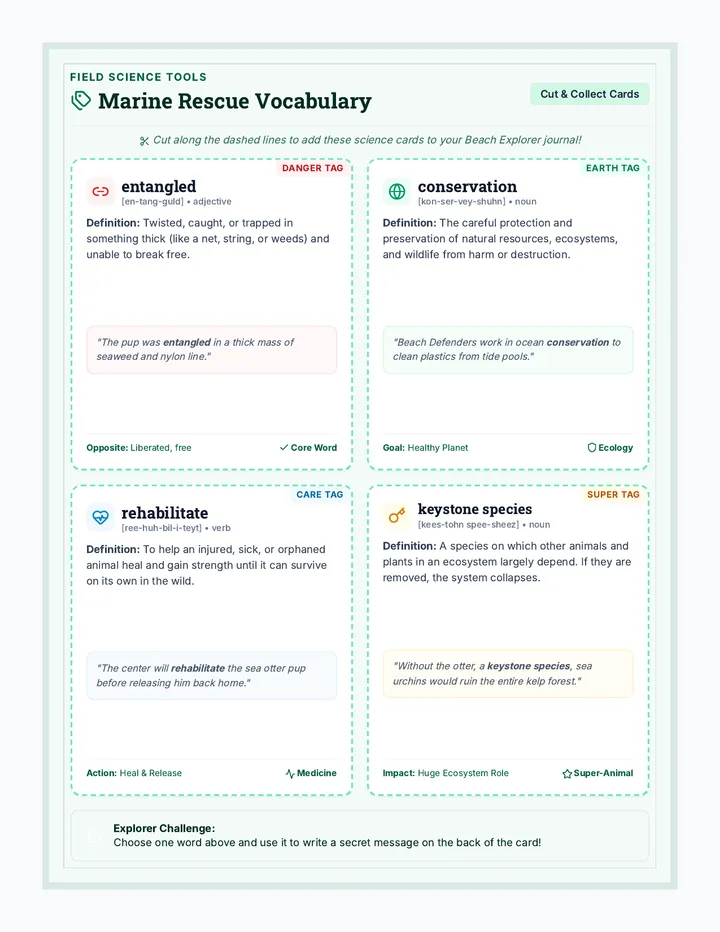
Whisker Rescue Cards Field Science Tools
Marine Rescue Vocabulary
Cut & Collect Cards
Cut along the dashed lines to add these science cards to your Beach Explorer journal!
Danger Tag
entangled
[en-tang-guld] • adjective
Definition: Twisted, caught, or trapped in something thick (like a net, string, or weeds) and unable to break free.
"The pup was entangled in a thick mass of seaweed and nylon line."
Opposite: Liberated, free Core Word
Earth Tag
conservation
[kon-ser-vey-shuhn] • noun
Definition: The careful protection and preservation of natural resources, ecosystems, and wildlife from harm or destruction.
"Beach Defenders work in ocean conservation to clean plastics from tide pools."
Goal: Healthy Planet Ecology
Care Tag
rehabilitate
[ree-huh-bil-i-teyt] • verb
Definition: To help an injured, sick, or orphaned animal heal and gain strength until it can survive on its own in the wild.
"The center will rehabilitate the sea otter pup before releasing him back home."
Action: Heal & Release Medicine
Super Tag
keystone species
[kees-tohn spee-sheez] • noun
Definition: A species on which other animals and plants in an ecosystem largely depend. If they are removed, the system collapses.
"Without the otter, a keystone species , sea urchins would ruin the entire kelp forest."
Impact: Huge Ecosystem Role Super-Animal
Explorer Challenge: Choose one word above and use it to write a secret message on the back of the card!
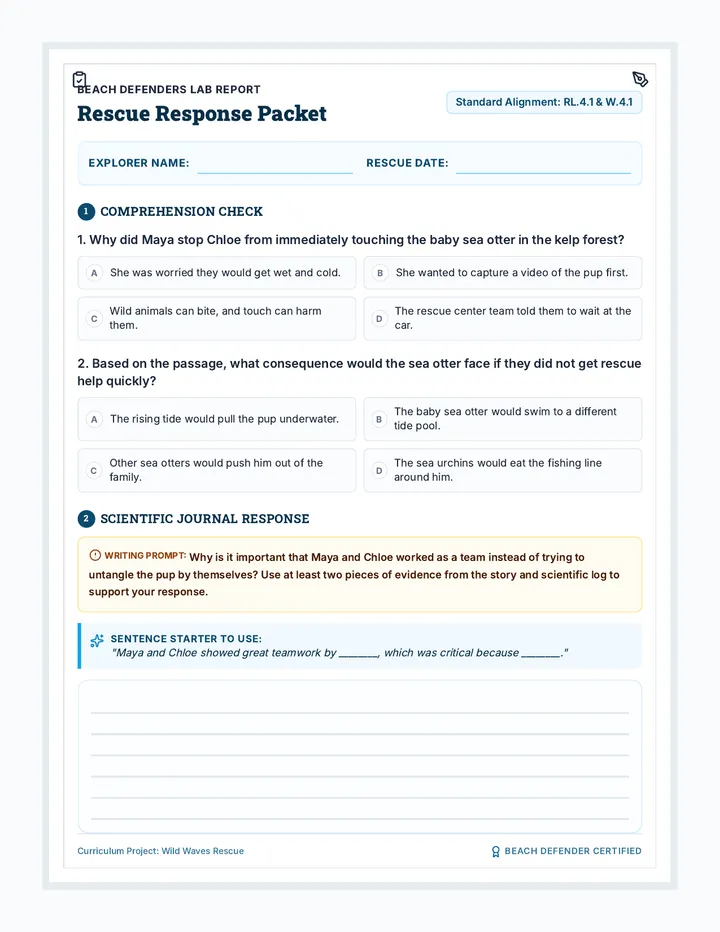
Whisker Rescue Packet Beach Defenders Lab Report
Rescue Response Packet
Standard Alignment: RL.4.1 & W.4.1
Explorer Name:
Rescue Date:
1 Comprehension Check
1. Why did Maya stop Chloe from immediately touching the baby sea otter in the kelp forest?
A She was worried they would get wet and cold.
B She wanted to capture a video of the pup first.
C Wild animals can bite, and touch can harm them.
D The rescue center team told them to wait at the car.
2. Based on the passage, what consequence would the sea otter face if they did not get rescue help quickly?
A The rising tide would pull the pup underwater.
B The baby sea otter would swim to a different tide pool.
C Other sea otters would push him out of the family.
D The sea urchins would eat the fishing line around him.
2 Scientific Journal Response
Writing Prompt: Why is it important that Maya and Chloe worked as a team instead of trying to untangle the pup by themselves? Use at least two pieces of evidence from the story and scientific log to support your response.
Sentence Starter to use:
"Maya and Chloe showed great teamwork by ________, which was critical because ________."
Curriculum Project: Wild Waves Rescue Beach Defender certified