Triangle Fire Comprehension Worksheet
TEKS 7.5(F) / 8.5(F) • 7.8(D)(i) • Informational Text Analysis
Triangle Fire Comprehension Worksheet
Albert Marrin, Excerpt from Chapter V: "Holocaust"
NAME:
DATE: PD:
Directions: Answer each section using specific textual evidence from the excerpt. Cite direct quotes accurately and provide reasoned explanations.
Part 1
Sequence of Disaster & Failure (TEKS 7.5F / 8.5F)
Number 1 to 5
Firefighters find aerial ladders reach only the 6th floor and life nets fail under the extreme force of jumpers.
Smoke pours from beneath a cutting table, and cutters' water buckets fail to extinguish the smoldering scrap bin.
A string of burning paper patterns drops, raining flaming fragments across machines and fabric goods.
9th-floor workers discover the exit door locked by management; 8th-floor flames "lap in" through upper windows.
Elevator operators save dozens of workers until intense heat warps the elevator tracks and halts service.
Part 2
Drawing Inferences with Textual Evidence (TEKS 7.5F / 8.5F)
1. Inference: How do the locked 9th-floor doors and disconnected standpipe hose prove that company management prioritized control and profit over worker safety?
Direct Quote / Text Evidence:
Your Inference & Explanation:
2. Inference: What does the text imply about why many workers chose to jump ninety-five feet rather than remain in the burning factory?
Direct Quote / Text Evidence:
Your Inference & Explanation:
TEKS 7.5(F) / 8.5(F) • Inference & Evidence Analysis Page 1 of 2
Triangle Fire Comprehension • Part 3 & Part 4
Student: Date:
Part 3
Central Idea & Author's Craft (TEKS 7.8D(i) / 8.8D(i))
Key Passage for Central Idea
“Chief Croker made his inspection. He found that the Asch Building had no damage to its structure. Its walls were in good shape; so were the floors. It had passed the test. It was fireproof. The woodwork, furniture, cotton goods, and people who worked in it were not.”
3. Author's Craft & Irony: How does Albert Marrin use the bitter contrast between a "fireproof building" and the human lives inside it to establish the central idea of this text?
4. Systemic Obstacles: Identify two specific municipal or equipment limitations described in the text (such as ladder length, water pressure, or life net capacity) and explain how they contributed to the high death toll.
Part 4
Objective Summary (TEKS 7.6D / 8.6D)
5–6 Sentences
Prompt: Write a concise, objective summary of the Triangle Fire excerpt. Include the central event, the key factors that prevented escape, and the catastrophe's outcome. Avoid personal opinions or judgmental commentary.
States central idea
Includes key text details
Neutral tone / No opinions
TEKS 7.6(D) / 8.6(D) • Summary & Synthesis Page 2 of 2
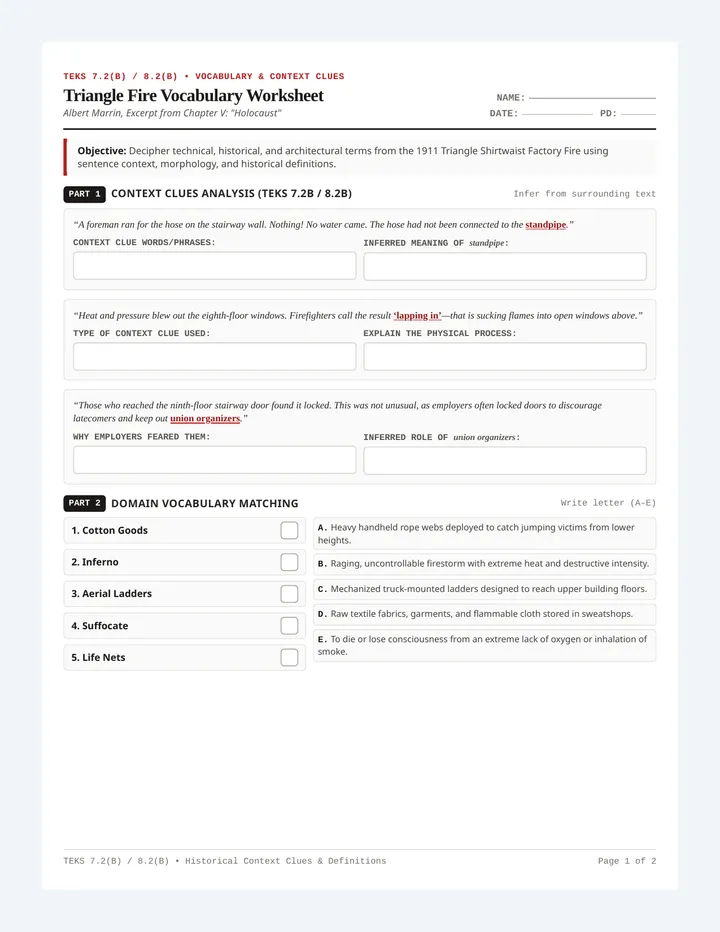
Triangle Fire Vocabulary Worksheet
TEKS 7.2(B) / 8.2(B) • Vocabulary & Context Clues
Triangle Fire Vocabulary Worksheet
Albert Marrin, Excerpt from Chapter V: "Holocaust"
NAME:
DATE: PD:
Objective: Decipher technical, historical, and architectural terms from the 1911 Triangle Shirtwaist Factory Fire using sentence context, morphology, and historical definitions.
Part 1
Context Clues Analysis (TEKS 7.2B / 8.2B)
Infer from surrounding text
“A foreman ran for the hose on the stairway wall. Nothing! No water came. The hose had not been connected to the standpipe.”
Context Clue Words/Phrases:
Inferred Meaning of standpipe:
“Heat and pressure blew out the eighth-floor windows. Firefighters call the result ‘lapping in’—that is sucking flames into open windows above.”
Type of Context Clue Used:
Explain the physical process:
“Those who reached the ninth-floor stairway door found it locked. This was not unusual, as employers often locked doors to discourage latecomers and keep out union organizers.”
Why employers feared them:
Inferred role of union organizers:
Part 2
Domain Vocabulary Matching
Write letter (A–E)
1. Cotton Goods
2. Inferno
3. Aerial Ladders
4. Suffocate
5. Life Nets
A. Heavy handheld rope webs deployed to catch jumping victims from lower heights.
B. Raging, uncontrollable firestorm with extreme heat and destructive intensity.
C. Mechanized truck-mounted ladders designed to reach upper building floors.
D. Raw textile fabrics, garments, and flammable cloth stored in sweatshops.
E. To die or lose consciousness from an extreme lack of oxygen or inhalation of smoke.
TEKS 7.2(B) / 8.2(B) • Historical Context Clues & Definitions Page 1 of 2
Triangle Fire Vocabulary • Part 3 & Part 4
Student: Date:
Part 3
Connotation & Word Nuance (TEKS 7.2B / 8.2B)
1. Word Choice Impact: The author writes that firefighters “crawled into the inferno on their bellies.” Why did the author select the word inferno instead of simply saying fire or room? What tone and imagery does this word convey?
2. Deceptive Technical Definition: Following the disaster, Chief Croker confirmed the building was legally How did the 1911 legal definition of “fireproof” differ tragically from what workers and the public assumed it meant?