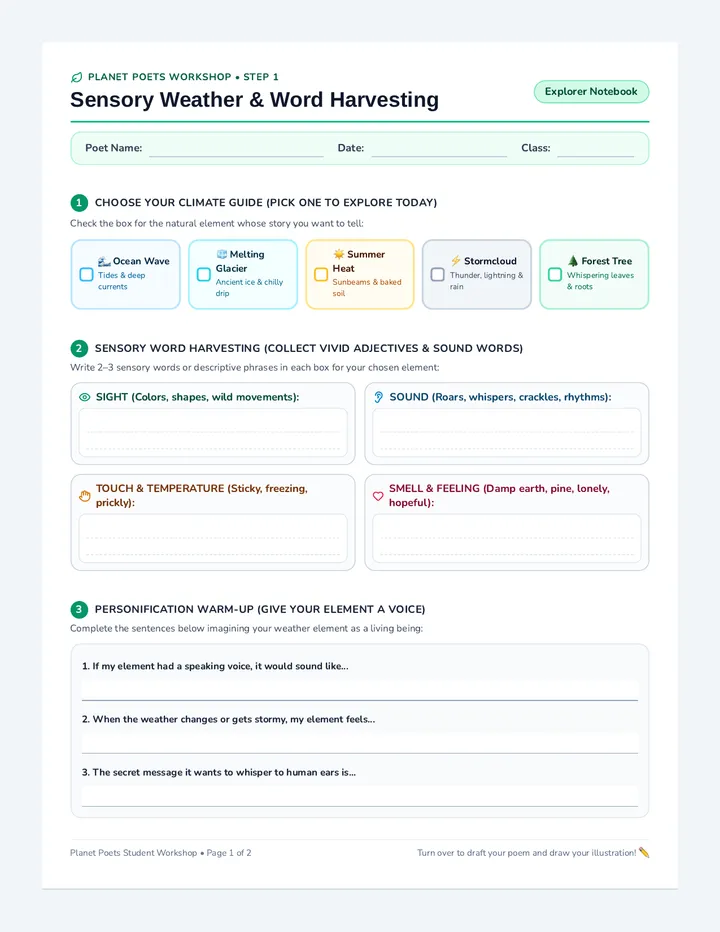
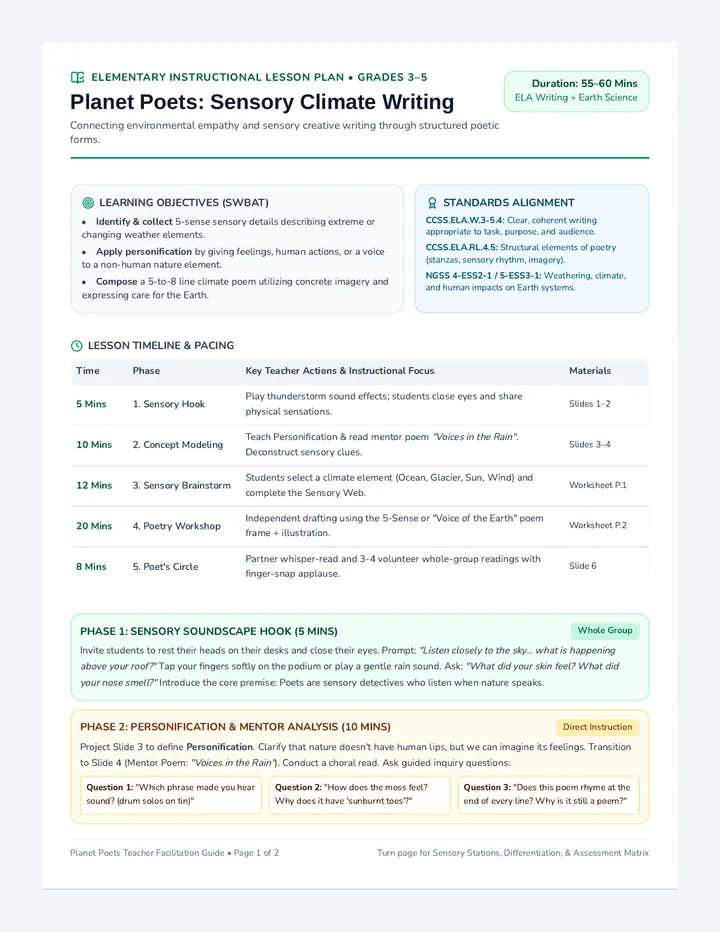
Triad Skills Assessment
Grade 10 English Language Arts & Mathematics
Diagnostic Skills Benchmark
Evaluation Form A
Mid-Year Assessment
Student Name:
Date:
Period:
Score:
1
Part I: Critical Reading & Contextual Inferences
Directions: Read the informational passage. Use the author's diction and surrounding context clues to infer deeper meanings and answer questions 1–4.
Passage: Relics of the Abyssal Plain
For centuries, maritime lore treated the deep ocean as a watery oblivion where sunken vessels dissolved into sediment. Yet when Dr. Vance guided the submersible probe into the benthic trench, acoustic sensors detected an astonishingly intact wooden hull resting nearly three miles beneath the sunlit surface. In this sun-starved abyss, the absence of photosynthetic life and wood-boring fauna establishes an anoxic sanctuary where biological decomposition is virtually halted. While terrestrial artifacts succumb to the inexorable erosion of wind, humidity, and microbial activity, this eighteenth-century frigate remained an immaculate capsule of historical craftsmanship.
Still, the expedition was fraught with quiet apprehension. The vessel's equilibrium depended upon the undisturbed stasis of its cold seabed tomb. Vance noticed how even gentle thruster wash from their vehicle stirred abrasive silt plumes capable of stripping the fragile timbers. In her mission log, she noted with tacit reverence that human curiosity and destruction often share the exact same wake. The true scientific imperative was not merely technological endurance, but exercising ethical restraint in an alien domain where every illumination casts an irrevocable shadow.
Based on context clues in paragraph 1, what does the word anoxic most likely mean?
A Devoid of oxygen and biological decay
B Disrupted by violent benthic tides
C Illuminated by natural bioluminescence
D Saturated with dense volcanic sulfur
In paragraph 1, the author contrasts terrestrial artifacts with the sunken frigate primarily to infer that:
A Eighteenth-century materials were indestructible
B Extreme deep-sea isolation can preserve delicate items
C Surface archaeological excavations are unreliable
D Wood-boring organisms migrate toward warmer currents
In paragraph 2, Vance notes that "human curiosity and destruction often share the exact same wake." Using context clues, infer her meaning and cite one piece of supporting evidence.
What does the author imply by stating that "every illumination casts an irrevocable shadow"? What central ethical dilemma does this reveal for scientific exploration?
Grade 10 Benchmark Assessment • Form A Page 1 of 2
2
Part II: Algebraic Reasoning • Two-Step Integer Equations
4 Problems • Show All Inverse Operations
Directions: Solve each two-step equation for the variable. You must show all algebraic steps in the workspace. Observe positive and negative integer rules carefully.
Equation A \(-4x + 18 = -14\)
Solution: \(x =\)
Equation B \(\frac{y}{-3} - 15 = -7\)
Solution: \(y =\)
Equation C \(5m - (-12) = -23\)
Solution: \(m =\)
Equation D \(\frac{w + 14}{-2} = 9\)
Solution: \(w =\)
3
Part III: Extended Written Response • Language Conventions
Target Convention: Capitalization of Pronoun "I"
Reflective Writing Prompt:
Think about a significant decision or unforeseen hurdle you encountered recently where you had to rely on your own judgment. In a focused paragraph (5–7 sentences), explain the obstacle, the choice you made, and what the outcome taught you about yourself.
Grammar & Mechanics Requirement: Because you are writing from your personal perspective, you will use the first-person pronoun I. Ensure that every single instance of the pronoun I is properly capitalized—including contractions like I'm, I've, I'd, and I'll.
Student Composition Area (Write neatly in ink or pencil): Aim for 5–7 complete sentences
Final Self-Check:
All "I" pronouns capitalized
Decision & lesson addressed
Punctuation & spelling proofread
Grade 10 Benchmark Assessment • Form A Page 2 of 2
Triad Skills Answer Key
Educator Evaluation Guide • Form A Key
Diagnostic Skills Benchmark • Teacher Key
Scoring Matrix
Standardized Criteria
Part I: Reading & Context Clues 8 Total Points (2 pts per item)
Part II: Two-Step Equations 8 Total Points (2 pts per equation)
Part III: Writing & Conventions 6 Total Points (3 pts "I", 3 pts content)
1
Part I: Reading Comprehension Keys, Rationales & Rubrics
Question 1: Vocabulary in Context (anoxic) Correct: A
Context Clue Rationale: The passage connects anoxic to the "absence of photosynthetic life and wood-boring fauna" and notes that "biological decomposition is virtually halted." Morphologically, prefix an- (without) and root ox- (oxygen) prove that oxygen-depleted conditions prevent bacterial decay.
Question 2: Inferential Purpose of Contrast Correct: B
Inferential Rationale: The author contrasts terrestrial artifacts (which rapidly decay from wind, moisture, and bacteria) with the frigate ("an immaculate capsule") to emphasize that deep-sea cold stasis preserves delicate organic materials. Distractors A, C, and D contain ungrounded overgeneralizations.
Question 3: Constructive Inference • "Curiosity & Destruction" 2-Point Analytical Rubric
Exemplar Response: Vance means that the very act of observing and studying fragile environments can accidentally ruin them. For instance, the probe's thruster wash stirs abrasive silt clouds that directly threaten the eighteenth-century deck timbers.
2 Pts: Explains inquiry vs. harm dualism AND cites textual evidence (thruster wash / abrasive silt).
1 Pt: Explains idea without textual citation, or quotes text without inferring meaning.
Question 4: Subtext • "Every Illumination Casts a Shadow" 2-Point Analytical Rubric
Exemplar Response: The metaphor implies that gaining scientific knowledge ("illumination") inevitably carries an ethical cost or permanent impact ("irrevocable shadow"). It exposes the researcher's dilemma: pursuing discovery while trying not to corrupt pristine ecosystems.
2 Pts: Interprets metaphor (discovery vs. permanent disturbance) and articulates the ethical dilemma.
1 Pt: Literal description only, or vague mention of ethics without textual connection.
Diagnostic Analysis & Common Reading Misconceptions
Over-Reliance on Prior Bias: Students who select Option 1C or 1D often guess based on unrelated deep-sea facts rather than reading adjacent text clues like "photosynthetic life" and "decay."
Literal vs. Figurative Blur: On Question 4, struggling readers interpret "shadow" as physical darkness rather than recognizing the symbolic consequence of human technological intrusion.
Unsupported Generalization: On Question 2, Option 2A tempts students who misinterpret the author's praise of craftsmanship as a claim that historical wood is physically indestructible.
Grade 10 Benchmark Teacher Key • Form A Page 1 of 2
2
Part II: Two-Step Integer Equations • Worked Solutions
8 Points Total • 2 Points Each
Equation A: \(-4x + 18 = -14\) x = 8
Step 1: \(-4x = -14 - 18 \implies -4x = -32\)
Step 2: \(x = \frac{-32}{-4} \implies x = 8\)
Key Rule: \(-14 - 18 = -32\). Negative divided by negative yields positive 8.
Equation B: \(\frac{y}{-3} - 15 = -7\) y = -24
Step 1: \(\frac{y}{-3} = -7 + 15 \implies \frac{y}{-3} = 8\)
Step 2: \(y = 8 \times (-3) \implies y = -24\)
Key Rule: \(-7 + 15 = +8\). Positive multiplied by negative yields negative 24.
Equation C: \(5m - (-12) = -23\) m = -7
Step 1: \(5m + 12 = -23 \implies 5m = -23 - 12 = -35\)
Step 2: \(m = \frac{-35}{5} \implies m = -7\)
Key Rule: Subtracting negative turns into \(+12\). \(-35 \div 5 = -7\).
Equation D: \(\frac{w + 14}{-2} = 9\) w = -32
Step 1: \(w + 14 = 9 \times (-2) \implies w + 14 = -18\)
Step 2: \(w = -18 - 14 \implies w = -32\)
Key Rule: Clear denominator first (\(-18\)). Subtracting 14 yields \(-32\).
3
Part III: Extended Response Scoring Rubric • Pronoun "I"
6 Points Total
Convention Focus: Capitalization of "I" (3 Pts)
- 3 Pts: 100% accurate capitalization of all instances of pronoun "I", including contractions (I'm, I've, I'll, I'd).
- 2 Pts: 1 minor lowercase error; all other instances capitalized.
- 1 Pt: Inconsistent capitalization (2–3 lowercase errors).
- 0 Pts: Systematic failure to capitalize pronoun "I" (4+ errors).
Content & Structure (3 Pts)
- 3 Pts: Directly addresses prompt; articulates decision/obstacle, actions taken, and insightful takeaway (5–7 sentences).
- 2 Pts: Narrates event with moderate reflection; minor lapses in sentence variety or paragraph cohesion.
- 1 Pt: Incomplete response (under 4 sentences) or fails to reflect on lesson learned.
Exemplar Student Response (All "I" forms capitalized in bold):
Last month, I faced an unexpected dilemma when my lab partner fell ill the morning our chemistry project was due. Although I was tempted to ask for an extension, I decided to finalize our calculations and deliver the oral presentation solo. I've always felt anxious speaking in front of peers, but I took a deep breath and walked through our data systematically. When our instructor praised the clarity of the analysis, I realized that I'm much more resilient under pressure than I previously believed. Through this challenge, I'll never underestimate my capacity to take initiative when others are depending on me.
Targeted Re-Teaching Strategies for Pronoun Capitalization:
1. Color-Coded Self-Audits: Have students use a highlighter to illuminate every single pronoun "I" and verify its uppercase status prior to submitting final drafts.
2. Contraction Deconstruction: Emphasize that in words like I'm or I've, the base word is still the personal pronoun "I", requiring automatic capitalization regardless of position.
Grade 10 Benchmark Teacher Key • Form A Page 2 of 2