Planet Poets Slides Elementary ELA & Science
Creative Writing Workshop
🌿 Voices of the Earth
Planet Poets
Writing sensory poems to listen, feel, and speak for our changing world.
Observe
Use all 5 senses
Feel
Weather & emotions
Create
Share your voice
What is Sensory Poetry?
Tool #1
Sensory poets don't just say "it was windy." They invite the reader to step right outside and feel it!
Sight
Golden rays, swirling gray skies
Sound
Crackling thunder, buzzing bees
Touch
Sticky humidity, shivering chill
Smell
Fresh damp pine, rain on dry dust
Heart
Calm stillness, eager hope
Poet's Secret: When you describe what your skin feels or your ears hear, your reader feels like they are standing beside you!
Word Magic: Personification
Tool #2
Personification means giving human actions, feelings, and voices to things in nature!
🌊
The Rising Tide
"The ocean wraps its chilly arms around the sandy beach, humming an ancient lullaby to the seashells."
Action: Wrapping arms & humming
☀️
The Summer Heatwave
"The sun presses its heavy yellow paw against the pavement, begging the thirsty green grass to take a nap."
Action: Pressing a paw & begging
Quick Question for the Class: If a stormy raincloud had a voice, what would it shout?
Mentor Poem: Voices in the Rain
Read & Notice
Poem by Lenny
I hear the sky take a deep, gray breath,
Poet Detective Hunt:
👂 Sound: "Drum solos on tin"
Rhythm you can tap with pencils!
👃 Smell: "Rich earth & sweet life"
Petrichor (the smell after rain).
💬 Personification: "Moss whispers"
Giving the moss feelings and words.
Notice how short, sensory lines make a big picture in your imagination!
The 5-Sense Poetry Recipe
Writing Frame
You can build a climate poem in five sensory steps:
1 I SEE... A color, movement, or wild weather shape.
2 I HEAR... A natural sound or a quiet nature whisper.
3 I FEEL... A temperature or physical texture on your skin.
4 I SMELL... Clean outdoor air, pine needles, or damp soil.
5 I HOPE... A caring promise to protect and heal the Earth.
✨ Tip: Poems do not need to rhyme to be powerful! Truth and feeling make it shine.
Today's Poet Mission
Worksheet Time
🌍
1. Choose a Guide
Pick one climate hero: Glacier, Stormcloud, Forest, Ocean, or Desert Wind.
Who speaks through you?
🎨
2. Harvest Words
Fill your sensory word web with vivid colors, sounds, and action verbs.
Use the Word Bank chart!
📝
3. Compose & Share
Draft your sensory poem or personification verse and add an illustration!
Ready for Poet's Circle!
"You have the power to give nature a voice!"
Planet Poets Teacher Guide Elementary Instructional Lesson Plan • Grades 3–5
Planet Poets: Sensory Climate Writing
Connecting environmental empathy and sensory creative writing through structured poetic forms.
Duration: 55–60 Mins
ELA Writing + Earth Science
Learning Objectives (SWBAT)
Identify & collect 5-sense sensory details describing extreme or changing weather elements.Apply personification by giving feelings, human actions, or a voice to a non-human nature element.Compose a 5-to-8 line climate poem utilizing concrete imagery and expressing care for the Earth.
Standards Alignment
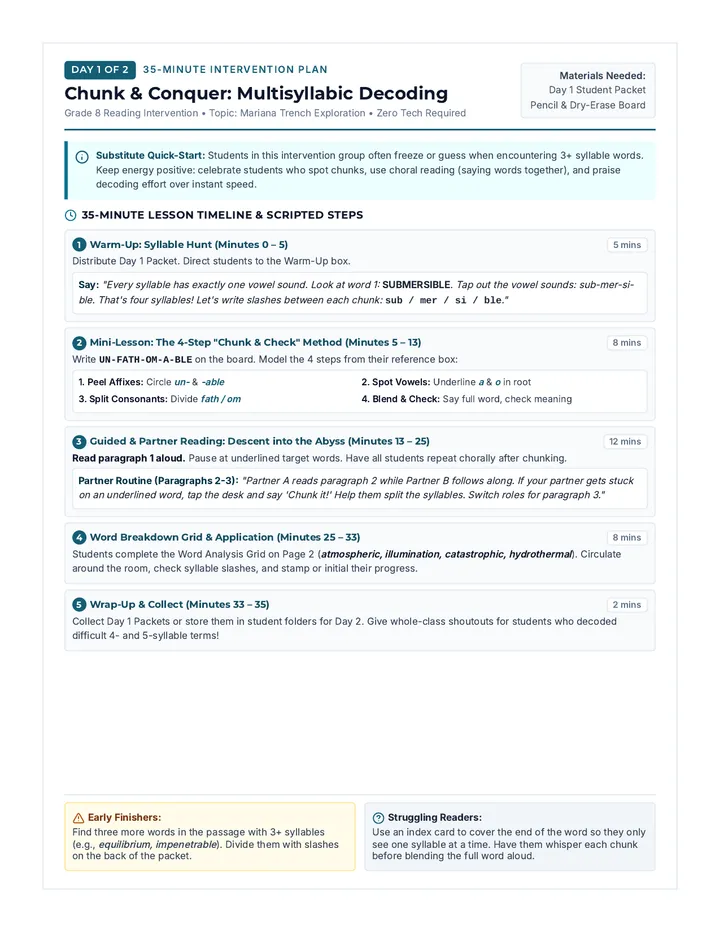
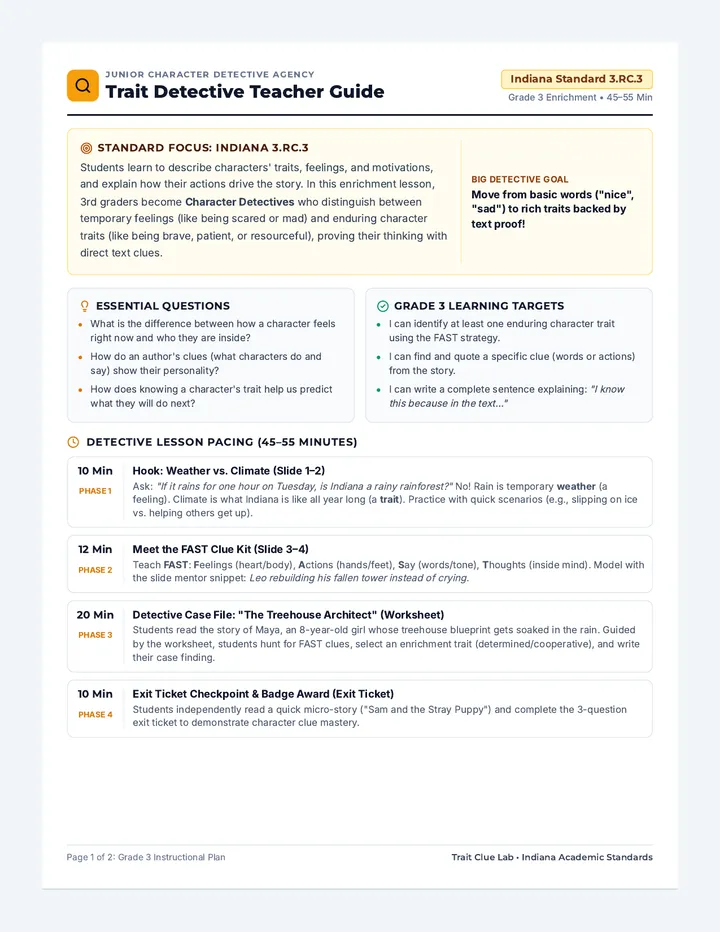
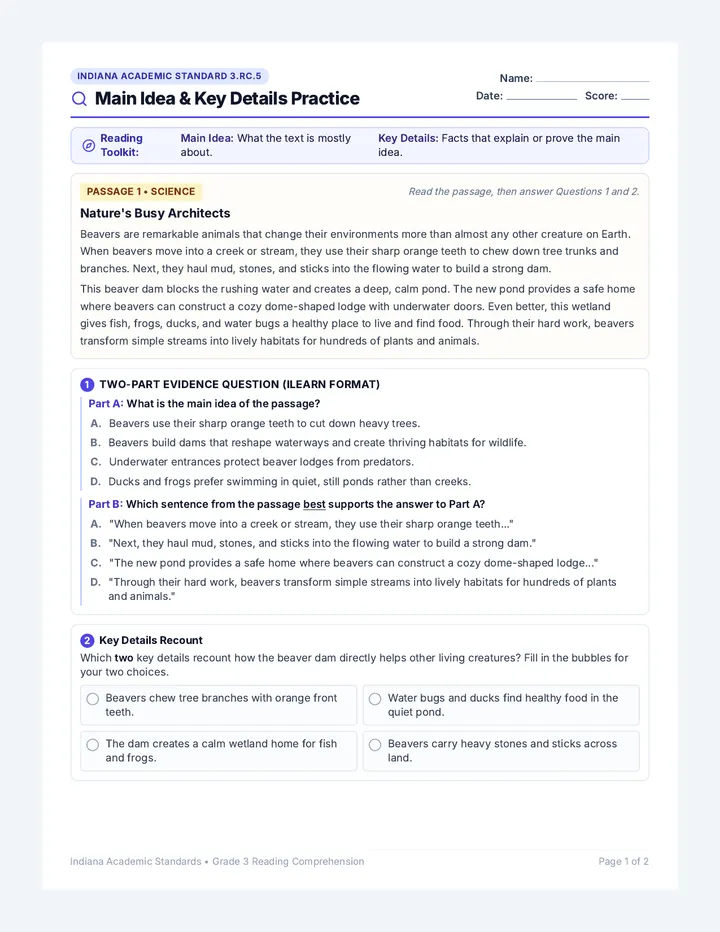
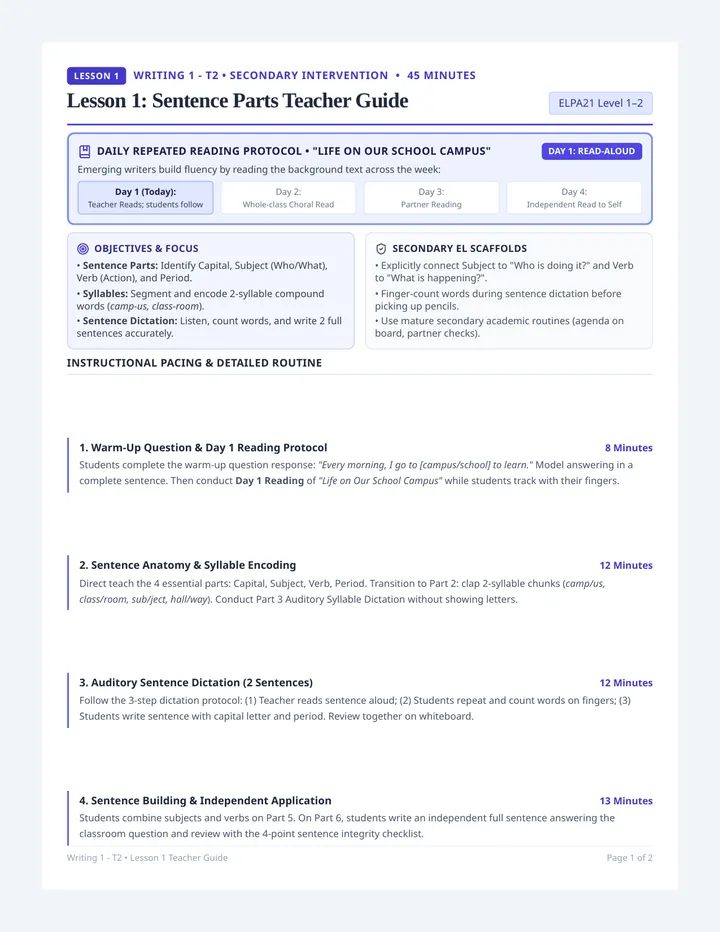
CCSS.ELA.W.3-5.4: Clear, coherent writing appropriate to task, purpose, and audience.
CCSS.ELA.RL.4.5: Structural elements of poetry (stanzas, sensory rhythm, imagery).
NGSS 4-ESS2-1 / 5-ESS3-1: Weathering, climate, and human impacts on Earth systems.
Lesson Timeline & Pacing
Time
Phase
Key Teacher Actions & Instructional Focus
Materials
5 Mins
1. Sensory Hook
Play thunderstorm sound effects; students close eyes and share physical sensations.
Slides 1–2
10 Mins
2. Concept Modeling
Teach Personification & read mentor poem "Voices in the Rain" . Deconstruct sensory clues.
Slides 3–4
12 Mins
3. Sensory Brainstorm
Students select a climate element (Ocean, Glacier, Sun, Wind) and complete the Sensory Web.
Worksheet P.1
20 Mins
4. Poetry Workshop
Independent drafting using the 5-Sense or "Voice of the Earth" poem frame + illustration.
Worksheet P.2
8 Mins
5. Poet's Circle
Partner whisper-read and 3-4 volunteer whole-group readings with finger-snap applause.
Slide 6
Phase 1: Sensory Soundscape Hook (5 mins) Whole Group
Invite students to rest their heads on their desks and close their eyes. Prompt: "Listen closely to the sky... what is happening above your roof?" Tap your fingers softly on the podium or play a gentle rain sound. Ask: "What did your skin feel? What did your nose smell?" Introduce the core premise: Poets are sensory detectives who listen when nature speaks.
Phase 2: Personification & Mentor Analysis (10 mins) Direct Instruction
Project Slide 3 to define Personification . Clarify that nature doesn't have human lips, but we can imagine its feelings. Transition to Slide 4 (Mentor Poem: "Voices in the Rain" ). Conduct a choral read. Ask guided inquiry questions:
Question 1: "Which phrase made you hear sound? (drum solos on tin)"
Question 2: "How does the moss feel? Why does it have 'sunburnt toes'?"
Question 3: "Does this poem rhyme at the end of every line? Why is it still a poem?"
Planet Poets Teacher Facilitation Guide • Page 1 of 2 Turn page for Sensory Stations, Differentiation, & Assessment Matrix
2
Facilitation Guide, Differentiation & Assessment
Workshop Protocols & Rubric
Sensory Brainstorming Protocol (12 Mins)
Have students choose one climate or weather element: Melting Glacier, Summer Heatwave, Forest Canopy, Raging Storm, or Rising Tide .
Circulation prompt: "Don't just say 'hot'—what color is the heat? (copper, neon yellow, shimmering white)?"Sound prompt: "If the wind had a musical instrument, would it be a flute or a bass drum?"Encourage referencing the Climate Wordplay Anchor Chart for strong action verbs and tactile adjectives.
Poet's Circle Celebration (8 Mins)
Create a respectful performance space. Teach the traditional "poet snap" (silent finger snapping instead of loud applause) so every voice is honored.
Partner Whisper: Read your favorite line to your elbow partner.Open Mic: Call on 3–4 diverse student volunteers to stand and deliver their poem aloud.Affirmation Prompt: "Who heard an image that painted a movie in their brain?"
Targeted Differentiation & Support Matrix
Emerging Writers / MLL
Provide the sentence-stem frame on Worksheet Page 2 ("I see...", "I hear..." ). Pair with illustrated sensory cards. Allow oral dictation or bilingual vocabulary in sensory web.
Sentence Starters Provided
On-Level / Grade Level
Encourage combining two senses into a single line (e.g., "I hear the sticky, buzzing sun" ). Aim for at least one vivid personification verb and a thoughtful closing message for Earth.
Dual Sensory Details
Extension / Advanced
Have students write in the first-person persona of the climate element itself ("I am the Arctic Glacier..." ). Challenge them to weave an extended metaphor contrasting the past and present.
Extended Personification
Formative Evaluation Rubric (4-Scale)
Criteria
Level 4: Exceeds (Planet Hero)
Level 3: Meets (Sensory Poet)
Level 2: Developing (Sprouting)
Sensory Imagery
Includes 4+ unique senses with vivid adjectives (e.g., crackling, petrichor, icy sting).
Includes 3 clear senses that help the reader visualize or feel the weather.
Relies mostly on basic visual statements (e.g., "it is blue", "it is hot").
Personification
Skillfully attributes natural human emotions and actions that reveal character.
Gives at least one clear human action or feeling to nature (e.g., wind sighs).
Attempts personification with teacher prompting or gives literal animal traits.
Climate Message
Expresses profound empathy or a thoughtful hope for protecting nature.
Includes a closing line showing care, respect, or observation of Earth.
Simple concluding line without clear connection to nature or climate.
Teacher Facilitation Tip & Common Misconception
Common Misconception: Elementary students often think poems must rhyme every couplet, which leads to forced or nonsensical words (e.g., "The sun is hot / I like a pot"). Emphasize repeatedly: "Poetry is about delicious sensory words and true feelings. Rhyme is optional; feeling is required!"
Planet Poets Teacher Facilitation Guide • Page 2 of 2 Printable Lesson Plan • Ready for Classroom Delivery
Sensory Weather Poetry Worksheet Planet Poets Workshop • Step 1
Sensory Weather & Word Harvesting
Explorer Notebook
Poet Name:
Date:
Class:
1
Choose Your Climate Guide (Pick ONE to explore today)
Check the box for the natural element whose story you want to tell:
🌊 Ocean Wave
Tides & deep currents
🧊 Melting Glacier
Ancient ice & chilly drip
☀️ Summer Heat
Sunbeams & baked soil
⚡ Stormcloud
Thunder, lightning & rain
🌲 Forest Tree
Whispering leaves & roots
2
Sensory Word Harvesting (Collect vivid adjectives & sound words)
Write 2–3 sensory words or descriptive phrases in each box for your chosen element:
SIGHT (Colors, shapes, wild movements):
SOUND (Roars, whispers, crackles, rhythms):
TOUCH & TEMPERATURE (Sticky, freezing, prickly):
SMELL & FEELING (Damp earth, pine, lonely, hopeful):
3
Personification Warm-Up (Give Your Element a Voice)
Complete the sentences below imagining your weather element as a living being:
1. If my element had a speaking voice, it would sound like...
2. When the weather changes or gets stormy, my element feels...
3. The secret message it wants to whisper to human ears is...
Planet Poets Student Workshop • Page 1 of 2 Turn over to draft your poem and draw your illustration! ✏️
Planet Poets Workshop • Step 2
My Climate Poem & Illustration
Poet:
Poem Title:
By You, Planet Poet
The 5-Sense Climate Stanza Use your sensory words from page 1
I see...
I hear...
I feel...
I smell...
I hope...
Bonus Earth Voice (Give your element two speaking lines):
"I am...
"
"Please...
"
Poet's Nature Illustration Box Draw colors, weather swirls, and textures that match your words!
Draw here
Poet's Self-Reflection Checklist
I used at least 3 sensory words.
I gave nature feelings or a voice.
I shared my poem in Poet's Circle!
Planet Poets Student Workshop • Page 2 of 2 🌿 Ready for the classroom wall & Poet's Circle performance!
Climate Wordplay Anchor Chart 🌱
Poet's Treasure Chest • Visual Anchor Chart
Climate Wordplay Anchor Chart
Tools for Poets
4 Poetic Superpowers for Earth Writers
1. Sensory Imagery 5 Senses
Use words that let your reader taste, touch, smell, see, or hear the world.
"Sticky summer asphalt baked under neon yellow skies."
2. Personification Nature's Voice
Give non-human nature things human feelings, voices, or actions.
"The ancient glacier wept cold tears into the warming bay."
3. Onomatopoeia Sound Words
Words that mimic the actual natural sounds they describe!
"CRACKLE, whoosh, drip-drop, rumble, hiss, and rustle."
4. Simile & Metaphor Word Pictures
Compare nature to another surprising image using "like" or "as".
"The forest canopy was a leafy emerald blanket."
The Climate Word Vault (Borrow These Delicious Words!)
Organized by Sensation
⚡ Storm & Sky
Verbs: rumble, flicker, howl, unleash, pour, shatter
🌊 Ocean & Rain
Verbs: ripple, surge, crash, drown, froth, quench
🧊 Glacier & Ice
Verbs: drip, fracture, melt, shiver, glide, thaw
☀️ Heat & Earth
Verbs: bake, blister, sprout, wither, glow, blaze
Earth Voice & Hope Words (For your final lines) Healing & Protection
whisper cherish protect breathe rest sprout listen healing gentle promise together
✨
The Golden Rule of Planet Poetry
Your poem does not need to rhyme. It just needs to share honest feelings and paint pictures in your reader's mind!
You are Nature's Voice!
Planet Poets Anchor Chart • Elementary ELA & Environmental Science Keep this reference sheet on your desk while writing! 🌿