Text Clue Slides
Grade 3 Informational Reading
Clue Hunt • Nonfiction Tools
Become a Nonfiction Text Detective! 🔍
Text Clue Detectives:
Nonfiction Text Features
Learn how authors use pictures, diagrams, word banks, and special headings to help you discover facts faster!
Headings
Captions
Diagrams
Glossary
Detective Briefing #1
What Are Nonfiction Text Features?
Reading Superpowers
Roadmaps for Your Brain
Nonfiction books are full of real facts. Text features are like road signs that guide you to the exact information you need.
You do not have to read top-to-bottom!
Why Authors Use Them
Authors use images, bold words, and diagrams to make complicated ideas crystal clear and super exciting to explore!
Pictures and text work together as a team!
Word Bank:
Heading Caption Diagram Label Bold Word Glossary Sidebar
Feature Focus #1
Headings & Table of Contents
Navigation Clues
Heading Big Title for a Section
Example Heading
Ocean Giants of the Pacific
Blue whales can grow over 100 feet long. They eat tiny krill by filtering water through baleen plates...
💡 Clue Rule: Read the heading first! It tells you the big topic before you read the paragraph.
Table of Contents Front of Book
Table of Contents
Chapter 1: The Deep Ocean Zone Page 4
Chapter 2: Coral Reef Habitats Page 12
Chapter 3: Protecting Sea Turtles Page 26
💡 Clue Rule: Found at the start of a book. Shows chapter titles and page numbers.
Quick Detective Question: If you only want to read about Coral Reefs, which page should you open? (Page 12!)
Feature Focus #2
Photographs & Captions
Visual Clues
🦅 Photograph / Real Image
Real Camera Shot
Caption:
"A bald eagle uses its razor-sharp talons to grab fish directly out of icy river waters."
Photograph
A real picture taken with a camera. Shows exactly how something looks in real life.
Caption
Sentences right underneath or beside a picture that tell the secret story of what is happening.
🔍 Detective Secret: Never skip the caption! It usually contains facts that are NOT in the main story!
Word Bank Match: Photograph + Caption Grade 3 Detective Rule #2
Feature Focus #3
Diagrams & Labels
How-It-Works Clues
Diagram of a Worker Honeybee
Labeled Drawing
🐝
Apis mellifera
Label ➔ Antenna (Smell & Touch)
Compound Eye ➔ Label
Label ➔ Clear Wings (200 bps)
Pollen Basket ➔ Label
Diagram
A drawing or illustration that shows the parts of something or explains how it works.
Label
Short words connected by arrows or lines that name each individual part.
🎯 Pair Rule: Diagrams and Labels always travel together!
Detective Check: What would happen if the labels were missing? You wouldn't know the parts!
Feature Focus #4
Bold Words & The Glossary
Vocabulary Clues
In the Reading Passage: Bold Print
Frogs are extraordinary amphibians. They begin their lives in water and undergo metamorphosis to grow strong back legs.
👀 Bold Words are darker and thicker than normal words because they are essential vocabulary!
At the Back of the Book: Glossary
amphibian (noun)
A cold-blooded animal that lives on both water and land.
metamorphosis (noun)
A dramatic change in body shape during an animal's life.
📖 Glossary Rule: Like a mini-dictionary built inside the book, alphabetized from A to Z!
Detective Strategy: Spot a bold word? Don't panic! Flip straight to the glossary to unlock the meaning!
Feature Focus #5
Sidebars & Maps
Bonus Information
Main Article Page
Journey of the Monarchs
Every autumn, millions of monarch butterflies take flight. They travel over 3,000 miles south from Canada to the warm fir forests of Mexico.
Along their journey, they stop to drink nectar from milkweed plants, which powers their delicate orange wings.
Main text gives the central narrative and core facts.
Sidebar Fact Box
Did You Know? 🦋
Monarchs can glide in rising warm air currents without flapping their wings, saving vital energy during their long migration flight!
📌 Sidebar Rule: A side box with extra fun facts, cool trivia, or quick stats.
Why look at the sidebar? It gives bonus facts that don't fit in the main story!
Case File Challenge
Can You Name That Feature?
Detective Test
Word Bank:
Diagram Caption Heading Glossary
Clue 1 At page top
Life in the Arctic Tundra
Match: HEADING 🏷️
Clue 2 Under a photo
"A mother sea otter floats with pup."
Match: CAPTION 📝
Clue 3 Volcano drawing
Shows crater, vent, & magma parts.
Match: DIAGRAM 🌋
Clue 4 Back of book
A-Z word list with definitions.
Match: GLOSSARY 📚
🌟 100% on the Detective Quiz! Ready for your worksheet mission!
Independent Mission
Your Detective Field Mission!
Ready to Hunt
1
Check the Word Bank
Review the 8 text feature clues at the top of your Feature Finder Worksheet before beginning.
Use correct spelling!
2
Inspect Each Clue
Look closely at every photograph, diagram, heading, and sidebar on the page to identify its purpose.
Look for arrows & boxes!
3
Solve the Axolotl Case
Read the mini-article on page 2 and answer the detective questions using the text features!
Unlock the facts!
🔎 Grab your pencils, Detectives—the case is officially open!
Begin!
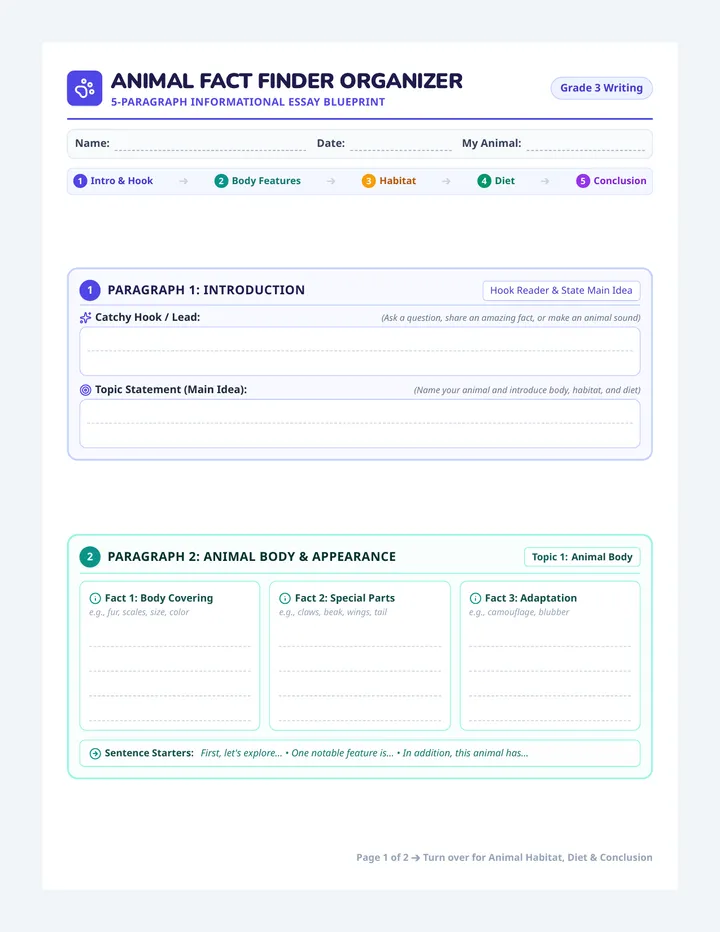
Feature Finder Worksheet
Nonfiction Feature Finder
Grade 3 Reading Detective Mission • RI.3.5
Case File #104
Detective Name:
Date:
Class / Room:
Detective Word Bank
Use each feature name once!
Heading
Caption
Diagram
Label
Bold Word
Glossary
Sidebar
Table of Contents
1 Part 1: Visual Evidence Hunt
Examine each artifact. Write the text feature name.
Artifact A Honeybee Parts
🐝
Antenna ➔
Wing ➔
➔ Pollen Basket
Text Feature:
Artifact B Wildlife Article Snippet
🦅
"An eagle uses curved talons to catch trout in river currents."
Pointed Words:
Artifact C Back of Book Page
habitat The natural home of a plant or animal.
predator An animal that hunts other animals for food.
Text Feature:
Artifact D Side of Main Text
⭐ FUN FACT!
Octopuses have three hearts and blue blood to help them survive deep undersea!
Text Feature:
2 Part 2: Clue Mission Matching
Write the letter of the correct purpose in each box.
1. Heading
2. Table of Contents
3. Bold Print
4. Label
A. Shows chapter titles and page numbers at the front of a book.
B. A word or short phrase that names a specific part on a picture.
C. A title at the top of a page telling what you will read about.
D. Darker letters showing an essential new vocabulary word.
CASE FILE P.2
Read & Detect in the Wild
Detective Name: _______________________
Nonfiction Article
The Incredible Axolotl
Freshwater Biome
The axolotl is a rare amphibian native to Lake Xochimilco in Mexico. Unlike other salamanders, it spends its whole life underwater.
Scientists study axolotls because they can regenerate body parts, including lost limbs and skin, within just a few weeks!
🦎
Feathery Gills ➔
➔ Webbed Feet
Diagram 1.1: Body structure of an adult axolotl
Fast Facts Sidebar
Feature Finder Teacher Guide
Teacher Guide & Lesson Plan
Grade 3 Informational Reading • Nonfiction Text Features
CCSS RI.3.5 Focus
Learning Objectives (SWBAT):
• Identify 8 key nonfiction text features (heading, caption, diagram, label, bold word, glossary, sidebar, table of contents) using visual cues.
• Utilize text features in an informational passage to locate answers efficiently without reading every sentence linearly.
Standard Focus:
"Use text features and search tools to locate information relevant to a given topic efficiently."
CCSS.ELA-LITERACY.RI.3.5
Lesson Architecture & Pacing (45–50 Minutes)
5 Min Hook
The "Book Without Clues" Mystery
Project a dense wall of text with no titles, images, or headings. Ask: "How fast can you find what this animal eats?" Contrast this with an illustrated page featuring a bold sidebar. Introduce the detective mission theme!
12 Min Direct
Visual Slide Deck Walkthrough
Present Text Clue Slides (Slides 2–7). Emphasize the distinct jobs of each feature: navigation clues (headings/TOC), visual clues (photos/captions), exploded diagrams (diagrams/labels), and vocabulary tools (bold/glossary).
8 Min Guided
Interactive Case File Challenge
Conduct the Slide 8 call-and-response challenge using mini whiteboards or hand signals. Reinforce distinguishing between a diagram (the picture) and a label (the word naming the part).
20 Min Apply
Feature Finder Worksheet & Case Wrap-Up
Students complete Pages 1 & 2 independently or in detective pairs. Circulate with sticky notes. Conclude with a quick student whip-around: "Which text feature helped you find facts the fastest?"
Common Misconceptions & Coaching Tips
⚠️ Misconception #1: Captions repeat the text
Fix: Students often think captions say what's already written. Show them that captions provide new, exclusive context about the specific photo (e.g., location, date, or specific action).
⚠️ Misconception #2: Confusing Diagrams & Labels
Fix: Students write "label" for the whole drawing. Teach the phrase: "The diagram is the whole map; the labels are the street signs!"
Differentiation & Support Strategies
Struggling Readers
Provide pre-highlighter strips to highlight the word bank choices as they are used. Focus on 4 features first (heading, caption, diagram, bold word).