Story Elements Slides 3rd Grade Writing & Reading
Story Blueprints
What makes a narrative story come alive?
Characters
Setting
Plot
Details
Today’s Goal
I can identify the key characteristics of a narrative story and use them to plan my own story.
Turn & Talk Warm-Up
Think of your favorite book or movie. Who is the main character, and what big problem did they have to solve?
What Is a Narrative Story?
It Tells a Story
A narrative tells a connected series of events. It can be real (a true memory) or imagined (make-believe).
It Has Order
Unlike a list of facts, a narrative moves through time with a clear Beginning, Middle, and End.
5 Essential Story Ingredients
Characters
Who is in the story
Setting
Where & when it happens
Problem
What goes wrong
Events
What happens in order
Solution
How it gets fixed
Characters & Setting
Characters
The people, animals, or creatures in the story.
Example: Maya, a curious 8-year-old inventor, and her fluffy dog, Pip.
Setting
Where and when the story takes place.
Example: A sunny treehouse on a breezy Saturday afternoon.
Problem & Solution
The Problem (Conflict)
Every exciting narrative needs a challenge! Without a problem, nothing much happens.
The Solution (Resolution)
How the characters try, fail, and finally solve the problem by the end of the story.
How a Story Moves: Plot & Details
1. Beginning
Meet the characters, see the setting, and discover the problem.
2. Middle
Characters take action and try to solve the problem.
3. End
The problem is solved and we see how characters feel or changed.
Writer’s Secret: Great narratives use dialogue (talking) and sensory details (sights, sounds, feelings)!
Read-Aloud: “The Lost Compass”
Listen for the 5 Ingredients!
On a foggy Saturday morning, Sam and his sister Nora hiked into Pinewood Trail. Suddenly, Sam patted his pocket and gasped. “Oh no! My brass compass fell out!”
The mist grew thicker, and every pine tree looked the same. Nora knelt down and spotted tiny boot prints in the damp mud. “Let’s follow our own tracks backward!” she suggested.
Ten minutes later, Sam spied a shiny glint beside a mossy log. He scooped up the compass and grinned. “Good thinking, Nora! Now let’s head home.”
Let’s Spot the Ingredients!
1. Who are the characters?
Look for who is speaking and taking action.
2. What is the setting?
Where are they, and what is the weather like?
3. What is the problem?
What goes wrong on the trail?
4. What is the solution?
How did Nora and Sam fix it?
Your Turn: Story Detectives!
Read the story on your Story Detective Worksheet, find all 5 narrative ingredients, and then blueprint your own story!
Don’t forget to complete your Exit Ticket before packing up!
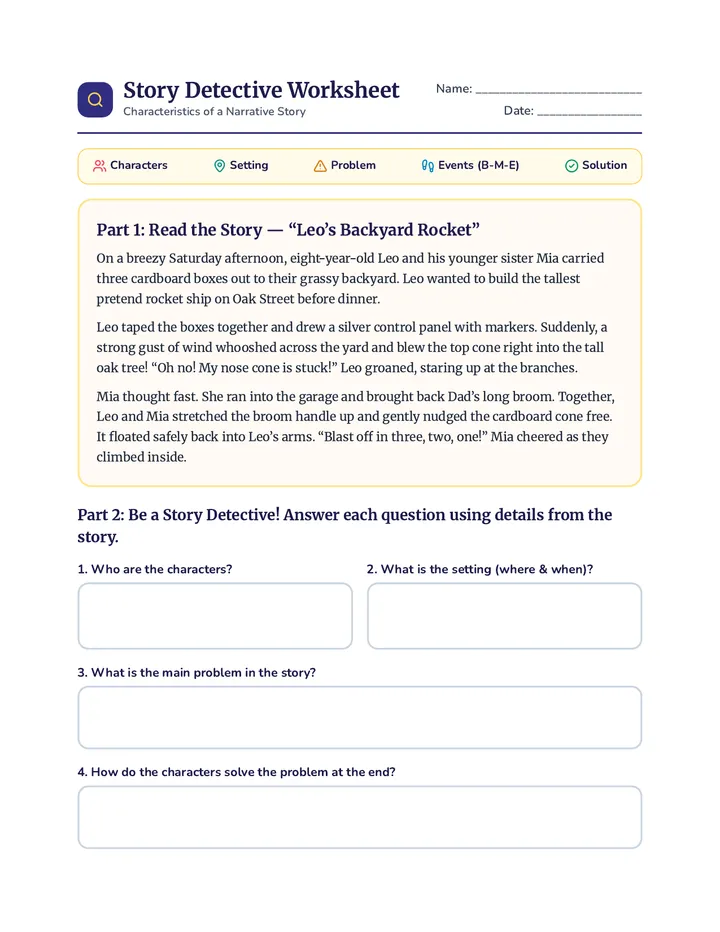
Story Detective Worksheet Story Detective Worksheet
Characteristics of a Narrative Story
Name: ___________________________
Date: _________________
Characters Setting Problem Events (B-M-E) Solution
Part 1: Read the Story — “Leo’s Backyard Rocket”
On a breezy Saturday afternoon, eight-year-old Leo and his younger sister Mia carried three cardboard boxes out to their grassy backyard. Leo wanted to build the tallest pretend rocket ship on Oak Street before dinner.
Leo taped the boxes together and drew a silver control panel with markers. Suddenly, a strong gust of wind whooshed across the yard and blew the top cone right into the tall oak tree! “Oh no! My nose cone is stuck!” Leo groaned, staring up at the branches.
Mia thought fast. She ran into the garage and brought back Dad’s long broom. Together, Leo and Mia stretched the broom handle up and gently nudged the cardboard cone free. It floated safely back into Leo’s arms. “Blast off in three, two, one!” Mia cheered as they climbed inside.
Part 2: Be a Story Detective! Answer each question using details from the story.
1. Who are the characters?
2. What is the setting (where & when)?
3. What is the main problem in the story?
4. How do the characters solve the problem at the end?
Part 3: Build Your Own Story Blueprint
Plan a real or imagined narrative story using all 5 ingredients!
My Story Title:
Characters (Who is in your story?)
Setting (Where & when does it happen?)
The Problem (What goes wrong for your character?)
Plot Events (What happens in order?)
Beginning (How does the story start?):
Middle (What does the character try to do?):
End / Solution (How is the problem solved?):
Bonus Detail: Write one sensory detail (sight, sound, or feeling) or line of dialogue you will include:
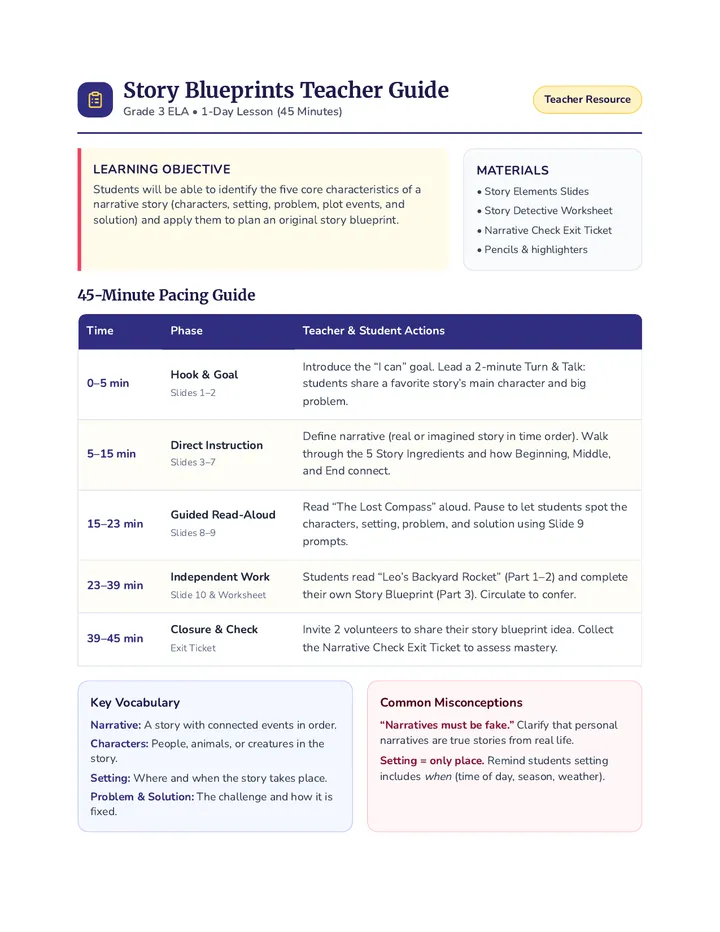
Story Blueprints Teacher Guide Story Blueprints Teacher Guide
Grade 3 ELA • 1-Day Lesson (45 Minutes)
Teacher Resource
Learning Objective
Students will be able to identify the five core characteristics of a narrative story (characters, setting, problem, plot events, and solution) and apply them to plan an original story blueprint.
Materials
• Story Elements Slides
• Story Detective Worksheet
• Narrative Check Exit Ticket
• Pencils & highlighters
45-Minute Pacing Guide
Time
Phase
Teacher & Student Actions
0–5 min
Hook & Goal
Slides 1–2
Introduce the “I can” goal. Lead a 2-minute Turn & Talk: students share a favorite story’s main character and big problem.
5–15 min
Direct Instruction
Slides 3–7
Define narrative (real or imagined story in time order). Walk through the 5 Story Ingredients and how Beginning, Middle, and End connect.
15–23 min
Guided Read-Aloud
Slides 8–9
Read “The Lost Compass” aloud. Pause to let students spot the characters, setting, problem, and solution using Slide 9 prompts.
23–39 min
Independent Work
Slide 10 & Worksheet
Students read “Leo’s Backyard Rocket” (Part 1–2) and complete their own Story Blueprint (Part 3). Circulate to confer.
39–45 min
Closure & Check
Exit Ticket
Invite 2 volunteers to share their story blueprint idea. Collect the Narrative Check Exit Ticket to assess mastery.
Key Vocabulary
Narrative: A story with connected events in order.
Characters: People, animals, or creatures in the story.
Setting: Where and when the story takes place.
Problem & Solution: The challenge and how it is fixed.
Common Misconceptions
“Narratives must be fake.” Clarify that personal narratives are true stories from real life.
Setting = only place. Remind students setting includes when (time of day, season, weather).
Facilitation Notes & Answer Keys
Page 2 of 2
Guided Discussion Key: “The Lost Compass” (Slides 8–9)
Characters: Sam and his sister Nora
Setting: Pinewood Trail, foggy Saturday morning
Problem: Sam’s brass compass fell out in the mist.
Solution: They followed their boot prints back to find it.
Differentiation Strategies
Support & Language Scaffolds
• Allow students to underline characters (red), setting (green), and problem (yellow) in the passage before writing.
• Offer sentence stems: “The main character is ___ because ___” and “The problem was solved when ___.”
Extension for Early Finishers
• Challenge students to draft the opening paragraph of their planned story on the back of their worksheet.
• Have them include at least two sensory details and one line of dialogue with quotation marks.
Answer Key: Story Detective Worksheet (“Leo’s Backyard Rocket”)
1. Characters: Leo (8 years old) and his younger sister Mia.
2. Setting: Their grassy backyard on Oak Street on a breezy Saturday afternoon.
3. Problem: A strong gust of wind blew the rocket’s top nose cone into the tall oak tree, where it got stuck.
4. Solution: Mia brought Dad’s long broom from the garage, and together they nudged the cone free so it floated back into Leo’s arms.
Part 3 (Story Blueprint): Student responses will vary. Check that all five ingredients (characters, setting, problem, B-M-E events, solution) are connected.
Answer Key: Narrative Check Exit Ticket
1. B — To tell a connected story with a beginning, middle, and end.
2. C — A snowy forest at midnight (describes both where and when).
3. A — How the characters fix or overcome the problem.
4. Short Answer: Accept any plausible character, setting, and problem that work together (e.g., “A puppy named Max gets lost in the park before dinner.” ).
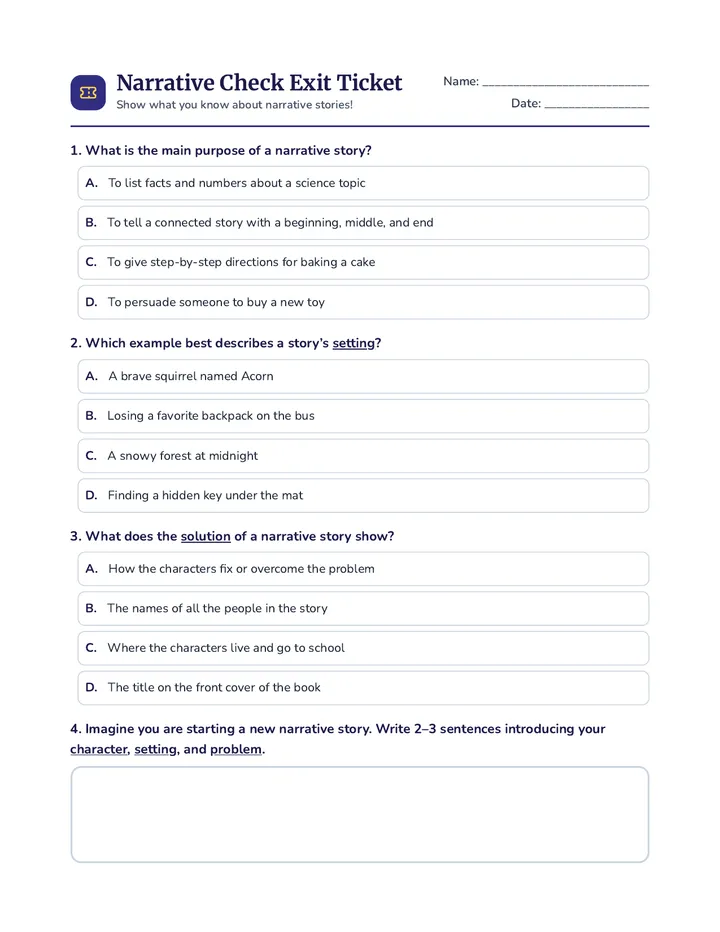
Narrative Check Exit Ticket Narrative Check Exit Ticket
Show what you know about narrative stories!
Name: ___________________________
Date: _________________
1. What is the main purpose of a narrative story?
A. To list facts and numbers about a science topic
B. To tell a connected story with a beginning, middle, and end
C. To give step-by-step directions for baking a cake
D. To persuade someone to buy a new toy
2. Which example best describes a story’s setting?
A. A brave squirrel named Acorn
B. Losing a favorite backpack on the bus
C. A snowy forest at midnight
D. Finding a hidden key under the mat
3. What does the solution of a narrative story show?
A. How the characters fix or overcome the problem
B. The names of all the people in the story
C. Where the characters live and go to school
D. The title on the front cover of the book
4. Imagine you are starting a new narrative story. Write 2–3 sentences introducing your character, setting, and problem.